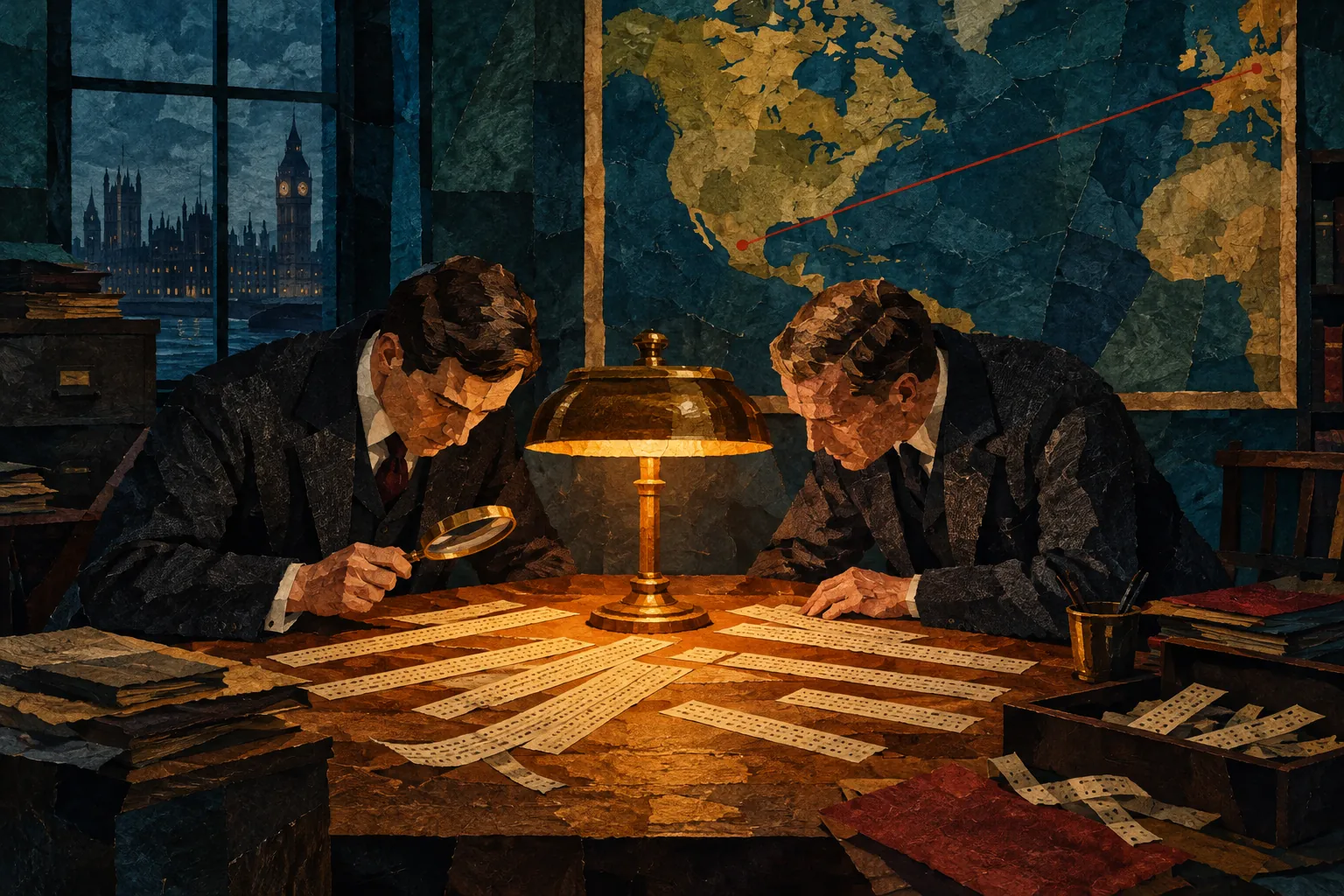
In five minutes: the Zimmermann Telegram
The Zimmermann Telegram was a secret diplomatic message that Germany sent on 16 January 1917. It was written by Arthur Zimmermann, the German foreign secretary, and addressed to Germany's minister in Mexico City, Heinrich von Eckardt. It told him to propose a military alliance to Mexico in case the United States joined the war against Germany. In return, Mexico would get money and the chance to win back Texas, New Mexico and Arizona, which it had lost to the United States in the 1840s.
British naval codebreakers intercepted and read the message. Britain passed it to Washington in late February, and American newspapers printed it on 1 March 1917. Zimmermann then confirmed it himself, which made it impossible to dismiss as a British trick. The United States declared war on Germany on 6 April 1917.
The telegram did not cause American entry into the war by itself. Germany's return to unrestricted submarine warfare did most of that work. What the telegram did was make the danger feel close to home, especially in the southwestern states. It is also one of the best-known examples of codebreaking changing the course of history. This page is part of our guide to World War I (1914–1918): causes, course and consequences.
What the telegram said
The message was short and had three main parts.
- The submarine announcement. Germany would begin unrestricted submarine warfare on 1 February 1917, meaning U-boats could sink ships around Britain without warning. Germany still hoped to keep the United States neutral.
- The conditional offer to Mexico. If that hope failed, Germany proposed an alliance with Mexico: war together, peace together, generous financial support, and an understanding that Mexico would reconquer its lost territory in Texas, New Mexico and Arizona.
- The request about Japan. Once war with the United States was certain, the Mexican president was asked to approach Japan on his own and invite it to join. The telegram also said that German submarines could force Britain to make peace within a few months.
The key word is “conditional.” Nothing was to happen unless the United States entered the war. The most likely German aim, as historians read it, was to keep American forces busy on their southern border, so that fewer men and less equipment could cross the Atlantic.
Why Germany sent it
By 1917 the war had lasted more than two years, and Germany was suffering under the British naval blockade, which cut off food and raw materials. German military leaders decided to gamble. They would let U-boats attack merchant ships without warning, hoping to starve Britain into talks before American help could arrive.
Germany had held back from this policy since 1915, when the sinking of the British liner Lusitania killed many civilians, including Americans, and caused an angry reaction in the United States. German leaders knew that going back to unrestricted submarine warfare risked bringing America in. The telegram was the backup plan.
Mexico looked like a possible partner for two reasons. Relations with Washington were poor after the 1916 Punitive Expedition, when American troops crossed into Mexico in search of the rebel leader Pancho Villa. And Mexico was in the middle of its own revolution under President Venustiano Carranza, which made it unpredictable. The plan ignored a basic problem: Mexico was weak, divided and short of arms, and Germany could not supply it across an ocean controlled by the British navy. The suggestion that Japan might switch sides was equally unrealistic, since Japan had been fighting on the Allied side since 1914.
How Britain read it
Britain's naval intelligence office, known as Room 40, listened to German radio and cable traffic. Germany sent the telegram through several routes, including a diplomatic channel that went through Washington, and the British intercepted it within days. Codebreakers such as Nigel de Grey and William Montgomery worked out the key parts of the text using a German diplomatic code that Room 40 had been studying.
Britain faced a problem. If it simply handed the message to the Americans, it would reveal both that it was reading German codes and that it was tapping cables that passed through neutral territory. British officials therefore waited. They also obtained a copy of the version sent on from Washington to Mexico City, which they could present as stolen from the Mexican telegraph office rather than decoded in London. That helped hide the real source.
On 23–24 February 1917 the British foreign secretary, Arthur Balfour, showed the text to the American ambassador, Walter Hines Page, who cabled it to President Woodrow Wilson.
Publication and the American reaction
Wilson's government released the text to the press, and the Associated Press carried it on 1 March 1917. Many Americans first thought it was a forgery, and some newspapers and politicians who opposed war said so. The doubt ended when Zimmermann stated publicly on 3 March that the telegram was genuine, and repeated this later in March.
The effect was strong. Anger over German submarines had already led the United States to cut diplomatic relations on 3 February. The telegram added the idea of a hostile plot directed at American territory. Wilson asked Congress for a declaration of war on 2 April. The Senate voted for it on 4 April, the House followed on 6 April, and Wilson signed the same day.
Mexico's answer
Mexico never accepted. Carranza's government had its own reasons for being careful, because it needed to deal with revolution at home and could not afford a war with its powerful neighbour. Mexican advisers judged that reconquering the lost territory was impossible, and that German arms and money could not be relied on. Carranza stayed neutral and, in the spring of 1917, turned the offer down. Germany's attempt gained nothing from Mexico and cost it heavily in American public opinion.
Consequences
- For the war: the United States joined as an “associated power” of the Allies. American troops arrived in large numbers only in 1918, but the promise of fresh forces and resources changed German planning.
- For Germany: Zimmermann lost his post in August 1917, and the telegram became a standard example of reckless German diplomacy.
- For intelligence: the affair showed how valuable signals intelligence could be and is often described as one of the first big public victories of modern codebreaking.
- For Mexican–American relations: it deepened suspicion in Washington about German activity in Mexico, even though the plan never went anywhere.
What exams ask
In AP-style questions, expect to explain the telegram as a cause of American entry into World War I, and to place it next to other causes: unrestricted submarine warfare, the Lusitania, economic ties to the Allies and the fall of the Russian tsar in March 1917, which made the Allied cause easier to present as a fight for democracy. A strong answer says the telegram was a trigger and a public-opinion factor, not the only cause.
Remember the sequence: sent 16 January, submarine warfare announced 31 January and begun 1 February, intercepted and shared with the United States in February, published 1 March, war declared 6 April. Also remember what the offer promised and why it failed.
Read next
- World War I (1914–1918): causes, course and consequences puts the telegram inside the whole war.
- Triple Alliance vs Triple Entente explains the alliance system that Germany was trying to extend across the Atlantic.
- Where are the Balkans? Map and countries shows where the war began, far from Mexico.