Newspeak in five minutes
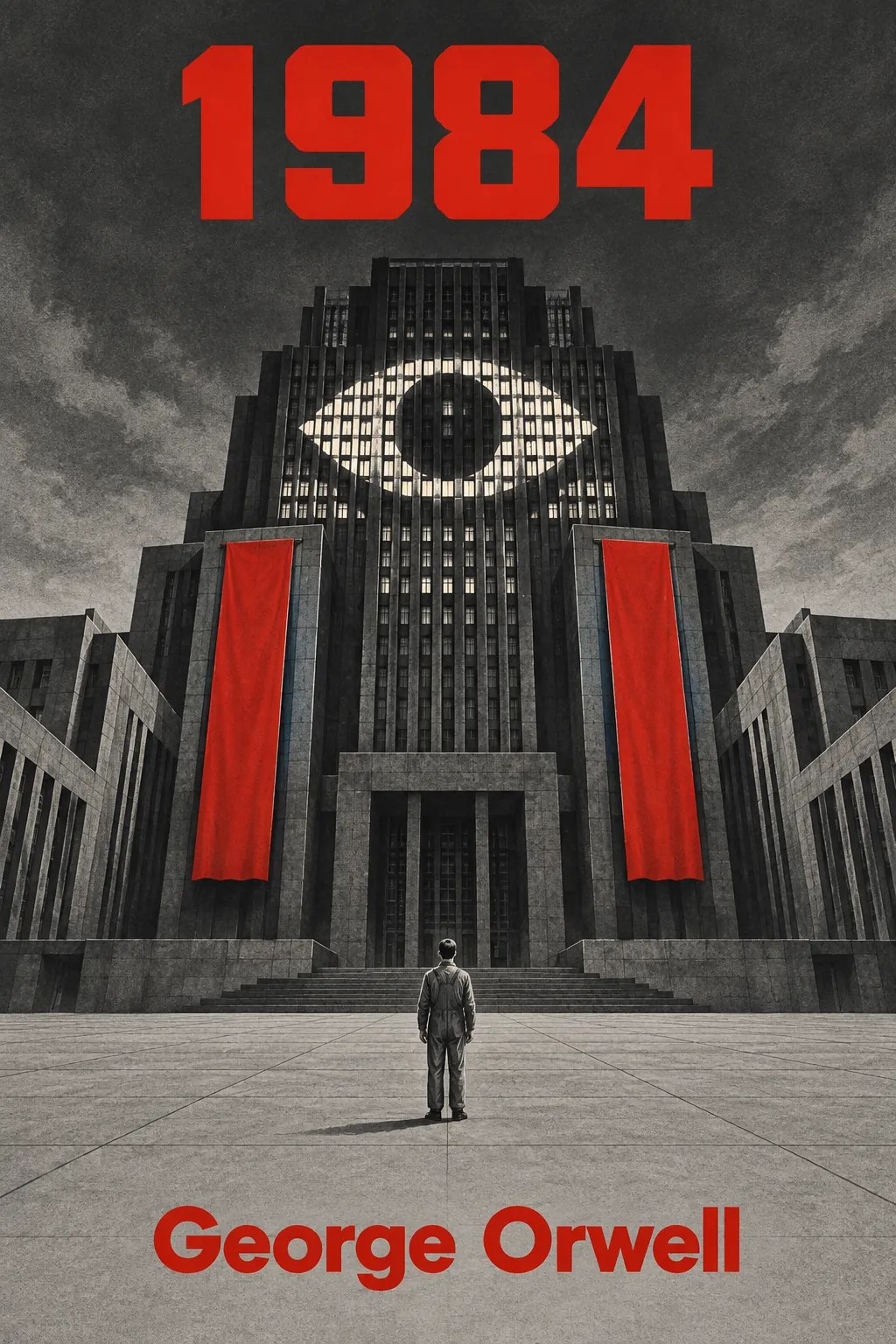
Newspeak is the official language of Oceania, the police state in George Orwell's novel 1984 (1949). The ruling Party is replacing ordinary English, which the book calls Oldspeak, with a smaller and smaller set of words. The plan is simple and chilling. If a forbidden thought has no word, nobody can think it clearly, and nobody can say it to anyone else.
The best summary comes from Syme, a Party language specialist who is helping to write the Newspeak dictionary. He explains his job to the hero, Winston Smith: "Don't you see that the whole aim of Newspeak is to narrow the range of thought?" (Part 1, Chapter 5)
Newspeak belongs to the long tradition covered in our history of science fiction, where invented futures are used to test real ideas. Orwell's experiment was about words: what happens to a society when its language is run like a government department?
What Newspeak is and how it works
Newspeak is not slang and not a secret code. Everybody in Oceania is meant to speak it openly, and the Party plans to make it the only language. In the story it is still unfinished. The Eleventh Edition of the Newspeak Dictionary is being prepared, and the Party expects Newspeak to replace Oldspeak completely by about 2050. Most people, Winston included, still think and write in Oldspeak.
Orwell explains the system in an appendix at the end of the book, "The Principles of Newspeak". It describes three layers of vocabulary:
- The A vocabulary covers everyday things such as eating, walking and tools. It is mostly ordinary English words with their meanings pinned down tightly.
- The B vocabulary is made of political words built to push the speaker toward the right attitude. Examples are goodthink (orthodox thinking) and duckspeak (talking without thinking, like a duck quacking).
- The C vocabulary holds scientific and technical terms, kept apart so that specialists can do their work without ever touching political ideas.
Three tricks that shrink thought
1. Cut words down. Newspeak removes shades of meaning. Nobody needs "bad" and all its cousins, because ungood covers them. Strength comes from prefixes: plusgood replaces "excellent" and doubleplusgood replaces "superb". Even "free" survives only in a plain physical sense, as in "this field is free from weeds". The political meaning of freedom can no longer be said, so it becomes hard to want.
2. Make words short and flat. Names such as Minitrue (the Ministry of Truth) and Miniluv (the Ministry of Love) are clipped so that the speaker hardly hears what the full name claims. Orwell points out that this habit was already common in real politics, with abbreviations like Comintern and Agitprop. Short words carry less picture and less memory.
3. Make words quick to say. Many Newspeak words are built to be spoken fast, almost without thought, so the voice runs ahead of the mind. That is what duckspeak names, and in the Party it can even be a compliment.
Other Newspeak words readers still borrow include unperson (someone wiped from the records), joycamp (a forced-labour camp, named with a cheerful word) and prolefeed (cheap entertainment for the working masses). Newspeak also supports doublethink, the skill of holding two opposite beliefs at once and accepting both.
Why the Party wants it
The appendix states the goal plainly. Newspeak is meant to give Ingsoc, the Party's ideology, its own way of speaking, and to make every other way of thinking impossible. Once the new language is fully adopted, a heretical idea should be, as far as thought depends on words, unthinkable.
The plan reaches into the past as well. The appendix says old books will be rewritten in Newspeak, so that writers such as Shakespeare, Milton and Dickens would be changed into something that supports the Party. A shrinking language therefore does two jobs: it blocks new rebellious ideas, and it cuts people off from old ones. The result is a population that has nothing to compare the present with, which is exactly what the all-seeing leader Big Brother needs.
The real science: can language limit thought?
Newspeak is fiction, but it rests on a real question called linguistic relativity, linked to the American linguists Edward Sapir and Benjamin Lee Whorf. There are two versions of the idea.
- The strong version says language sets hard limits on what a person can think. Most linguists reject this. People invent words for new things all the time, and babies and animals clearly think without a spoken language.
- The weak version says the words you have can nudge attention and memory. This has some experimental support. In a 2007 study, Russian speakers, whose language has separate basic words for light blue and dark blue, were faster at telling those shades apart than English speakers.
So the honest answer is that a government could not literally delete a thought by deleting a word. What it can do is shape what is easy to say, what sounds respectable and what sounds dangerous. Orwell understood this from experience. He had worked on wartime propaganda at the BBC, and in his 1946 essay "Politics and the English Language" he argued that vague, worn-out phrases hide ugly facts. His examples included "pacification" for bombing villages. He also noted that the habit can be broken, because thinking clearly can repair language.
A real influence behind Newspeak was Basic English, a list of about 850 words proposed by C. K. Ogden in 1930. Orwell liked its aim of simplicity but turned the idea upside down: simplifying language to help people, or to limit them?
Where it shows up in fiction
The best place to meet Newspeak is the novel itself. Our page on 1984 by George Orwell covers the full story, including how Winston keeps a forbidden diary in a language the Party is trying to remove.
Other science fiction explores control of ideas by different routes. Fahrenheit 451 burns books so there is nothing to read, and Brave New World uses conditioning and pleasure instead of fear. A Clockwork Orange invents the slang called Nadsat, but for style, not for control. Outside novels, "Newspeak" has become an everyday insult for empty jargon, as in "corporate newspeak".
Common misconceptions
"Newspeak is just a polite word for euphemism."
A euphemism softens a hard fact but leaves the idea alive. Newspeak aims to remove the idea itself by removing its word. The Party does use soft names for harsh things (the Ministry of Love is the secret police and torture), but the larger goal is a smaller mind.
"Newspeak and doublethink are the same thing."
They work together but are different. Newspeak is a language, a set of words. Doublethink is a mental habit, believing two contradictory things and accepting both. The language makes the habit easier.
"Everyone in the book already speaks Newspeak."
Not quite. In the story's present, it is still being built, and ordinary English is still spoken widely. Spoiler note for readers who have not finished the book: the appendix is written in the past tense and in standard English, which hints at how the Party's plan turned out.
"Orwell wanted people to use fewer and simpler words."
Orwell did favour plain, clear English, but he wanted people to choose words freely. Newspeak is the opposite: simplicity forced on people by the state.
Read next
- Doublethink: the mental habit that Newspeak is designed to support.
- Big Brother (Orwellian): the face of the power that uses Newspeak.
- 1984 by George Orwell: the full study guide to the novel where it all begins.
- History of Science Fiction: where Orwell's warning sits among other imagined futures.