Part of the History of Science Fiction series.
In five minutes
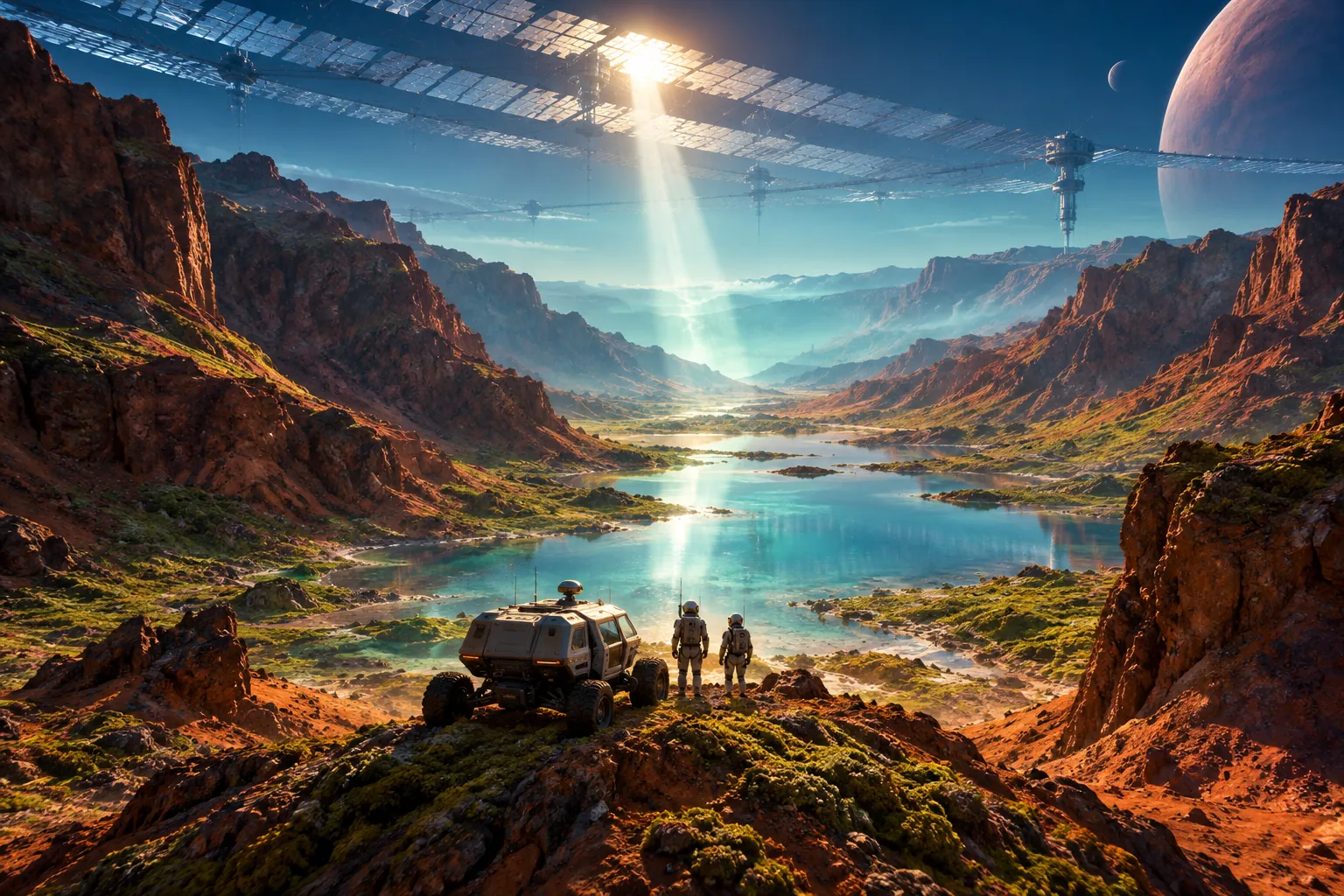
Terraforming means reshaping a planet so that people can live on its surface in the open air. The name joins the Latin terra, “earth”, with “forming”, so it literally means “making Earth-like”. In practice it would mean warming the surface, thickening the atmosphere, bringing liquid water back and, last of all, adding breathable oxygen.
Mars is the usual target, and “terraforming Mars” is what most people type into a search box. It is cold and dry and has only about 38 percent of Earth’s gravity. But its day lasts about 24 hours and 37 minutes, close to ours, and it has ice at its poles and underground. Venus is the other candidate, with the opposite trouble: it is far too hot, and its air is crushingly thick.
Here is the honest state of play. Nobody has terraformed anything, and no space agency has a terraforming programme. What exists is calculations, a few small experiments and a great deal of fiction. This article keeps those three apart.
Where the word “terraforming” comes from
The word was coined by a novelist, not a scientist. Jack Williamson used “terraforming” in a short story called “Collision Orbit”, published in Astounding Science-Fiction in 1942 under the pen name Will Stewart. He was writing pulp adventure and had no idea he was naming a field of study.
The science came later. In 1961 the astronomer Carl Sagan suggested in the journal Science that microbes released into the clouds of Venus might break down carbon dioxide and cool the planet. Later probes showed Venus was far harsher than Sagan assumed, but the idea of engineering a whole world had entered serious discussion. In 1973 Sagan turned to Mars and wrote about warming its polar ice. In 1993 Christopher McKay and Robert Zubrin published an analysis of the technology Mars would need, and in 1995 Martyn Fogg’s book Terraforming: Engineering Planetary Environments pulled the field together. In about half a century, a pulp-magazine word became a research topic.
How terraforming Mars would work, in theory
Researchers usually describe the plan as four stages, and the order matters.
- Warm the planet. Mars averages roughly minus 60 °C. Proposals include orbiting mirrors that focus sunlight, dark dust spread on the polar caps so they absorb heat, and factories that release strong greenhouse gases.
- Thicken the air. Mars’s atmosphere is mostly carbon dioxide, at about 0.6 percent of Earth’s surface pressure. Warming should release carbon dioxide frozen at the poles and held in the soil, which warms the planet further. This feedback loop is the heart of most plans.
- Bring back water. As temperatures rise, ice melts and liquid water can collect on the surface.
- Add oxygen. Plants and microbes, possibly engineered ones, would slowly turn carbon dioxide into oxygen. On Earth this took billions of years. Even with help, it is expected to be by far the slowest stage.
That last point explains a common surprise. A warm, wet Mars would still have air that humans cannot breathe. Walking outside without a mask is the final step, not the first.
The real science: what we know and what we don’t
There may not be enough carbon dioxide
In 2018 Bruce Jakosky and Christopher Edwards counted the carbon dioxide stored in Mars’s polar caps, soil and minerals and published the result in Nature Astronomy. Even if all of it could be released, the pressure would stay well under a tenth of Earth’s, and much of it is hard to extract. Their conclusion was that terraforming Mars is not possible with technology we have or can foresee soon.
Magnetic field and radiation
Mars has no global magnetic field like Earth’s. The solar wind has stripped away part of its air over billions of years, and NASA’s MAVEN orbiter measured that loss. The loss is slow, though, so a thicker atmosphere might last a long time. In 2017 NASA scientist Jim Green proposed placing a magnetic shield between Mars and the Sun. Whether that is practical is still debated. Martian soil also contains perchlorates, which are toxic, so it could not simply be used as farmland.
Making oxygen: a first small step
In April 2021 the MOXIE instrument on the Perseverance rover made oxygen from Martian carbon dioxide. Its first run produced about 5 grams, roughly ten minutes of breathing for one astronaut. It proves a technique works, but it is nowhere near the scale of changing a planet.
Venus
Venus has a surface temperature of about 465 °C and a pressure around 90 times Earth’s. Ideas include giant sunshades and stripping away most of the air, but the scale is enormous. A more modest proposal notes that about 50 kilometres up in the clouds, pressure and temperature are much milder, and suggests floating habitats there.
Living without changing the whole planet
Another approach, sometimes called paraterraforming, skips the planet-wide change. It builds sealed domes or uses underground lava tubes as living space. This is far more realistic than rebuilding an atmosphere.
Time and ethics
Estimates of how long full terraforming would take range from centuries to many thousands of years, and there is no agreed figure. There is also an ethical question: if Mars holds native microbes, changing its environment could destroy them, which is why planetary protection rules matter.
Where it shows up in fiction
Fiction got there first. Williamson’s story gave us the word. Arthur C. Clarke’s The Sands of Mars (1951) imagines a colony where a plan to turn the moon Phobos into a small second sun is part of making Mars warmer. Poul Anderson’s The Big Rain (1954) deals with remaking Venus. Frank Herbert’s Dune (1965) shows a long project to turn the desert planet Arrakis green, and what it costs.
The most detailed treatment is Kim Stanley Robinson’s Mars trilogy: Red Mars (1992), Green Mars (1993) and Blue Mars (1996). It follows settlers over generations, with engineering described in real technical detail. It also argues about the choice itself, as characters split between those who want to transform Mars and those who want to leave it as it is. The word has even reached Japanese pop culture, where it is the root of the manga title Terra Formars.
Common misconceptions
- “Just nuke the poles.” This is a famous idea, but the 2018 count suggests there is not enough carbon dioxide locked in the ice and soil for it to work.
- “Terraforming makes a planet exactly like Earth.” Plans are staged. The first results would be a warmer, wetter planet with microbes or plants, not a copy of Earth.
- “The Martian is about terraforming.” Andy Weir’s novel is about one astronaut surviving on an unchanged Mars. It does not change the planet.
- “We are already terraforming Earth.” People sometimes call climate change accidental terraforming. That is an image, not a plan, since nobody is steering it toward a goal.
- “It is only a matter of money.” The 2018 study points to missing material, not missing funds.
Read next
- Space elevator: any large off-world project needs cheaper ways to lift material out of Earth’s gravity, and this is the best-known idea for doing it.
- History of Science Fiction: the hub for this series, showing where Williamson, Clarke, Herbert and Robinson fit in the genre’s story.