In five minutes
A parallel universe is a reality that exists alongside ours but apart from it. It might be almost identical, with a single historical event turned out differently, or it might run on different physical rules altogether. The phrase covers three quite different things: a reading of quantum mechanics, a possible by-product of cosmology, and one of the oldest tools in science fiction. Keeping them apart is most of what it takes to understand the topic.
The short version: no one has ever observed another universe. Some physicists take certain versions of the idea seriously because they follow from theories that work well, while others regard them as untestable. Writers, meanwhile, need no proof. For them a parallel universe is a way to ask what if, and to hold the answer up next to the real world.
This page belongs to our History of Science Fiction topic. For the bigger picture of many universes, see the multiverse article, and for a very different kind of other reality, the simulation hypothesis.
Three meanings, one phrase
- Quantum branches. In the many-worlds reading of quantum mechanics, every possible outcome of a quantum event happens, each in its own branch of reality.
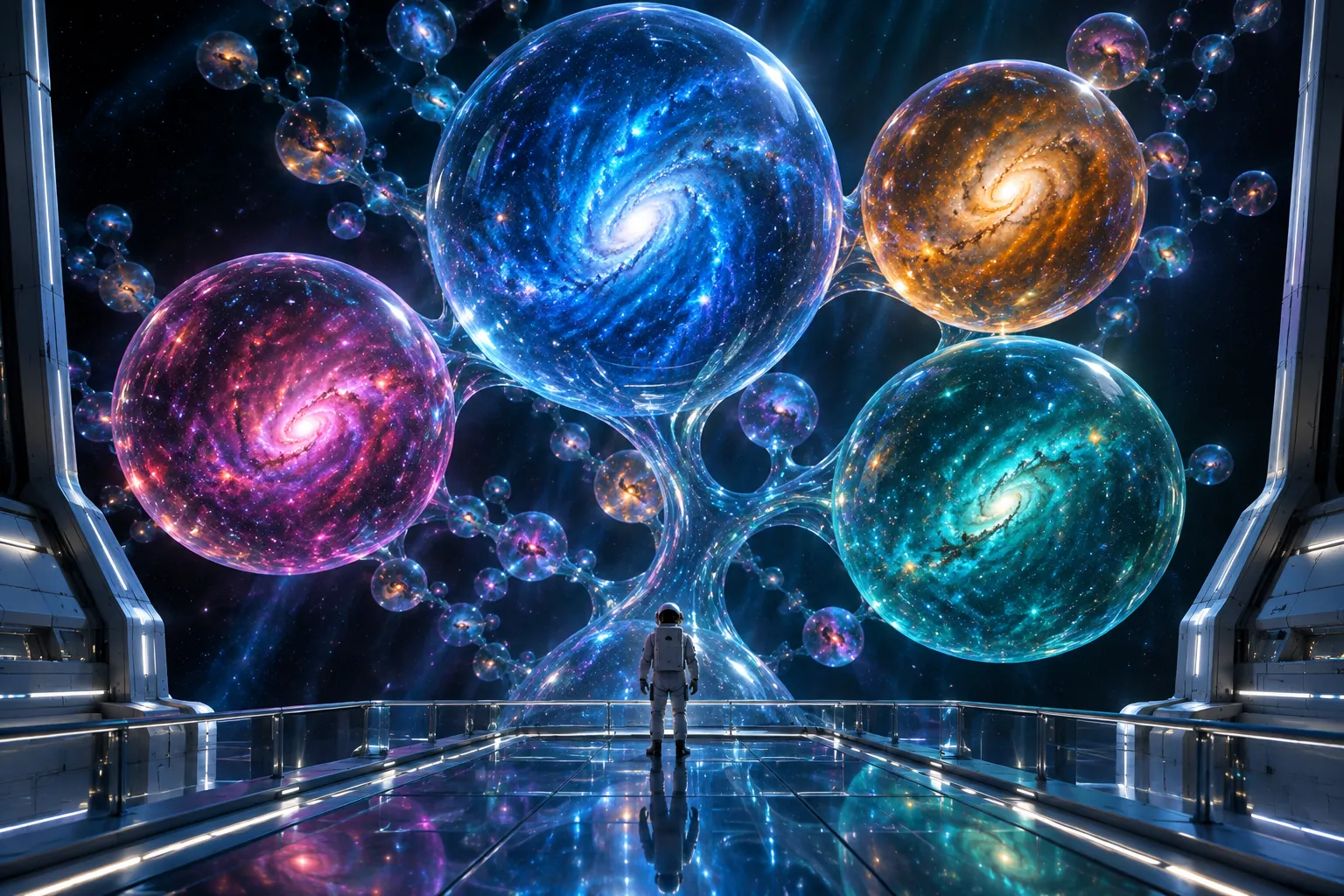
- Other regions of space. Some cosmology models predict countless universes, each a separate bubble of space with its own conditions.
- Fictional alternate worlds. Stories use the phrase for any other version of reality, from a history where a war ended differently to a world where physics itself behaves oddly.
The real science
Many-worlds: the quantum version
In the 1950s, the usual textbook account of quantum mechanics said that a particle can be in several states at once until it is measured, and that measuring it makes it settle on one. Many physicists were uneasy about this, because the theory never said exactly what counts as a measurement.
In 1957 Hugh Everett III, then a doctoral student at Princeton working with John Wheeler, proposed a different route: drop the special rule. Let the same equations apply to everything, including the measuring device and the person reading it. After a measurement, the equipment and the observer become linked with each possible result. Every outcome is real, and each version of the observer sees just one of them.
Everett's paper was largely ignored at first. In the early 1970s Bryce DeWitt promoted the idea and gave it the name many-worlds. Take Schrödinger's cat, the thought experiment Erwin Schrödinger published in 1935. In the standard telling, the cat is both alive and dead until someone opens the box. In many-worlds nothing half-and-half happens: there is one branch where the box holds a living cat and another where it holds a dead one, and the two no longer affect each other.
Many-worlds makes the same predictions as the standard version of the theory. That is why it is called an interpretation and not a new theory, and why no experiment today can tell them apart. Some physicists find it elegant, others find it extravagant, and there is no agreement. Single-world options such as pilot-wave theory and objective-collapse models are still actively discussed.
Cosmology: bubbles of space
Cosmic inflation, proposed by Alan Guth in 1981, says that the young universe expanded at a staggering rate for a tiny fraction of a second. It helps explain why the universe looks so smooth and why the cosmic microwave background, the oldest light we can see, is so even.
Andrei Linde, Alexander Vilenkin and others later showed that in many versions of inflation the expansion never stops everywhere at once. It ends in one patch, which becomes a universe like ours, while elsewhere it carries on and forms more patches. The picture is a foam of bubble universes, each possibly with different constants of nature or even different particles.
In 2003 the cosmologist Max Tegmark sorted the possibilities into four levels in a Scientific American article called Parallel Universes. Level I is faraway regions of our own space, Level II is separate bubbles, Level III is quantum branches, and Level IV is entirely different mathematical structures. The list is a helpful map, though the higher the level, the more speculative it gets.
What is established and what is not
Quantum mechanics itself is among the best-tested theories in science. Inflation matches measurements of the microwave background well, although its details are still debated. What remains unproven is the step from those theories to other universes that actually exist. No telescope or experiment has detected one, and for the bubble picture it is unclear whether any observation ever could. Headlines claiming that someone has proved a parallel universe deserve a careful look at what was really measured.
Where it shows up in fiction
Writers did not wait for physicists. Stories about other worlds that sit beside ours go back at least a century.
H. G. Wells sent travellers into a parallel world in Men Like Gods (1923), where they find a calm, well-organised society living in a universe next to Earth's. In 1934 Murray Leinster published the story Sidewise in Time, in which patches of Earth swap places with versions from other histories, so Roman legions and modern towns end up side by side.
Philip K. Dick's The Man in the High Castle (1962) is an alternate history in which the Axis powers won the Second World War. Its characters pass around a banned novel that imagines a different outcome, and the book keeps asking which version of the world is the real one. In the 1960s Michael Moorcock used the word multiverse in his fantasy and science fiction, helping to make the idea of many linked worlds familiar to readers.
Philip Pullman's His Dark Materials trilogy, which began in 1995, moves its young heroes between several worlds through cuts in the air. More recently Blake Crouch's thriller Dark Matter (2016) turns the quantum version into a personal nightmare: a physicist wakes up in a life that is almost his own, but not quite. On screen, the film Everything Everywhere All at Once (2022) and the Japanese visual novel Steins;Gate (2009) are two well-known examples.
Three patterns writers keep using
- The road not taken. A world split from ours by one event, so the story can compare the two histories.
- The mirror world. A place where a character meets a double, or sees how their own life might have gone.
- The crossing. A machine, door or accident that lets someone travel between worlds. The crossing is pure fiction; no physics suggests it is possible.
Common misconceptions
- Many-worlds means everything imaginable happens. No. Only outcomes that quantum theory allows occur, and they carry different weights. A world where you can fly is not on the list.
- We might visit a parallel universe. There is no known way. In the many-worlds picture, branches stop influencing one another in practice, so there is nothing to cross.
- Déjà vu or the Mandela effect shows another world leaking in. These are well-studied features of human memory, and they are not evidence for other universes.
- Parallel universe and multiverse are the same. They overlap. A multiverse is the whole collection, while a parallel universe is one member of it, and people often use the words loosely.
- Scientists have proved it. Not so. It is an open question and, for now, a matter of interpretation and speculation.
Read next
Multiverse zooms out from a single parallel universe to the whole collection and the arguments for and against it.
Simulation hypothesis asks a different question: not whether other universes exist beside ours, but whether ours is built on something else.
History of Science Fiction places the parallel world in the longer story of the genre, from early scientific romances to today.