The Great Filter in five minutes
The Great Filter is the idea that somewhere on the road from lifeless chemistry to a civilisation that spreads across the galaxy, there is at least one step so unlikely that almost nothing gets past it. It is one proposed answer to the Fermi paradox: the puzzle of why a galaxy that looks so well suited to life shows no sign of anyone else. Economist Robin Hanson named and argued the idea in his 1998 essay “The Great Filter – Are We Almost Past It?”
The reasoning is simple counting. The Milky Way holds hundreds of billions of stars, and the universe holds an enormous number of galaxies. If life were likely to grow into something that expands and leaves visible traces, we would expect to have seen those traces by now. We have not. So something in the chain must be very hard, and Hanson called that hard step the Filter. It is a hypothesis, not a discovery: nobody has found the Filter or shown that it exists.
What makes the idea gripping is the question it leaves open. Is the Filter behind us, a rare event that we were lucky to survive? Or is it still ahead? This page belongs to our History of Science Fiction topic because writers have been playing with exactly that fear for a long time.
How the Great Filter works
Think of the path to a galaxy-spanning civilisation as a ladder with many rungs. Hanson’s own list runs roughly like this: a suitable star and planet, molecules that copy themselves, simple single-celled life, complex cells, sexual reproduction, many-celled bodies, tool-using animals with big brains, our present stage, and finally an expansion into space that lasts. Every rung has some chance of being climbed. The Filter is whichever rung has a chance so small that, even across all those stars, almost nobody reaches the top.
The argument does not need one single killer step. Several moderately hard steps multiplied together can act as a filter just as well as one nearly impossible step.
Where the Filter sits matters more than anything else, and there are three broad answers.
- It is behind us. One of the early steps is extremely rare, perhaps the start of life itself or the jump to complex cells. In that case we are unusual, and the quiet sky is simply what a rare event looks like. Our future is open.
- It is ahead of us. Life and even intelligence are common, but civilisations tend to fail before they spread. People name nuclear war, engineered disease, runaway climate change or technology that slips out of control as examples of what could stop a young civilisation. None of these is established as a universal trap. They show the kind of thing the Filter might be. This is the frightening answer.
- There is no filter in the strict sense. Someone has to be first, and perhaps we are simply early. Other explanations of the silence, such as hidden or distant civilisations, belong to the Fermi paradox rather than to the Filter.
Hanson’s sharpest point is about hope. The easier it turns out to be for life to start and grow, the less of the Filter can lie behind us, and the more must lie ahead. Good news about the past is bad news about the future.
The real science: what is known and what is guesswork
Some pieces of the puzzle are measured. Astronomers have confirmed more than 6,000 planets around other stars, and studies of data from NASA’s Kepler telescope suggest that rocky planets in the habitable zone of Sun-like stars are common. A shortage of planets is probably not the Filter.
Our own planet gives a rough timeline. Earth formed about 4.5 billion years ago. Evidence of life goes back at least 3.5 billion years, which suggests that simple life appeared fairly soon after conditions allowed. Complex cells took far longer, and animals appeared only around 600 million years ago. Tool-making humans are a very recent arrival. Some researchers read the long wait for complex cells as a hint that this step may be hard. But we have exactly one example, and a single example cannot tell us how likely any step really is.
The same uncertainty runs through the Drake equation, where several factors are unknown by many orders of magnitude. In a 2018 paper, “Dissolving the Fermi Paradox,” Anders Sandberg, Eric Drexler and Toby Ord argued that once this uncertainty is handled honestly, it is quite plausible that we are alone in the galaxy, and the paradox mostly fades. If they are right, a Filter in our past is a natural result.
The idea has also changed how some thinkers see the search for life. In a 2008 essay, philosopher Nick Bostrom argued that finding a second, independent origin of life, on Mars for example, would be bad news. A sterile Mars leaves the hard step safely in the past. Simple life next door would suggest that life starts easily, which pushes more of the Filter toward our future. It is a probability argument, not a prediction.
Everything about the Filter’s location remains speculation. What is established is the missing evidence: after decades of radio searches and sky surveys, no confirmed signal or artefact from another civilisation has turned up.
Where it shows up in fiction
Note: this section mentions an idea from a novel trilogy without giving away how it ends.
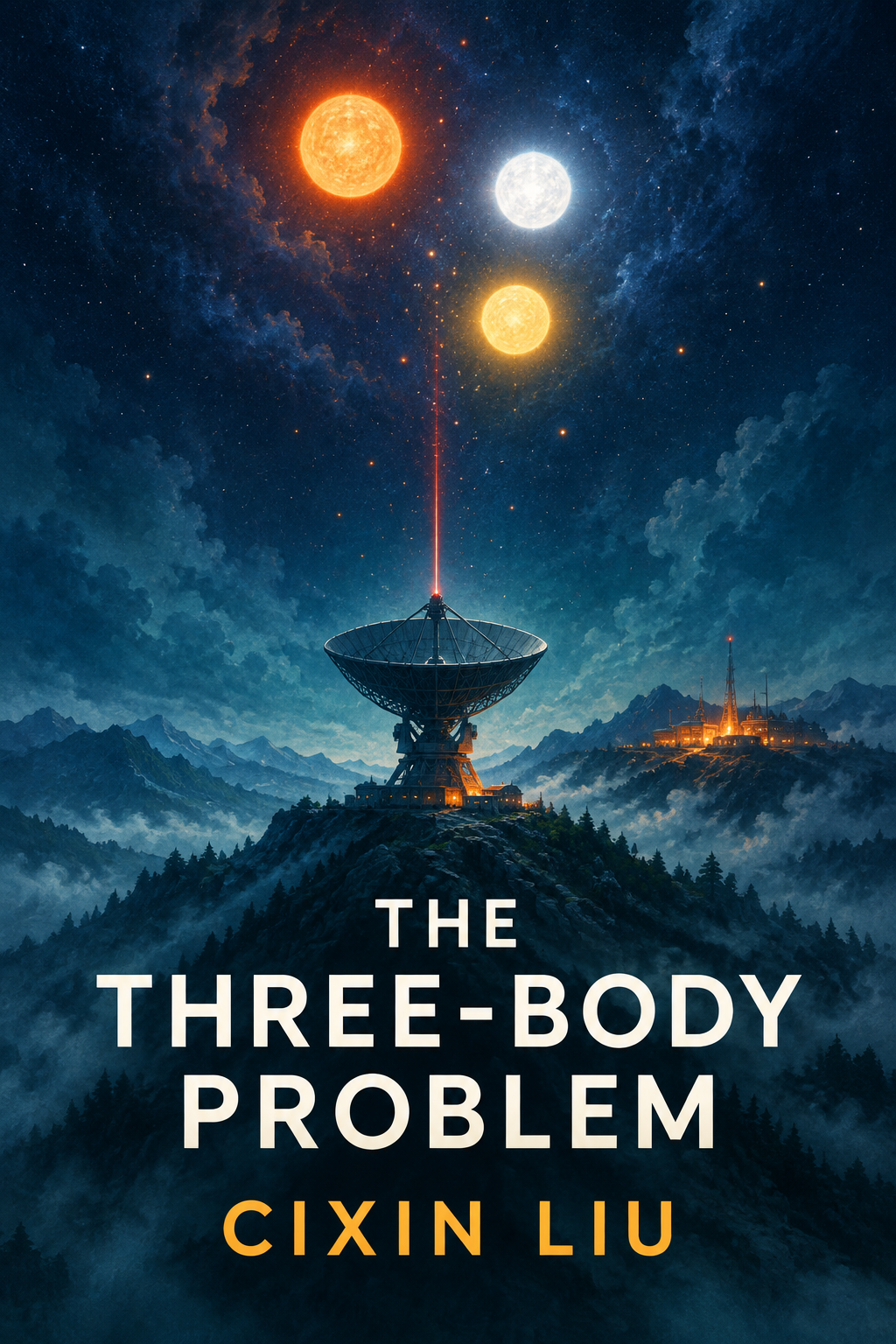
Fiction rarely uses the phrase, but it keeps returning to the shape of the idea: a universe that should be full and is not. Liu Cixin’s The Three-Body Problem trilogy gives one of the best-known answers. Its “dark forest” idea, named in the second book, says civilisations stay silent because any civilisation that reveals itself risks being destroyed by another.
The dark forest is not Hanson’s Filter, since it does not say that life fails to develop. It is a rival answer to the same empty sky, and the comparison helps. A Filter says few civilisations get far. A dark forest says many exist and hide. The trilogy was first published in Chinese from 2008, and the first book reached English readers in 2014 in Ken Liu’s translation.
Peter Watts’s novel Blindsight (2006) is another hard science fiction story often discussed next to the Fermi paradox. It imagines intelligence that does not look like what we expect, and it asks whether minds like ours are as common in the cosmos as we assume.
Common misconceptions
- “Astronomers found the Great Filter.” No. It is a way of reasoning about missing evidence. Nobody has detected it, and it may not exist as a single thing at all.
- “Hanson predicted that humanity is doomed.” No. His essay title is a question: are we almost past it? He laid out where the Filter could be and what different discoveries would imply, and he did not claim that it lies ahead.
- “It is the same as the Fermi paradox.” No. The paradox is the puzzle. The Great Filter is one possible solution among several.
- “The Filter must be one big catastrophe.” No. Many moderately hard steps can add up to the same effect.
- “A silent sky proves we are in danger.” No. Our searches cover only a small part of the sky and a narrow range of signals. Silence has many possible explanations, including that we are simply rare or early.
Read next
- Fermi paradox: the puzzle the Great Filter tries to answer, with the other main solutions.
- Drake equation: the formula that shows how uncertain the odds really are.
- The Three-Body Problem: the novel that begins the trilogy behind the dark forest idea.
- History of Science Fiction: how the genre has imagined the silence of space.