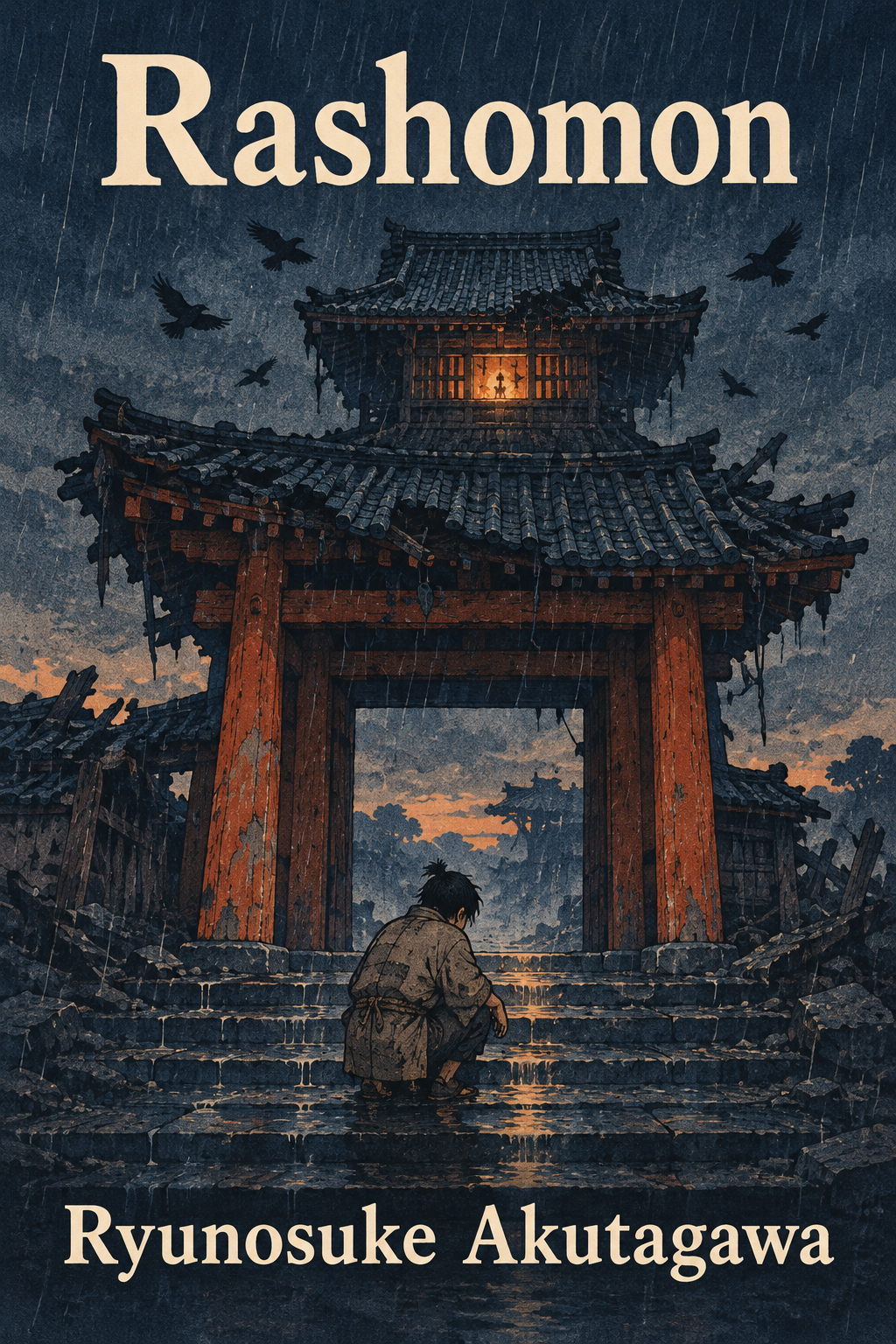
Rashomon
by Ryunosuke Akutagawa
Rashomon is a short story by Ryunosuke Akutagawa, published in 1915 and set in Kyoto during a time of famine and disaster. A servant who has just lost his job shelters from the rain under the city's ruined gate and has to decide whether to starve honestly or survive by crime. Up in the gate's tower he finds something that forces his answer. It is a standard text in Japanese schools and a good first step into Akutagawa.
The Big Idea
"In Rashomon, a servant about to starve learns how easily “I have no choice” can become a reason to do wrong, and the story asks where survival ends and selfishness begins."
Key Insights
Necessity is not the same as permission
The servant begins with a real dilemma: he does not want to starve and he does not want to steal. Rashomon shows how a genuine need slowly becomes a reason for harm. Need explains why people act; it does not make the act good. The story lets us feel both truths at once.
In Part 1 he tells himself that when something has to be fixed there is no time to choose the method. In Part 5 that thought becomes the act of stripping the old woman's robe.
Wrongs travel with their excuses
The old woman defends herself by pointing to the dead woman's wrong, and the dead woman's wrong is excused by hunger. Each act is justified by the one before it. The servant, hearing this chain, simply adds his own link. Harmful actions spread through reasoning as well as through emotion.
A woman sells snake as fish, an old woman strips her hair, a servant strips the old woman's robe. Ask who started it, and the answer slips away. Nobody in the chain thinks of themselves as the villain.
Two opposite kinds of courage
After the old woman's speech, the servant finds a courage that is the opposite of the one he felt a moment earlier. Then he was brave enough to condemn evil; now he is brave enough to do it. Akutagawa shows that people are not simply good or bad: the same person can swing between the two within minutes.
In Part 3 he is the one accusing her. In Part 5, minutes later, he is the one robbing her. Watch for the line where the feeling flips.
A collapsing world presses on a person
Earthquakes, whirlwinds, fires and famine have emptied Kyoto, and the gate is a dump for the dead. The servant's dilemma is personal, but the story will not let us ignore the society that created it. Blaming him alone misses what the setting says.
The master's decision to dismiss him is a small, ordinary event in a falling city, yet it is what pushes him under the gate. Reading the setting closely helps explain why the old woman's logic feels so hard to resist.
An ending that stays open
The final line says no one knows where the servant went. Akutagawa does not tell us if he became a thief, was caught or changed his mind. By refusing to answer, he leaves the question with the reader: what would you have done?
Try writing the next paragraph yourself. Whatever you choose, point to a word or detail in the text that supports your idea; that is what makes it a reading and not a guess. The open ending is one reason the story keeps working in classrooms.
Chapter Breakdown
Chapter-by-chapter summary
Spoiler warning: this section covers the whole plot, including the ending. The story has no chapters, so it is split here into six natural parts.
Part 1: A servant under the gate
The story opens one evening beneath the Rashomon, the great southern gate of Kyoto, then the capital. A servant sits on the stone steps waiting for the rain to stop. A few days earlier his master let him go, and the city, worn down by earthquakes, whirlwinds, fires and famine, has no work for him. The gate itself has been left to rot: foxes and thieves have moved in, and people even dump unclaimed bodies there. The servant's choice is plain: starve, or become a thief. He cannot yet bring himself to choose the second. Why it matters: Akutagawa turns a huge question about right and wrong into one hungry young man sheltering from the rain.
Part 2: Up the ladder
The servant, desperate for somewhere to sleep, climbs the ladder to the tower above the gate. A faint firelight shows him a room of abandoned corpses, and among them a living person: a tiny, grey-haired old woman holding a pine torch, pulling hair out of a dead woman's head, strand by strand. Why it matters: the scene gives the story its horror, but also its question. This is the first time the servant sees what people do to stay alive, and it turns the abstract idea of a hard choice into something he must look at.
Part 3: A sudden hatred
Fear soon turns into something else: a clean, burning hatred of every kind of evil. A moment earlier he was himself weighing whether to become a thief, yet now he feels that the old woman's act is wrong without question. He steps in, seizes her arm, with his hand on his sword, and demands to know what she is doing. The frightened old woman, shaking, answers that she is making wigs from the hair. Why it matters: his anger is real, but one reading is that it comes cheaply, since he is not yet the one being tested.
Part 4: The old woman's excuse
The old woman admits that pulling hair from the dead is a bad thing, but says that everyone lying here deserves no better. The woman whose hair she is taking sold dried snake meat as dried fish in life, she says. She does not think it was wrong, because the woman had to do it to avoid starving, so she would surely forgive an old woman for doing the same. As the servant listens, an opposite feeling gathers in him. Why it matters: each wrong is excused by an earlier wrong, and the servant is quietly offered the same chain of excuses.
Part 5: The robe
When she finishes, the servant asks in a mocking voice whether she is sure, then grabs her by the collar. “Then you won't blame me for robbing you,” he says. “I'll starve if I don't.” Here he finds the courage he lacked beneath the gate. He tears off her robe, kicks her onto the corpses and flees down the ladder. Why it matters: he does not invent a new argument; he borrows the old woman's own, and the hesitation that held him back is gone.
Part 6: Nobody knows
The old woman, left behind, drags her bare body to the top of the ladder and peers down, her grey hair hanging. Outside there is only black night. The last line says that no one knows where the servant went. Why it matters: Akutagawa withholds the answer on purpose. We never learn whether the servant became a thief, and the question about survival and conscience is passed on to the reader. The ending also echoes the opening, where he was a nameless man waiting for the rain; now he is a nameless man vanishing into the dark.
Characters in Rashomon
The servant
A young man dismissed by his master a few days earlier, with a large pimple on his right cheek. He is not wicked, only hungry and undecided, and the story is the record of how that indecision ends.
The old woman
A thin, grey, monkey-like woman living on the gate's upper floor, pulling hair from corpses to make wigs. She is both repulsive and pitiful, and her speech supplies the argument that tips the servant.
The woman whose hair is pulled
She is dead before the story begins and appears only in the old woman's account: a seller of dried snake meat passed off as fish. Though silent, she turns the old woman's act into one link in a chain of excuses.
The servant's former master
Never seen. His decision to let the servant go, in the middle of the city's collapse, is what sends the young man to the gate. He stands for a world where people are cut loose without a second thought.
The Rashomon gate
More than a setting. Once the grand southern entrance to the capital, it is now falling apart and used as a dumping ground for the dead, a picture of a society that can no longer hold itself up.
Background
Rashomon retells a tale from the Konjaku Monogatari-shu, a collection of stories compiled in the late Heian period. In that tale, a thief climbs the gate tower and finds an old woman pulling hair from a corpse. Akutagawa added the servant's hesitation, which turns a short anecdote into a study of choice. He published the story in 1915, at 23, while a student at Tokyo Imperial University. It later gave its title to his first collection (1917) and is widely read in Japanese schools. Because the text is out of copyright, the Japanese original is free to read on Aozora Bunko.
Writing about this book
Do not try to judge the servant; ask what you would do in his place. These questions help:
- What changes in the servant between Part 3 and Part 5?
- How far do you accept the old woman's excuses, and where do they fail?
- Does “to survive” justify every act? Link it to a news story or a moment in history.
- Why does the story end with “no one knows”?
For structure, pick one scene that stayed with you, write honestly what you felt, then connect the story's question to your own experience or to events in the world. Close by saying how your view changed from before reading to after. Keep the plot summary to about a fifth of the piece and spend the rest on your own thinking. If you quote, use one short line and say where it comes from.
Take Action
Practical steps you can implement today:
-
When you hear “I had no choice” in a story, in the news or in your own head, ask which other options were really available.
-
Read the old woman's speech slowly and list each excuse she gives. Then ask which are reasons and which are only comfort.
-
Track the servant's mood scene by scene: hesitation, disgust, hatred, decision. The change takes only a few lines.
-
Compare the first and last sentences of the story to see what Akutagawa leaves unanswered on purpose.
Notable Quotes
"“One evening at dusk, a servant was waiting for the rain to stop beneath the Rashomon.” (Part 1, our translation)"
— Ryunosuke Akutagawa
"“To do something about what cannot be helped, there is no time to pick your means.” (Part 1, our translation)"
— Ryunosuke Akutagawa
"“Then you won't blame me for robbing you. I too will starve if I don't.” (Part 5, our translation)"
— Ryunosuke Akutagawa
"“Where the servant went, no one knows.” (Part 6, our translation)"
— Ryunosuke Akutagawa
Who Should Read This
Upper-secondary students (about ages 15 to 18) who meet Rashomon in class, university readers of modern Japanese literature, and anyone who wants a short, sharp story about hunger and conscience. It is short enough to read in one sitting, and this guide works before, during or after.
Frequently Asked Questions
What is Rashomon about?
Rashomon follows a nameless servant in Heian-era Kyoto who has lost his job and shelters under a ruined gate. In the tower above he meets an old woman stealing hair from corpses. Her excuse gives him the reason he needed to rob her in turn. It is a short story about survival, conscience and how easily excuses spread.
How many characters are there in Rashomon?
Only two characters act on stage: the servant and the old woman. Two more, the dead woman whose hair is pulled and the master who dismissed the servant, appear only in the telling. The gate itself, rotting and filled with bodies, works almost like a character too. None of them is given a name.
Is the film Rashomon the same story?
No. Akira Kurosawa's 1950 film borrows the title and the ruined-gate frame from this story, but its plot of conflicting accounts of a crime comes mainly from Akutagawa's other short story In a Grove (1922). This guide covers the original 1915 short story.
What is Rashomon based on?
It reworks a tale from the Konjaku Monogatari-shu, a collection of stories from the late Heian period, in which a thief climbs the gate tower and finds an old woman pulling hair from a corpse. Akutagawa added the servant's hesitation and rebuilt the old woman's explanation, which are the heart of his version.
Why does the servant take the old woman's robe?
He takes it because her own argument gives him permission. She said that doing wrong to avoid starving is forgivable, so he applies that rule to her. The courage to become a thief, which he lacked under the gate, arrives the moment someone else has justified it for him.
When did Akutagawa write Rashomon?
He published it in 1915 in the magazine Teikoku Bungaku while a 23-year-old student at Tokyo Imperial University. Its title later became the name of his first short-story collection, published in 1917. The story is out of copyright in Japan, and the Japanese original is free to read online at Aozora Bunko.
Check Your Understanding
Pick an answer for each question to see if you were right.
-
What is the servant waiting for at the start of the story?
The rain to stop — He sits under the gate waiting for the rain to stop while he wonders whether to starve or steal.
-
What is the old woman doing in the tower?
Pulling hair from a corpse — She pulls hair from a dead woman's head to make wigs.
-
According to the old woman, what did the dead woman sell in life?
Snake meat sold as dried fish — The old woman says the woman sold dried snake as fish, and that she did it to avoid starving.
-
What does the servant take from the old woman?
Her robe — He strips her robe and runs, using her own excuse as his reason.
-
Which older collection did Akutagawa draw on for Rashomon?
Konjaku Monogatari-shu — The story reworks a tale from the Konjaku Monogatari-shu about a thief and an old woman in the gate tower.
About Ryunosuke Akutagawa
Ryunosuke Akutagawa (1892–1927) was a Japanese short-story writer born in Tokyo. He published Rashomon in 1915 while still a student at Tokyo Imperial University, and went on to write stories such as The Nose and In a Grove. He died at 35. Japan's Akutagawa Prize for new writers is named after him.
Summary Written By

Software Engineer & Writer
Software engineer with a passion for distilling complex ideas into actionable insights. Writes about finance, investment, entrepreneurship, and technology.
View all summaries →Reviews
No reviews yet. Be the first to share your thoughts!
Write a Review
Keep reading
Explore the topic: FictionSummaries

Out of My Mind
Sharon M. Draper
“Out of My Mind” by Sharon M. Draper is a poignant narrative that explores the life of Melody Brooks, a…

Ender’s Game
Orson Scott Card
“Ender’s Game” by Orson Scott Card is a riveting science fiction novel that transports readers into a future where humanity…

Pachinko
Min Jin Lee
“Pachinko”, a spellbinding multigenerational historical saga by Min Jin Lee, explores the lives of a Korean family trying to make…

The Perks of Being a Wallflower
Stephen Chbosky
The Perks of Being a Wallflower by Stephen Chbosky is a profound coming-of-age novel, told through the intimate letters of…
Articles

The Enlightenment Explained: Ideas, Thinkers and Legacy
The Enlightenment was an 18th-century European movement that trusted reason and evidence over tradition and authority. Its thinkers, from Locke…

World History 1700–1918: Revolutions, Industry, Empire and War
Between 1700 and 1918, revolutions, factories, empires and a world war reshaped societies across Europe, the Americas, Asia and Africa.…

A Christmas Carol themes: generosity, isolation and responsibility
Dickens's novella is usually read as a story about a man who changes his mind. Its themes are sharper than…