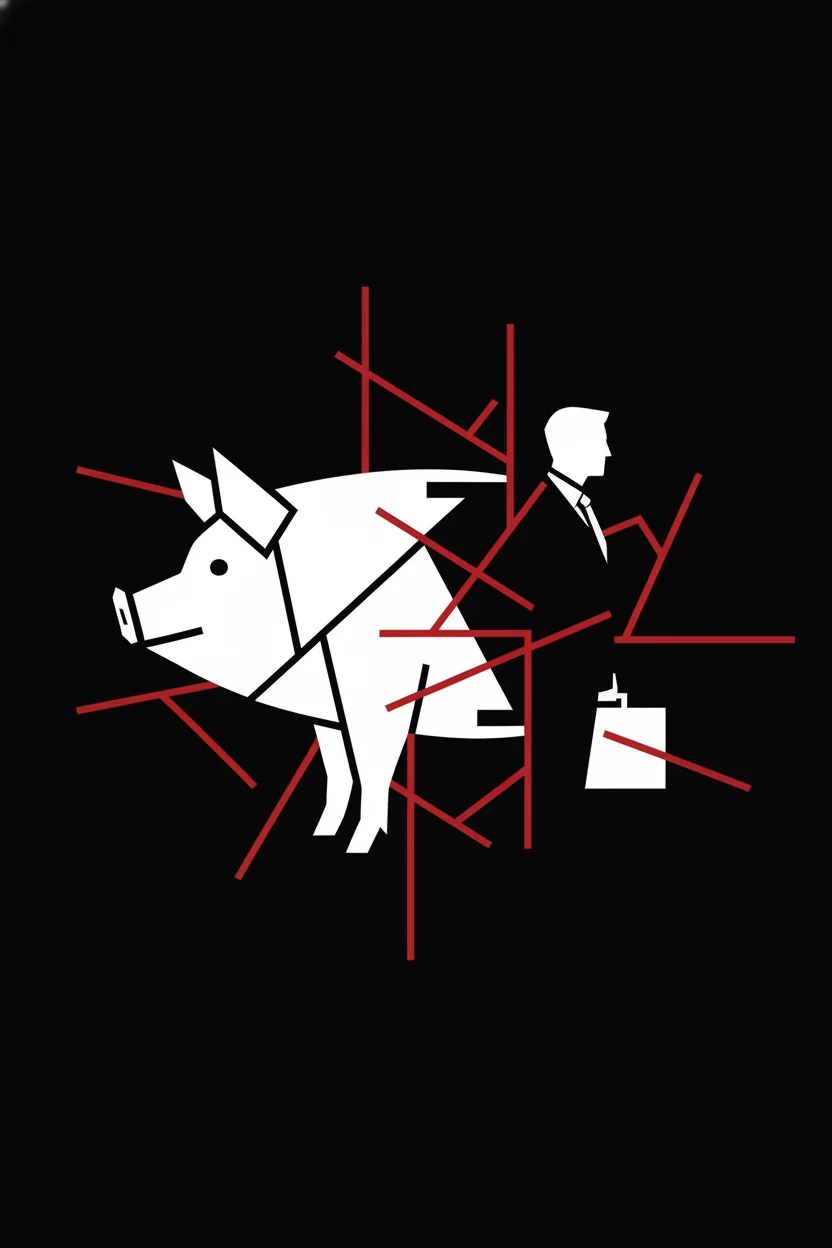
Animal Farm by George Orwell
by George Orwell
The animals of Manor Farm revolt against their human owner to create a utopian society based on equality. However, the pigs gradually seize power, rewrite the laws to suit their own greed, and eventually transform into the very tyrants they once fought to overthrow.
The Big Idea
"Animal Farm is Orwell's razor-sharp allegory for how revolutions betray their own ideals: the oppressed overthrow their oppressors, only to become indistinguishable from them — proving that power corrupts whoever holds it."
Key Insights
The Revolution Always Eats Its Own
Power does not change because of who holds it; rather, the possession of power changes the person. Napoleon was not a corrupted idealist, but a power-hungry opportunist from the start.
The expulsion of Snowball, who was framed as a traitor to justify Napoleon's absolute rule.
Propaganda Is the Most Dangerous Weapon
Physical force (the dogs) is only half the battle; the true victory of a dictator lies in controlling the narrative and gaslighting the population.
Squealer convincing the animals that their memories of the commandments are wrong.
Gradual Change Is Invisible Change
Authoritarianism rarely arrives overnight. It happens through incremental shifts that are small enough to avoid immediate mass resistance.
The slow modification of the commandment against beds to include "with sheets."
The Exploitation of the Loyal
The most hardworking and loyal members of a society are often the most vulnerable to exploitation by a corrupt regime.
Boxer's unwavering faith in Napoleon leading him directly to the knacker's van.
The Use of External Scapegoats
Regimes maintain internal compliance by creating a permanent external enemy to blame for all failures.
Blaming Snowball for the collapse of the windmill and every food shortage on the farm.
Chapter Breakdown
The Dream of a Better World
The story begins at Manor Farm, where the animals live under the oppressive rule of Mr. Jones, a drunken and negligent farmer. The catalyst for the revolution is Old Major, a prize boar whose wisdom is respected by all. In a secret gathering, Old Major shares a vision of a future where animals are free from human tyranny. He introduces the concept of Animalism, arguing that humans are the only creatures that consume without producing, and that the animals' labor is stolen to fuel human luxury.
To ignite this spark of rebellion, Old Major teaches them a song called "Beasts of England," an anthem of liberation that unites the animals in a shared emotional goal. While Old Major dies shortly after his speech, he leaves behind the seeds of a revolution based on the premise that all animals are equal and that any animal who identifies with human traits is a traitor to their own kind.
Revolution! — But Then What?
The revolution happens sooner than expected when Mr. Jones forgets to feed the animals, leading to a spontaneous uprising. The animals successfully drive Jones and his men off the farm, renaming it "Animal Farm." Initially, the transition is a triumph of collective spirit. The pigs, being the most intelligent, emerge as the natural leaders. They distill Old Major's teachings into the Seven Commandments, which are painted on the barn wall. The most central tenets include "No animal shall kill any other animal" and the definitive "All animals are equal."
However, the honeymoon phase quickly reveals cracks in the leadership. Two pigs, Snowball and Napoleon, emerge as rivals. Snowball is an idealist and a brilliant orator who wants to modernize the farm by building a windmill to provide electricity. Napoleon is quieter, more secretive, and focused on consolidating power. Their conflict represents the classic struggle between intellectual idealism and raw, authoritarian ambition.
How Power Is Stolen Slowly
Napoleon’s rise to power is not an overnight coup, but a calculated series of maneuvers. While Snowball is busy planning the windmill and organizing committees, Napoleon secretly trains a litter of puppies to be his personal guard. At the height of a debate over the windmill, Napoleon unleashes these ferocious dogs to chase Snowball off the farm forever. With the opposition removed, Napoleon declares that meetings and debates are over; decisions will now be made by a committee of pigs in private.
To maintain control, Napoleon employs Squealer, a master of propaganda. Squealer is the bridge between the regime and the working animals. Whenever the pigs take a new privilege—such as claiming the farm's milk and apples for themselves—Squealer uses "science" and fear to justify it. He convinces the animals that the pigs need these luxuries to maintain their brainpower, which is essential for the farm's survival. He frames any questioning of Napoleon as a betrayal of the revolution.
The Commandments Rewrite Themselves
As Napoleon’s tyranny deepens, the Seven Commandments begin to change. The animals notice that the writing on the barn wall is different, but Squealer gaslights them into believing their memories are faulty. When the pigs begin sleeping in beds, the commandment "No animal shall sleep in a bed" is amended to "...with sheets." When the pigs start killing other animals to maintain order, the rule against killing is changed to "...without cause."
The most tragic figure in this descent is Boxer, the immense and loyal cart-horse. Boxer embodies the hardworking proletariat, adopting the mottos "I will work harder" and "Napoleon is always right." Despite his strength and devotion, he is eventually betrayed. Once Boxer becomes too old and injured to work, Napoleon sells him to a knacker (a horse slaughterer) to buy a case of whiskey for the pigs, while telling the other animals that Boxer died peacefully in a hospital.
"All Animals Are Equal, But Some Animals Are More Equal Than Others"
The climax of the allegory occurs when the pigs fully embrace the human behaviors they once despised. They begin walking on two legs, wearing clothes, and carrying whips. The Seven Commandments are erased entirely, replaced by a single, paradoxical sentence: "All animals are equal, but some animals are more equal than others." This sentence represents the ultimate betrayal of the revolution—the creation of a new class system that is even more oppressive than the one they overthrew.
The novel ends with a chilling scene where the pigs host a dinner party for the neighboring human farmers. As the other animals watch through the window, they realize they can no longer tell the difference between the pigs and the humans. The revolution has come full circle; the liberators have become the oppressors, and the dream of equality has been completely extinguished.
Why Animal Farm Still Matters
While George Orwell wrote this as a direct allegory for the Russian Revolution and the rise of Stalin (Napoleon) over Trotsky (Snowball), the story transcends its specific historical context. It is a timeless study of how power corrupts and how language is used to manipulate the masses. The "doublespeak" employed by Squealer is mirrored in modern political and corporate rhetoric, where words are redefined to hide uncomfortable truths.
The book serves as a warning that vigilance is the price of liberty. It teaches us that when leaders create scapegoats or rewrite history to suit their needs, the path to authoritarianism is being paved. Animal Farm remains a vital piece of literature because it exposes the psychological mechanisms of control that exist in every society, regardless of the political ideology it claims to follow.
Take Action
Practical steps you can implement today:
-
Question leaders who create permanent enemies or scapegoats to deflect from their own failures.
-
Be vigilant against gradual rule changes; small shifts in policy normalized over time can lead to total loss of freedom.
-
Recognize when history is being rewritten or 'reinterpreted' to serve a current political agenda.
-
Distinguish between those who speak for a movement's ideals and those who actually implement its policies.
-
Understand that hard work is only a virtue when the system you are supporting is ethically sound.
Notable Quotes
"All animals are equal, but some animals are more equal than others."
— George Orwell
"The creatures outside looked from pig to man, and from man to pig, and from pig to man again; but already it was impossible to say which was which."
— George Orwell
"Napoleon is always right."
— George Orwell
"Four legs good, two legs bad."
— George Orwell
"If liberty means anything at all, it means the right to tell people what they do not want to hear."
— George Orwell
Who Should Read This
Students of political science, history, and literature who want to understand the mechanics of authoritarianism. It is essential for anyone who has witnessed an organization or government promise equality while delivering inequality. It is also a perfect entry point for readers who enjoy Orwell's 1984 but want a more concise, accessible allegory on how idealistic revolutions go wrong.
Summary Written By
Software Engineer & Writer
Software engineer with a passion for distilling complex ideas into actionable insights. Writes about finance, investment, entrepreneurship, and technology.
View all summaries →Reviews
No reviews yet. Be the first to share your thoughts!