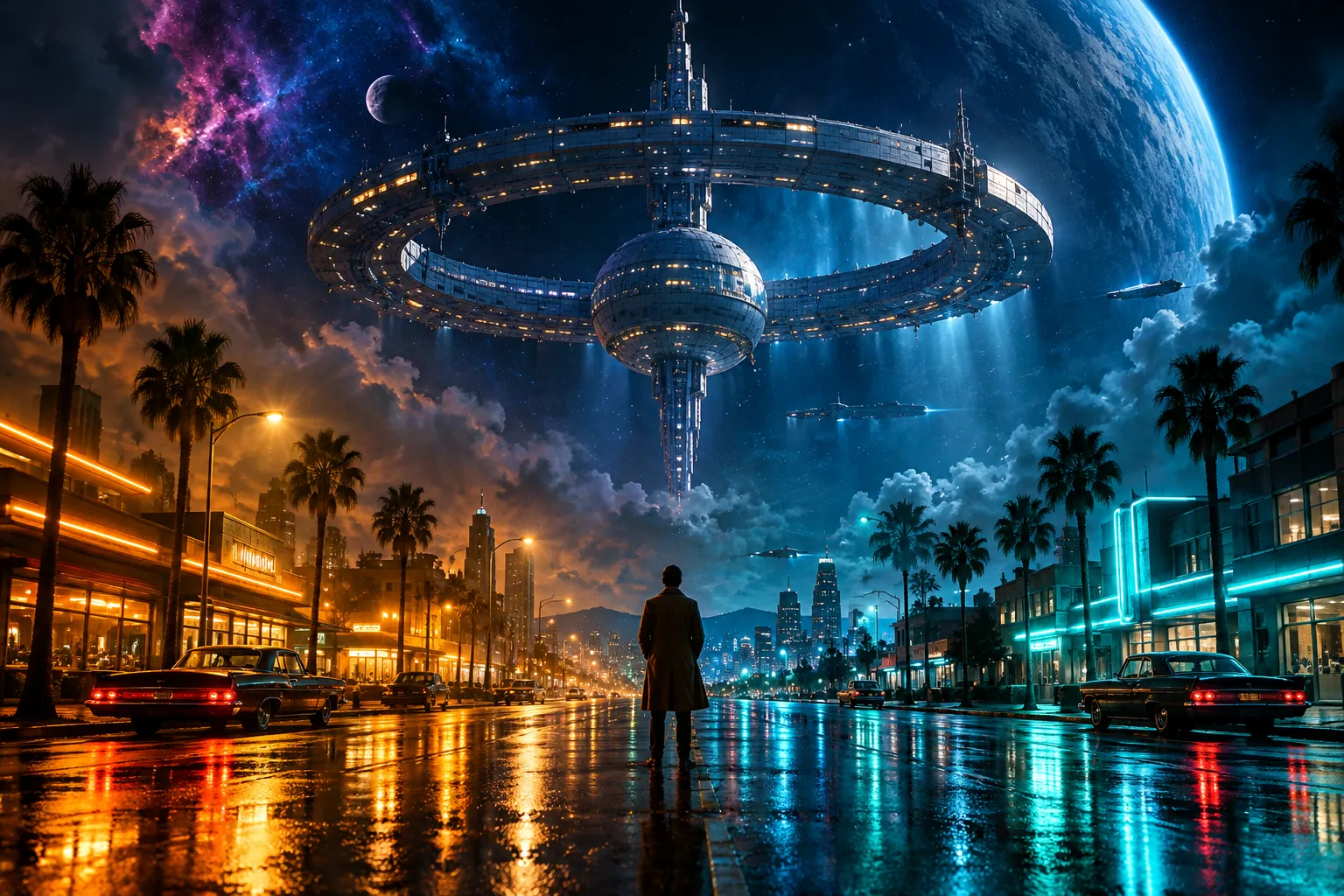
In five minutes: who was Philip K. Dick?
Philip K. Dick was an American writer who published about forty novels and well over a hundred short stories, almost all of them science fiction. If you want one sentence, here it is: Dick wrote about ordinary people whose world turns out not to be what it seemed, and who must still decide how to treat each other. Alternate histories, false memories, androids that feel more human than the humans, and drug-bent perceptions all serve that single worry.
He lived most of his life in California, never had much money until the end, and died in 1982, just months before the film Blade Runner opened. In the decades since, his name has become an adjective. When people call a story "Dickian", they mean a world with a trapdoor under the floor. This page is part of our History of Science Fiction topic, where Dick sits in the generation that turned the genre inward, from rockets to minds.
His life, step by step
Philip Kindred Dick was born in Chicago on 16 December 1928, together with a twin sister, Jane, who died within weeks. Biographers agree that this loss stayed with him; the idea of a missing double runs through his fiction. After his parents separated, he grew up with his mother in the San Francisco Bay Area and lived in Berkeley for many years. He worked in a record shop and spent a short time at the University of California, Berkeley, but he was mainly a self-taught reader of pulp magazines and philosophy.
His first story appeared in 1952, and through the 1950s he wrote at great speed for magazines and paperback publishers. His first novel, Solar Lottery, came out in 1955. Pay was low, so he wrote a lot. The output of this period is uneven, yet it already contains his habits: tired salesmen, broken marriages, bureaucracies, and a sudden crack in what everyone assumed was normal.
The breakthrough was The Man in the High Castle (1962), which won the Hugo Award for best novel in 1963. The mid-1960s and early 1970s were his most productive years, with Martian Time-Slip, The Three Stigmata of Palmer Eldritch, Do Androids Dream of Electric Sheep?, Ubik and Flow My Tears, the Policeman Said, the last of which won the John W. Campbell Memorial Award in 1975.
In February and March 1974, Dick had a series of intense visual and mental experiences that he came to call "2-3-74". He believed he had received information from a vast intelligence. Whether these were religious, medical or something else, he spent the rest of his life writing about them, including thousands of pages of notes known as the Exegesis. They fed his late novels, notably VALIS (1981). He died on 2 March 1982 in Santa Ana, California, at 53, after strokes.
The big question: what is real, and what is human?
Two questions drive almost everything he wrote.
1. What is real?
Dick's characters often discover that their reality has been edited: by an enemy government, a drug, a corporation, or something stranger. He rarely treats this as a puzzle to solve. The interesting part is what a person does after the floor drops away. In his own later essays he argued that the real test of reality is that it keeps going whether or not you believe in it.
2. What is human?
The second question is about empathy. In Do Androids Dream of Electric Sheep?, the line between human and android is drawn not by intelligence but by the capacity to care about other living things. Dick suggests that cruelty can make a flesh-and-blood person less human than a machine. This is the heart of the book, and it is often lost when people discuss it only as a story about robots.
Around these two questions sit smaller, recurring themes: ordinary working-class heroes, paranoia about authority, drugs and altered states, religion and gnostic ideas, and the cheap, decaying objects of a consumer future.
The key books
- The Man in the High Castle (1962): an alternate history in which the Axis powers won the Second World War and the United States is divided between Germany and Japan. Characters consult the I Ching, and a banned novel imagines a different outcome. It asks how people live under occupation, and how fragile any version of history is.
- Martian Time-Slip (1964): a story of a colonised Mars, real-estate schemes and a boy whose perception of time is different. It shows Dick's interest in mental illness and how others perceive it.
- The Three Stigmata of Palmer Eldritch (1965): colonists on Mars escape into a shared drug fantasy, until a powerful figure returns from deep space with a rival product. It is one of his strongest studies of illusion.
- Do Androids Dream of Electric Sheep? (1968): set in a ruined San Francisco after a global catastrophe. Bounty hunter Rick Deckard is paid to track down escaped androids, using an empathy test. This is the source of Blade Runner.
- Ubik (1969): a squad of people with psychic abilities face a disaster, and then the world around them starts to decay, with older technologies reappearing. Time magazine included it in its 2005 list of 100 best English-language novels since 1923.
- A Scanner Darkly (1977): an undercover narcotics agent is gradually torn apart by the drug he is investigating. It draws on Dick's own circle of friends in the drug culture of the time and is among his most moving books.
- VALIS (1981): a fictional version of his 1974 experiences, in which a character named Horselover Fat tries to understand a vision.
If you are new to him, the usual starting points are Do Androids Dream of Electric Sheep? for a clear story, The Man in the High Castle for the best-regarded literary novel, and Ubik for the strangest.
Where he shows up on screen
Dick did not live to see his work become famous in cinema. Blade Runner (1982), directed by Ridley Scott and based on Do Androids Dream of Electric Sheep?, opened in June of that year, a few months after his death. It changed many details of the novel, and its dark, rainy city became the visual model for a generation of science fiction.
Other adaptations followed: Total Recall (1990), loosely based on the short story "We Can Remember It for You Wholesale" (1966); Minority Report (2002), from a 1956 story; A Scanner Darkly (2006), an animated film; and The Man in the High Castle, a television series released between 2015 and 2019. Most of these keep one Dick idea and change the rest, so reading the originals is a different experience.
Legacy
The Philip K. Dick Award, created after his death in 1983, is given every year for a distinguished science fiction paperback original. In 2007 the Library of America published a collection of his novels, a sign that critics had moved him from pulp writer to a major American author.
Common misconceptions
- "He wrote Blade Runner." He wrote the novel it is based on, Do Androids Dream of Electric Sheep?, and never saw the finished film. The film and the book differ in many plot points and tone.
- "His books are all about drugs." Drugs appear in some, especially A Scanner Darkly and Palmer Eldritch, but most of his best-known books are about reality, empathy and power.
- "His work is predictions of technology." Dick was not mainly forecasting gadgets. His androids and false realities are ways to talk about what people owe each other.
- "You must read in publication order." Almost every novel stands alone, so you can start anywhere.
Read next
Continue with the History of Science Fiction to see where Dick sits between the golden age of the 1940s and the cyberpunk writers who followed him in the 1980s.