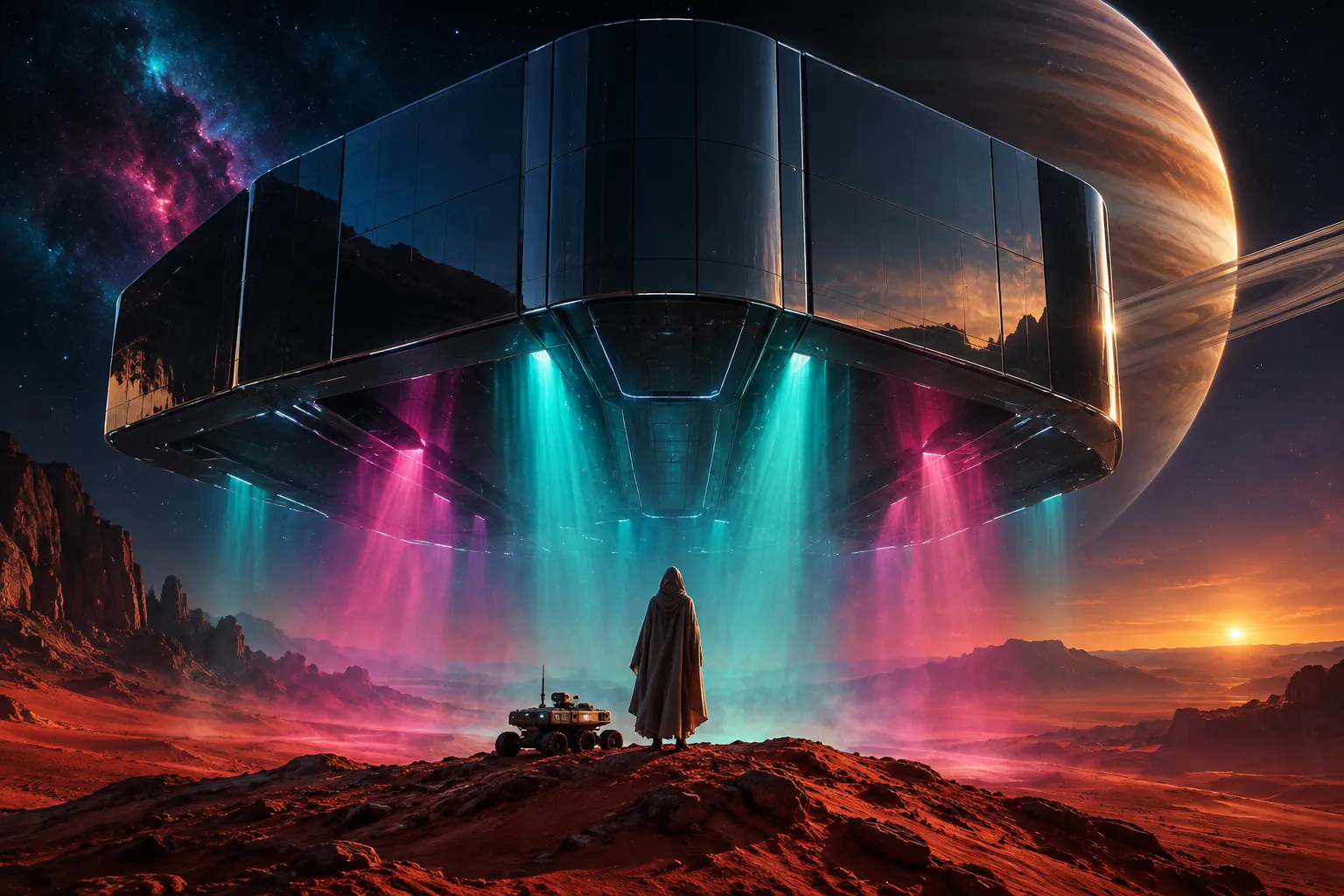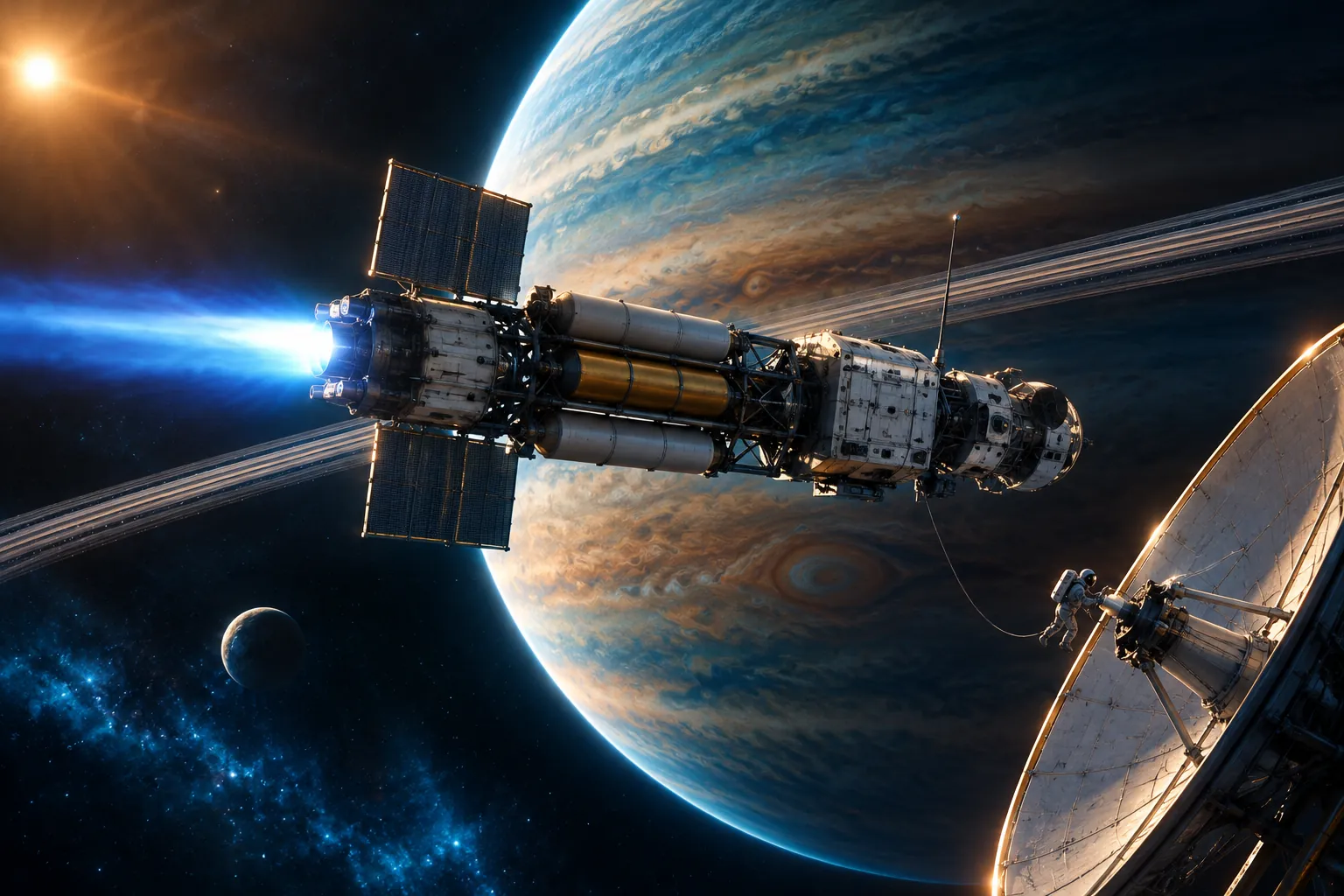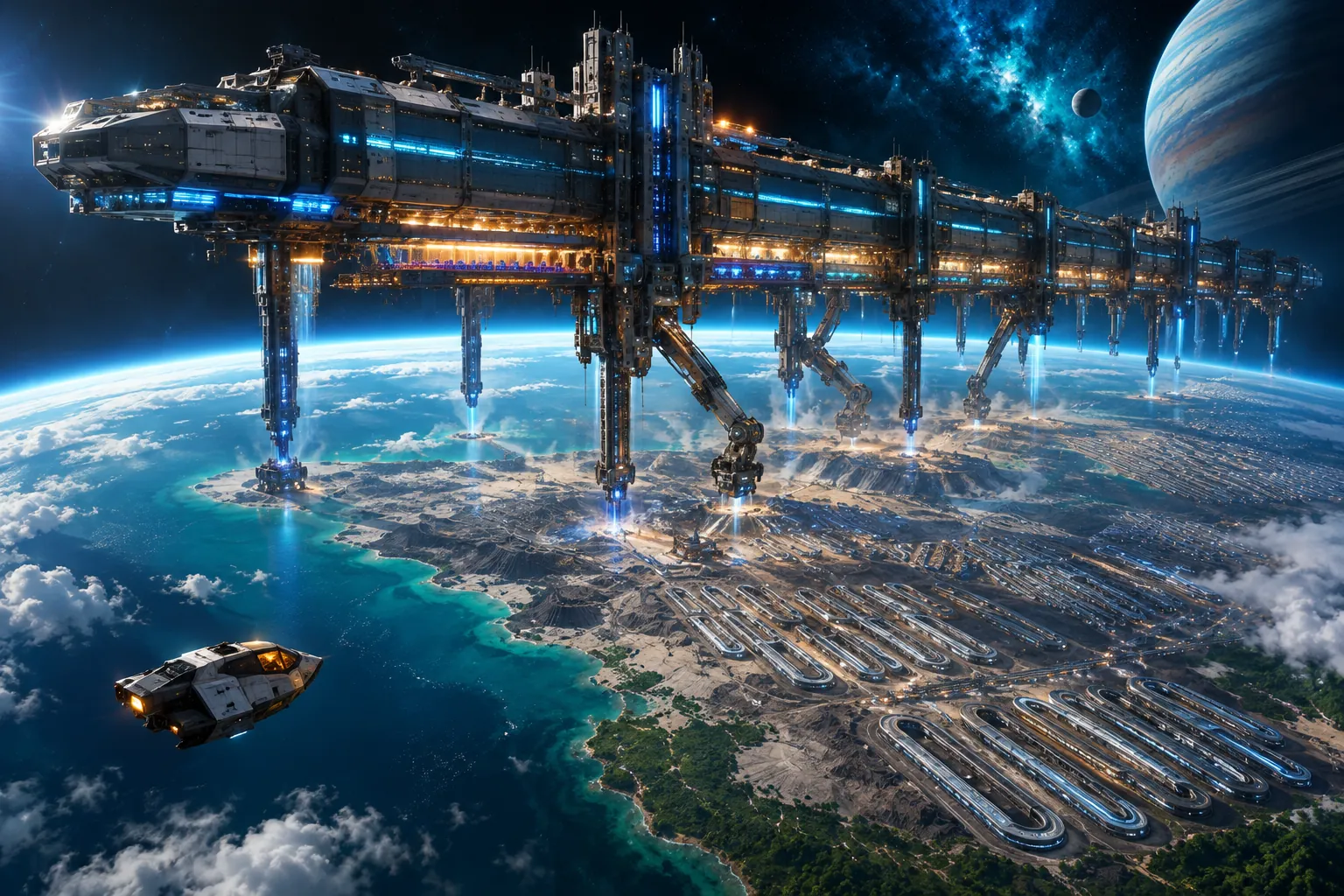
A generation ship is a starship that travels slower than light, so the trip takes longer than a human life. The people who leave are not the people who arrive. Children are born aboard, grow up aboard and grow old aboard, and only their descendants step onto the new world. This page is part of our History of Science Fiction guide.
In five minutes: what a generation ship is
The idea answers a plain problem: the stars are very far away, and nothing we can build travels anywhere near the speed of light. The nearest star system, Alpha Centauri, is about 4.4 light years away. Light covers that in four and a half years. Our fastest spacecraft would take tens of thousands of years.
If the trip cannot be made short, the travellers have to be able to live through it, and a single lifetime is not enough. So the ship becomes a small world. It carries farms, water, air, workshops, schools and a few thousand people, and it keeps them going for centuries. Grandparents board the ship. Their great-great-grandchildren, or many generations later, arrive.
Writers love the idea because it turns the voyage into a society. The crew has to make laws, share food, choose who has children and decide what to teach. Nobody on board ever chose the mission, and nobody will see its end. That tension is what the stories are about.
How the idea began
The idea is older than most readers expect. The American rocket pioneer Robert Goddard wrote a short, unpublished essay in 1918 about sending people to the stars in a ship where they could live and die. In 1928 the Russian scientist Konstantin Tsiolkovsky described large space arks in which people could travel for a very long time. The British scientist J. D. Bernal, in 1929, pictured a hollow sphere that held a whole community.
Fiction soon took it up. Don Wilcox’s story “The Voyage That Lasted 600 Years” appeared in the magazine Amazing Stories in October 1940. Robert A. Heinlein followed in 1941 with “Universe” and “Common Sense”, which were later joined as the book Orphans of the Sky (1963). Mild spoiler for Orphans of the Sky in the next sentence. Heinlein added the twist that made the idea famous: the crew forgets it is on a ship.
The real science
No generation ship has been built, and none is being built. But engineers and researchers do study the idea, because it avoids one huge difficulty. It needs no new physics. Only large amounts of engineering are needed.
The distance problem
Voyager 1, a probe now leaving the Solar System, moves at roughly 17 kilometres per second, which makes it one of the fastest objects we have sent far from the Sun. At that speed the trip to Proxima Centauri, about 4.24 light years away, would take around 75,000 years. In 2016 astronomers announced a planet, Proxima b, orbiting that star, which is one reason the target gets so much attention. A generation ship would have to be many times faster than Voyager to finish in a few hundred years, and it would also be vastly heavier.
The people problem
The harder questions are about people. How many do you need so the group stays healthy over many generations? A 2014 study by the anthropologist Cameron Smith suggested a starting population of roughly 14,000 to 44,000 people, to keep enough genetic variety. Other researchers have proposed smaller numbers, and the answer depends on assumptions. It is an area of active debate, not settled fact.
The ship also has to recycle nearly everything. Air, water, food and waste must go round in a closed loop, with almost no losses, for centuries. Small closed-ecosystem experiments on Earth have so far struggled to do this for even a few years. Radiation, gravity and mental health over generations are further open problems.
What is speculation
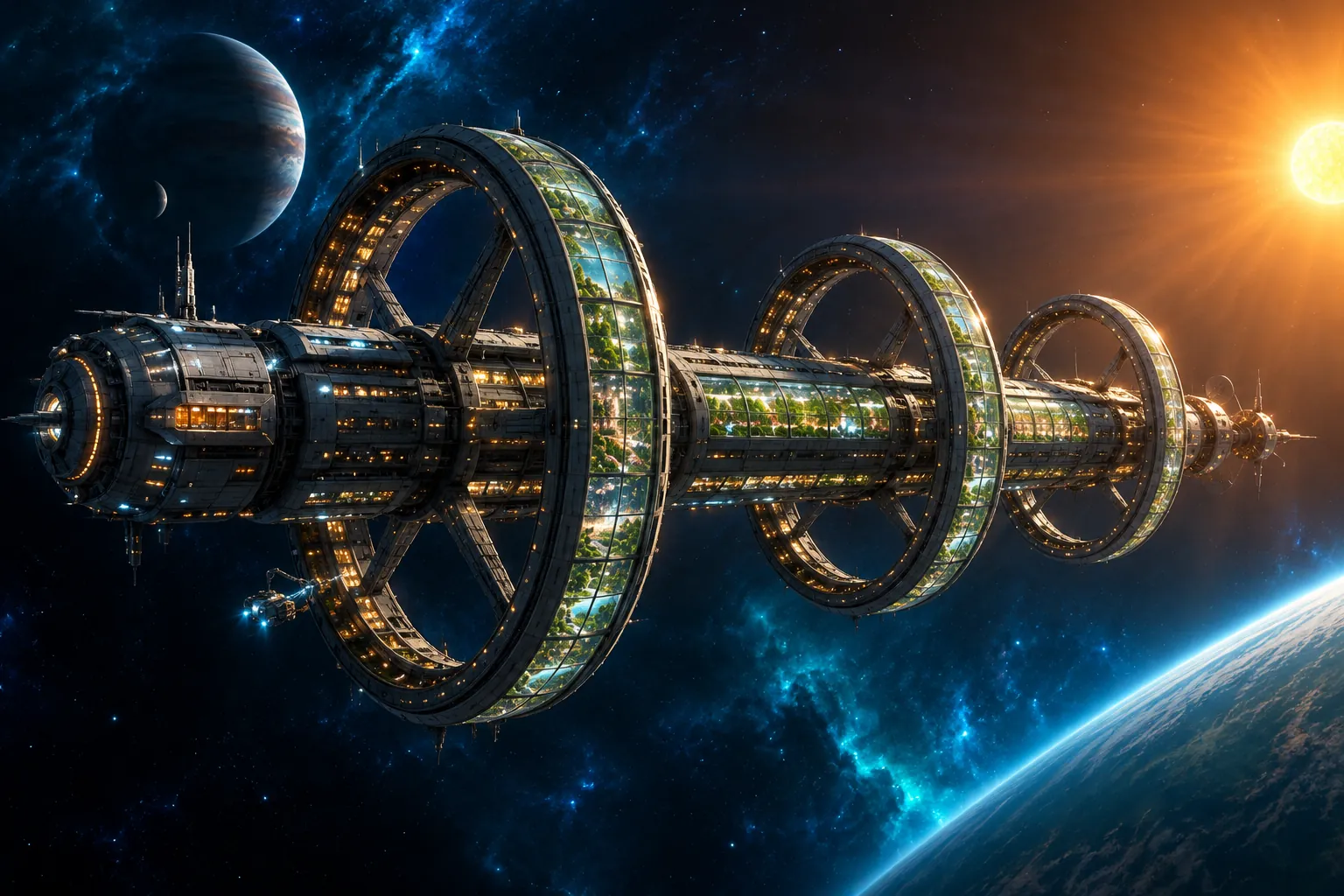
The ship designs in stories, with farms, forests and whole towns inside a rotating cylinder, are imaginative projects, not plans. Studies such as Project Hyperion, a design contest run in 2011 by the Icarus Interstellar group, explore what a real ship might need, but they remain thought experiments.
Where it shows up in fiction
Spoiler note: the list below gives away the central twist of Orphans of the Sky and a hint of the premise of Non-Stop. Skip to “Common misconceptions” if you plan to read them cold.
Generation ships are one of the most reliable settings in science fiction, and the best stories use them to ask what happens to a society when it cannot leave.
- Orphans of the Sky (Robert A. Heinlein, 1963 book; stories from 1941). The crew has lost the knowledge that they are on a ship. The hull is the whole world, and the stars are myth. A young man who rejects the legends finds the truth.
- Non-Stop (Brian Aldiss, 1958). Known in the US as Starship. Descendants of the original crew live in a jungle-like ship. Their tribal life hides an unusual explanation.
- Paradises Lost (Ursula K. Le Guin, 2002). A short novella that follows the passengers of a ship over generations, and asks whether a people born in transit can feel at home anywhere else.
- Aurora (Kim Stanley Robinson, 2015). A modern, scientifically careful novel that treats a generation ship as a fragile machine and asks whether the project was ever realistic.
These stories share a pattern. The ship is a closed society, and closed societies drift. Rules harden, history turns into religion, and the purpose of the trip gets lost. Writers use the setting to ask about our own ship: Earth, which also has limited resources and no way to leave.
Common misconceptions
“A generation ship is the same as a sleeper ship.” It is not. A sleeper ship, based on suspended animation or cryosleep, keeps the same people alive in a frozen state. On a generation ship, everyone stays awake and the crew changes by birth and death. Some stories combine both.
“It is a way to travel faster than light.” The opposite is true. A generation ship accepts light speed as a hard limit. If you could use something like a warp drive, you would not need a ship that lasts centuries. The generation ship is the answer for writers and engineers who do not assume a loophole.
“The crew always forgets and goes wild.” That is Heinlein’s twist, and many stories follow it, but it is a storytelling choice. A real mission would likely build education and record keeping into the design to prevent it.
“It is only a plan for the far future.” It is mainly a thought experiment today. It matters because it shows how much more difficult the human side of interstellar travel is than the rocket.
Read next
- Suspended animation and cryosleep: the other classic answer to long travel times, where nobody ages on the way.
- Warp drive: the opposite choice, where fiction bends space so no one has to wait generations.
- History of Science Fiction: how these ideas developed across a century of magazines and novels.