In five minutes
Kurt Vonnegut was an American writer who used science fiction as a way to talk about ordinary human cruelty and ordinary human kindness. His books are short, funny and sad at once, and they are written in simple sentences that sound like a person talking.
He is part of the story told in History of Science Fiction, as one of the writers who took the genre out of the pulp magazines and into the classroom.
If you only remember three things, remember these. He survived the Allied bombing of Dresden as a prisoner of war, he turned that experience into Slaughterhouse-Five (1969), and he never stopped asking how decent people can build machines and weapons that do terrible things.
The life that shaped the books
Vonnegut was born on 11 November 1922 in Indianapolis, Indiana. His family had once been comfortable, but the Great Depression hit them hard.
He studied chemistry at Cornell University, then joined the US Army in 1943. In May 1944 his mother, Edith, died by suicide, and he spoke about that loss for the rest of his life.
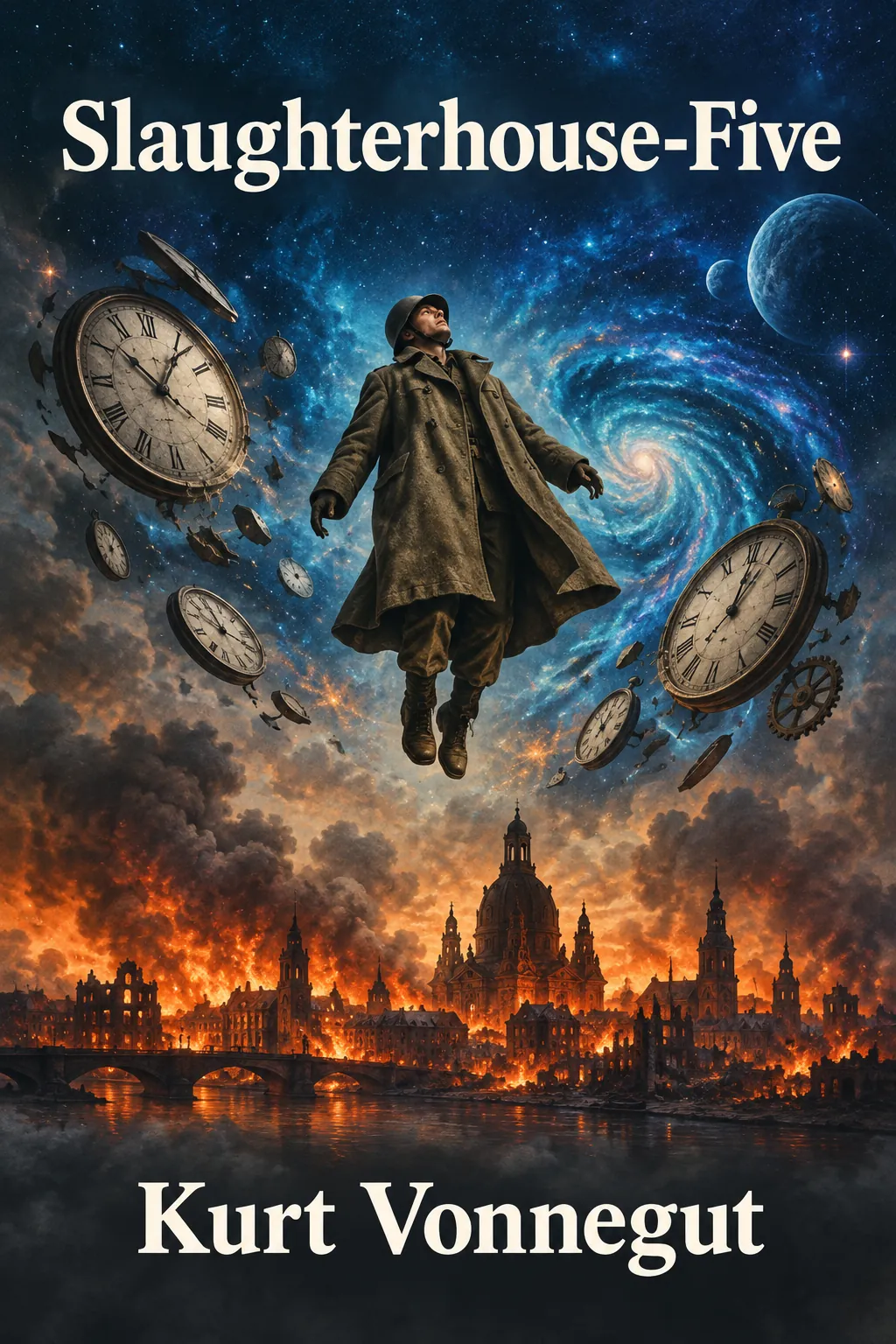
In December 1944 he was captured during the Battle of the Bulge and sent to Dresden, Germany, as a prisoner of war. He and other prisoners were held in a former slaughterhouse called Schlachthof-Fünf, which means Slaughterhouse Five.
On the night of 13 February 1945 and the following days, British and American bombers destroyed much of the city. Vonnegut survived because he was sheltering in an underground meat locker, and afterwards he was put to work digging bodies out of the ruins.
The most widely cited modern estimate puts the dead at up to about 25,000 people. For years he could not write about it directly.
After the war he married Jane Cox, studied anthropology at the University of Chicago and then worked in public relations at General Electric in Schenectady, New York. There he saw a world of engineers and managers close up, and that world became the setting of his first novel.
He began to make his living from short stories for magazines, and then from novels. He later taught at the Iowa Writers' Workshop and became a public figure who gave speeches and interviews well into old age.
He died in New York on 11 April 2007, aged 84.
The main books, and what each one is about
Player Piano (1952) is his first novel. It imagines a United States where machines run the factories and a small class of engineers runs the machines, while everyone else feels useless.
The Sirens of Titan (1959) is a wild space story with a serious question underneath it. Is there any purpose to human life, and if the purpose turns out to be a joke told by someone else, does it still matter?
Our Sirens of Titan study guide covers the plot and the people.
Cat's Cradle (1963) follows a writer who researches the family of a scientist who helped build the atomic bomb. It introduces ice-nine, an invented form of water that freezes everything it touches, and Bokononism, a made-up religion that admits it is made up.
Read the Cat's Cradle summary if you want the full story and its themes.
Slaughterhouse-Five (1969) is the book most people mean when they say Vonnegut. Its hero, Billy Pilgrim, becomes “unstuck in time” and drifts between his war, his ordinary life and a zoo on a distant planet.
The Slaughterhouse-Five study guide explains the structure, the characters and the famous refrain “So it goes,” which the narrator says after every mention of death.
Other novels worth knowing are Mother Night (1961), Breakfast of Champions (1973) and Galápagos (1985). His last novel, Timequake (1997), mixes fiction with memories and comments on his own career.
A short story to start with: “Harrison Bergeron”
“Harrison Bergeron” first appeared in 1961 and was later collected in Welcome to the Monkey House (1968). It is only a few pages long.
In the year 2081 everyone is made equal by force. The strong wear weights, the beautiful wear masks, and the clever wear devices that blast noise into their ears so they cannot think for long.
The story is often read as a warning against forced equality, but it also works as a joke about how nervous a society can be about anyone who stands out. Vonnegut leaves it to the reader to decide which target he means.
The science in the fiction
Vonnegut had a science background, and it shows. His brother Bernard was a respected atmospheric scientist who worked on cloud seeding, and Kurt used that world as a model for the scientists in his stories.
Ice-nine is fiction. There is a real thing called ice-nine in the sense that water ice has many crystal forms, but nothing like Vonnegut's version, which freezes ordinary water at room temperature, exists.
What is real is the worry behind it. A discovery made out of curiosity can be used in ways its maker never wanted, and the scientist in Cat's Cradle shrugs off the consequences.
The Tralfamadorians in Slaughterhouse-Five are also invented. They see all of time at once, like a mountain range seen from far away, and so they believe every moment always exists.
That idea is a thought experiment about how to bear grief. It is not a claim from physics, though readers often connect it to the “block universe” idea discussed by some physicists and philosophers.
What ties his work together
The first thread is war and what it does to people. Dresden is at the centre of one book, but its shadow falls on many others.
The second is a suspicion of grand systems: the machine economy, nuclear weapons, rigid religions and rules that treat people like parts. He keeps asking who gets hurt when the system works exactly as designed.
The third is kindness. In God Bless You, Mr. Rosewater (1965), a rich man gives time and care to people the world ignores.
Vonnegut's own answer to a hard universe was usually small and plain: be decent to the person in front of you.
Finally, there is his voice. He used short sentences, direct address and jokes that make a sad point land harder.
In Mother Night he wrote a line that many readers keep: “We are what we pretend to be, so we must be careful about what we pretend to be.”
Common misconceptions
“He only wrote about Dresden.” Dresden matters most in one novel, but his other books deal with technology, religion, money, loneliness and politics, often with no war at all.
“So it goes means he did not care.” The phrase is closer to the opposite.
It is a way of facing death without pretending it is not there, because the narrator repeats it every time someone dies.
“He was just a science fiction writer.” He wrote science fiction, but he was uneasy about being filed under that label and wanted to be read as a novelist and essayist like any other.
“Kilgore Trout is a real author.” Trout is a fictional, unsuccessful science fiction writer who appears in several Vonnegut novels, a running joke and a self-portrait of sorts.
“It is a hopeless, cynical body of work.” The books are bleak about institutions, yet they keep returning to small acts of care.
Many readers finish them feeling comforted, not crushed.
Where to start
Begin with Slaughterhouse-Five for the best-known work, or Cat's Cradle if you want a faster, funnier read. If you only have ten minutes, read “Harrison Bergeron.”
Then try The Sirens of Titan for his strangest science fiction. After that, Mother Night and Breakfast of Champions show how far his style could stretch.
Read next
History of Science Fiction places Vonnegut among the writers who changed what the genre could be about.
Slaughterhouse-Five is the best next step for his Dresden story and the idea of being unstuck in time.
Cat's Cradle is the one to read for ice-nine, Bokononism and the cost of careless science.
The Sirens of Titan is the one to read for cosmic comedy and a hard question about purpose.