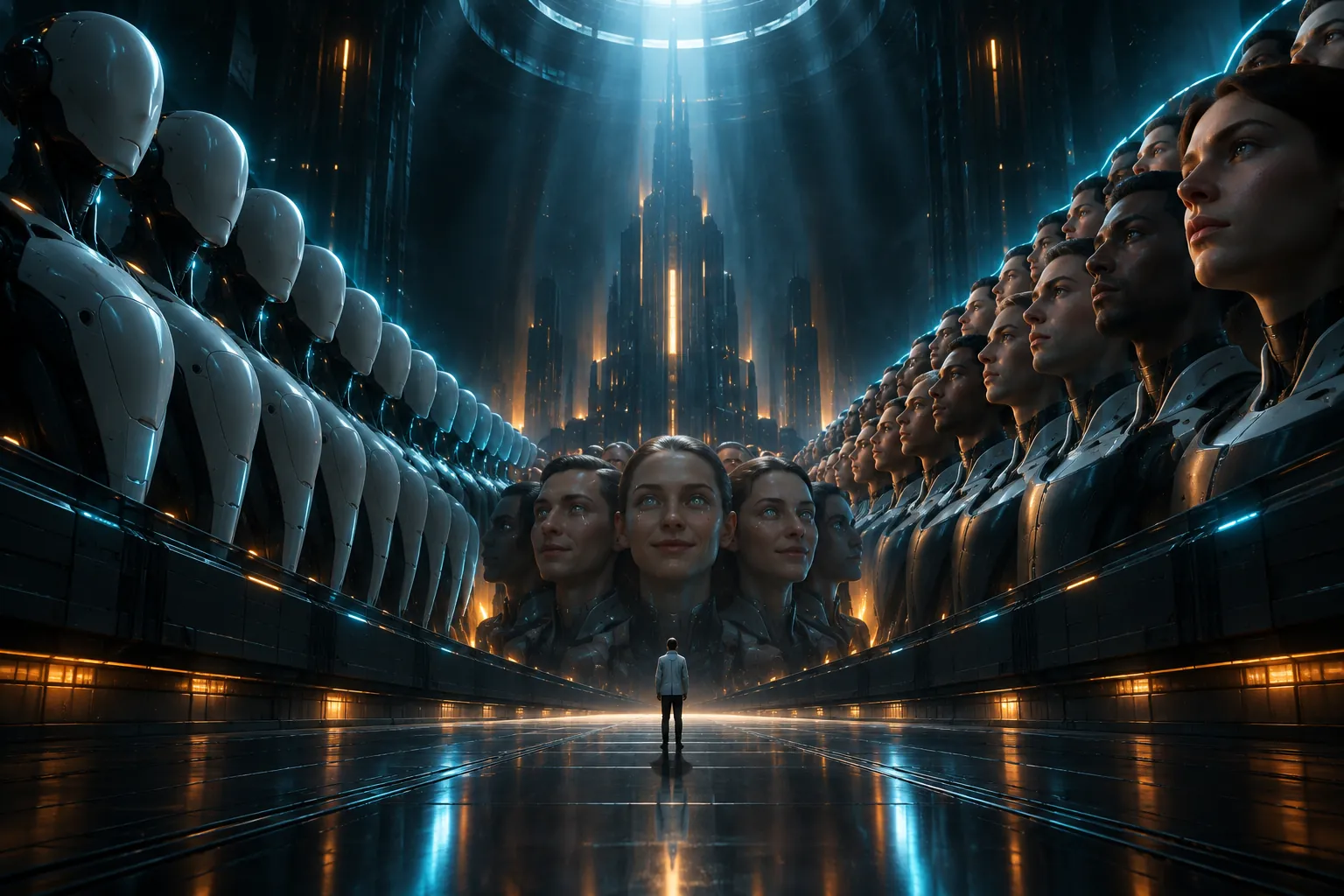
In five minutes: what is a humanoid robot?
A humanoid robot is a machine with a human-shaped body: a torso, two arms, two legs and a head, or most of that.
The shape is a choice, not a vanity project. Stairs, doors, tools and shelves were all made for human bodies, so a robot with similar proportions can in theory work in our spaces without changing them.
Fiction got there first. Writers pictured artificial people long before engineers could make one stand up, and the two stories have fed each other ever since.
This page sits in our History of Science Fiction topic. It covers where the idea came from, what the machines can really do, and what is still only hope.
Why build robots in our shape?
The first reason is the built world. The height of a stair, the position of a door handle and the depth of a shelf are all set by the human body.
The second is tools. Hammers, screwdrivers and car seats are designed for human hands, so a robot with a similar hand might be able to use them as they are.
The third is communication. A head and arms let a robot nod, point and wave, which makes its intentions easier for people nearby to read.
The fourth is learning. Researchers try to teach robots by showing them recordings of human movement, and the closer the robot's body is to ours, the easier those examples are to use.
None of this proves that a human shape is always best. It only explains why people want it in places built around people.
A short history of the humanoid robot
Clockwork people
Mechanical figures that look like people are old. In 1206 the engineer Ismail al-Jazari described a boat of automatic musicians in his book on ingenious machines.
In Japan, karakuri ningyo, clockwork dolls, served tea and performed on stage during the Edo period. They were not robots, but they are often mentioned when people ask why Japan feels at home with human-shaped machines.
The word robot is born (1921)
The Czech writer Karel Čapek used the word robot in his play R.U.R. (Rossum's Universal Robots), first staged in Prague in 1921. It comes from the Czech word robota, meaning forced labour, and Čapek credited his brother Josef with the idea.
Čapek's robots are not metal. They are artificial people made from a synthetic living substance, built to work in factories, and in the end they rise up against humans.
Fritz Lang's film Metropolis (1927) gave the idea its first famous screen image: a metal-bodied machine-human that takes the form of a woman named Maria.
From stories to prototypes
In 1939 Westinghouse showed Elektro, a tall humanoid that could walk along a track, respond to voice signals and mimic smoking, at the New York World's Fair. It was a stage show more than a thinking machine.
Isaac Asimov's I, Robot (1950) treated robots as ordinary engineered products with safety rules built in. We cover those rules in Three Laws of Robotics.
In 1952 Osamu Tezuka began the manga Astro Boy, and a robot boy with feelings became a familiar figure for Japanese children.
In 1973 Waseda University in Tokyo completed WABOT-1, usually called the first full-scale humanoid robot. It walked slowly, gripped objects and communicated in simple Japanese.
Walking for real
Honda began research on two-legged walking in 1986, showed the P2 in 1996 and unveiled ASIMO in 2000. ASIMO's walking and stair climbing made humanoids familiar to the public.
Honda ended work on ASIMO in 2018.
Boston Dynamics showed its Atlas robot in 2013 and later taught it to jump and do backflips. In 2024 the company replaced the hydraulic version with an all-electric Atlas.
Since 2021 companies such as Tesla (Optimus), Figure, Agility Robotics and Unitree have shown humanoids aimed at work in factories and warehouses.
The real science: what works and what does not
Walking on two legs is mostly controlled falling. A tall body on a small footprint has to be rebalanced many times a second, and a hard shove or a patch of loose gravel can end the run.
Hands are the other hard part. People pick up eggs, turn screws and thread needles with the same hand, and matching that mix of strength and touch is still an open engineering problem.
Power is a third limit. Batteries let today's humanoids work for hours, not days, and heavy loads drain them faster.
What is established: prototypes can walk, run, climb stairs, jump and carry objects in controlled demonstrations. Modern machines often use machine-learning controllers that are trained in simulation first.
What is still speculation: a general-purpose humanoid that reliably does varied housework at a price ordinary families can pay. Companies have announced goals and pilot projects, but nobody has shown it working at scale.
There is also a real debate about the shape itself. A wheeled base with two arms is often cheaper, safer and more efficient, so some engineers argue that form should follow the task.
Supporters of humanoids answer that one general body can use tools and spaces made for people and can be built in large numbers.
People also react to the look. In 1970 the Japanese roboticist Masahiro Mori described the uncanny valley: a robot that looks almost, but not quite, human can feel eerie instead of friendly.
Where it shows up in fiction
Karel Čapek's R.U.R. (1921) is the starting point: artificial workers made for labour who rise against their makers.
Isaac Asimov's I, Robot (1950) collects stories about robots as engineered products with built-in rules. His novel The Caves of Steel (1954) pairs a human detective with R. Daneel Olivaw, a robot built to pass as a person.
In Osamu Tezuka's manga Astro Boy (begun 1952), a robot boy with feelings lives among humans. It shaped how many Japanese readers first pictured a robot.
Philip K. Dick's Do Androids Dream of Electric Sheep? (1968) asks what separates a person from a machine that looks and acts like one.
The film Blade Runner (1982) was adapted from it.
More recently, Kazuo Ishiguro's Klara and the Sun (2021) is told by Klara, an Artificial Friend, and looks at care and loneliness from a robot's point of view.
These stories usually ask one of three questions: will robots work for us, will they turn on us, or could we come to care about them?
Common misconceptions
Humanoid, android and cyborg mean the same thing. They do not.
Humanoid describes a body shape, android usually means a robot made to look convincingly human, and a cyborg is a living being with machine parts.
The first robots were metal. In R.U.R. they were made of synthetic living matter.
The metal robot became the standard picture later, largely through the screen.
Humanoids already do our chores. Videos show carefully prepared tasks, and most deployments so far are small pilots in factories and warehouses.
The Three Laws of Robotics are real programming. They are a storytelling device that Asimov invented.
Real robot safety depends on engineering standards, sensors and limits on force.
A human shape is always best. It is one option, and for many jobs a wheeled or specialised machine does better.
Read next
- History of Science Fiction: the wider story of how writers imagined machines, space and the future.
- Three Laws of Robotics: Asimov's rules for robots and why his own stories keep breaking them.
- Uncanny valley: why a nearly human face can feel more unsettling than an obvious machine.
- Cyborg: the other way to blend people and machines, by adding technology to a living body.