In five minutes
Momotaro, the 'Peach Boy', is a Japanese folktale about a child who comes out of a giant peach, grows up strong and kind, and sails to Demon Island with a dog, a monkey and a pheasant to stop the oni who raid his village.
It is one of the most widely known children's stories in Japan, and many people there can recite its beats from memory.
The standard version rests on two layers of source: the cheap illustrated booklets of the Edo period (1603–1868), and Iwaya Sazanami's 1894 retelling for children, which fixed the plot most readers know today.
Oni are horned ogres of Japanese folklore, not devils in the Christian sense, and Demon Island is called Onigashima.
Momotaro is a folktale, not a myth of the gods, so it does not appear in the Kojiki. For that older layer of stories, see our guide to Japanese mythology and the Kojiki.
The story
Long ago, an old man and an old woman lived alone in a village. One morning the man went up the mountain to gather firewood, and the woman went down to the river to wash clothes.
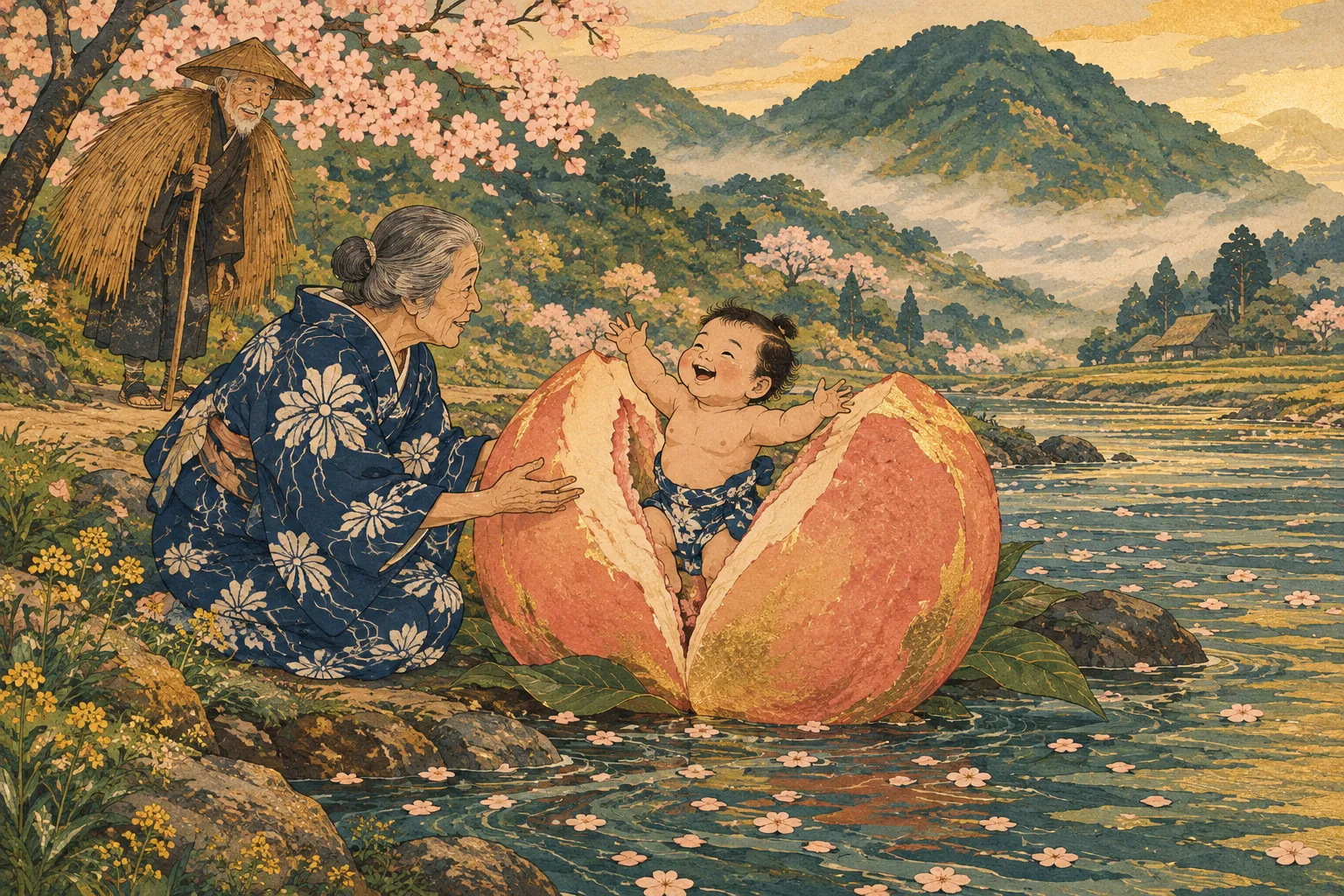
As she washed, an enormous peach came bobbing downstream, going donburako, donburako, as the Japanese sound effect has it. She fished it out and carried it home.
That evening the old couple tried to cut it open. The peach split by itself, and a healthy baby boy jumped out.
They had no children, so they were overjoyed. They called him Momotaro, 'Peach Taro', and raised him with great care.
Momotaro grew fast and became the strongest boy in the village, though a kind one.
In those days word reached the village of oni living on a far island called Onigashima, Demon Island. They sailed out to raid coastal villages and carry off treasure and food.
Momotaro asked his parents' permission to go and put a stop to it. They worried, but they let him go, and the old woman packed kibi dango, millet dumplings, for the road.
On the way a dog asked for a dumpling. Momotaro gave him one, and the dog promised to follow him.
A monkey and then a pheasant met him in the same way, and each joined the party in exchange for a dumpling.
The four crossed the sea and reached the island. The oni had barred their gate and were waiting.
The pheasant flew over the walls and pecked at the oni, the monkey climbed in and drew back the bolt, and the dog bit at their legs. Momotaro fought at the front.
The chief oni gave in. He promised never to raid again and handed back the stolen treasure.
Momotaro and his friends loaded the treasure on a cart and went home. The old couple welcomed them, and everyone lived happily.
The shape is simple: a miraculous birth, a quest, helpers won by sharing, a victory and a return. That tidy shape is a large part of why children remember it.
Variants
There is no single fixed Momotaro, and the biggest difference is how he is born.
Some Edo-period picture books have the old couple eat the peach. They grow young again, and a child is born to them afterwards.
The version in which the boy comes straight out of the peach became the standard one in the Meiji era (1868–1912), helped by popular books and school readers.
Smaller details change too: which companions join, what treasure the oni hand over, and whether the oni are beaten or simply surrender. Local retellings also tie the hero to particular places.
None of these is the 'true' one. Each age retold the tale to suit its listeners.
Where the story comes from
Momotaro is a folktale with no single named author and no known date of origin.
Its earliest firm written form is the illustrated booklets of the Edo period, known as kusazoshi, cheap picture books for children and families in which Momotaro was a popular subject.
The version most readers know comes from Iwaya Sazanami (1870–1933), a pioneer of Japanese children's literature.
In 1894 he began the Nihon Mukashibanashi (Tales of Old Japan) series for the publisher Hakubunkan, and Momotaro was its first volume.
Sazanami retold the story in a lively style meant to be read aloud. Through his book and the school readers of the period, one plot spread across the whole country.
Several places lay claim to the tale. Okayama prefecture, the old province of Kibi, is the best known: its famous kibi dango sweets share the name, and local legend tells of Prince Kibitsuhiko, said to have defeated a demon-like figure called Ura.
On the Inland Sea, the island of Megijima in Kagawa is traditionally called Onigashima. These are local traditions, not proof of a single origin.
The peach itself has deep roots. In the Kojiki (712), Izanagi throws peaches at the pursuers from the land of the dead and they flee, and in East Asia the fruit was long believed to drive away evil.
That does not make Momotaro a Kojiki story, but it helps explain why a peach is a fitting vessel for an oni-slayer.
What it means
Momotaro follows a hero pattern found in folktales around the world: a special birth, a journey, helpers and a victory.
What stands out is that he does not fight alone. Dog, monkey and pheasant each bring a different strength, and the dumpling works as both payment and a sign of sharing that turns strangers into companions.
He also asks his parents before leaving and returns to them, which many tellers have used to teach gratitude and duty to family.
The oni stand for threats from outside the village: raiders, pirates, perhaps disaster and disease. Fear is given a face that can be fought.
The story is easy to read from the other side as well. In his 1924 short story Momotaro, the writer Akutagawa Ryunosuke turned it around, picturing a peaceful island and a hero who arrives for its treasure.
In the 1930s and 1940s the tale was also used in wartime propaganda, with the oni standing in for Japan's enemies.
That history is a reminder that a children's story can be bent to serve the needs of its time.
Common misconceptions
'Momotaro is always born from a peach'
Not in every version. Older picture books have the couple eat the peach and become young again before a child is born.
'It is an ancient myth from the Kojiki'
It is not. The Kojiki and Nihon Shoki record the age of the gods and early rulers, while Momotaro is a later folktale that took its familiar written form in the Edo period.
'The oni are devils'
Oni are ogres from Japanese folk belief, usually pictured with horns, fangs and a tiger-skin loincloth. They are dangerous, but they are not the Christian devil.
'Kibi dango are just ordinary sweet dumplings'
The name points to millet (kibi) and to the Kibi region. In the tale they are travel food that Momotaro shares, and the Okayama sweet sold today is a soft, chewy souvenir inspired by them.
'The story records real history'
Local legends link it to real places and to Prince Kibitsuhiko, but nothing shows that a boy named Momotaro ever lived. Treat it as a folktale and enjoy it as one.
Read next
Japanese mythology and the Kojiki covers the older tales of gods and heroes that came before folktales like this one.
Urashima Taro is another well-loved Japanese folktale, about a fisherman who visits a palace under the sea, and it shows how a story changes across the centuries.