In five minutes
Kuchisake-onna (口裂け女, “the slit-mouthed woman”) is a Japanese urban legend about a woman in a surgical mask who stops passers-by and asks, “Am I pretty?” The best-documented moment is the spring of 1979, when the rumour ran through Japanese schools and into newspapers and weekly magazines.
She is not a figure from the old myths of the Kojiki and Japanese mythology. The anchor for this page is the 1979 press coverage itself: newspaper reports, weekly magazine stories and the accounts of schools and police responding to the rumour.
Retellings often reach back to the Edo period for her origin, and she is usually grouped with older yokai, Japan’s spirits and monsters. The panic of 1979, though, is the part that can be traced in print.
Below you will find the tale, the outbreak, the variants, what the legend may mean and the common mistakes people make about it.
The story
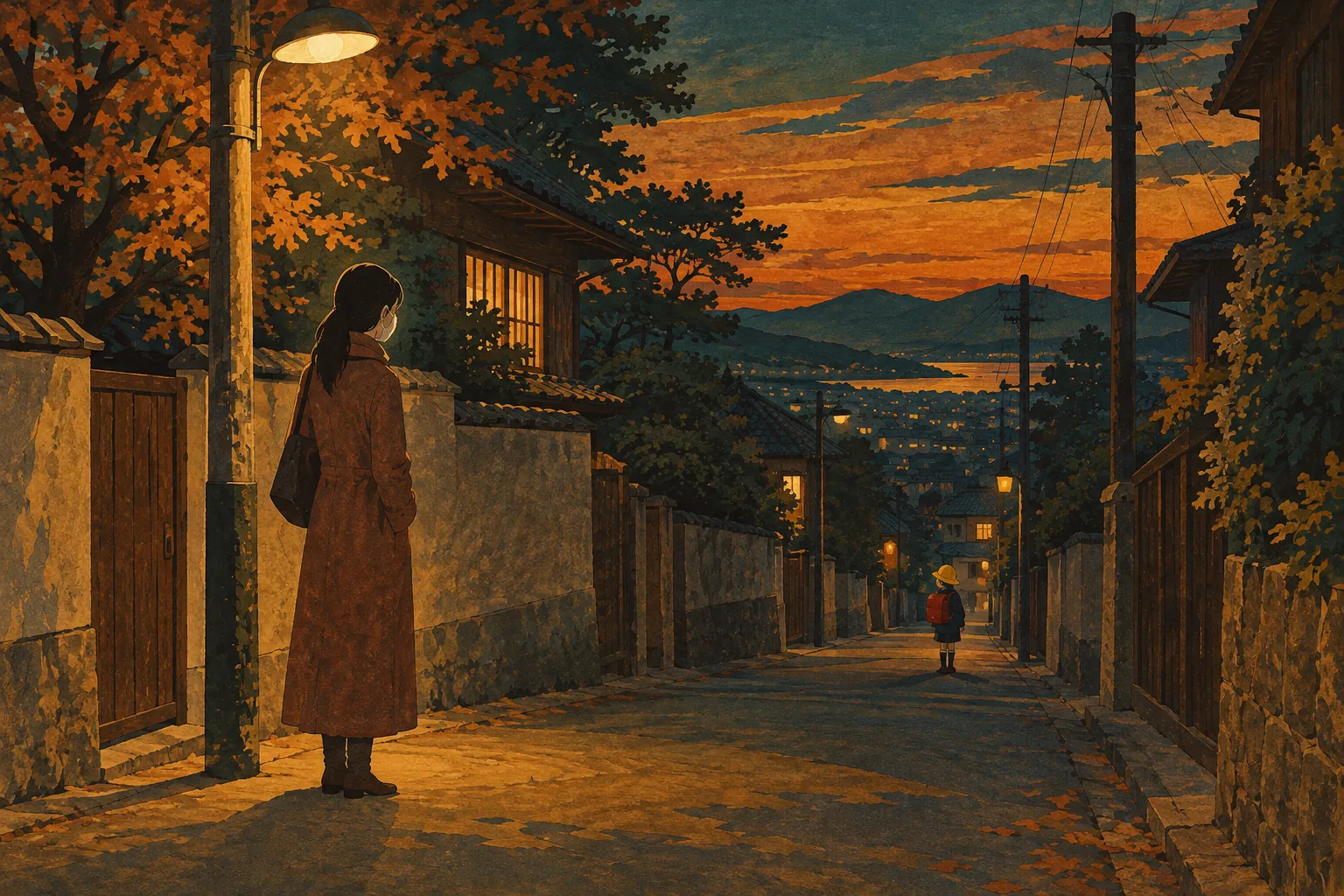
The core tale is short. A child walks home alone at dusk, and a tall woman in a long coat and a white mask steps into the road.
She asks, “Am I pretty?” The child has to answer.
If the child says no, the stories say she becomes angry. If the child says yes, she removes the mask to show a mouth cut wide from ear to ear, and asks again, “Even now?”
That second question is the trap. Almost every version is built so that neither honest answer is safe.
The legend also comes with a set of escapes, and these are the part children loved to share. The best known is to say the word “pomade” (ポマード) three times, because she supposedly cannot stand it.
Another is to throw down hard candy, the amber kind called bekko-ame (べっこう飴), so that she stops to pick it up. A third is to answer “so-so” (まあまあ), which confuses her because it is neither yes nor no.
Warnings usually add that she is impossibly fast, so running does not help. The tale never needs to describe any harm in detail, and it works better when it does not.
The 1979 outbreak
The rumour is reported to have taken hold around the Gifu area in the winter of 1978 to 1979. By the spring of 1979 it was being told in many prefectures.
Newspapers and weekly magazines took it up, and the coverage described schools telling children to walk home in groups and parents collecting their children. Police were reported to have received calls and to have stepped up patrols.
No woman matching the description was ever identified. What the reports actually record is the reaction, not the monster.
The panic faded over the following months, as rumour waves usually do. The legend itself did not disappear, and she kept returning in children’s talk, books, manga and later films.
Why did it spread so quickly? The story is short, easy to repeat and ends on a question that a listener can imagine being asked.
It also arrives with a set of rules, so children could feel they knew how to survive it.
Media attention matters as well. Once adults began taking precautions, the precautions themselves seemed to prove that the rumour was real, and each new report fed the next.
Where the story comes from
Unlike the gods of the Kojiki or the heroes of Homer, Kuchisake-onna has no ancient text behind her. The source is a period of print: the newspaper and weekly magazine reports of 1979, together with the rumour as children told it.
Many retellings place her origin in the Edo period. In the most common version she is the wife or lover of a samurai, cut by a jealous husband, and she returns as a ghost.
That older setting is part of how the story is told today. The documented outbreak is the one from 1979, and we should keep the two apart.
Other origin stories are more modern. In one, a surgeon makes a terrible mistake in a hospital.
In another, she is simply a woman who was attacked. The explanation changes from teller to teller, which is typical of an urban legend.
Her mask is a useful detail. Surgical masks were already an ordinary sight in Japan, so a woman in a mask looked normal enough to meet on the street, and that is what makes the reveal frightening.
Variants
The legend is a family of stories, not one text. The question is usually “Am I pretty?”, but some tellers use slightly different words.
The defence also varies. Pomade, candy and “so-so” are the best-known, and in some places a different object or a different phrase takes their place.
Her appearance changes too. She may carry scissors, a sickle or a blade in some versions, and carry nothing in others.
Some versions have her in a red coat, some in a trench coat, some with a scarf over her face instead of a mask.
Modern urban legends in Japan, such as the toilet ghost Hanako-san and the half-bodied woman Teke Teke, work in similar ways. Each has a simple rule, a place children know, and a hint of how to get away.
What it means
One reading is that the legend is about strangers and how to meet them. A child alone at dusk, an adult who asks for a judgement, and a question with no safe answer: the tale turns a vague adult worry into a clear scene.
Another reading is about appearance. The story is built around the word “pretty” and a face that is hidden and then shown, so it speaks to how people are judged by how they look.
A third reading is about rumour itself. The 1979 wave shows how a story can spread from child to child and then be amplified by the press, police and parents.
The fact that she can be beaten with a word or a sweet matters too. The legend gives children a small amount of power, which may be why it was so fun to tell.
None of this makes the legend “true history”. It is better understood as a story people made together, and the 1979 reports show how seriously communities treated it.
Common misconceptions
She is an ancient yokai from the old chronicles. No. She is a modern legend whose best-documented appearance is in 1979, even though many retellings give her an Edo-period background.
A real woman was caught. The reports describe the rumour and the reaction to it.
They do not record a real woman matching the legend.
The pomade answer is the one correct rule. It is one variant among several, and the escapes differ by region and by teller.
The legend ended in 1979. The wave faded, but the character stayed in children’s stories, books, manga and films.
Read next
Japanese mythology and the Kojiki explains the ancient texts, so you can compare a written myth with a modern rumour.
Yokai explained: Japan’s spirits and monsters covers the wider world of Japanese creatures that the slit-mouthed woman is often grouped with.
Tengu: the mountain goblins shows an older creature of folk belief with a long written history.