In five minutes
The Seven Lucky Gods (Shichifukujin, 七福神) are seven deities of fortune that Japan shows together on New Year pictures, shop signs and shrine banners.
Only one of them, Ebisu, is Japanese by origin. Three came from India through Buddhism, and three came from China.
Between them they cover what ordinary people hoped for in the Edo period (1603–1868): a good catch, a full rice store, protection, art and skill, a long life and a cheerful mind.
This page belongs to our guide to Japanese mythology and the Kojiki. The group itself is a later folk-belief creation, not a story from the Kojiki, but two of its members can be traced back to that book.
The story: seven gods on one ship
There is no single founding tale of the seven, as there is for Amaterasu or Izanagi. The group grew out of popular belief, temple custom and a good deal of picture-making.
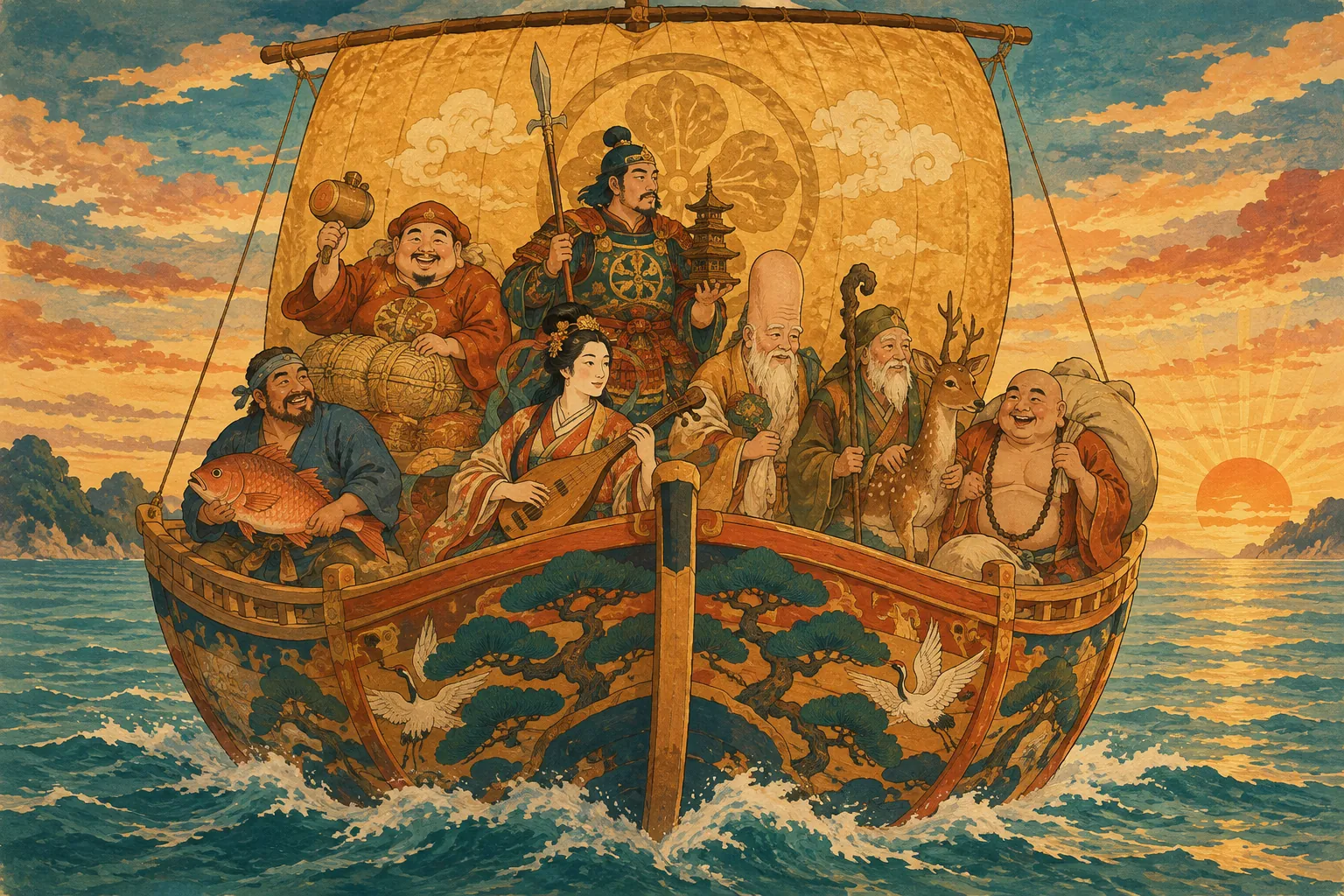
The best-known image is the takarabune, the treasure ship. The seven sit aboard a ship loaded with treasure, sailing into harbour on New Year's Day.
Here is each god in turn, with where he or she comes from.
Ebisu: the fisherman (Japan)
Ebisu carries a fishing rod and a sea bream, and he is the god of fishing, trade and the prosperity of merchants.
He is the only native Japanese god of the seven. Many traditions identify him with Hiruko, the first child of Izanagi and Izanami in the Kojiki, who was born weak and set adrift in a reed boat.
That identification is a later one, and shrines tell it in different ways. In some places Ebisu is instead linked with another deity, Kotoshironushi.
Daikokuten: the rice and wealth god (India, merged with Japan)
Daikokuten holds a small mallet and stands on bales of rice. He is the god of the kitchen, farming and wealth.
His roots lie in the Indian Buddhist deity Mahakala, a fierce guardian. In Japan he became a smiling figure, partly because his name, written 大黒, is read the same way as the name of Ōkuninushi (大国), the kindly earth deity of the Kojiki.
The two were blended, and the result is the friendly Daikoku of New Year cards.
Bishamonten: the armoured guardian (India)
Bishamonten wears armour and carries a spear and a small pagoda. He comes from Vaishravana, the guardian of the north among the Four Heavenly Kings of Buddhism.
He is the only warrior of the group, and he stands for protection from misfortune and the dignity of a good leader.
Benzaiten: the goddess of music and water (India)
Benzaiten plays a biwa, a Japanese lute, and is the only woman in most versions of the group. She comes from Sarasvati, the Indian goddess of rivers, speech and music.
In Japan she became the patron of music, the arts and learning. She is also linked to wealth, and her shrines often stand beside water, on islands or by ponds.
Fukurokuju: the long-headed sage (China)
Fukurokuju has a very tall forehead, a staff and often a crane. He comes from Chinese Taoist belief and is tied to the Southern Pole Star, which was thought to rule the span of human life.
His name joins the ideas of happiness, wealth and long life.
Jurōjin: the old man of long life (China)
Jurōjin is an elderly sage with a staff, a deer and sometimes a peach. He is another Chinese god of long life and is also tied to the Southern Pole Star.
He is so close to Fukurokuju that old pictures sometimes mix them up. In some lists a seventh god, Kichijōten, takes the place of one of them.
Hotei: the laughing monk (China)
Hotei is a round-bellied man with a big cloth sack and a wide smile. He is based on Budai, a Chinese Chan Buddhist monk remembered for his cheerfulness and generosity.
He is the god of contentment and good humour, and the sack is said to hold treasures and the hopes of children.
Where the story comes from
The source here is not one book but Edo-period popular belief and temple tradition. Printed pictures, fortune sheets and guidebooks of the 1600s and 1700s carried the group to ordinary households.
Two older works still matter. The Kojiki (712), Japan's oldest surviving chronicle, tells of Hiruko and of Ōkuninushi, the figures later linked to Ebisu and Daikokuten.
The Buddhist Ninnō Sutra, which spoke of the seven misfortunes vanishing and the seven fortunes arising, is often said to have helped fix the number seven. That is a popular explanation, not a documented founding event.
Groups of seven lucky gods appear in Japan by the Muromachi period (15th century). A well-known story credits the monk Tenkai, an adviser to the early Tokugawa shoguns, with listing seven virtues that the seven gods represent: long life, fortune, popularity, candour, amiability, dignity and generosity.
That story is traditional and attractive, but treat it as lore, not a proven record.
Visiting the seven: the pilgrimage
In Japan today the Seven Lucky Gods are best known through the Shichifukujin meguri, a walk that visits seven temples and shrines, each enshrining one of the gods.
It is traditionally done in the first days of the New Year, though many routes are walked at other times too.
Visitors usually collect a stamp or a small signed mark at each place, often on a special board or sheet sold for the purpose. Finishing all seven is said to bring a year of good fortune.
The custom was already established in Edo by the early 1800s, and several routes are still known today, including the Yanaka area in Tokyo and the Sumida River course.
Many other cities and regions have their own courses. Because routes, stamp customs and opening times differ by place and can change, check the local temple or tourist office before you go.
Another New Year custom is to put a picture of the treasure ship under the pillow on the night of 2 January, in hope of a lucky first dream of the year.
What it means
The seven are a portrait of how Japanese religion actually worked in daily life. People did not choose between Shinto, Buddhism and Chinese belief: they took helpful figures from all three.
That mix is the point. A merchant could pray to Ebisu, a samurai household to Bishamonten, a musician to Benzaiten, and an elder to Jurōjin, all within one picture.
It also reflects the Edo-period world of trade and city life. The wishes are practical and cheerful: money, food, health, skill, and enough laughter to enjoy them.
Many people today treat the gods lightly, as charming New Year symbols, while others keep serious devotion at particular shrines. Both are part of the living tradition.
Common misconceptions
"All seven are Japanese gods." Only Ebisu is Japanese in origin.
The rest came from India and China and were adopted over many centuries.
"The lineup is fixed." Kichijōten sometimes replaces Jurōjin or Fukurokuju, and some lists differ in detail.
The standard list given here is the most familiar one.
"Hotei is the Buddha." The laughing figure is a monk, Budai, and not Siddhartha Gautama.
"They appear in the Kojiki as a group." They do not.
Only the figures later tied to Ebisu and Daikokuten have roots there.
"Bringing luck means a guarantee." The tradition treats them as helpers and symbols of hope, not as promises.
Read next
Japanese mythology and the Kojiki explains the creation myths, the gods Izanagi and Izanami, and the book that tells of Hiruko and Ōkuninushi.
Yokai explained: Japan's spirits and monsters shows the stranger side of Japanese folk belief, from mischievous spirits to haunted objects.