In five minutes
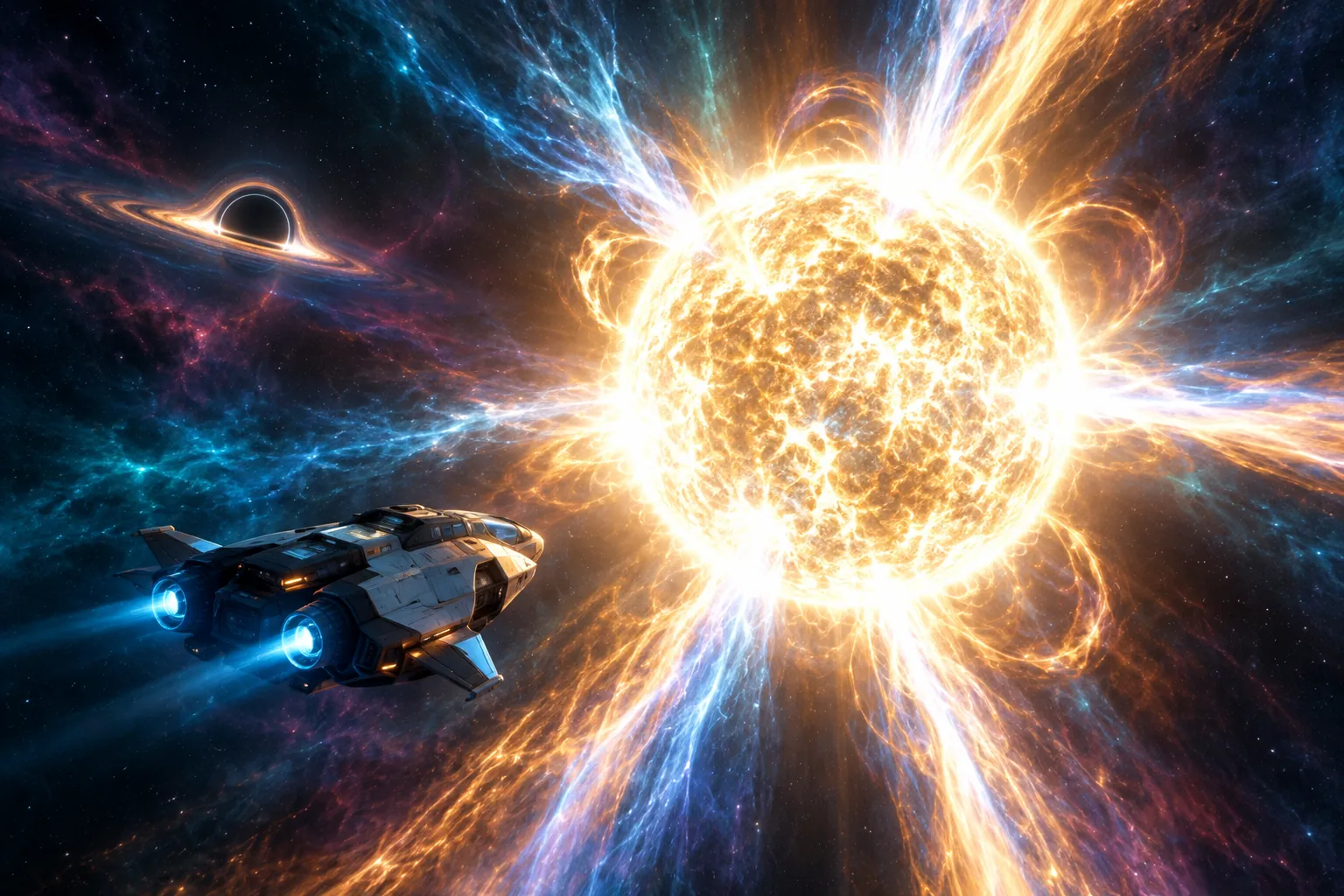
A white hole is the mirror image of a black hole. A black hole lets things fall in and never lets them out, while a white hole lets things out and never lets anything in.
It is a real solution of Einstein's general relativity, which makes it more than a daydream. But nobody has ever seen one, and there is no known way for nature to build one.
The short version is this: the equations allow white holes, the physics around them looks shaky, and a few researchers think they might still matter in quantum gravity. If you also want the sister idea, our page on the wormhole covers the tunnel that a white hole is often imagined to open into.
This page is part of our History of Science Fiction topic, which follows how scientific ideas turn into stories.
What a white hole is
Start with the black hole. Its edge, the event horizon, is a one-way door: anything that crosses it can only move inward.
Now run the film backwards. In the reversed film, the door only lets things move outward, and nothing from outside can ever cross it.
That reversed object is the white hole. Matter and light emerge from it, but a spaceship aimed at it would never reach the inside, because the horizon pushes everything away.
Like a black hole, a white hole would have a mass and would bend space around it. From far away its gravity would pull on you just as a black hole's does.
The odd part is only the horizon. It behaves like a door that you can watch things leave through but can never walk into.
A rough picture helps here. Think of a black hole as a waterfall that no boat can climb back up, and a white hole as a spring that keeps pushing water out while no boat can ever swim down into it.
Like every analogy, this one breaks down at the edges. It is only meant to give your mind a place to start.
Where the idea comes from
Einstein published general relativity in 1915, and Karl Schwarzschild found the first exact solution for a non-rotating mass in 1916. That solution describes the space around a star, and it also contains the black-hole geometry.
In 1935 Einstein and Nathan Rosen noticed that the same mathematics seemed to connect two regions of space through a narrow neck, now called the Einstein-Rosen bridge. This is the root of the wormhole idea.
In 1960 Martin Kruskal and George Szekeres, working separately, showed how to describe the full Schwarzschild geometry without the coordinate trouble at the horizon. Their maps revealed four regions: a black hole, a white hole and two outside universes.
The white-hole region was simply the part of the map in which time runs the other way. In 1964 the Soviet physicist Igor Novikov discussed a related idea, in which part of an expanding universe might lag behind and burst out later.
So the white hole did not arrive as a prediction of a new force or particle. It arrived as the second half of a mathematical picture.
The real science
Here is what is established: general relativity allows the white-hole solution, and its equations treat time in both directions equally. Here is what is not: no observation shows a white hole, and no known process forms one.
A real black hole forms when a massive star collapses. A white hole would need to exist from the start, since there is no collapse to make it.
The solution used in the maps describes an eternal, empty black hole, which is not what astronomers see. Real black holes formed at a particular time from matter, so the white-hole half of the diagram never appears in them.
There is a second problem, studied in the 1970s by Douglas Eardley and others. A white hole would be unstable, because any matter or radiation falling toward it would pile up at its horizon and could turn it into a black hole.
There is also a problem of timing. Physics at small scales is mostly time-symmetric, but large objects follow the arrow of time, with entropy increasing.
A white hole spitting out matter in an orderly way sits badly with that arrow.
Still, the idea has not been dropped. In 2014 Hal Haggard and Carlo Rovelli proposed that quantum gravity could turn a collapsing black hole into a white hole after a very long time, as seen from far away.
That is a proposal in loop quantum gravity, not a measured result. It is a thought about what might happen inside a black hole, and nobody has a way to test it yet.
Some researchers have also asked whether the tiny, long-lived remnants of such a process could account for dark matter. That too is speculation, and it should be read as a question rather than an answer.
Why the question still matters
Even a doubtful idea can be useful. White holes push physicists to ask what really happens to the matter and information that fall into a black hole.
In 1974 Stephen Hawking showed that black holes slowly lose energy as radiation. If a black hole can shrink over time, something has to happen at the end of that process.
A bounce into a white-hole-like state is one candidate for that ending. Other candidates exist, and none of them has won.
That is why the white hole is best treated as a live question rather than a settled answer. It sits at the border between what we can calculate and what we can only guess.
It helps to keep three claims apart: the mathematics allows it, nature may not make it, and a quantum-gravity story might still bring it back. Each claim has a different level of support.
Where it shows up in fiction
Writers like white holes because they solve a storytelling problem. A wormhole needs an entrance and an exit, and the black hole is the entrance, so a white hole is the exit.
Wormhole stories are the natural home for the idea, since the one-way door fits a genre that loves points of no return. The film Interstellar (2014), for example, sends its crew through a wormhole and to a black hole, though a white hole is not part of its plot.
That example shows how loosely stories follow the mathematics. A fictional gate rarely behaves like the strictly one-way surface that the equations describe.
To read next, start with the concept that nearly always comes first. Our page on the wormhole explains how stories make a tunnel from the same mathematics.
Common misconceptions
"White holes have been found." They have not.
Occasionally a bright burst of light is described in the press, or in a research paper, as a possible white hole, but mainstream astronomy has found no event that needs a white hole to explain it.
"A white hole is just a black hole seen from the other side." Not quite.
In the standard maps, the two are different regions, and a real black hole formed from a star has no white-hole region.
"The Big Bang was a white hole." The Big Bang resembles a time-reversed collapse in one way, but it is not an object in a pre-existing space.
Mainstream cosmology does not describe it as a white hole.
"You could fly into one." The horizon is the whole point: everything moves outward, so nothing from outside can cross it.
"Wormholes need white holes." The popular picture does, but physicists have written wormhole solutions without any horizon at all.
Read next
- Wormhole: the tunnel that a white hole is usually pictured as the exit of.
- History of Science Fiction: how ideas like this one moved from physics into stories.