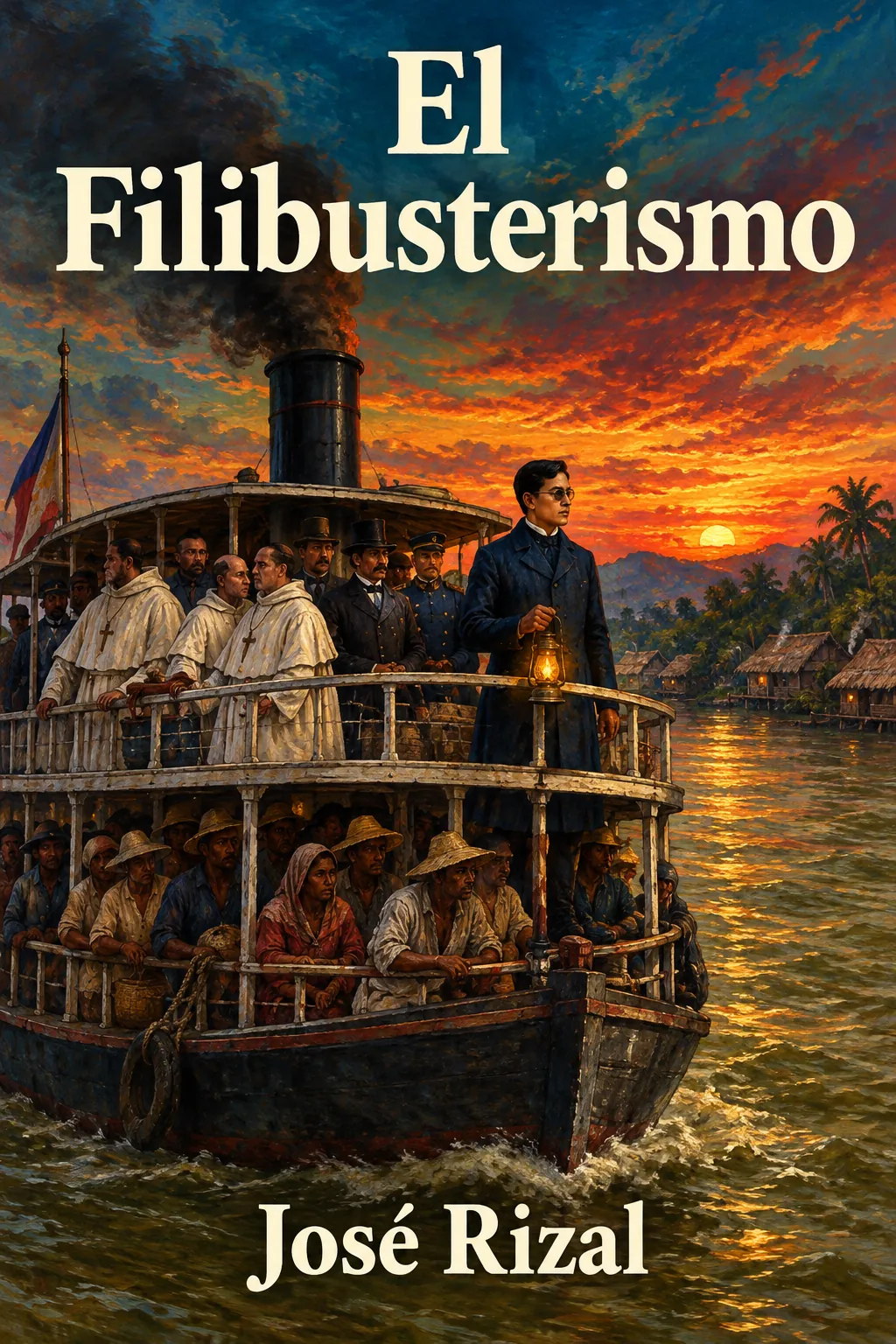
El Filibusterismo
by José Rizal
El Filibusterismo (1891) is José Rizal's sequel to Noli Me Tangere. A wealthy jeweler called Simoun returns to the Philippines and becomes an adviser to the Captain-General, but he hides a secret identity and a plan for revenge. Around him, farmers, students and officials show how land grabs, rote schooling and corrupt rule wear people down. As the date of a grand wedding feast approaches, the novel asks what price a nation should pay for change, and who has the right to decide.
The Big Idea
"Thirteen years after Noli Me Tangere, a rich jeweler named Simoun plots revenge on a corrupt colony, while the novel asks whether violence can deliver justice or whether freedom must be earned through character."
Key Insights
Injustice is built into the system
Rizal shows that abuse does not come only from bad individuals. It is carried by rents, courts, schools and customs that favour the powerful, so the farmer, the student and the servant all lose. Each institution looks respectable on its own, yet together they close every honest exit, which is why decent people drift toward anger or despair.
Kabesang Tales develops his farm by his own labour, but the friars' estate raises the rent and then claims the land, and the courts and officials side with the owners. His daughter Juli then has to sell her freedom as a servant to pay for his release.
Violence cannot be the answer to violence
Simoun wants the colony to become worse so that people will rise. The book shows that this plan makes more victims and makes the avenger resemble the oppressor, and Rizal treats this as a moral failure. Even readers who understand Simoun's pain are asked to see that a just goal does not excuse any method.
Simoun's explosive lamp at the wedding feast would kill innocent guests along with the powerful, and it is stopped when Isagani, warned by Basilio, throws it into the river in an act of conscience.
Education must teach thinking
Rizal argues that schools which reward memory and obedience produce discouraged students, not free citizens. A nation needs learners who can question and judge, and a school that punishes questions teaches people to accept what they are told, including injustice.
Plácido Penitente leaves school because his class is a routine of recitation. The students' petition for a Spanish academy is delayed and then, by Don Custodio's ruling, handed to a religious order, so the students lose control of their own idea.
Freedom must be deserved
Padre Florentino says a people who are not ready for freedom may simply replace one tyranny with another. Real change needs character, sacrifice and just means as well as courage, and it cannot be handed over by a lucky stroke or a sudden uprising.
In the last chapter, Florentino tells the dying Simoun that justice cannot be won by hatred. He then lets the sea take Simoun's jewels so that they cannot be used for harm, leaving the future to people who earn it.
Chapter Breakdown
Chapter-by-chapter summary (Buod ng bawat kabanata)
Spoiler warning: this section covers the whole plot, including the ending.
The novel has 38 kabanata. They are grouped here into nine parts so that the story is easier to follow.
Part 1: Kabanata 1–3, The Steamer Tabo
The crowded steamer Tabo crawls along the Pasig River and Laguna de Bay toward Laguna. On the upper deck, friars, officials and wealthy passengers argue about how to speed up the river trip, while ordinary travelers sit below.
The jeweler Simoun, always in dark glasses, stands on the upper deck near the powerful, and the thoughtful retired priest Padre Florentino is among the travelers. The talk goes nowhere, which shows from the first pages how much talk and how little action the people at the top produce.
Part 2: Kabanata 4–6, Kabesang Tales and Basilio
Kabesang Tales turns wild land into a good farm, but the friars' estate claims it and keeps raising the rent. He fights in court and loses, and Simoun visits him, takes Maria Clara's locket and leaves a revolver in exchange.
Basilio, now a medical student, goes home to San Diego for the holidays to see Juli, Tales's daughter, whom he hopes to marry. This part matters because it ties the injustice of land to the lives of the young characters we will follow.
Part 3: Kabanata 7–10, Simoun Revealed
In a forest near his mother's grave, Basilio meets Simoun in Kabanata 7 and learns that he is Crisostomo Ibarra, who is still alive. Simoun explains his plan for a revolt and invites Basilio to join, but Basilio prefers to finish his studies.
In the village, Kabesang Tales takes to the hills as an outlaw, and Juli must serve a wealthy pious woman to repay the ransom. The village gossip shows how the "respectable" often look away from suffering.
Part 4: Kabanata 11–14, Los Baños and the Students
The Captain-General holidays at Los Baños (Kabanata 11), where Plácido Penitente is a clever but unhappy student. In the physics class (Kabanata 13), the teacher rewards memorising and obedience instead of understanding, and Plácido walks away from his studies.
In the house of the students (Kabanata 14), Isagani, Makaraig and their friends plan a petition for an academy that teaches Spanish. The novel uses the classroom to show that colonial schooling does not build thinking citizens.
Part 5: Kabanata 15–21, The Petition and Don Custodio
The petition travels through offices and drawing rooms, starting with the lawyer Señor Pasta (Kabanata 15), where friars and officials care more about their own standing than about the cause. Gossip among merchants, journalists and clergy turns the matter into a game of pride.
In Kabanata 20, Don Custodio, the official who must decide, approves the academy but places it under a religious order, probably the Dominicans of Santo Tomás. The students learn this a little later and feel it is a hollow result, because the friars now control their own idea, and this is where Simoun's arguments start to sound convincing to them.
Part 6: Kabanata 22–26, The Theatre and the Posters
An evening at the theatre (Kabanata 22) shows Manila's elite laughing and flirting, while Isagani watches Paulita Gómez, whom he loves. Their relationship, like the country, is quietly failing.
Then threatening posters appear overnight in public places (Kabanata 26). They raise fear and give the authorities an excuse to arrest the students.
Part 7: Kabanata 27–32, Panic and Arrests
In Kabanata 27, Padre Fernandez and Isagani debate whether the Filipino can ever be heard under the present order. Manila panics about the posters (Kabanata 28), and officials look for someone to blame.
Basilio is arrested although he had nothing to do with the posters. Juli, desperate to help him, goes to Padre Camorra and jumps from a window rather than be harmed (Kabanata 30), and her death shows the system's cruelty at its sharpest.
Part 8: Kabanata 33–35, The Plan and the Feast
Simoun gets Basilio released and invites him again to join the uprising, and this time Basilio is bitter enough to consider it. Simoun prepares a lamp filled with explosive, to be placed at the wedding feast of Paulita and Juanito Pelaez, where the colony's rulers will gather.
At the feast (Kabanata 35), Basilio warns Isagani of the danger. Isagani bursts in, seizes the lamp, throws it out of the window into the river and escapes unrecognised.
The wedding is also the end of Isagani's hopes, so the political plot and the love story meet in a single room.
Part 9: Kabanata 36–38, The Aftermath and the Ending
In Kabanata 36 and 37 the guests, officials and the journalist Ben-Zayb are left puzzled by what happened, and rumours of gunpowder and conspiracy spread through Manila. Isagani's act has saved many lives and ended the plot.
Simoun escapes, wounded and defeated, and reaches Padre Florentino's seaside home (Kabanata 38).
Simoun takes poison, confesses his past, and talks with the priest about why his plan failed. Florentino says freedom must come through justice and sacrifice, then throws Simoun's jewels into the sea, leaving the future to those who deserve it.
Characters (Mga Tauhan)
- Simoun: A rich jeweler who is really Ibarra from Noli Me Tangere. He plans a bloody revolt.
- Basilio: A diligent medical student whose family was destroyed in the first book. He wants a quiet life but is dragged into the plot.
- Isagani: A poet and student leader with a strong conscience. His love for Paulita and his honour pull him in different directions.
- Padre Florentino: A kind and thoughtful retired priest. He gives the book's last moral judgement.
- Kabesang Tales: A farmer who loses his land to the friars' estate and becomes an outlaw.
- Juli: Tales's daughter and Basilio's sweetheart, who sacrifices herself for her family.
- Plácido Penitente: A talented student who leaves school after unfair treatment.
- Don Custodio and Ben-Zayb: A self-important official and a vain journalist who show the shallow side of power.
Writing about this book (Pagsulat ng Reaksyon o Repleksyon)
DepEd tasks on El Filibusterismo usually ask for a character analysis, a theme and aral essay, a reaction or reflection paper, or a compare-and-contrast. Start with a clear claim, such as "Simoun's failure shows that revenge cannot create justice."
Then support the claim with one specific scene for each point, such as Kabesang Tales losing his land or Isagani throwing the lamp into the river. Keep quotations short, and add your own comment after each piece of evidence to explain why it matters.
For a reflection, connect the book to your own life: where do you see fairness or unfairness at school or in the community? Say what you would do differently, and give a lesson (aral) that you believe in.
Compare characters by using the same points for each of them, such as goals, methods and results. The model essays below show three levels, and you should use them to compare with your own work, not copy.
Take Action
Practical steps you can implement today:
-
Look for the system behind an injustice, not only the person who does the harm.
-
Judge a cause by its methods as well as its goals.
-
Use education, honest speech and community action when you want change.
-
Treat love, friendship and conscience as real forces in your decisions.
Notable Quotes
"Why independence, if the slaves of today will be the tyrants of tomorrow? (Padre Florentino, Derbyshire translation, "Conclusion"; Kabanata 38 in the usual numbering)"
— José Rizal
"You have believed that what crime and iniquity have defiled and deformed, another crime and another iniquity can purify and redeem. (Padre Florentino, Derbyshire translation, "Conclusion"; Kabanata 38 in the usual numbering)"
— José Rizal
Who Should Read This
This guide suits Grade 9 and 10 students in the Philippines who are studying El Filibusterismo for DepEd English or Filipino class, as well as senior high school and college readers. It also helps anyone who wants a clear summary, character guide and essay models before reading the full novel.
Characters
Simoun
protagonist and antagonist
A wealthy jeweler who advises the Captain-General, Simoun is really Crisostomo Ibarra in disguise. He wants to cause a revolution through violence, and his plan fails because it rests on hatred and harm to the innocent.
Basilio
foil to Simoun
A hard-working medical student and the son of Sisa from Noli Me Tangere. He wants to live peacefully, but he is arrested unjustly and is nearly drawn into Simoun's plot.
Isagani
idealist
A poet and student leader who believes in honest reform. His conscience makes him throw the explosive lamp into the river, and he loses Paulita in the same hour.
Padre Florentino
moral voice
A retired priest who is kind, learned and honest. In the final chapter he gives Simoun and the reader the book's judgement about freedom, sacrifice and justice.
Kabesang Tales
victim of injustice
A farmer who clears land and then loses it to the friars' estate. After the courts fail him, he becomes an outlaw, which shows what unjust rule can do to an honest man.
Juli
tragic figure
Tales's daughter and Basilio's sweetheart. She works as a servant to free her father, and her death after turning to Padre Camorra is one of the novel's most painful moments.
Tandang Selo
elder
Kabesang Tales's father and Juli's grandfather, an old hunter and broom-maker in San Diego. He counsels patience toward the friars, and he falls silent after Juli sells herself into service, standing for the older generation who suffer without a voice.
Plácido Penitente
symbol of wasted talent
A bright student from Batangas who becomes disgusted with a school based on memory and obedience. He leaves his studies, which shows what the system costs the country.
Paulita Gómez
love interest
A beautiful and practical young woman who is loved by Isagani but chooses to marry the wealthier Juanito Pelaez. Her choice links the love story to the final crisis at the wedding feast.
Don Custodio
corrupt official
A self-important Spanish official who rules on public matters mainly to protect his reputation. He stands for lazy, self-serving government.
Padre Camorra
abusive friar
A friar who uses his position to pursue women and frighten the poor. His treatment of Juli makes him one of the novel's clearest examples of abuse of power.
Exam practice: sample answers
Model answers are examples to learn from; write your own in your words.
character analysis
1. Character analysis: How does Rizal present Simoun in El Filibusterismo, and what does his story suggest about revenge and justice?
Outline
- State your view of Simoun in one sentence.
- Explain his double identity and what changed him.
- Give two or three examples of his methods and their results.
- Contrast him with another character, such as Basilio, Isagani or Florentino.
- End with the lesson that Rizal wants the reader to take.
Basic Model answer
Simoun is the main character of El Filibusterismo. He is a rich jeweler who is secretly Crisostomo Ibarra from Noli Me Tangere, and many people think he is a foreign businessman who advises the Captain-General.
Simoun wants revenge. He suffered in the first book, so he wants to start a revolution against the Spanish government.
He sells jewels to make friends in high places, and he secretly plans to blow up a wedding feast.
Rizal shows that Simoun is not completely good or bad. He loves Maria Clara and he is angry about injustice, but his plan can hurt innocent people.
In the end his plan fails, and he dies in the house of Padre Florentino.
In conclusion, Simoun teaches us that revenge is not the answer. It is important to fight injustice in a good way.
Good Model answer
In El Filibusterismo, Rizal presents Simoun as a man whose pain has turned into a plan, and the novel uses him to question whether violent revenge can ever free a nation. Simoun is both a victim of the system and a person who spreads its worst habits.
First, Rizal makes Simoun's anger understandable. He is Crisostomo Ibarra, who lost his home, his name and his future in Noli Me Tangere, and thirteen years later he returns as a rich jeweler with the ear of the Captain-General.
He uses that trust to make the government more abusive, because he believes harsher rule will push the people to rise.
Second, the novel shows that this plan feeds on suffering. Kabesang Tales loses his land to the friars' estate, and Juli's death shows how ordinary families pay for the system Simoun wants to destroy.
Yet Simoun's strategy needs more of this suffering, so he becomes part of the problem he hates.
Third, Simoun's weakness is that he trusts money and force more than people. He arms a desperate farmer with a revolver and plans to hide an explosive lamp at a wedding feast, where it would kill guests who have done nothing.
Rizal marks this as a moral failure as well as a practical one.
Fourth, Rizal sharpens the picture by placing Simoun beside other young and old men. Basilio wants to heal and study quietly, Isagani trusts honest argument, and Padre Florentino believes that freedom must be deserved.
Each of them rejects Simoun's method in a different way, and the contrast makes the weakness of the plan easy to see. At the end Simoun confesses to Florentino and dies, and the priest does not praise the revenge, although he understands the pain behind it.
In conclusion, Simoun is a tragic warning, not a hero to copy. Rizal respects his anger but argues that a cause built on hatred and secret violence cannot produce a free and fair society.
Excellent Model answer
Rizal's Simoun is best read as a study in how righteous anger can harden into the very tyranny it opposes. Through his double identity, his use of wealth and his final confession, the novel argues that revenge without a moral foundation cannot redeem a nation.
Simoun's double identity carries the book's first argument. Readers of Noli Me Tangere remember Crisostomo Ibarra as an idealist who wanted schools and patient reform, and who was destroyed by friars and false charges.
When he returns as Simoun, with dark glasses and a sharp tongue, Rizal shows what the colonial order does to a reformer: it does not only punish him, it changes him. The new name is a mask, but it also marks the death of the old hope.
Simoun's methods show the cost of that change. He becomes rich and therefore useful to the Captain-General, and he advises him towards harsher policies so that people will have no choice but to revolt.
Rizal places this beside concrete suffering: Kabesang Tales loses his farm to the friar estate and takes to the hills, and Juli sells her freedom as a servant to rescue him. Simoun speeds up exactly the kind of misery that these characters endure, and the more he promotes corruption in order to end it, the more he resembles the officials he despises.
Rizal also deepens Simoun by contrast. Basilio wants to heal people and study quietly, Isagani trusts in honest argument and reform, and Padre Florentino represents an older moral courage.
Simoun's offer to Basilio to join his plot is therefore a test of the novel's options, and Basilio's arrest, though he did nothing, shows that neutrality is not safe either. By placing Simoun among these men, Rizal asks which route to change is both effective and decent.
The climax answers that question. Simoun hides an explosive lamp in the wedding feast, a plan that would kill innocent guests and officials alike, and it fails when Basilio warns Isagani and Isagani throws the lamp out of the window into the river.
The irony is that the plot is stopped not by the Spanish authorities but by a young man's act of conscience. Simoun's defeat is therefore moral before it is political.
After the failed plot Simoun flees, wounded, to Padre Florentino and takes poison. There he hears the priest ask, "Why independence, if the slaves of today will be the tyrants of tomorrow?"
(Derbyshire translation, "Conclusion"), and the question applies directly to him.
Florentino adds that Simoun believed one crime could be purified by another, and his death gives the reader the novel's judgement: anger is valid, but a cause that borrows the tools of its oppressor will reproduce the oppressor.
In conclusion, Simoun is Rizal's most pointed critique of revolutionary revenge. He is sympathetic, intelligent and tragically wrong, and his failure leaves the reader with the harder task that the book calls for: reforming a society through justice, education and character.
Marking rubric
- Clear thesis about Simoun's character and what the novel says about revenge
- Accurate use of plot events and the link to Noli Me Tangere
- Analysis of why each example matters, not only description
- Contrast with at least one other character at higher levels
- Organised paragraphs and a controlled conclusion
Now write your own
Now write your own answer in 250 to 400 words. Choose a different scene from the ones above and decide whether you would defend or criticise Simoun's choice, then support your view with two pieces of evidence.
theme and aral essay
2. Theme and aral: Explain how El Filibusterismo presents the theme of social injustice, and state the aral that Filipino students can take from it today.
Outline
- Define the theme in one sentence.
- Give two or three examples from different parts of society.
- Explain what Rizal suggests about the solution.
- State the aral and connect it to life today.
Basic Model answer
One big theme in El Filibusterismo is social injustice. The poor and the powerless are treated unfairly by the government and the friars.
An example is Kabesang Tales. He is a hardworking farmer who clears land and makes it fertile, but the friars' estate raises the rent and finally takes the land.
When he tries to fight, he is punished instead, and his family is broken apart.
Another example is Juli, his daughter. She works as a servant to raise money to free her father, and later she asks Padre Camorra for help.
She jumps from a window rather than be harmed, and her story shows that the weak suffer most.
The aral of the novel is that we must not accept injustice. We should speak up, study hard and help others.
Today, young people can show this by being honest, by respecting the rights of others and by working for a fair community.
Good Model answer
Social injustice is the central theme of El Filibusterismo. Rizal shows that when power belongs to a few, ordinary people lose their land, their dignity and sometimes their lives, and that the harm spreads through a whole society.
The clearest example is Kabesang Tales. He turns forest into farmland through years of labour, but the friars' estate claims the land and keeps raising the rent.
When he protests, the courts and authorities side with the powerful, and he becomes an outlaw. Rizal wants readers to see that his anger comes from a lawful grievance that was ignored.
The injustice also touches the next generation. Juli sells her freedom as a servant to pay for her father's ransom, and in the end her desperate trip to Padre Camorra leads to her death.
Basilio, who is honest and studious, is arrested after the posters scandal even though he did nothing, which shows that the law protects the powerful more than the innocent. Plácido Penitente's story shows the same pattern in education, where rote learning and punishment push a capable student out of school.
At the top of society, Don Custodio and the journalist Ben-Zayb treat serious questions as chances to look clever. The students' petition for a Spanish academy is delayed, and when Don Custodio finally rules, the academy is handed to a religious order, so the students lose control of their own idea because officials care more about their standing than about the question.
Taken together, the farmer, the student and the ruler show that injustice is not one bad act but a habit shared by many institutions.
Rizal does not offer an easy cure. Simoun's solution of violence fails, and Padre Florentino's final speech suggests that freedom must be earned by character and sacrifice.
The aral for today's youth is that justice starts with small choices: telling the truth, refusing corrupt shortcuts and defending the weak. A student who copies a classmate's work, or who stays silent when someone is bullied, practises a small version of the same failure.
We should also remember that a good cause needs good means, so we use education, voting and community action to resist abuse.
Excellent Model answer
El Filibusterismo argues that injustice is a system, not a series of unlucky events, and that the response to it must be moral as well as political. Rizal builds the argument through three levels of society: the farmers, the students and the ruling class, and then through the question of what the young must do about it.
At the bottom, injustice takes land and family. Kabesang Tales develops his plot by his own labour, yet the friar estate raises the rent and then claims it, and the officials who should protect him side with the owners.
He is driven to the hills, and his daughter Juli sells her freedom as a servant to raise his ransom. Rizal shows that the system works through ordinary tools, such as a lease, a court order or a rule, which makes it harder to resist than open violence.
In the middle, injustice takes away the future of the young. The students' request for a Spanish academy is passed from office to office and then, by Don Custodio's ruling, handed to a religious order, so the students lose control of it, because officials care more about their reputation than about the question.
Plácido Penitente's classroom gives the same lesson on a smaller scale: his teacher values memory and obedience over understanding, and Plácido leaves school bitter and unfinished. The education system, like the land system, rewards submission.
At the top, injustice becomes comedy and cruelty at the same time. Friars, officials and the journalist Ben-Zayb are more concerned with their own comfort than with the country, and the wedding feast of Paulita and Juanito Pelaez shows a society dancing on the edge of disaster.
Their selfishness is why Simoun's rage can find an audience.
Rizal then refuses both easy answers. Simoun represents the violence of despair, and his failure shows that injustice cannot be ended by making more suffering.
Isagani represents idealism that is sincere but untested, and Padre Florentino points to a harder path: that freedom must be deserved, because a people unprepared for liberty may only swap one tyranny for another. His question, "Why independence, if the slaves of today will be the tyrants of tomorrow?"
(Derbyshire translation, "Conclusion"), makes character the real test of reform.
The comparison with Noli Me Tangere makes the point sharper. In the first novel Ibarra's school and his reforms are blocked by the friars, and in the sequel the friars again end up in control of the students' academy, which suggests that thirteen years have changed the faces but not the structure.
This continuity is Rizal's evidence that injustice is a system, and it explains why patient petitions lose their force and why Simoun's arguments begin to sound reasonable to tired young men. Rizal does not endorse that reasoning, but he lets the reader feel its pull.
The aral, then, is not only "do not be unjust" but "become the kind of person who can build a just community." For Filipino students today that means learning thoroughly, resisting corrupt shortcuts, protecting those who have less power and demanding fairness through peaceful, informed action.
In conclusion, Rizal shows that social injustice damages land, schools and character, and that the cure begins in the conscience of the citizen.
Marking rubric
- Theme defined and linked to a thesis
- Specific examples from more than one part of the novel
- Explanation of why each example proves the theme
- Aral that follows from the text and is relevant today
- Organised paragraphs, clear language and a controlled conclusion
Now write your own
Write your own theme and aral essay in about 300 words. Pick one scene we did not use above, such as the posters or the students' petition, and explain what injustice it shows and what aral you take from it.
compare and contrast
3. Compare and contrast: How are Basilio and Isagani alike and different in El Filibusterismo, and what does Rizal show through the contrast?
Outline
- Name the main similarity and the main difference.
- Compare their goals, personalities and choices.
- Explain what happens to each at the end.
- Say what the contrast shows about the novel's message.
Basic Model answer
Basilio and Isagani are two students in El Filibusterismo. They are friends, but they are different in many ways.
Basilio is serious and quiet. He studies medicine and wants to finish school and help his people through his career.
He had a hard life because of what happened to his family in Noli Me Tangere, so he is careful and does not like trouble.
Isagani is a poet. He is brave and emotional, and he speaks up for the students' request for a Spanish academy.
He is also in love with Paulita Gómez, and he follows his heart.
They are alike because both love their country and both are good students. They are different because Basilio is practical and careful, while Isagani is idealistic and passionate.
In the end Basilio suffers in prison, and Isagani saves many people at the wedding.
The lesson is that we need both thinking and feeling to help our country.
Good Model answer
Basilio and Isagani are both young, honest and patriotic, but Rizal gives them different temperaments to show two ways in which the young can respond to an unjust society. Basilio is careful and practical, while Isagani is passionate and idealistic.
Their similarities are clear. Both study in Manila, both care for the country, and neither wants to harm others.
Both are also let down by the colonial order: Basilio is arrested for no reason, and Isagani's petition for a Spanish academy is delayed and then handed to the friars.
The differences appear in their goals and methods. Basilio wants to finish medicine and live quietly, because his family's past has taught him to fear trouble.
Isagani speaks in public, writes poetry and argues openly with the friars, trusting that honest words can win a fair hearing.
Their relationship to Simoun also separates them. Simoun invites Basilio to join the plot, and Basilio, bitter after prison and Juli's death, comes close to saying yes.
Isagani never joins, although he has just as much reason for anger, because he cannot accept harm to innocent people.
Even their friendships show the contrast. Basilio keeps a small circle and avoids public arguments, while Isagani is popular among the students and speaks for them in the debate over the academy.
Each approach has a price: Basilio's caution leaves him alone when trouble arrives, and Isagani's openness makes him a target of the friars' anger.
Their endings also differ. Basilio loses Juli and is pushed towards Simoun's plan because the legal route has failed him.
Isagani loses Paulita, yet he chooses to throw the explosive lamp into the river instead of letting innocent people die, which is a decision made from conscience and not calculation.
Through this contrast Rizal suggests that caution alone cannot protect a person from an unfair system, and that idealism alone cannot change it. The country needs young people who combine careful thought with moral courage.
Excellent Model answer
Basilio and Isagani share the same age, school and love of country, but Rizal places them on opposite sides of a quiet debate: should a young Filipino keep his head down and build a career, or speak and act on principle? The contrast shows that neither pure caution nor pure idealism is enough, and that the novel's real hope lies in a union of knowledge and conscience.
Their similarities explain why the contrast matters. Both are bright students of Manila's colleges, both are sincere, and both are hurt by the same system.
Basilio is arrested during the posters scandal even though he had no part in it, and Isagani's petition for a Spanish academy is delayed in offices and then handed to the friars, so the students lose control of it. Rizal uses these parallels to show that injustice does not choose its victims by temperament.
Their characters, however, pull apart. Basilio is shaped by the tragedy of his family in Noli Me Tangere, and his answer is discipline: study medicine, avoid trouble, serve through a profession.
Isagani, by contrast, is a poet whose faith in honest argument leads him to debate the friars and to speak for his classmates. Where Basilio calculates, Isagani feels, and Rizal lets each trait be both a strength and a risk.
Their relationships with the women they love underline the same difference. Basilio's love for Juli is quiet and loyal, and her death turns his patience into bitterness.
Isagani's love for Paulita is romantic and public, and he loses her to the wealthier Juanito Pelaez on the day of the feast, so he faces the choice about the lamp while heartbroken. Rizal makes both young men pay personally, which prevents the contrast from becoming a simple lesson.
Their friendships follow the pattern: Basilio keeps a small circle and avoids public debate, whereas Isagani is the voice of the students in the dispute over the academy.
Each habit has a cost, since caution leaves Basilio alone when trouble arrives and openness makes Isagani a target. A reader who sees only one of the two young men misses half of Rizal's argument.
Both traits are tested by Simoun. Basilio's care becomes bitterness after Juli's death and his imprisonment, and he comes close to joining the plot because he sees no remaining lawful path.
Isagani's idealism is tested differently, because he learns of the danger from Basilio just when he has lost Paulita, and he could easily have let events take their course. Instead he bursts in, throws the explosive lamp out of the window into the river and escapes unrecognised, and his act of conscience stops the plot that Basilio's disappointment had nearly supported.
The contrast therefore carries the novel's argument. Basilio shows what happens when decency is not protected by justice, and Isagani shows what happens when conscience guides action even at personal cost.
Padre Florentino's closing question, "Why independence, if the slaves of today will be the tyrants of tomorrow?" (Derbyshire translation, "Conclusion"), suggests that the future depends on young people who have both the training of Basilio and the moral courage of Isagani.
In conclusion, Rizal does not choose one student over the other. He uses their differences to ask the reader to build a character that can think carefully and still act rightly when it matters.
Marking rubric
- Clear thesis about what the contrast shows
- Balanced treatment of both characters using the same criteria
- Accurate events as evidence, with comment on why they matter
- Link to the wider message of the novel at higher levels
- Clear structure with a concluding judgement
Now write your own
Choose another pair, such as Simoun and Padre Florentino, or Kabesang Tales and Don Custodio, and write your own compare-and-contrast essay of 250 to 350 words. Use the same points of comparison for both people.
Frequently Asked Questions
What is El Filibusterismo about?
It is José Rizal's 1891 novel about Simoun, a rich jeweler who plans revenge on the colonial government. Around him, farmers, students and officials show how injustice damages a whole society, and the story asks whether violence or moral reform can bring freedom.
Who are the main characters (tauhan) of El Filibusterismo?
The main characters are Simoun, Basilio, Isagani, Padre Florentino, Kabesang Tales, Juli, Plácido Penitente, Paulita Gómez, Don Custodio and Padre Camorra. Simoun is the central figure, and Basilio and Isagani represent two kinds of young Filipino.
How many kabanata does El Filibusterismo have?
The novel has 38 kabanata. Many teachers group them into parts, such as the voyage on the steamer, the story of Kabesang Tales, the student petition, the posters, the wedding feast and the ending.
What are the themes and aral of El Filibusterismo?
Main themes are social injustice, the failure of violent revenge, the role of education, love and sacrifice, and the need for moral character in a free society. The aral is that change should be built on justice, knowledge and conscience, not hatred.
How is El Filibusterismo related to Noli Me Tangere?
It is the sequel, set about thirteen years later. Crisostomo Ibarra seems to have died, but he returns as Simoun, and Basilio, who was a boy in the first book, is now a student.
Who is the novel dedicated to?
Rizal dedicated it to the three priests Mariano Gómez, José Burgos and Jacinto Zamora, who were executed in 1872. Their deaths shaped his view of colonial justice and reform.
Check Your Understanding
Pick an answer for each question to see if you were right.
-
What is Simoun's true identity?
Crisostomo Ibarra — Simoun is Crisostomo Ibarra from Noli Me Tangere, who returns in disguise to seek revenge.
-
What happens to Kabesang Tales's land?
The friars' estate claims it and raises the rent — The friar estate claims the farm he developed, pushing Tales into conflict and then outlawry.
-
What does Isagani do with the explosive lamp at the wedding feast?
He throws it into the river — Isagani throws the lamp out of the window into the river, which stops Simoun's plot and saves the guests.
-
Who speaks with Simoun at the end of the novel?
Padre Florentino — Padre Florentino hears Simoun's confession and gives the book's moral conclusion.
-
What does the students' petition ask for?
A Spanish-language academy — Isagani and his friends want an academy where Filipinos can learn Spanish. The petition is delayed, and Don Custodio's ruling then places the academy under a religious order, so the students lose control of it.
About José Rizal
José Rizal (1861–1896) was a Filipino doctor, writer and reformer born in Calamba, Laguna. He wrote Noli Me Tangere (1887) and El Filibusterismo (1891) to expose abuses under Spanish rule and argue for reform through education. He was executed in Manila on 30 December 1896, and he is the Philippines' national hero.
Summary Written By

Software Engineer & Writer
Software engineer with a passion for distilling complex ideas into actionable insights. Writes about finance, investment, entrepreneurship, and technology.
View all summaries →Reviews
No reviews yet. Be the first to share your thoughts!
Write a Review
Keep reading
Explore the topic: Study GuidesSummaries
The Outsiders by S.E. Hinton
S.E. Hinton
Ponyboy Curtis and his gang of Greasers clash with the wealthy Socs in a cycle of violence. After a tragic…
To Kill a Mockingbird by Harper Lee
Harper Lee
A young girl named Scout Finch grows up in the racially divided town of Maycomb, Alabama. Through her father Atticus's…
Noli Me Tangere
José Rizal
Noli Me Tangere (1887) is José Rizal's novel about Crisóstomo Ibarra, a young Filipino who returns home after seven years…
The Crucible
Arthur Miller
The Crucible is Arthur Miller's 1953 play about the Salem witch trials of 1692. When a group of girls is…
Articles

Antimatter
Antimatter is made of antiparticles: twins of ordinary particles with the same mass and the opposite charge. Paul Dirac's theory…
Egyptian Gods and Goddesses Explained
The Egyptian gods are the deities of ancient Egypt, from the sun god Ra to Osiris, Isis, Horus, Set, Anubis,…

Telepathy
Telepathy is the supposed transfer of thoughts or feelings between minds without speech or any known sense. The word was…