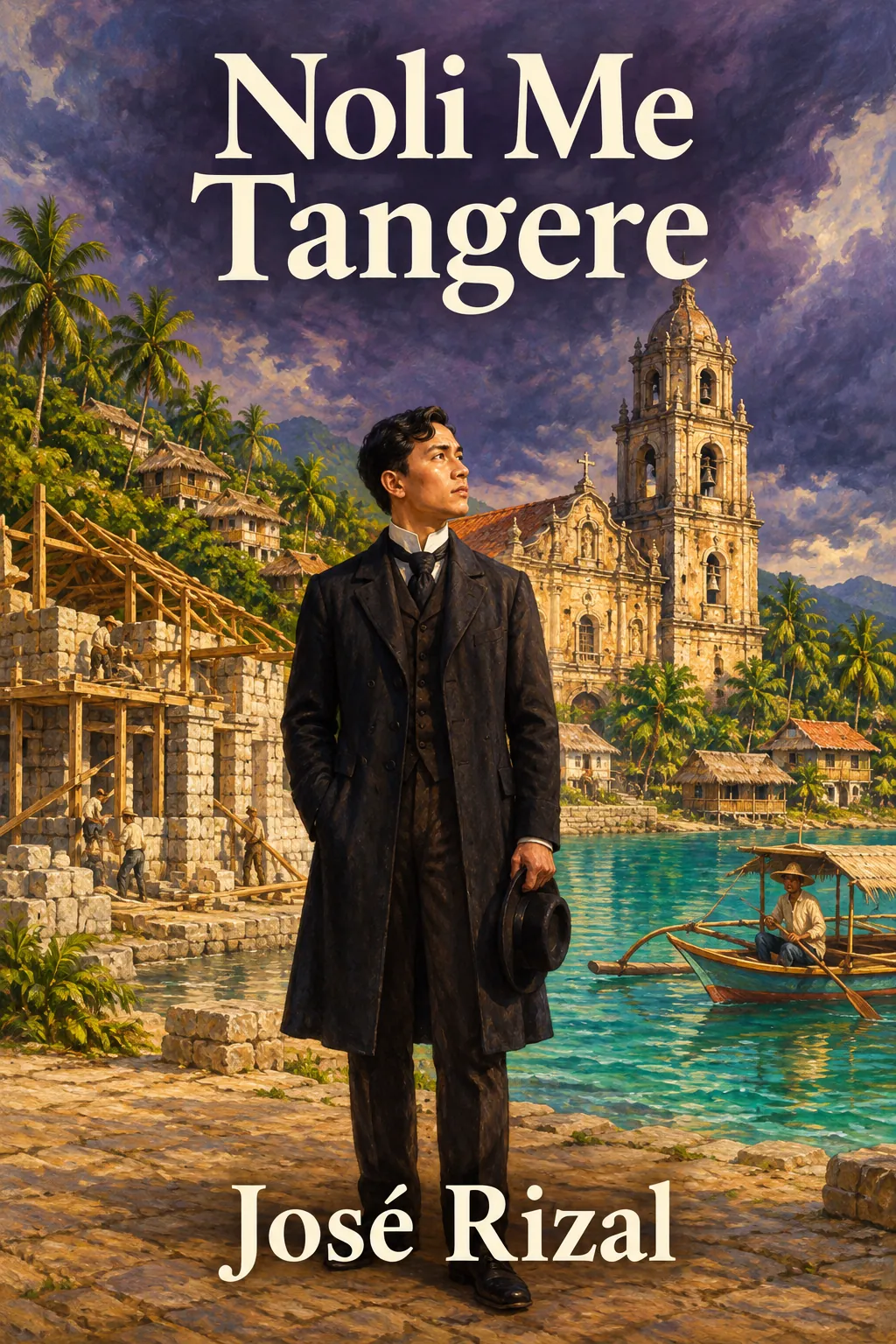
Noli Me Tangere
by José Rizal
Noli Me Tangere (1887) is José Rizal's novel about Crisóstomo Ibarra, a young Filipino who returns home after seven years in Europe, full of plans to build a school. In the town of San Diego he meets the power of the friars and of the officials who protect them. Through his love for María Clara and his friendship with the hunted boatman Elías, the book shows how abuse, fear and silence damage a whole society. It is the first of Rizal's two novels and a Grade 9 set text in the Philippines.
The Big Idea
"Noli Me Tangere shows a Philippines held back by abusive friars, corrupt officials and fearful neighbours. Rizal argues that real change needs education, courage and honest reform, not good intentions alone."
Key Insights
Power without accountability
Rizal shows a town where religious, police and social power belong to the same small circle. Because nobody can check them, small cruelties grow into serious injustice. The novel's target is the system that lets abuse go unchecked, not every person in authority.
Father Dámaso insults Ibarra and has his father's body removed from its grave, and nothing happens to him. Later, Father Salví uses the false uprising to destroy Ibarra, and the authorities accept it.
Education as hope and as a threat
Ibarra believes a school can change San Diego, but the book also shows why education worries the powerful. The old schoolmaster describes classes built on fear and memorising, which keep pupils obedient. Rizal suggests that real learning builds independent minds.
The schoolmaster's account of beatings and rote lessons contrasts with Ibarra's plan for a modern school, which draws immediate attempts at control from the friars' supporters.
Reform or resistance
Ibarra and Elías answer injustice in opposite ways: one through lawful reform, the other from the experience of being hunted. Rizal does not simply choose a side. Both men are honest, and both are defeated by a system built on fear.
Elías saves Ibarra twice and finally gives his life so that Ibarra can escape. Their friendship shows that the two approaches need each other, even while they disagree.
Fear, silence and imitation
The book shows how ordinary people help abuse survive. Some stay silent, some turn on a neighbour who is accused, and some copy the rulers in the hope of rising. Rizal asks readers to see their own part in these habits.
After Ibarra's arrest, neighbours who praised him now join the accusers. Capitán Tiago protects his wealth by pleasing the powerful, and Doña Victorina pretends to be Spanish.
Chapter Breakdown
Chapter-by-chapter summary (Buod ng mga Kabanata)
Spoiler warning: this section covers the whole plot, including the ending.
The novel has 63 numbered chapters and an epilogue (some editions count the epilogue as chapter 64), so the chapters (kabanata) are grouped into nine parts here.
Part 1: The Homecoming (Chapters 1–8)
Capitán Tiago holds a dinner in Manila to welcome Crisóstomo Ibarra, who has just returned after seven years of study in Europe. Most guests praise him, but Father Dámaso, a friar who knew his family, insults him in front of everyone.
Ibarra stays polite, and Lieutenant Guevara quietly tells him that his father, Don Rafael, died in prison after the priest turned the town against him. Ibarra then meets María Clara, Tiago's daughter and his childhood sweetheart, and the two renew their promise to each other.
Why it matters: the dinner introduces the three forces that drive the plot, which are Ibarra's idealism, the friars' arrogance and a love that the powerful will try to control.
Part 2: San Diego (Chapters 9–14)
Ibarra travels to his home town, where the priest and the Guardia Civil matter more than the elected officials. At the cemetery, a gravedigger tells him that his father's body was dug up and thrown into the lake.
Ibarra is shaken but does not seek revenge. He decides to honour his father by building a modern school instead.
Why it matters: his answer to cruelty is reform, and the rest of the book tests whether that answer can work.
Part 3: Sisa and Her Sons (Chapters 15–19)
Sisa is a poor mother whose sons, Basilio and Crispín, work as church sacristans. Crispín is accused of stealing money and is beaten, then he disappears, while Basilio is wounded and escapes.
Sisa slowly loses her mind as she searches for them. An old schoolmaster also explains how beatings and rote memorising ruin the classroom.
Why it matters: the chapters show that the poor pay the price for the abuse of power, and they explain why Ibarra's school matters.
Part 4: The School and the Lake (Chapters 20–27)
Ibarra's school plan reaches the town council, where the friars' supporters try to control it. On a picnic at the lake, a crocodile attacks, and Elías, a quiet boatman, saves Ibarra's life.
The old thinker Pilosopo Tasyo then advises Ibarra to seek the backing of the priest and the authorities.
Why it matters: Elías enters as a counterpoint to Ibarra, a man who knows that reform alone may not be enough.
Part 5: Fiesta and Banquet (Chapters 28–34)
The town celebrates its fiesta with a sermon, a procession and the laying of the school's foundation stone. Elías again saves Ibarra when a rigged derrick collapses and kills another man instead.
At the banquet, Dámaso insults the memory of Ibarra's father. Ibarra loses control and raises a knife at the priest until María Clara stops him.
Why it matters: the one moment when Ibarra loses his temper gives his enemies the excuse they need.
Part 6: Excommunication and Intrigue (Chapters 35–44)
Dámaso's allies have Ibarra excommunicated, but the friendly Governor-General lifts the punishment. Meanwhile Doña Consolación, the wife of the alferez, mistreats Sisa, and Father Salví quietly works against Ibarra.
Why it matters: these chapters show how the church, the army and the social elite protect each other.
Part 7: Elías and Ibarra (Chapters 45–51)
Elías reveals that he is hunted by the authorities and tells Ibarra about the injustice that destroyed his family. He asks Ibarra to use his influence for the poor.
Ibarra believes in lawful reform and the goodwill of the government.
Why it matters: this is the philosophical heart of the book, the debate between patient reform and harder resistance.
Part 8: The False Uprising (Chapters 52–58)
A staged attack on the barracks breaks out, and Salví and his hired men make sure the blame falls on Ibarra. Ibarra is arrested, and the neighbours who once praised him now turn on him.
Why it matters: the town's fear makes it easy to trick, and the system accepts a forged accusation.
Part 9: Escape, Loss and Epilogue (Chapters 59–63 and Epilogue)
María Clara is pressed to marry a Spaniard, Alfonso Linares, and begs Dámaso to let her enter a convent. Ibarra escapes by boat with Elías, who draws the pursuers away and is shot.
On Christmas Eve, the dying Elías bids farewell to the dawn he will not see and asks those who live to remember the people who fell in the night. Sisa finds Basilio but dies soon after.
The epilogue closes the story with María Clara behind convent walls and no justice for the town.
Why it matters: the ending offers no easy victory, so the reader is left to carry the question forward.
Characters (Mga Tauhan)
- Crisóstomo Ibarra: the idealistic hero who returns from Europe to build a school. He trusts the law and the government to bring change.
- María Clara: Ibarra's sweetheart, raised by Capitán Tiago. She is gentle and obedient but chooses the convent over a forced marriage.
- Elías: a boatman hunted by the authorities. He saves Ibarra and sees the poor's suffering clearly.
- Padre Dámaso: an arrogant friar who insults Ibarra and abuses his power.
- Padre Salví: a quiet, scheming friar who plots Ibarra's downfall.
- Capitán Tiago: a rich man who protects his wealth by pleasing the powerful.
- Sisa: a poor mother whose grief at losing her sons drives her mad.
- Pilosopo Tasyo: an old thinker, laughed at by the town, who warns Ibarra about the road ahead.
Writing about this book (Aral at Tema)
Grade 9 teachers often ask about theme (tema), character (tauhan) and the aral, so plan your answer around one clear idea.
Start with a thesis, for example: Rizal shows that abuse of power survives when ordinary people stay afraid.
Support it with two or three events, such as Crispín's punishment, the insult to Don Rafael's memory and the false uprising. Explain what each event proves instead of stopping at the plot (buod).
For a character analysis (pagsusuri ng tauhan), pick one trait and follow it across the book. Ibarra's idealism, for example, is strongest in the school plan and is tested at the banquet and during the false uprising.
For a reflection or reaction paper, say what the book made you think and connect it to your own community.
Keep quotes short, give the chapter, and use your own words for everything else.
The sample answers at the end of this page are for learning, so compare them with your own work instead of copying them.
Take Action
Practical steps you can implement today:
-
Treat the aral as the point of your essay: say what a character's choice teaches, then support it with one clear event.
-
Compare characters by their methods, not only their traits. Ibarra and Elías make the best pair.
-
Notice who benefits from silence in a story, and ask who might speak up in your own community.
-
Keep quotes short and give the chapter, then explain them in your own words.
Notable Quotes
"“To my Fatherland.” (Dedication, our translation)"
— José Rizal
"“I will do what the ancients did with their sick: place them on the temple steps, so each visitor may suggest a cure.” (Dedication, our translation)"
— José Rizal
"“I die without seeing dawn shine on my country. You who will see it, welcome it, and remember those who fell in the night.” (Chapter 63, our translation)"
— José Rizal
Who Should Read This
Best for Grade 9 and 10 students in the Philippines who are studying Noli Me Tangere for class, and for anyone who wants a clear overview before reading the full novel. It also helps readers who are new to Philippine history and want to understand why the book still matters.
Characters
Crisóstomo Ibarra
protagonist
A rich, educated young man who returns from seven years in Europe. He believes in patient, lawful reform and plans to build a school in memory of his father. His one loss of temper is used by his enemies to destroy him.
María Clara
love interest
Capitán Tiago's daughter and Ibarra's childhood sweetheart. She is gentle and loyal, and she is pressured by the adults around her. In the end she chooses the convent over a marriage she does not want.
Elías
foil
A boatman hunted by the authorities. He saves Ibarra's life and understands the suffering of the poor better than the reformer does. His dying words give the novel its hope for a future dawn.
Padre Dámaso
antagonist
A proud friar who insults Ibarra and treats the town as his own. The novel shows him as the face of friar abuse. He also has a hidden link to María Clara's family.
Padre Salví
antagonist
The quiet parish priest of San Diego who works in secret against Ibarra. He uses the false uprising to remove his rival. He is more dangerous than Dámaso because he hides his cruelty.
Capitán Tiago
social climber
A rich businessman who officially raised María Clara. He protects his wealth by pleasing priests and officials. His fear shows how comfort can stop people from taking a stand.
Sisa
symbol
A poor mother who loses both her sons and her mind. Her story shows what the abuse of power does to ordinary families. She is one of the book's most moving symbols of suffering.
Basilio
victim and survivor
Sisa's older son, a church sacristan who escapes after his brother's disappearance. He survives the ordeal. His reunion with his mother in the final chapters is among the book's saddest scenes.
Pilosopo Tasyo
mentor
An old thinker whom the town calls crazy because he reads and questions. He advises Ibarra to work with the powerful, even while he doubts the town is ready. He represents a wisdom that society refuses to hear.
Doña Victorina
satire
A Filipina who pretends to be Spanish and looks down on her own people. Rizal uses her to mock the habit of imitating the rulers. Her comic scenes carry a serious point about colonial mentality.
Exam practice: sample answers
Model answers are examples to learn from; write your own in your words.
compare and contrast
1. Compare and contrast Crisóstomo Ibarra and Elías as responses to injustice in Noli Me Tangere. Which approach does the novel treat more seriously? (Grade 9 compare-and-contrast essay)
Outline
- Introduction: name both characters and your thesis about how they respond to injustice
- Ibarra's approach with one event as evidence
- Elías's approach with one event as evidence
- What they share, and what the plot shows about each approach
- Conclusion with the aral
Basic Model answer
Ibarra and Elías are two main characters who both want a fair society, but they handle injustice in different ways.
Ibarra is rich and educated. He came back from Europe and wants to build a school in San Diego.
He believes that change can happen through the law and by working with the priest and the government.
Elías is a poor boatman who is hunted by the authorities. He has suffered because of unfair treatment, and he wants stronger action for the poor.
He saves Ibarra's life twice.
They are alike because both are brave and both care about their country. They are different because Ibarra trusts the system while Elías does not.
In the end, Ibarra's plan does not work because his enemies trick him, and Elías dies helping him. This shows that the novel thinks injustice is very hard to fix.
I think the author wants readers to think about which way is better.
Good Model answer
Crisóstomo Ibarra and Elías both want to end the unfair treatment of ordinary Filipinos in Noli Me Tangere, but they disagree about how. The novel uses them as a pair, and it shows that neither path is safe.
Ibarra believes in reform through the system. He builds a school in memory of his father and asks for the help of the priest and the officials.
Even when he learns that Father Dámaso dishonoured his father's grave, he first holds back his anger.
Pilosopo Tasyo advises him to rely on the friars' support. This shows that even wise reformers feel they must bargain with the powerful, and Ibarra follows the advice and still fails.
Elías, in contrast, has seen the law fail the poor. He is hunted like a criminal, and he asks Ibarra to use his connections to speak for people like him.
He doubts that those in power will give up anything freely.
The two men are also alike. Both are honest and brave, and both save each other: Elías pulls Ibarra from the crocodile and later helps him escape.
Their friendship shows that people from different classes can share one goal.
Yet the plot tests Ibarra's belief. When he loses his temper at the banquet, his enemies use it to accuse him of rebellion, and the law he trusted turns against him.
Elías is proven partly right, but he also dies, so violence does not win either.
In conclusion, the novel does not simply choose one man. It warns that a society ruled by fear and abuse makes both patient reform and anger dangerous.
Elías's last wish that others will see the dawn leaves hope that a better way can still be found.
Excellent Model answer
Rizal builds Crisóstomo Ibarra and Elías as foils: two honest men who answer the same injustice in opposite ways, so the reader can test both answers. The novel's verdict is not that one man is right, but that a society ruled by fear leaves little room for either reform or revolt.
Ibarra represents patient, lawful reform. He returns from Europe convinced that education will lift San Diego, and his school is both a gift to the town and a memorial to his father.
Even his restraint is principled: after the gravedigger reveals what was done to Don Rafael's body, he does not call for revenge.
Elías represents experience rather than theory. A hunted man with a family history of loss, he knows how the justice system treats the poor, so he sees reform that depends on the goodwill of the powerful as a gamble.
His request that Ibarra use his influence for people like him shows both his respect for Ibarra and his doubt that the system will listen.
The pairing works because each man supplies what the other lacks. Ibarra has wealth, education and connections, while Elías has local knowledge and a clear view of how power really works.
Elías saves Ibarra from the crocodile and from the falling derrick, and later gives his life so that Ibarra can escape, which shows that the two approaches need each other even as they conflict.
The plot then tests Ibarra's faith. His single loss of temper at the banquet, when he raises a knife against Father Dámaso, is turned by Father Salví and others into proof of rebellion.
The system Ibarra trusted accepts a forged accusation, and the neighbours he hoped to help turn on him.
The town's abandonment of him shows that reform fails when people are too afraid to defend the reformer. In that sense Ibarra's defeat is as much a failure of the community as a failure of his method.
Elías is not simply vindicated, however. His dying words, “I die without seeing dawn shine on my country” (Chapter 63, our translation), carry hope rather than victory.
He asks those who live to remember the people who fell in the night, which points toward a future built on both Ibarra's ideals and Elías's memory of suffering.
This reading fits the time in which Rizal wrote. He belonged to the reform movement of Filipinos in Europe in the 1880s, which asked Spain for change, and the novel doubts whether Spain would answer.
Ibarra's failure therefore works as a warning to readers, not as an argument against hope.
In conclusion, Ibarra and Elías are two halves of one question: how should people answer injustice? Rizal lets both fail so that the reader must carry the question forward.
Marking rubric
- Thesis compares the two characters and answers the second question
- At least two specific events used as evidence, with the chapter or scene named
- Analysis explains what each event shows and does not only retell
- Clear structure with an introduction, body paragraphs and a conclusion
- Accurate, original wording; any quote is short
Now write your own
Write your own compare-and-contrast essay on Ibarra and Elías, or choose another pair from the novel such as Father Dámaso and Father Salví, then compare it with the three levels above.
theme and aral essay
2. Explain how Noli Me Tangere shows the abuse of power by friars and officials. What aral can a Grade 9 student take from the novel? (theme and aral essay)
Outline
- Introduction: state the theme of abuse of power
- Example of a friar's abuse (Dámaso or Salví)
- Example of its effect on ordinary people (Sisa, Crispín)
- Counter-point or limit: not every person in authority is cruel
- Aral and conclusion
Basic Model answer
Noli Me Tangere shows that the friars and officials in San Diego use their power unfairly. They are supposed to protect the people, but many of them only protect themselves.
Father Dámaso is a good example. He insults Ibarra at the dinner and is blamed for the bad treatment of Ibarra's father, Don Rafael, even after his death.
Father Salví also plays a secret game against Ibarra because he wants María Clara.
Ordinary people suffer most. Sisa loses her sons and her mind.
The poor are afraid to speak because they know the priest and the Guardia Civil can punish them.
The aral is that power must be used with care and kindness. People who have authority should serve others, not hurt them.
I also learned that we should speak up when we see injustice, even if it is hard.
Rizal wrote this book so Filipinos would see these problems and think about how to fix them.
Good Model answer
In Noli Me Tangere, Rizal argues that the power of friars and officials in San Diego is abused because nobody can hold it to account. The novel shows this in the treatment of individuals, the control of public life and the fear that spreads through the town.
First, Father Dámaso uses his position to humiliate and punish. He mocks Ibarra at the welcome dinner, and the cemetery scene reveals that Don Rafael's body was dug up and thrown into the lake.
The cruelty goes beyond one man's death because it shows that the priest believes he can insult even the dead without consequence.
Second, the Church and the Guardia Civil work together. Father Salví uses the false uprising to destroy Ibarra, while the alferez and his wife, Doña Consolación, humiliate anyone they choose, including Sisa.
Because the same small circle holds religious, police and social power, the poor have nowhere to turn.
Third, the effect on ordinary people is fear. Crispín is beaten for a theft he did not clearly commit, and his mother Sisa loses her mind when she cannot find her sons.
After Ibarra's arrest, many neighbours who once praised him now join the accusers.
The novel is also fair. Not every figure of authority is cruel: the Governor-General lifts Ibarra's excommunication, and Don Filipo defends the town's rights in the council.
Rizal's target is a system that lets abuse go unchecked, not every person in office.
The aral I take from this is that power without accountability harms the weakest first, so a community needs honest laws, fair teachers and people ready to speak up. Rizal also reminds readers that leaders, and even ordinary neighbours, must choose courage over silence.
Excellent Model answer
Rizal's Noli Me Tangere argues that abuse of power flourishes not only because some friars and officials are cruel, but because the system around them removes every check. The novel shows this on three levels: personal cruelty, institutional protection and social fear.
At the personal level, Father Dámaso treats the town as his property. He humiliates Ibarra at the welcome dinner, and the cemetery scene reveals that Don Rafael's body was dug up and thrown into the lake.
The act is cruel, and it also shows that Dámaso expects no consequences even for desecrating the dead.
At the institutional level, the Church, the Guardia Civil and the colonial government protect one another. Father Salví, a quieter figure than Dámaso, uses the false uprising to remove his rival, and the authorities accept a forged accusation without proper proof.
The irony is that Ibarra's enemies use the law to commit injustice, so the law becomes a tool of the abusers.
The pattern also appears in smaller scenes. The fiesta sermon and the quarrels in the town council show that public life in San Diego is arranged around the wishes of the priest, so even the laying of a school's foundation stone must pass through his approval.
When Ibarra's plan meets this web of control, the book makes clear that abuse is not only violence but also the power to block good things from happening.
At the social level, fear turns neighbours into accomplices. After Ibarra's arrest, people who once praised him now accuse him, and the poor are afraid to speak because the priest and the alferez can punish them.
Doña Consolación's humiliation of Sisa shows that the pettiest member of the powerful circle can hurt the weakest with impunity.
Rizal also shows that victims are taught to blame themselves. The old schoolmaster explains that pupils learn through fear and memorising, so a child who grows up obeying a stick later finds it natural to obey a priest.
Abuse is therefore passed down through habit, which is why the novel places education at the centre of its cure.
The human cost is clearest in Sisa's story. Crispín is beaten for a theft he did not clearly commit, and Sisa slowly loses her mind searching for her sons.
Rizal does not make her suffering a side detail: her story is the novel's picture of what an unchecked system does to a family.
The novel is careful, however. The Governor-General lifts Ibarra's excommunication, and Don Filipo defends the town's rights in the council.
Rizal's target is a structure that rewards cruelty and silence, not every person who holds office. This matters for the aral, because it asks readers to judge actions and systems rather than to hate a group.
This reading fits the book's dedication, where Rizal says he will expose his country's sickness on the temple steps so that each visitor may suggest a cure (our translation). He wants readers to see the problem and to think of remedies.
The aral for a Grade 9 student is therefore twofold. People with power must serve and answer to others, and ordinary people must refuse to be silent when they see injustice.
The novel suggests that a fair society begins with informed, courageous individuals.
Marking rubric
- Clear thesis about how and why power is abused
- Specific evidence from at least three events or characters
- Explanation links each example to the theme
- Balanced treatment (not every authority figure is cruel)
- Aral stated clearly and connected to the evidence
Now write your own
Choose another theme from the novel, such as the role of education, and write your own theme and aral essay, then compare it with these samples.
reaction paper / reflection
3. Write a short reflection (reaction paper): Which event in Noli Me Tangere stayed with you most, and how does it connect to your own community today? (Grade 9 reflection)
Outline
- Name the event and say briefly what happens
- Say what you felt or thought
- Connect it to something in your community or school
- State what you learned (aral) and what you will do
Basic Model answer
The event that stayed with me most in Noli Me Tangere is the story of Sisa and her sons. Crispín is accused of stealing and is punished, and then he disappears.
Sisa is so worried that she loses her mind.
I felt very sad when I read this part. Sisa is poor, and nobody helps her.
The people with power did not care about her family.
Sisa's story is also hard to forget because she is only a mother who wants her children safe. Crispín and Basilio work in the church, yet they are treated unfairly, and she cannot protect them.
It reminds me that the author wanted us to care about ordinary people, not only the heroes.
In my community, some people are also treated badly because they are poor. Sometimes others do not help because they are afraid or busy.
My aral is that we should be kind and help people who are suffering. I will try to listen to my classmates who are in trouble and tell a teacher when someone is being treated unfairly.
Good Model answer
The event that stayed with me most in Noli Me Tangere is the story of Sisa and her sons, Basilio and Crispín. Crispín is accused of stealing money in the church and is beaten, then he disappears, and Basilio is wounded while escaping.
Sisa slowly loses her mind as she searches for them.
I felt sad and angry, because the family did nothing wrong yet nobody with power helped them. Doña Consolación even humiliates Sisa later in the novel, which shows how the powerful can hurt the weak without any punishment.
Rizal does not describe this with long speeches; he shows it through a mother's suffering, which made it easier for me to feel it.
I connect this to my own community because poor families still face problems when they cannot defend themselves. For example, a student who cannot pay for school needs may be ignored or laughed at, and many neighbours do not know how to help.
In San Diego, the people stay silent out of fear, while in my community we may stay silent because we think it is not our problem.
The aral I take from this is that silence makes it easier for people to suffer. I will try to speak to a teacher or barangay official when I see someone being treated unfairly, and I will be kinder to classmates who seem alone.
A small action may not change a whole system, but it shows that someone cares.
Reading this part made me understand why Rizal wrote the novel. He wanted readers to feel the cost of injustice so that they would act.
Excellent Model answer
The event that stayed with me most in Noli Me Tangere is not a dramatic fight or a banquet scene but the quiet story of Sisa and her sons. Crispín is accused of stealing money in the church and beaten, and then he disappears, while Basilio is wounded and escapes.
Sisa slowly loses her mind searching for them.
I felt sad, but I also felt uncomfortable, because nobody in the story seems willing to help her. The scene did not hurt me only because of what happened to Sisa; it hurt because the people who could have helped, the priest and the guards, were the ones who caused the harm.
Doña Consolación later humiliates her, so the abuse is repeated rather than corrected.
I think Rizal placed this story beside Ibarra's plan for a school on purpose. Ibarra talks about progress, but Sisa's family shows what happens to people who have no education, money or protection.
The two stories together suggest that reform means little if it does not reach the poorest. When I compare this with the banquet scene, where the powerful quarrel over honour and insults, I see that the novel judges the town by how it treats its weakest members.
The scene also reads differently when I compare it with Ibarra's own loss. Ibarra suffers for his father, but he has money, a name and a friend like Elías, while Sisa has none of these.
That difference taught me that the same injustice does not weigh equally on everyone.
I connect this to my own community because there are people who are overlooked in the same way: a family that cannot pay for school supplies, a classmate who is teased, a neighbour who has nobody to turn to.
In my own school, a popular student can shrug off bullying or an unfair rule, but a quiet student may carry it alone. Noticing that gap is the first step toward doing something about it.
In San Diego, fear keeps people quiet. In my community, the silence is usually quieter still, because many people assume that someone else will help.
I also noticed how Rizal ends Sisa's story. She finds Basilio only at the very end and dies soon after, so even her small happiness comes too late.
That lateness feels like a warning to me: help that arrives after the harm is done is not enough, so kindness should come early.
The aral I take from this is that compassion has to become action. I will try to notice who is left out in my class and speak up politely when someone is treated unfairly.
If a problem is too big for me, I will tell a teacher or a trusted adult instead of staying silent.
Sisa's story also changed how I read the book as a whole. Rizal wants readers not only to know the history but to feel responsible for the world around them, and that is why I think this novel is still worth reading.
Marking rubric
- A specific event from the novel is named and briefly explained
- Honest personal response in the first person
- Believable connection to the student's own community or school
- Clear aral and a realistic action
- Clear organisation and respectful tone
Now write your own
Write your own reflection on a different event, such as Elías's last words or the false uprising. Use your own community, then compare it with the three samples.
Frequently Asked Questions
What is Noli Me Tangere about?
It follows Crisóstomo Ibarra, who returns to the Philippines after seven years in Europe and tries to build a school in his home town. His plans bring him into conflict with abusive friars and officials. The novel uses his story to expose injustice, fear and silence in colonial society.
What does Noli Me Tangere mean?
It is Latin for “touch me not”, words that come from the Gospel of John. Rizal used the phrase for a sickness in society that people avoid talking about. The novel is his attempt to open that subject to public view.
Who are the main characters (mga tauhan) of Noli Me Tangere?
The main characters are Crisóstomo Ibarra, María Clara, Elías, Father Dámaso, Father Salví, Capitán Tiago, Sisa, Basilio and Pilosopo Tasyo. Ibarra and Elías are the key pair, since they respond to injustice in different ways. The characters section above gives a short note on each.
How many chapters (kabanata) does Noli Me Tangere have?
The novel has 63 numbered chapters and an epilogue, and some editions count the epilogue as chapter 64. Chapter titles differ slightly between translations. This guide groups the chapters into nine parts so the story is easy to follow.
What are the main themes (tema) and aral?
The main themes are abuse of power, the need for education, the choice between reform and resistance, and the cost of fear and silence. The aral for students is that power should serve people, and that courage and honest learning are needed for a fair society.
Check Your Understanding
Pick an answer for each question to see if you were right.
-
Where has Crisóstomo Ibarra been before the story begins?
Studying in Europe for seven years — Ibarra returns to the Philippines after seven years of study in Europe.
-
What project does Ibarra want to build in San Diego?
A school — He wants to build a modern school in memory of his father.
-
Who saves Ibarra from the crocodile?
Elías — Elías, the boatman, saves Ibarra's life during the lake picnic.
-
What happens to Sisa's son Crispín?
He is accused of stealing, beaten and disappears — Crispín is accused of stealing money and punished, then disappears, which pushes Sisa toward madness.
-
What does the Latin title Noli Me Tangere mean?
Touch me not — The title means “touch me not” and refers to a sickness in society that people avoid discussing.
About José Rizal
José Rizal (1861–1896) was a Filipino physician, writer and reformer born in Calamba, Laguna. He studied medicine in Madrid and wrote Noli Me Tangere in Europe, publishing it in Berlin in 1887, followed by El Filibusterismo in 1891. He was executed in Manila in December 1896 and is the Philippines' national hero.
Summary Written By

Software Engineer & Writer
Software engineer with a passion for distilling complex ideas into actionable insights. Writes about finance, investment, entrepreneurship, and technology.
View all summaries →Reviews
No reviews yet. Be the first to share your thoughts!
Write a Review
Keep reading
Explore the topic: Study GuidesSummaries

Educated by Tara Westover
Tara Westover
A memoir about a young woman born to survivalists in Idaho who, despite having no formal schooling, teaches herself to…

Atomic Habits: An Easy & Proven Way to Build Good Habits & Break Bad Ones
James Clear
No matter your goals, Atomic Habits offers a proven framework for improving–every day. James Clear, one of the world’s leading…

The Psychology of Money
Morgan Housel
Morgan Housel’s insightful exploration of how psychology affects our financial decisions and wealth-building journey.

Think and Grow Rich
Napoleon Hill
What if the secrets to wealth and success weren’t hidden in complex financial strategies, but within the power of your…
Articles

Black Holes in Science Fiction
A black hole is a region of space where gravity is so strong that nothing, not even light, can escape…

Greek mythology explained
Greek mythology is the set of stories the ancient Greeks told about gods, Titans and heroes. Its oldest written sources…

Nebula Award: What It Is and Notable Winners
The Nebula Award is an American science fiction and fantasy prize voted on by working writers. The Science Fiction and…