In five minutes: Greek mythology
Greek mythology is the collection of stories the ancient Greeks told about gods, heroes and the beginning of the world. The oldest written versions come from poets such as Hesiod and Homer, around 700 BCE.
There was no single holy book. Stories were sung, retold and changed from city to city, so the same god can have different parents in different poems.
This page is a map of the whole world of Greek mythology. It follows the family line from the first powers to the Olympian gods, then on to humans and heroes, and it names the ancient text behind each part.
The story: from Chaos to Olympus
Chaos and the first powers
Hesiod's Theogony says that first there was Chaos, a great yawning gap. After it came Gaia, the Earth, then Tartarus, the deep pit below her, and Eros, the force of desire.
Gaia bore Uranus, the Sky, on her own. Later the two became the parents of the Titans, a family of giant divine children.
Cronus and the swallowed children
Uranus hated his children and kept them hidden inside Gaia. Gaia handed a sickle to her youngest Titan son, Cronus, and he overthrew his father and took power.
Cronus then learned that one of his own children would take his throne. So he swallowed every child his sister and wife Rhea gave birth to.
When Zeus was born, Rhea hid him on Crete and gave Cronus a stone wrapped in cloth instead. Cronus swallowed the stone and never noticed.
Zeus and the war with the Titans
When Zeus grew up, he made Cronus bring his brothers and sisters back up. The young gods then fought the Titans for ten years, a conflict later called the Titanomachy.
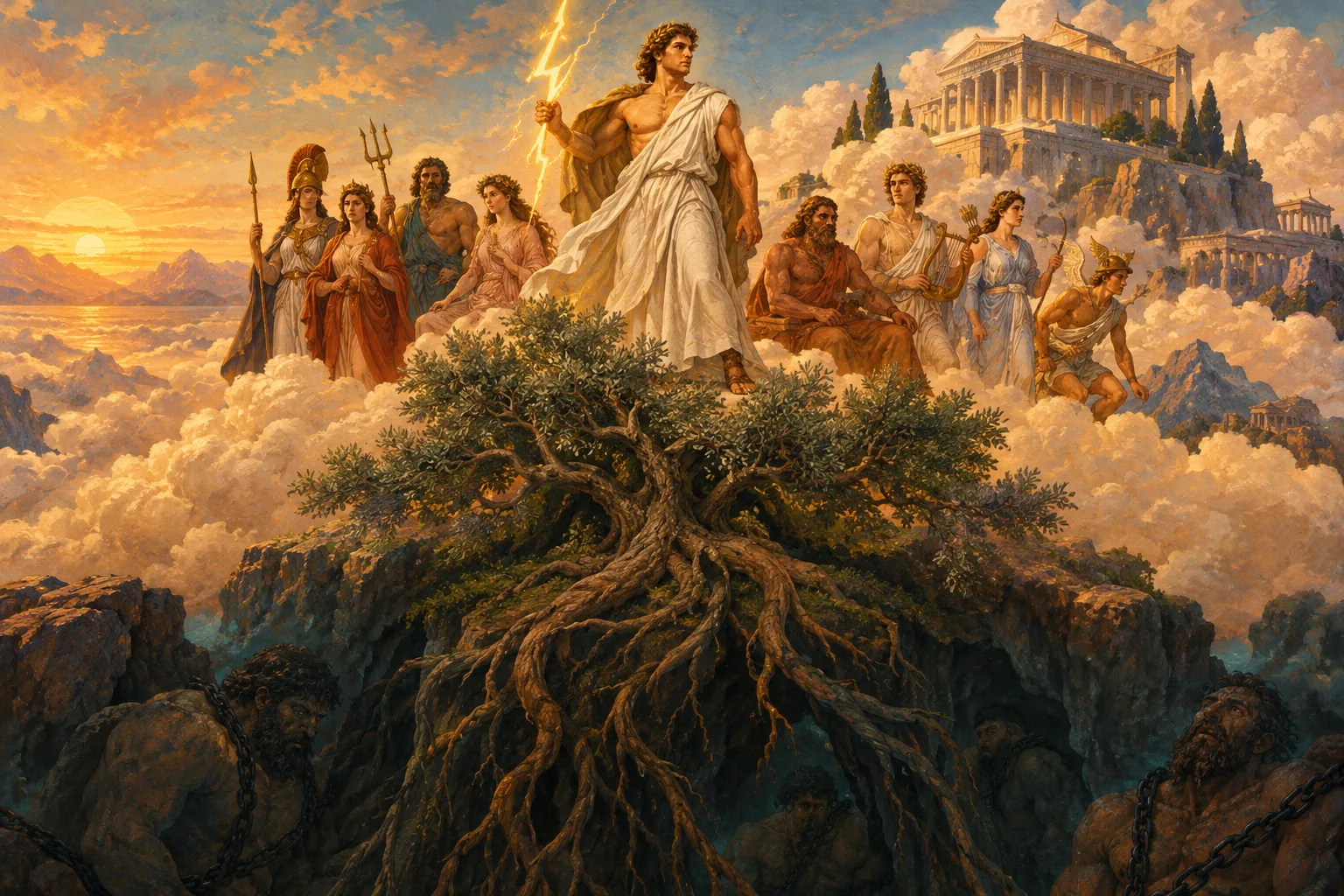
Zeus freed the Cyclopes and the Hundred-Handers from Tartarus, and they fought on his side. With the thunderbolt in his hand, Zeus won, and the defeated Titans were locked away in Tartarus.
The Theogony also tells of Zeus's fight with the monster Typhon, whose defeat made the new order of the gods secure.
The Olympian gods
The victors made their home on Mount Olympus. The usual list of twelve is Zeus, Hera, Poseidon, Demeter, Athena, Apollo, Artemis, Ares, Aphrodite, Hephaestus, Hermes, and either Hestia or Dionysus.
The twelfth seat changes from list to list. Hades rules the underworld and does not live on Olympus, so he is usually left out of the twelve.
Each god has a story of his or her own. The twelve Olympian gods introduces them one by one, and Persephone, Hades and the seasons tells how Demeter's daughter ended up between two worlds.
Humans, Prometheus and Pandora
Hesiod's Works and Days turns to the human world. When the Titan Prometheus stole fire for people, Zeus punished humanity by sending the first woman, Pandora.
Pandora opened a large jar, and troubles and sickness spread across the world. Only hope stayed inside.
Pandora and her box explains how the jar later became a box.
The same poem divides human history into five ages: gold, silver, bronze, heroes and iron. Hesiod places himself in the last, hardest age.
The heroes
Between gods and ordinary people stand the heroes. Heracles performs twelve labours, Perseus kills the Gorgon Medusa, Theseus defeats the Minotaur of Crete, and Jason sails with the Argonauts for the golden fleece.
Their stories are spread across many sources, from epic poems to the plays of Athenian tragedians and the scenes painted on pottery.
Troy and the long way home
Homer's Iliad is set in the tenth year of the Trojan War and centres on the anger of the warrior Achilles. It covers only a few weeks, not the whole war.
The Odyssey follows Odysseus on his ten-year journey home to Ithaca after the war. The famous wooden horse is not in the Iliad at all, as The Trojan War and the wooden horse shows.
The family tree of the gods
The Theogony works like a genealogy, so a simple family tree is the quickest way to hold the stories together.
- First powers: Chaos, then Gaia (Earth), Tartarus and Eros.
- Gaia and Uranus: the Titans, including Oceanus, Themis, Mnemosyne, Cronus and Rhea.
- Cronus and Rhea: Hestia, Demeter, Hera, Hades, Poseidon and Zeus.
- Zeus's children: Athena, Apollo and Artemis (with Leto), Hermes (with Maia), Dionysus (with the mortal Semele) and Persephone (with Demeter).
- Hera's children: Ares and Hephaestus in Hesiod's account.
- Aphrodite: born from the sea foam in the Theogony, but a daughter of Zeus and Dione in the Iliad.
Where the story comes from
The anchor for this page is a group of public-domain texts. Hesiod's Theogony tells the birth of the gods, and his Works and Days tells of Prometheus, Pandora and the five ages.
Both date from about 700 BCE.
Homer's Iliad and Odyssey are somewhat older or about the same age, and they show the gods taking sides among humans. Ovid's Metamorphoses, a Latin poem finished around 8 CE, retells hundreds of stories of transformation, often under Roman names.
Hesiod opens the Theogony by calling on the Muses. In our own translation: Let us begin our song with the Muses of Helicon.
Because these texts were written centuries apart, versions differ. Aphrodite has two different births, and the twelfth Olympian is not fixed.
Pandora's jar became a box only in the sixteenth century, through a Latin rendering of the Greek word. Early and late tellers also gave Greek gods Roman names, so Zeus becomes Jupiter and Athena becomes Minerva.
What it means
The Theogony is above all a story of order growing out of disorder. Each generation of gods is more civilised than the last, and Zeus ends the cycle of sons overthrowing fathers by sharing out honours among the gods.
The myths also explain the world as the Greeks met it: thunder, the sea, the harvest, the seasons, death. Works and Days uses Pandora and the five ages to explain why human life holds hard work and loss.
The epics ask a different question: what do people owe each other, and what do they lose through pride? Achilles' anger and Odysseus' patience are two answers.
These gods were also worshipped in real temples and festivals. The stories are best read as both religion of their time and literature that still speaks today.
Common misconceptions
- There is one official version. There is not. Poets, cities and centuries gave different answers.
- Greek and Roman gods are the same. The Romans adopted and renamed many Greek gods and added their own traditions.
- Pandora opened a box. In Hesiod it is a large jar.
- The wooden horse is in the Iliad. The Iliad ends before Troy falls.
- Hades is the devil. He is a stern ruler of the dead, not a force of evil.
- The gods are role models. They love, quarrel and make mistakes, and the stories rarely hide it.
Read next
- The twelve Olympian gods: who each god is and what they rule.
- Pandora and her box: the jar, the evils and the hope left inside.
- The Trojan War and the wooden horse: what Homer tells and what later poets added.
- Persephone, Hades and the seasons: a myth of loss and return.