In five minutes
Icarus and Daedalus is the Greek myth of a father and son who escape the island of Crete on wings made of feathers and wax. The father arrives safely, and the boy falls into the sea.
The fullest ancient telling is in Book VIII of Ovid's Metamorphoses, a Latin poem finished around 8 CE. It is a Roman retelling of an older Greek story, and it is the version most people mean when they talk about Icarus.
Daedalus, an Athenian craftsman, is held on Crete by King Minos. He cannot leave by land or sea, so he builds a way out through the air.
Before they take off, he tells his son to fly the middle course, neither low over the waves nor high near the sun. Icarus is thrilled by flying and forgets the advice.
The phrase “flying too close to the sun” comes from this scene. It now means chasing a goal with more daring than sense, though Ovid's story says more than that.
This page belongs to our guide Greek mythology explained, which places the story among the other myths of Crete and Athens.
The story
A craftsman who cannot go home
Daedalus is the great inventor of Greek myth, an Athenian famous for his skill with tools and stone. In Ovid's telling he has come to Crete, where he built the Labyrinth for King Minos, a maze meant to hold the Minotaur, the monstrous child of the queen.
Years pass, and Daedalus longs for his own country. Minos watches the harbours and the coast, so no ship will carry him away.
Then Daedalus has his idea. He reasons, in our own translation of Ovid: “Minos may block the land and the waves, but the sky is surely open.”
Wings of feathers and wax
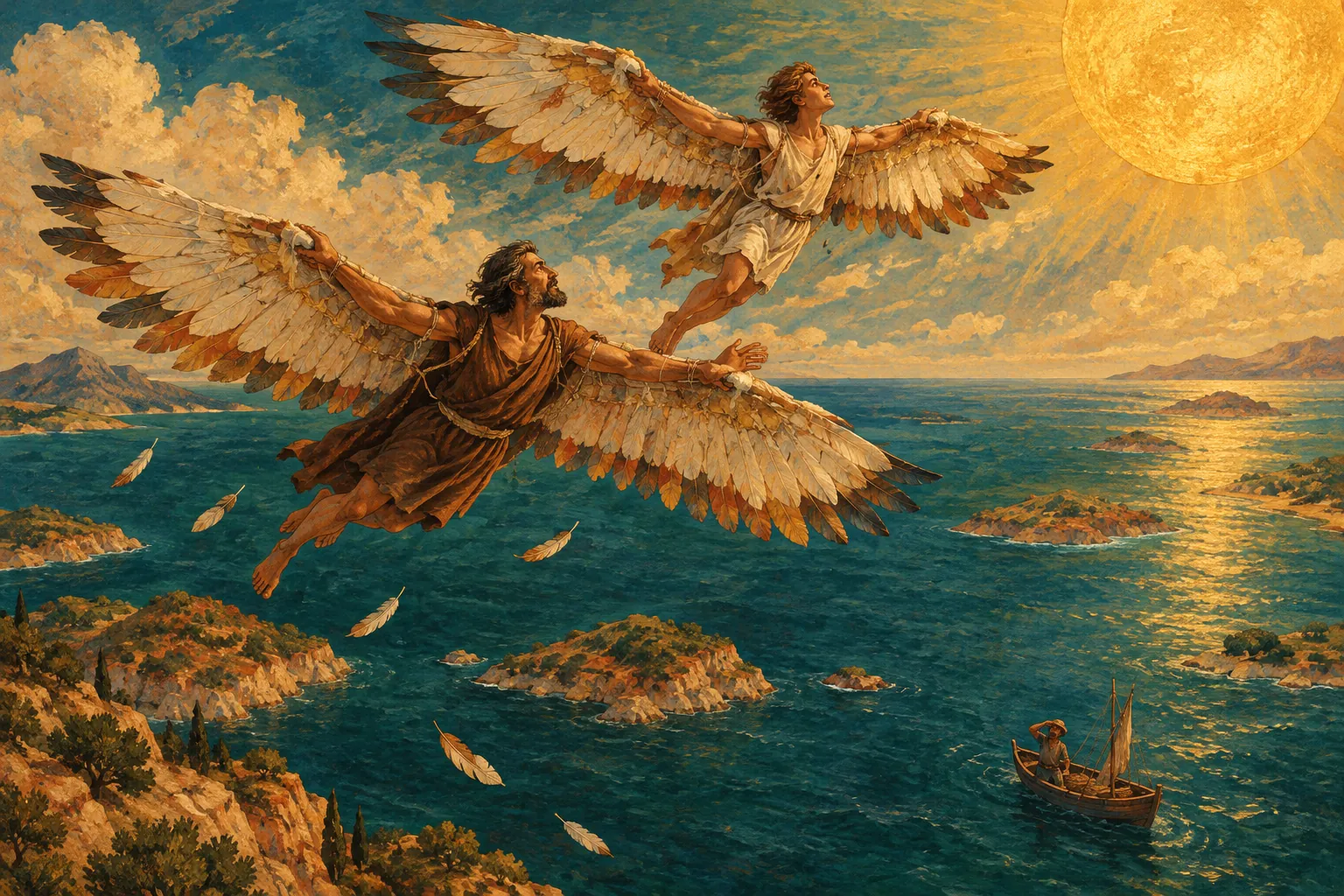
Daedalus sets feathers in a row, starting with the shortest and growing longer, so the edge rises like a slope. He ties the middle of the feathers with thread and fixes the base with wax.
Then he bends the finished frame into a gentle curve, so that it looks like the wing of a real bird.
Icarus stands beside him and has no idea how much depends on the work. He chases feathers that drift in the breeze and squeezes the soft wax with his thumb, playing while his father works.
Ovid points out, quietly, that the boy is handling the very things that will put him in danger.
The warning
When the wings are done, Daedalus teaches his son to fly. He tells him to keep to the middle of the sky.
If Icarus flies too low, the sea spray will make the feathers heavy. If he flies too high, the heat of the sun will burn them.
He tells the boy to follow him and not to steer by the stars. As he gives the lesson, Ovid says, the old man's cheeks are wet and his hands tremble.
Then he rises into the air, looking back to check on his son, like a bird leading its young out of the nest.
The flight
They pass over the islands of the Aegean, with Samos, Delos and Paros on their left and Lebinthos and Calymne on their right.
Below, a fisherman with his rod, a shepherd on his staff and a farmer at his plough look up and stop, and they take the two flyers for gods.
The fall
Icarus now grows bold. Delighted by the open sky, he leaves his father's lead and climbs higher.
The sun's heat softens the wax. The feathers loosen, and soon the boy is waving bare arms that catch no air.
He cries out for his father as he falls, and the dark blue water closes over him. The sea is later called the Icarian Sea in his memory.
Daedalus is a father now and no longer a craftsman, and he calls out, “Icarus, where are you?” At last he sees feathers floating on the waves.
He curses his own art and buries the body. The land where he lays his son is named Icaria after the boy.
The partridge
While Daedalus is burying the boy, a partridge claps its wings from a nearby ditch and calls out as if it were glad. Ovid explains that the bird was once Perdix, Daedalus's own nephew and pupil.
Daedalus had been jealous of the boy's talent and had thrown him from the citadel of Athens. The goddess Minerva (Athena) caught him in mid-fall and turned him into a bird, which is why the partridge still keeps low and avoids heights.
Ovid sets this tale beside the burial, and it casts an uneasy light on Daedalus. In other ancient accounts he later finds shelter in Sicily.
Where the story comes from
The source is Book VIII of Ovid's Metamorphoses, a long Latin poem about transformations written by the Roman poet Publius Ovidius Naso. Ovid finished it around 8 CE, during the reign of Augustus.
Book VIII moves from King Minos and the Minotaur to Daedalus, and then on to the hunt of the Calydonian boar. The flight of Icarus is a short, vivid pause between two larger stories.
The name Daedalus is much older than Ovid. Homer's Iliad, composed around the eighth century BCE, mentions a dancing floor he made at Knossos for Ariadne.
Virgil's Aeneid (Book VI) says Daedalus landed at Cumae and carved scenes on a temple door there. When he tries to carve the fate of Icarus, grief stops his hands.
Variants
Versions differ in detail. Ovid keeps the feathers, the wax and the father's warning, and gives Icarus joy as his motive rather than defiance.
Shorter handbook versions, such as the one attributed to the Greek mythographer Apollodorus, say only that Icarus ignored his father's advice and flew too high. In that telling his fall gives the sea its name.
Some ancient writers also explain the myth away: in one such version the wings are the sails of a fast ship, and Icarus drowns at sea. Any detail that is not in Ovid, then, belongs to a particular retelling.
What it means
The most common reading is a warning about ambition and obedience. A young person ignores a wise elder, reaches too far and pays for it.
Ovid's text is more careful than that. The danger runs both ways, since the feathers fail in the spray as well as near the sun, so Daedalus is asking for balance and not for timidity.
A second reading is about the maker. Daedalus builds the Labyrinth, the wings and the escape, and each invention carries a cost he did not foresee.
After the fall he curses his own art. That makes the story an early picture of the inventor who is answerable for what his tools do.
A third reading is about joy. Icarus is a child who has just discovered flight and forgets the world, so the scene lets us feel the wonder as well as the warning.
In modern English, Icarus has become shorthand for overreach, from company founders to aircraft designers. The idiom keeps the sun and drops the sea, which is why it often sounds like a warning against ambition itself.
Common misconceptions
- “Icarus was punished for pride.” Ovid describes no punishment from the gods. Icarus is a boy carried away by the thrill of the sky.
- “The sun was the only danger.” Daedalus warns about the sea as well, because both extremes ruin the wings.
- “The wings melted.” The wax that held the feathers softened, and the feathers came away. In the real atmosphere the air also gets colder with height, so this is a story and not physics.
- “It is a Greek text.” The myth is Greek, but the best-known telling is Latin, by a Roman poet.
- “Daedalus is simply the wise father.” Ovid also shows a jealous man with a dark past, in the story of Perdix.
Read next
Greek mythology explained maps the gods, heroes and sources behind this story, including Crete and the Minotaur.
Narcissus and Echo is another tale from Ovid's Metamorphoses, about a young man undone by his own reflection.