In five minutes
The story of the hidden cave (Ama-no-Iwato, 天岩戸) tells how the sun goddess Amaterasu shuts herself inside a rock cave and the whole world goes dark. It is one of the best-known scenes in the Kojiki, the oldest surviving book of Japanese myth, completed in 712.
The crisis is solved without a fight. The gods hold a festival outside the cave, and curiosity does what force could not.
In short: Amaterasu's brother Susanoo wrecks her rice fields and her weaving hall, and she hides. Eight hundred myriad gods plan a ritual with a mirror, jewels, crowing roosters and a dance, and the laughter draws her out.
This page belongs to our guide to Japanese mythology and the Kojiki. For what happens to Susanoo next, read Susanoo and the eight-headed serpent.
The story
This retelling follows the Kojiki, in our own words. Where the Nihon Shoki differs, the next section says so.
A brother who will not behave
Amaterasu Ōmikami rules the High Plain of Heaven (Takamagahara). Her younger brother Susanoo comes up from below to take his leave before going to the land of his mother, and Amaterasu meets him armed, because she suspects he wants her realm.
To prove his good intentions, the two swear an oath and bring new gods into being from each other's belongings. Susanoo takes the result as proof that his heart is pure, and he grows boastful.
He breaks down the ridges between Amaterasu's rice fields and fills in her irrigation ditches. He also fouls the hall where the first fruits of the harvest are offered.
Amaterasu defends him at first and says he must have acted out of drunkenness or some good reason. His behaviour only gets worse.
Then he cuts a hole in the roof of the sacred weaving hall and drops in a piebald horse he has skinned. A weaving woman is so frightened that she is fatally injured by her own shuttle.
The world goes dark
Afraid and angry, Amaterasu opens the door of the heavenly rock cave, steps inside and closes it behind her. The Kojiki puts the result in one line (our translation):
The High Plain of Heaven grew dark, and the Central Land of Reed Plains went dark with it.
Night no longer ends. The text describes the voices of countless gods swarming like summer flies, and every kind of disaster rising across the land.
The council on the riverbed
The eight hundred myriad gods gather on the dry bed of the heavenly river Ame-no-Yasu-no-Kawa. They ask Omohikane, a god known for wise planning, to work out how to bring her back.
The plan has several parts:
- Bring the long-singing birds of the eternal land (roosters) and make them crow.
- Have Ishikoridome make a mirror and Tamanoya make a string of curved jewels.
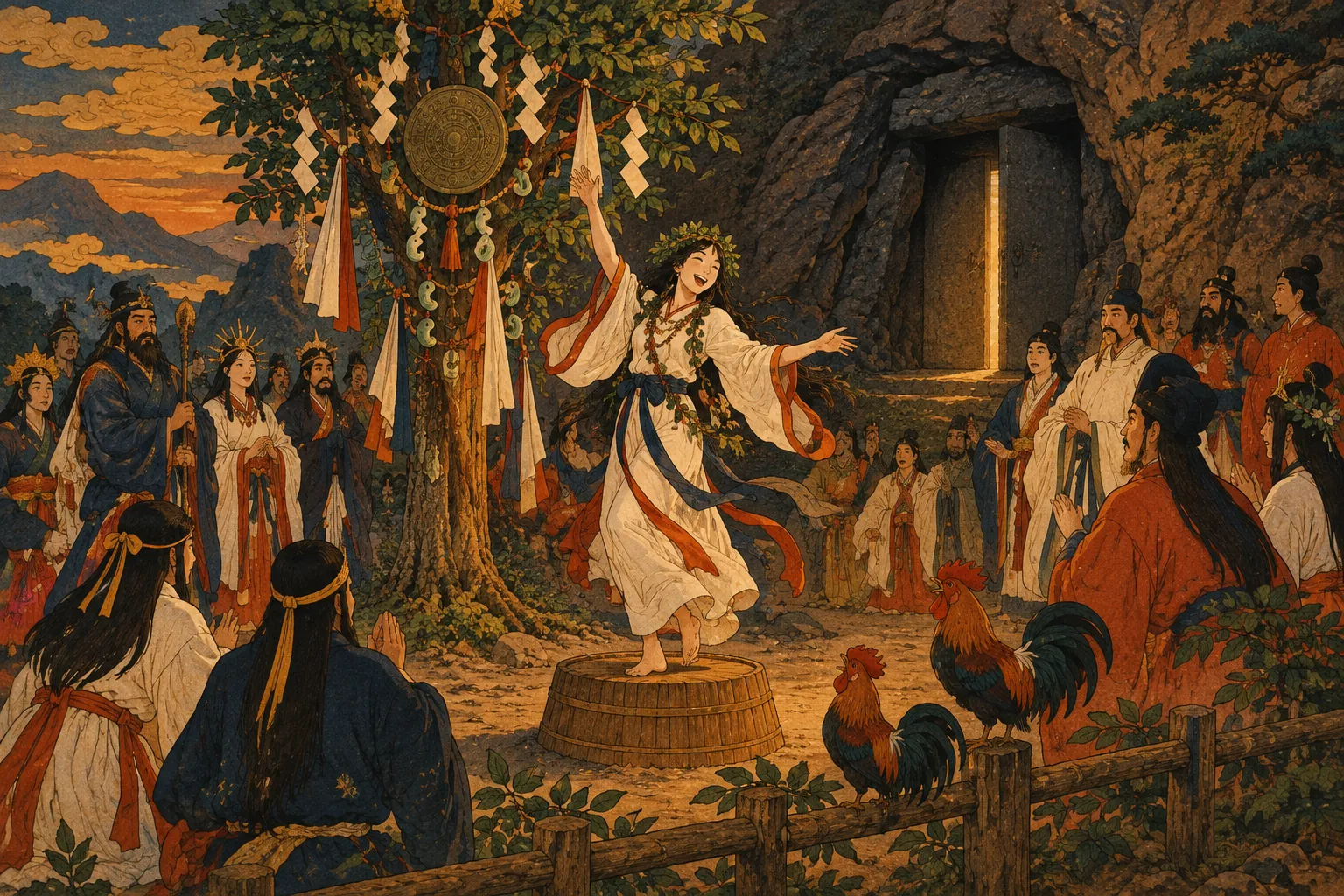
- Uproot a sacred sakaki tree from Mount Ame-no-Kaguyama and hang the jewels, the mirror and cloth offerings on it.
- Have Futodama hold up the offerings and Ame-no-Koyane chant ritual words, after a divination with a deer's shoulder bone.
Everything is set in front of the cave, like a shrine festival. The strong god Ame-no-Tajikarao hides beside the door.
Uzume's dance
Ame-no-Uzume ties back her sleeves with vines, crowns herself with leaves and carries bundles of bamboo grass. She overturns a wooden tub in front of the cave and stamps on it until it booms.
She falls into a possessed state, and as she dances her robe slips. The whole High Plain of Heaven shakes with the laughter of the eight hundred myriad gods.
The door opens
Inside the cave, Amaterasu is puzzled. She says she hid so that the world would be dark, so why are the gods laughing and dancing?
Uzume answers that they are glad because a god more illustrious than Amaterasu has appeared. While she speaks, Koyane and Futodama lift the mirror towards the door.
Amaterasu leans out to see who this rival is. Tajikarao, waiting by the door, takes her hand and pulls her into the open.
Futodama stretches a rope of rice straw behind her and tells her she may not go back inside. The light returns to heaven and earth.
After the light returns
The gods fine Susanoo heavily, cut his beard and the nails of his hands and feet, and drive him out of heaven. From there his story moves to the land of Izumo.
Where the story comes from
The Kojiki ("Record of Ancient Matters") was presented to Empress Genmei in 712. By its own preface, the court scholar Ō no Yasumaro wrote it down from the recitation of Hieda no Are, who knew older family records and tales by heart.
The hidden cave sits in the first of its three volumes, the age of the gods. That volume traces events from the creation of the world to the ancestors of the ruling family.
The Nihon Shoki ("Chronicles of Japan"), finished in 720 and written in classical Chinese, tells the same episode. It gives a main text and then several "another writing says" variants.
The best-known differences are these:
- In the Kojiki a weaving woman dies. In the main text of the Nihon Shoki, Amaterasu herself is hurt by the shuttle.
- The Kojiki gives Uzume bundles of bamboo grass. The Nihon Shoki has her hold a spear wrapped in grass.
- The Nihon Shoki lists alternative versions of who made which object, so the cast of craftsmen changes from account to account.
Neither book is an eyewitness record. Both draw on older oral tradition and were shaped for a court that wanted a written account of its gods.
The Edo-period scholar Motoori Norinaga spent decades on his commentary Kojiki-den, finished in 1798. It made the Kojiki's difficult text readable and is why this version of the story is the one most people know.
What it means
The first thing to notice is that the offences against Amaterasu are agricultural: broken rice ridges, filled ditches, a fouled harvest hall. The loss of the sun is a farming disaster as much as a divine quarrel.
The second is how the crisis ends. The gods use a gathering, a ritual and shared laughter, not weapons, and many scholars see the scene as a picture of a festival that calls a spirit back.
The mirror matters too. Amaterasu is drawn out by seeing a bright figure, which is her own reflection.
Mirror and jewels reappear later in the Kojiki, when Amaterasu sends her grandson Ninigi down to rule the land. By tradition, a mirror is the sacred object of her shrine at Ise.
The rope that closes the door behind her is the straw rope (shirikume-nawa) of the text. Shinto shrines still hang straw ropes (shimenawa) to mark sacred space.
Shinto is a living tradition, so the story is best read as belief and ritual memory. Its dance is echoed in kagura, the sacred music and dance performed at shrines.
Where you can see it today
Local tradition in Takachiho, in Miyazaki Prefecture, places the cave in its mountain valley. Amano Iwato Shrine stands there, and night kagura performances retell the story.
Many other shrines across Japan hold festivals that draw on the same images of mirror, jewels and dance.
Common misconceptions
"The other gods locked her in." The Kojiki says Amaterasu closed the door herself.
The gods only prevent her from going back in.
"It describes a solar eclipse." Some modern writers suggest this, but the text never mentions an eclipse and there is no evidence for it.
It is an interpretation, not a fact.
"Uzume's dance is just a joke." The Kojiki frames it as ritual possession, and the laughter is what breaks the deadlock.
"The Kojiki is a history book." It mixes myth, genealogy and songs.
It is a source for belief and for how the early court told its own story.
Read next
Japanese mythology and the Kojiki gives the full map of the book and the order of its stories.
Susanoo and the eight-headed serpent follows the banished brother to Izumo.