In five minutes
Pandora's box is a Greek myth about the first woman, a sealed jar and the troubles that entered the human world. The fullest telling is in Hesiod's Works and Days, composed around 700 BCE, with a shorter version in his Theogony.
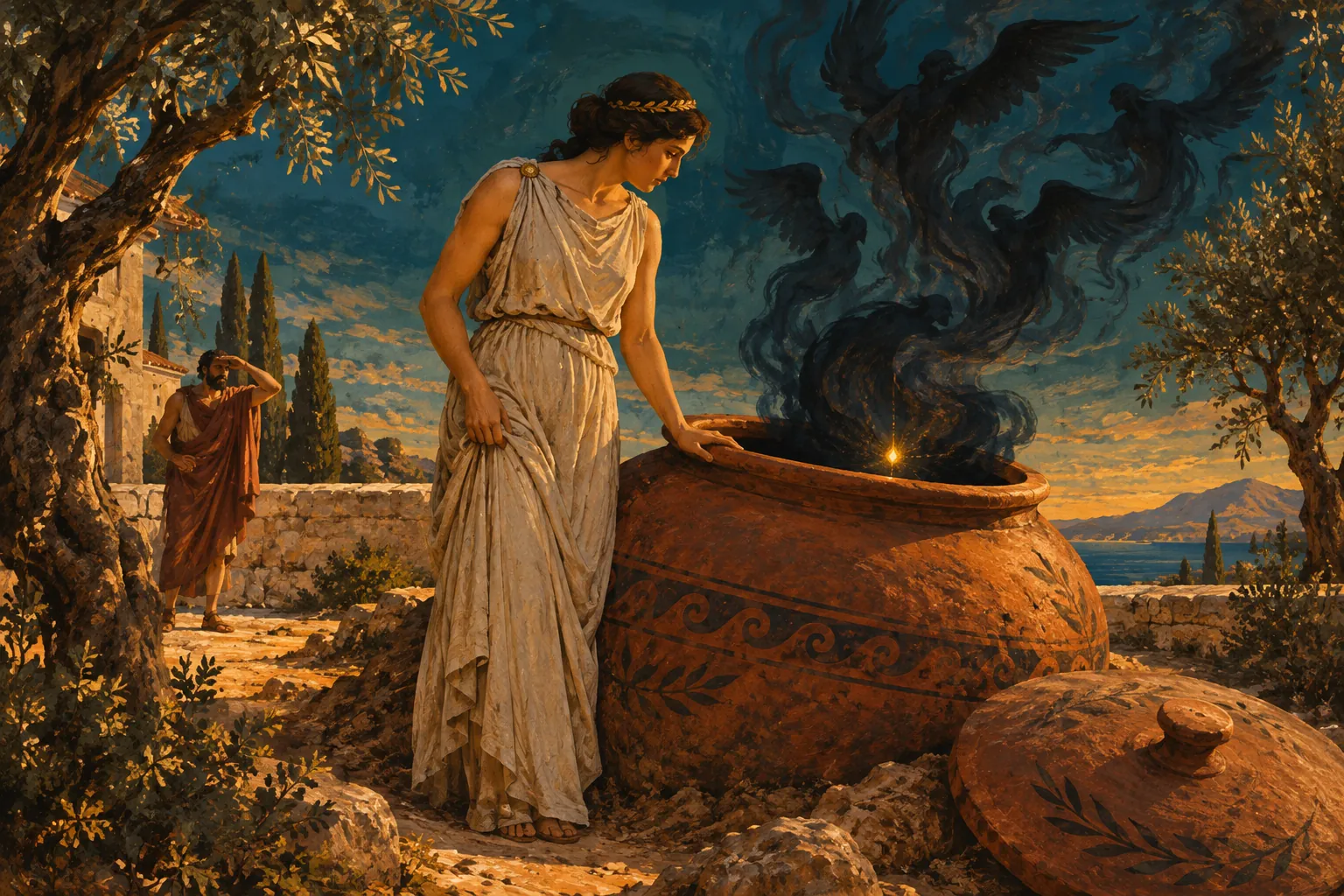
In Hesiod there is no box. Pandora lifts the lid of a large storage jar, a pithos, and evils pour out while Hope stays under the rim.
The word “box” arrived more than two thousand years later, when the scholar Erasmus put the story into Latin. Today “opening Pandora's box” means starting something that cannot be undone.
This page belongs to our guide to Greek mythology explained. It tells the story first, then the sources, the variants and the meaning.
The story
Fire and the anger of Zeus
The myth starts with a quarrel between gods and humans. Prometheus, a Titan on humanity's side, tricked Zeus over the share of a sacrificed ox, and Zeus answered by hiding fire from people.
Prometheus stole it back, carrying a spark in a hollow fennel stalk. Zeus decided that humankind would pay for the theft with a gift that looked lovely and would bring them grief.
The first woman
Zeus ordered Hephaestus, the divine smith, to mould a woman from earth and water. Athena dressed her and taught her to weave, and Aphrodite gave her charm and longing.
Hermes, the messenger god, gave her a sly mind and a talent for persuasive words. Because every god had given her a gift, Hesiod explains, she was named Pandora, “all gifts”.
The Graces and Persuasion hung golden necklaces on her, and the Seasons crowned her with spring flowers.
Epimetheus and the jar
Zeus sent Pandora to Epimetheus, whose name suggests “afterthought”, while his brother Prometheus' name means “forethought”. Prometheus had warned him never to accept a gift from Zeus, but Epimetheus took her in and understood the danger only afterwards.
Before this, Hesiod says, human tribes lived without hard labour or painful disease. Then Pandora took the great lid off a jar and scattered sorrows, toil and sickness among people.
The poem does not say where the jar came from or why she opened it. It only says that she did.
Hope alone stayed behind. In our own translation: “Only Hope stayed there, in an unbreakable home, under the rim of the jar.”
Following the plan of Zeus, Pandora put the lid back before Hope could fly out. Hesiod adds that the other troubles still roam by day and by night, in silence, because Zeus took away their voice.
His conclusion is grim: there is no way to escape the mind of Zeus.
Hesiod's earlier telling
In the Theogony the woman has no name and there is no jar. She is a “beautiful evil” made for men, and the poet compares women to drones in a hive that eat what the workers gather.
Both poems reflect the view of a farmer-poet in a male-dominated society. Modern readers usually take the story as an ancient explanation for why life is hard, not as a fair judgement on women.
From jar to box: the variants
The Greek word in Hesiod is pithos, a big clay jar used to store wine, oil or grain. It was far too large to be a small box that someone could hold in her lap.
The change is usually traced to 1508, when Erasmus included the story in his Latin collection of sayings, the Adagia. He used a word meaning a small box, and writers and painters followed his version.
Other ancient versions differ. In Book 24 of Homer's Iliad, Zeus keeps two jars on his floor, one of good gifts and one of bad, and Pandora does not appear.
A later fable, collected under the name of Babrius, has Zeus store good things in a jar that a man opens. The goods fly back to the gods and only Hope is left among people, so in that version Hope reads as a comfort.
In the mythographer's handbook known as the Library, attributed to Apollodorus, Pandora and Epimetheus have a daughter, Pyrrha. She survives the great flood with her husband Deucalion, and the jar does not feature there.
Where the story comes from
Our anchor text is Hesiod's Works and Days, a poem of advice on farming and fair dealing addressed to the poet's brother Perses. The Pandora passage sits near the start and explains why people must work for their bread.
Hesiod is traditionally placed around 700 BCE, a farmer-poet from Boeotia in central Greece. His Theogony tells how the gods came to be, and its Prometheus section holds the shorter telling above.
Both poems are in the public domain, and every quotation on this page is our own translation. Athenian vase painters also showed the birth of Pandora, with gods gathered around the new woman.
The Pandora passage is followed in Works and Days by Hesiod's account of the five ages of humankind, which runs from a golden age down to the harsh age of iron. Together the two stories explain how people ended up in a world of labour and loss.
The poem's purpose is practical. Hesiod wants his brother to stop quarrelling over land and to work honestly, and the myth shows why that effort is unavoidable.
Pandora's name and her afterlife
Hesiod reads the name Pandora as “given all gifts”, because every god added something. Some modern scholars point out that the same Greek name can also mean “giver of all”, which may hint at an older earth figure behind the story.
That older reading is a scholarly guess, and Hesiod's own explanation is the one the text gives. It does show that the character may have meant more than the poet allowed.
After the Renaissance, painters usually showed Pandora with a small casket and an anxious or curious face. These images came from the Erasmus version, not from the Greek poems.
In everyday English the phrase has grown beyond the myth. People use it for new technology, political decisions or scientific discoveries that may lead to consequences nobody can control.
What it means
Hesiod never explains Hope. The Greek word elpis means expectation and can point to good or bad things, so readers have long argued whether hope is a comfort kept for people or an illusion locked away.
If Hope is good, its staying in the jar can mean people still have it, or that it was kept out of reach. The text allows both readings, which is part of why the myth stays alive.
The story is also an origin tale. It explains work, illness and death as the price of Prometheus' theft, and it shows Zeus answering a clever trick with a cleverer one.
Today the phrase has a looser meaning: an action that releases problems nobody planned for. The original myth adds a small detail worth remembering, that something was left in the jar.
Common misconceptions
“It was a box.” Hesiod describes a jar, and the box comes from Erasmus around 1508.
“Pandora was curious.” Hesiod gives no motive, and the curiosity is a later addition.
“Hope escaped, or Hope was an evil.” In Hesiod Hope stays under the rim, and whether that is good news is still debated.
“Pandora was being punished.” In the poem she herself is the punishment Zeus sends to humankind for the theft of fire.
Read next
Start with Greek mythology explained for the wider map of gods, Titans and heroes.
Then meet the gods who gave Pandora her gifts in The twelve Olympian gods.