In five minutes
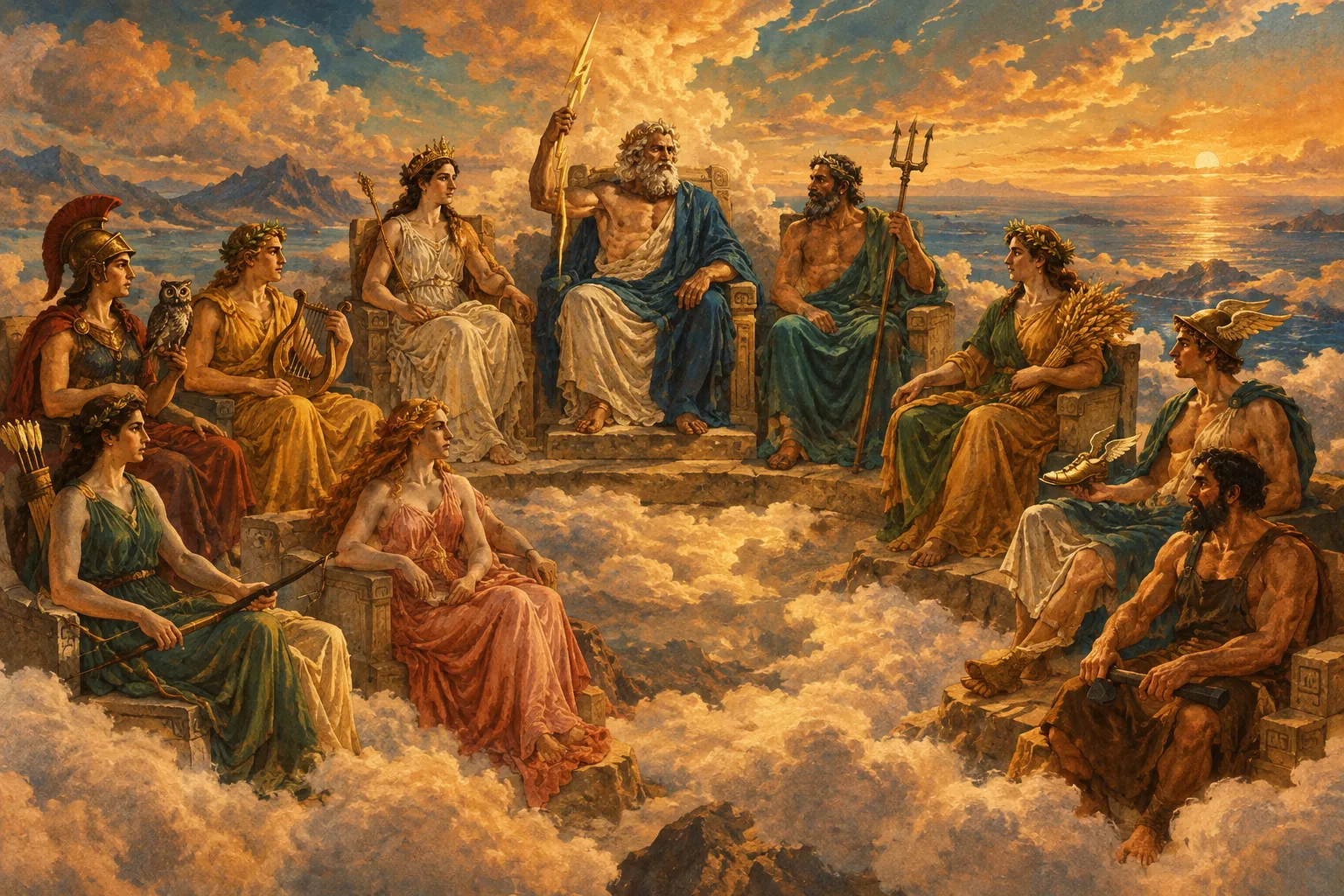
The twelve Olympian gods are the main deities of Greek mythology, the family said to rule the world from the peak of Mount Olympus. The Greeks called the group the Dodekatheon, "the twelve gods".
The names that appear on almost every list of Greek gods and goddesses are Zeus, Hera, Poseidon, Demeter, Athena, Apollo, Artemis, Ares, Aphrodite, Hephaestus and Hermes. The twelfth seat belongs to Hestia in some sources and to Dionysus in others.
This guide follows the oldest written accounts: Hesiod's Theogony, the Homeric Hymns and Apollodorus' Library. For the wider map of the myths, start with Greek mythology explained.
The twelve at a glance
- Zeus (Roman Jupiter): king of the gods, sky and thunder. Symbols: thunderbolt, eagle, oak.
- Hera (Juno): queen of the gods, marriage and women. Symbols: peacock, diadem, pomegranate.
- Poseidon (Neptune): the sea, earthquakes and horses. Symbols: trident, horse.
- Demeter (Ceres): grain and harvest. Symbols: sheaf of wheat, torch.
- Athena (Minerva): wisdom, crafts and strategic war. Symbols: owl, olive tree, aegis.
- Apollo (Apollo): music, prophecy, healing and light. Symbols: lyre, bow, laurel.
- Artemis (Diana): the hunt, wild animals and young girls. Symbols: bow, deer.
- Ares (Mars): war as violence and battle fury. Symbols: spear, helmet.
- Aphrodite (Venus): love, desire and beauty. Symbols: dove, myrtle, seashell.
- Hephaestus (Vulcan): fire, the forge and craft. Symbols: hammer, anvil, tongs.
- Hermes (Mercury): messages, travellers, trade and boundaries. Symbols: winged sandals, herald's staff.
- Hestia (Vesta) or Dionysus (Bacchus): the hearth, or wine and festival. Symbols: hearth fire, or ivy and vine.
The story: how the twelve came to rule
In Hesiod's Theogony, the world begins with Chaos and Gaia, the Earth. Gaia's son Ouranos, the Sky, becomes the first ruler, and the Titans are born from them.
Their youngest son Cronus overthrows his father and takes the throne. He then learns that one of his own children is fated to overthrow him.
So Cronus swallows each child as soon as it is born. Hestia, Demeter, Hera, Hades and Poseidon all disappear into him.
When Zeus is about to be born, his mother Rhea hides him on Crete. She hands Cronus a stone wrapped in cloth, and he swallows it.
Zeus grows up and forces Cronus to bring his siblings back up. Then the young gods and the Titans fight a war that lasts ten years.
Zeus wins with the help of the Cyclopes, who give him the thunderbolt, and of the Hundred-Handers. The other gods then ask him to rule, and he divides out their honours.
Apollodorus adds a tidy detail: the three brothers draw lots, and Zeus gets the sky, Poseidon the sea and Hades the underworld. Hades stays below, which is why he is not usually counted among the twelve.
Later children join the family: Athena, Apollo, Artemis, Ares, Hephaestus, Hermes and Aphrodite, each with a different birth. Together with Zeus's siblings they make up the court of Olympus.
Meet the twelve
Zeus
Zeus is the youngest son of Cronus and Rhea and, after the Titan war, king of gods and humans. He rules the sky, weather and justice, and his weapon is the thunderbolt.
He is not the creator of the world, since in Hesiod the earth and sky exist before him. He is the ruler who keeps the order.
Hera
Hera is Zeus's sister and wife, queen of Olympus and guardian of marriage. Her symbols are the peacock, the diadem and the pomegranate.
Many stories show her angry at Zeus's affairs. Yet she was also worshipped as a great goddess in her own right, with major sanctuaries at Argos and Samos.
Poseidon
Poseidon, brother of Zeus, rules the sea. Greeks also thought of him as the god who shakes the earth and the god of horses.
His symbol is the trident. Sailors prayed to him before a voyage, and coastal cities that feared earthquakes honoured him too.
Demeter
Demeter, another sister of Zeus, is the goddess of grain and harvest. Her symbols are the sheaf of wheat and the torch.
Her most famous story is told in the Homeric Hymn to Demeter. Her daughter Persephone is taken to the underworld, and Demeter's grief explains why the seasons turn.
Athena
Athena is the goddess of wisdom, crafts and strategic war, and the patron of Athens. Her symbols are the owl, the olive tree, the helmet and the aegis.
Hesiod says Zeus swallowed her mother Metis, and Athena was then born from his head. The Homeric Hymns picture her appearing fully armed.
Apollo
Apollo, son of Zeus and Leto, is the god of music, prophecy, healing and light. His symbols are the lyre, the bow and the laurel.
His oracle at Delphi was among the most respected in the Greek world. The Homeric Hymn to Apollo tells how he and his twin sister were born on the island of Delos.
Artemis
Artemis, Apollo's twin, is the goddess of the hunt, wild places and young girls. She also watches over childbirth.
Her symbols are the bow and the deer, and Greek tradition pictured her as a lifelong maiden. Later writers linked her with the moon.
Ares
Ares, son of Zeus and Hera, is the god of war as raw violence. His symbols are the spear and the helmet.
Homer's Iliad has Zeus himself call Ares hateful. He is the opposite of Athena, who stands for planning and strategy.
Aphrodite
Aphrodite is the goddess of love, desire and beauty. Her symbols are the dove, the myrtle and the seashell.
Her birth has two versions. Hesiod has her rise from the sea foam, while Homer calls her a daughter of Zeus and Dione.
Hephaestus
Hephaestus is the god of fire, metalwork and craft. He is the working god of the family, and his symbols are the hammer, the anvil and the tongs.
In the Theogony Hera bears him alone, while Homer names Zeus and Hera as parents. In Hesiod's Works and Days he shapes the first woman from clay, a story told in Pandora and her box.
Hermes
Hermes, son of Zeus and the nymph Maia, is the messenger of the gods. He guides travellers, protects trade and boundaries, and leads souls to the underworld.
The Homeric Hymn to Hermes says he was born in a cave and stole Apollo's cattle on his first day. His winged sandals and herald's staff make him easy to spot in art.
Hestia
Hestia, eldest child of Cronus and Rhea, is the goddess of the hearth. Her symbol is the household fire itself.
She has almost no adventures. The hymns give her the first and last offering at a sacrifice, a sign of how central the hearth was to Greek life.
Dionysus
Dionysus, son of Zeus and the mortal woman Semele, is the god of wine, festival and ecstasy. His symbols are ivy, the vine and the fennel staff called the thyrsus.
Many tellings treat him as the youngest of the great gods, the one who joined Olympus last. His festivals are tied to the origins of Greek theatre.
Who gets the twelfth seat?
The Greeks never kept one official roster. Lists changed with the city, the festival and the artist.
The most famous cult evidence is the Altar of the Twelve Gods in the Athenian Agora, dedicated in 522/1 BC. The Parthenon's east frieze shows seated gods that scholars commonly read as the Olympians.
Hestia and Dionysus are the two usual candidates for the last place. Hestia was among the first-born of Zeus's generation, while Dionysus was the newcomer with a growing cult.
This is why a careful list gives eleven fixed names and one flexible seat. Hades, Persephone and Heracles are important, but they are not part of the standard twelve.
Where the story comes from
Hesiod's Theogony, composed about 700 BC, is the oldest long account of how the gods were born and how Zeus came to rule. It gives the lineage of Cronus and the war with the Titans.
The Homeric Hymns are a collection of poems praising individual gods, among them Demeter, Apollo, Hermes, Aphrodite and Dionysus. They were composed over a long span of time and fill in birth stories and special powers.
Apollodorus' Library is a prose handbook of myth from about the 1st or 2nd century AD. It lines up the different traditions in one orderly narrative, which makes it a handy cross-check.
The three works do not always agree, and the Greeks did not mind. Myth was a living tradition told differently in different places.
What it means
The twelve gods work as a map of the Greek world. Each one owns an area of life: sea, harvest, craft, war, love, travel, home.
The gods are also strongly human in temper. They argue, take sides and hold grudges, and that is why their stories keep telling us about power and family tension.
Ancient Greeks honoured these gods in cult and festival, not only in stories. Reading the myths today helps us see what they valued and feared, without treating the tales as history.
Common misconceptions
"Zeus created the world." In Hesiod the cosmos exists before Zeus, and he comes to power only after two earlier rulers.
"Hades is an Olympian." He is one of Zeus's brothers, but his realm is below the earth, so he is normally left out of the twelve.
"The list of twelve never changes." Eleven names are very stable, but the twelfth varies by source and by place.
"Greek and Roman gods are the same." The Romans matched their gods to Greek ones, such as Jupiter to Zeus, yet each had its own cult and character.
Read next
Greek mythology explained places the twelve gods within the whole story, from Chaos to the heroes.
Pandora and her box shows Hephaestus, Athena, Aphrodite and Hermes at work in one of Hesiod's best-known tales.