In five minutes
Sisyphus was a king of Ephyra, the city later known as Corinth, and the craftiest mortal in Greek myth. After death he was sentenced to push a huge stone up a slope in the underworld, and each time it nears the top it rolls back down.
The oldest surviving picture of this punishment is in Homer's Odyssey, Book 11. Homer shows the labour but never explains the crime, so later writers supplied the stories of his tricks.
Those stories are why he is remembered: he cheated Death twice and was given a task that never ends. Today the word “Sisyphean” describes any effort that keeps returning to the start.
Sisyphus is one figure in a much larger world of gods and heroes. For the wider picture, see our guide to Greek mythology explained.
The story
A king who was too clever
Sisyphus was a son of Aeolus and the founder of Ephyra, a rich trading town on the narrow strip of land between two seas. Later Greeks knew the city as Corinth.
Corinth sat beneath Acrocorinth, a steep rock that served as a natural fortress and watched over the harbours of the isthmus. A king there controlled trade routes, which fits the picture of a clever, wealthy ruler.
Some later writers also credit Sisyphus with founding the Isthmian Games, in memory of his nephew Melicertes. That makes him a civic founder as well as a trickster.
He married Merope, one of the Pleiades, and their son Glaucus became the father of the hero Bellerophon. So Sisyphus was also a grandfather of a famous hero.
In the Iliad, Book 6, he is introduced as the most cunning of men. That was meant as praise, and it also hints at danger.
The Roman writer Hyginus preserves another tale of his cunning. When a thief named Autolycus kept stealing his cattle, Sisyphus is said to have marked their hooves so he could prove the theft.
Stories like this show why Greeks admired and feared him. His wits were useful to a city, yet they also made him a man no one could trust.
Telling Zeus's secret
In the mythographer Apollodorus, Zeus carries off Aegina, the daughter of the river god Asopus. Asopus goes searching for her, and Sisyphus, who has seen what happened, tells him.
In some versions he is paid with a spring of fresh water for Corinth's high citadel. Betraying the king of the gods was a serious offence, and Zeus sent Thanatos, Death himself, to take Sisyphus down to the underworld.
Chaining Death
Sisyphus outwitted Thanatos and locked him in chains instead. While Death was bound, nobody on earth could die.
The result was chaos, not mercy. Ares, the god of war, found that his battles had lost their point, so he freed Death and handed Sisyphus over.
Going home from the underworld
Before dying, Sisyphus had told his wife Merope not to carry out his funeral rites. In the underworld he complained that she was neglecting him and asked leave to return and set her straight.
Our sources disagree on who was fooled: Hades in some tellings, his queen Persephone in others. Either way, Sisyphus went home and stayed there.
He lived to old age, and in the end the god Hermes, who guides the dead, took him back by force. Greek writers of later centuries, among them the poet Theognis and Apollodorus, tell this part with relish.
The stone
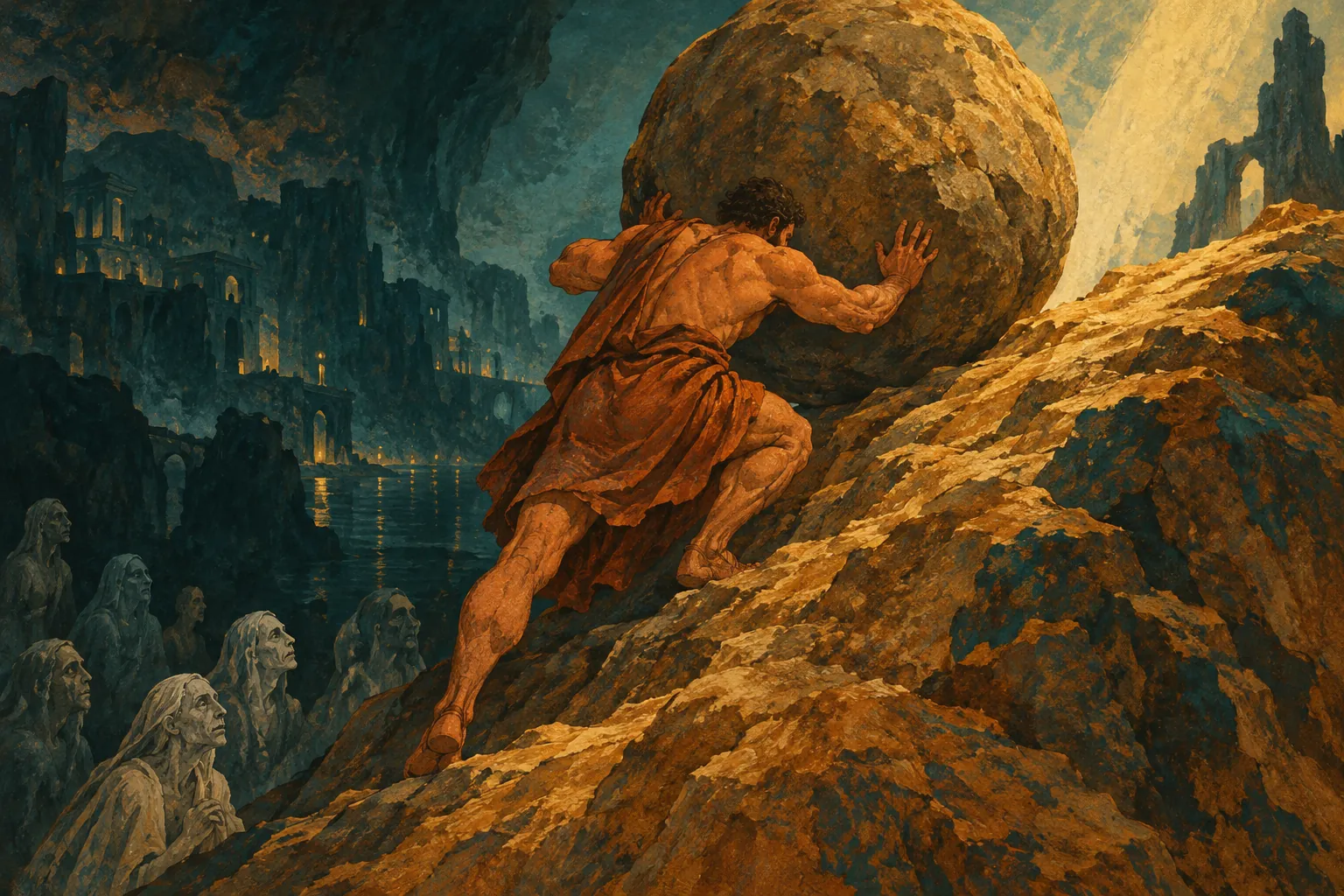
Odysseus meets Sisyphus in Odyssey Book 11, when he visits the land of the dead. Sisyphus is straining with both arms to shove a huge stone up a slope, bracing hands and feet.
Just as he is about to tip it over the crest, some force turns the stone back, and it bounds down to the plain. Then he begins again, sweat running from his limbs and dust rising from his head.
Homer places Sisyphus among a small group of famous sufferers Odysseus sees in the same book, alongside Tityos and Tantalus. Each has a punishment that fits the offence.
Notice that Sisyphus is not tortured by a monster or by fire. His only enemy is the stone and the slope, which is part of why the image feels so modern.
The Roman poet Ovid, in the Metamorphoses, Book 4, lists Sisyphus among the punished dead. In Book 10, while Orpheus sings, Sisyphus sits down on his stone and the labour pauses for a moment.
Where the story comes from
No ancient book tells the life of Sisyphus from start to finish. The pieces are scattered through Homer's Iliad and Odyssey, the poems of Theognis, Apollodorus's handbook of myths, and Ovid's Metamorphoses.
This article builds on Odyssey Book 11, the oldest surviving account of the punishment, and treats the other tales as later tradition.
The versions differ in several places. Homer speaks of a stone, and the image of a great round boulder grew up later.
Homer gives no reason for the punishment. Some tellers blame the betrayal of Zeus, some the cheating of Death, and some combine both.
In Greek tragedy, enemies of Odysseus sometimes sneer that he is really the son of Sisyphus. The idea rests on a later rumour that his mother Anticleia was already carrying a child when she married Laertes.
The modern reading comes from the French writer Albert Camus, whose 1942 essay The Myth of Sisyphus reshaped how the story is understood. We describe his argument in our own words below.
What it means
The punishment fits the crime. A man who refused to stay dead is given a task he can never finish.
For ancient listeners it was a warning against defying the order of the gods. Whoever sells Zeus's secrets and chains Death is caught in the end.
Greek readers also saw in him the danger of cleverness without respect. Cunning was a prized quality, yet in the end Zeus and Hades hold the real power.
The stone also looks like a picture of ordinary labour: the same chores, repeated daily, with no final victory. That is why “Sisyphean” has stayed in English for any task that never seems to end.
Why Camus called him happy
Camus read the myth as a picture of a person who looks for meaning in a world that gives no answer. He called that gap between hope and silence “the absurd”.
He published the essay in 1942, in occupied France, and it begins by asking whether life is worth living at all. Sisyphus is his answer to that question.
His attention falls on the walk back down the hill after the stone has rolled away. In that pause Sisyphus knows exactly what his fate is.
Camus argued that a person who sees the fate clearly and keeps pushing is stronger than it. He ends by saying we must imagine Sisyphus as happy.
The final image is not of triumph but of acceptance. The struggle itself, he says, is enough to fill a person's heart.
This is Camus's reading, not Homer's. The old poem presents a punishment, and a twentieth-century thinker found a different meaning in it.
Common misconceptions
“Homer explains the crime.” He does not; the reasons come from later writers.
“Sisyphus never gets close.” In Homer he reaches the very edge of the crest before the stone turns back.
“It takes place in hell.” The setting is the Greek realm of the dead ruled by Hades, which is not the Christian hell.
“Camus said the myth means happiness.” Camus offered his own reading of the story and never claimed that the ancient sources say it.
Read next
Greek mythology explained maps the gods, titans and heroes around Sisyphus, so you can see where Corinth's king fits.
Persephone, Hades and the seasons tells the story of the queen and king of the underworld, the very rulers Sisyphus tried to trick.