In five minutes
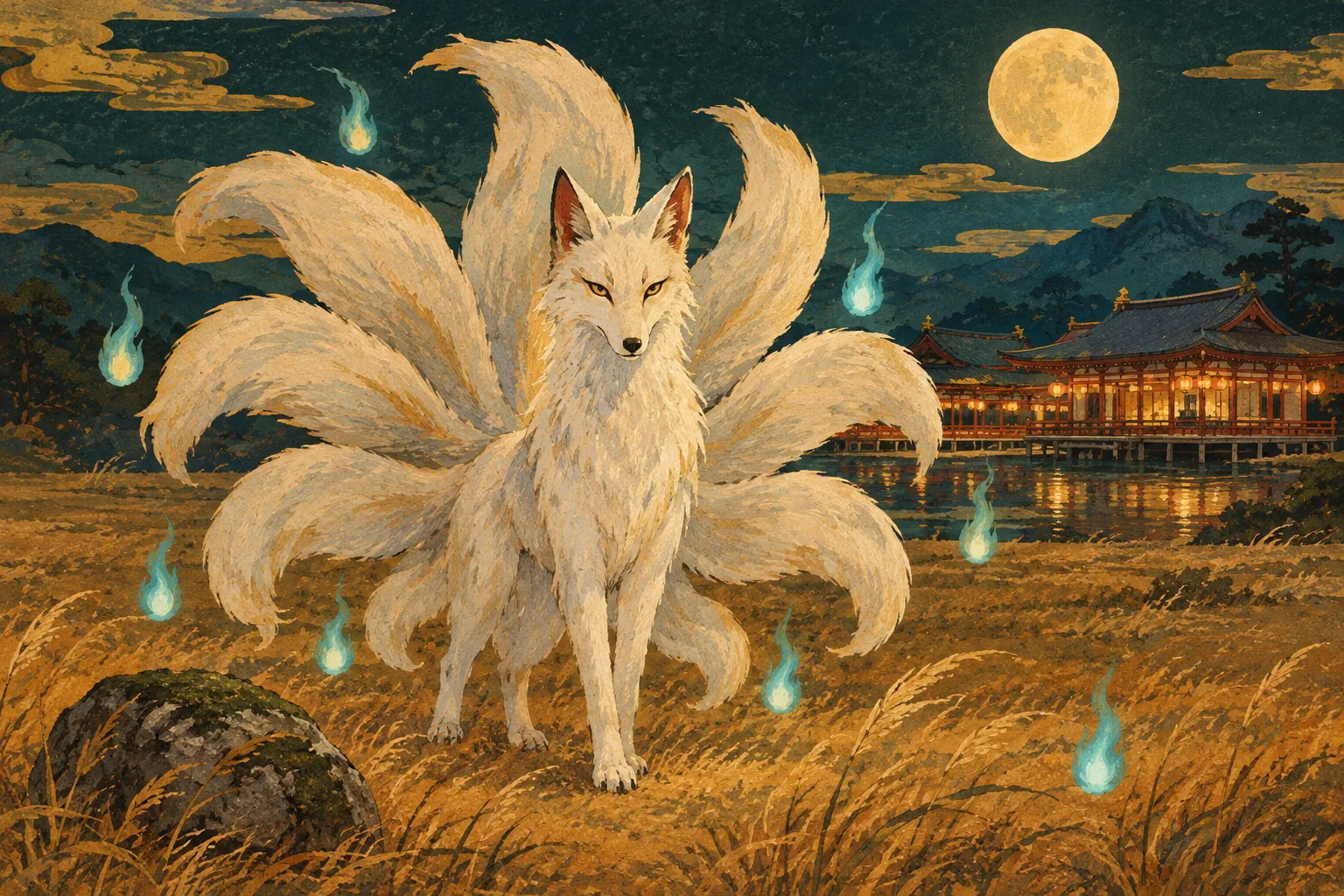
A kitsune is a fox in Japanese folklore that has gained magic with age. It can take human shape, make false lights and lead travellers astray.
The old stories use it in two ways: as a trickster or danger, and as a faithful, sorrowful wife.
The famous "nine-tailed fox" (kyūbi no kitsune) is the oldest and most powerful form. The more tails a fox has, the more years and power the tales give it.
The best-known nine-tailed fox is Tamamo-no-Mae, a court lady said to have served the retired emperor Toba in the first half of the twelfth century. The best-loved fox wife is Kuzunoha, the mother of the diviner Abe no Seimei.
This page is part of our guide to Japanese mythology and the Kojiki. Kitsune also belong to the wider world of yokai, Japan's spirits and monsters.
The story
There is no single kitsune myth. There are three well-known tales, and each shows a different side of the fox.
The fox wife of Mino
The oldest tale comes from the Nihon Ryōiki, a Buddhist story collection compiled around 822 by the monk Kyōkai. A man from Mino province goes looking for a good wife and meets a beautiful woman on a wide field.
They marry, and she bears a son.
At the same time, the household dog gives birth to a puppy, and the puppy keeps snarling at the wife. One day it lunges at her, and in her terror she turns back into a fox and leaps onto the fence.
Her husband is not angry. He tells her that they have a child together and that he cannot forget her, so she should come and sleep with him whenever she likes.
She does, and the tale says this is how the fox got its name. The words for "come and sleep" sound like kitsu-ne, a piece of wordplay in the story rather than proven word history.
Their son grows up famous for his strength.
Tamamo-no-Mae and the nine tails
In the later legend, a young woman named Tamamo-no-Mae appears at the court of the retired emperor Toba (Toba-in), in the first half of the twelfth century. She is beautiful, learned and seems to know everything.
The retired emperor falls ill, and no prayer cures him. The court diviner (in most versions Abe no Yasunari) names Tamamo as the cause and says she is a fox with nine tails.
Exposed, she flees to the Nasu plain in the north. Two warriors, usually named Kazusa-no-suke and Miura-no-suke, chase her down and kill her.
The tale says her spirit stayed in a rock, the Sesshō-seki, or "killing stone", which poisoned anything that came near it. Later stories have a Buddhist priest release her spirit.
In March 2022 the stone, which is a real landmark at Nasu, was found split in two, and the news spread widely.
Kuzunoha of Shinoda forest
In the Kuzunoha story, a man named Abe no Yasuna saves a white fox from hunters in Shinoda forest, in what is now Osaka. Soon afterwards, a woman named Kuzunoha comes to nurse his wounds.
They marry and have a son, Dōji-maru, who is later said to be Abe no Seimei. Years pass, and then the boy sees his mother's tail, or she sees her own fox shadow, depending on the telling.
She cannot stay, and she writes a farewell poem on the paper door. In our own words, it says: "If you miss me, come and find me in Shinoda forest in Izumi."
Her husband can only follow her to the forest. The tale ends with her gone and the child carrying her magic.
Where the story comes from
Our main anchor is the Nihon Ryōiki, the earliest Japanese collection of Buddhist miracle tales. It holds the fox-wife story and the naming joke above.
The second anchor is the Konjaku Monogatarishū, a large collection of tales from the early twelfth century. It shows foxes in many roles: disguising themselves as people, frightening travellers and being caught or beaten in return.
Tamamo-no-Mae is not in either of these two books. Her tale grew in later medieval stories, plays and picture books, and Kuzunoha reached the stage in the eighteenth century, when the puppet and kabuki drama Ashiya Dōman Ōuchi Kagami was first staged in 1734.
The nine-tailed fox itself has Chinese roots. The ancient Shan Hai Jing mentions a fox with nine tails, and in China it could even be a lucky sign.
Japanese tales mostly turned it into a danger.
The versions differ widely. In some Tamamo is a Chinese or Indian fox that has haunted several kingdoms.
In others she is a local Japanese fox, and the Kuzunoha poem has several wordings.
What it means
The kitsune sits on a border: between human and animal, between the village and the wild. That border is why it can be a frightening deceiver in one story and a loving mother in another.
It is also tied to Inari, the kami of rice and prosperity. Foxes are not Inari itself.
They are its messengers, and Inari shrines across Japan, including the great Fushimi Inari Taisha in Kyoto, are guarded by fox statues, often with a key, jewel, rice sheaf or scroll in the mouth.
Fried tofu, which people say foxes like, is a common offering and gave its name to inari sushi.
Other beliefs add detail. Foxfire (kitsune-bi) is the pale lights seen at night, and a sun shower is sometimes called a fox's wedding.
Fox possession (kitsunetsuki) was a folk explanation for strange illness.
The stories about foxes asked how far an outsider can be trusted, and what a family owes to someone who is not entirely human.
Common misconceptions
"All kitsune are evil." They are not.
Folklore separates zenko, good foxes tied to Inari, from wilder, mischievous ones, and the Kuzunoha and Mino stories are about loyalty.
"Every kitsune has nine tails." Most tales give a fox one tail, and more tails come with age.
Nine is the top of the scale, not the norm.
"Kitsune are the same as the Chinese huli jing." They are related, but the Japanese fox has its own tales, including its link with Inari.
"Tamamo-no-Mae is a historical person." She is a legend.
The Nasu stone is real, but the story told about it is folklore and not history.
Read next
Japanese mythology and the Kojiki tells how Japan's own creation stories begin.
Yokai explained: Japan's spirits and monsters puts the fox next to other creatures such as the kappa and the tengu.