In five minutes: Japanese mythology and the Kojiki
Japanese mythology is the body of stories about the kami (gods and sacred beings) that were written down in the early eighth century. Two books carry almost all of it: the Kojiki (712) and the Nihon Shoki (720).
The tale starts with heaven and earth taking shape and ends with the line of emperors. In between come the island-making couple Izanagi and Izanami, the sun goddess Amaterasu, her stormy brother Susanoo, and the earth-builder Okuninushi.
Each story below has its own page on FiveMinRead. This page is the map that connects them.
The story, as the Kojiki tells it
1. The first gods and the floating land
The Kojiki opens when heaven and earth first part. Three gods appear in the high plain of heaven, Takamagahara: Ame-no-Minakanushi, Takamimusubi and Kamimusubi.
The young land below is soft and drifts like oil on water. Several more generations of gods appear, and the last of them are the pair Izanagi (伊邪那岐) and Izanami (伊邪那美).
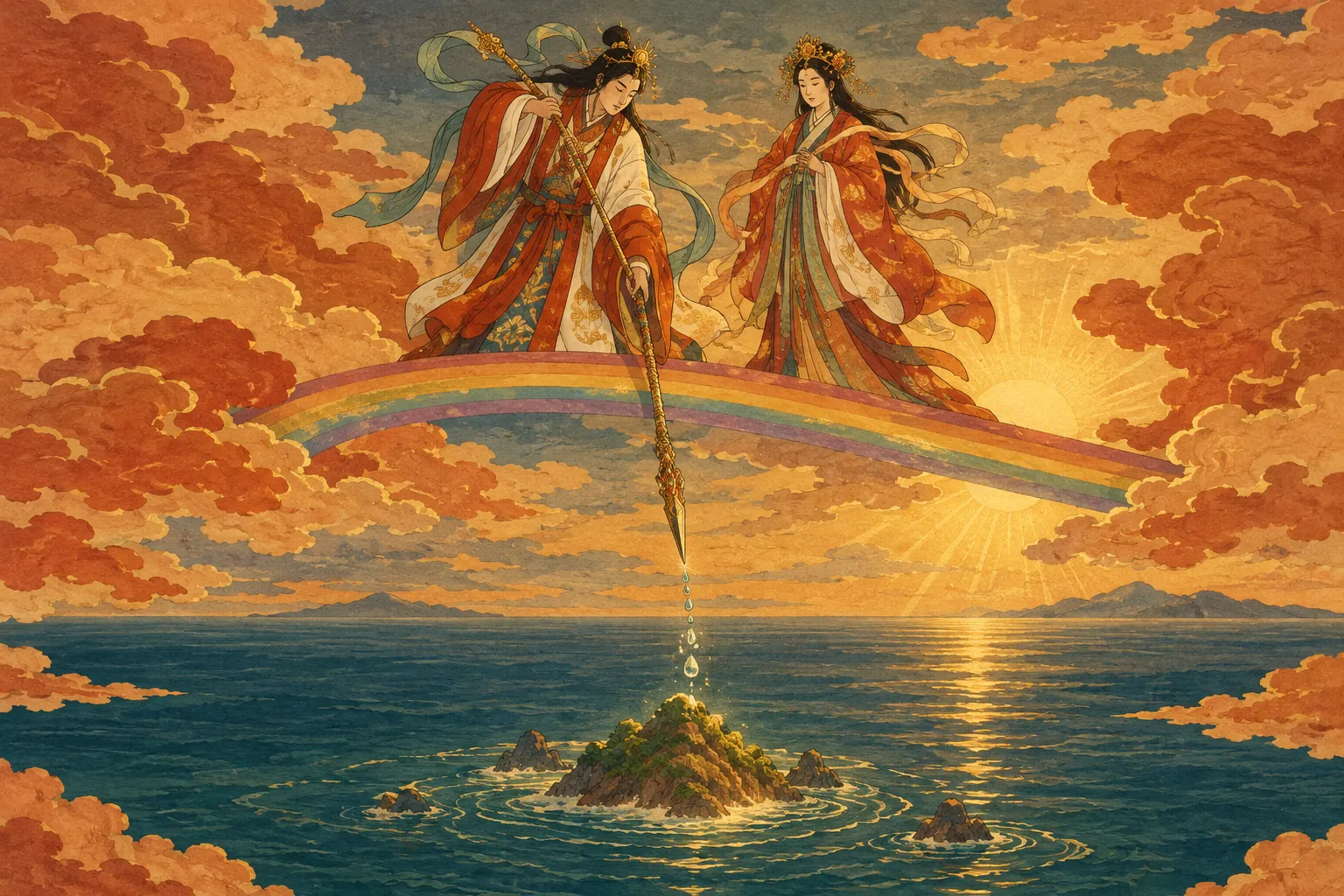
The older gods order them to make the land firm. They are given a jewelled spear.
2. Izanagi and Izanami make the islands
Standing on the floating bridge of heaven, the two stir the brine with the spear. Drops fall from its tip and pile up into the first island, Onogoro.
They descend to it and marry around a pillar. The first child is born badly, and the gods explain that the woman spoke first, so the rite is repeated in the right order.
After that Izanami gives birth to the islands of Japan one after another. She then bears many gods of wind, trees, mountains and the sea.
3. Death and the land of Yomi
The last child is Kagutsuchi, the god of fire, and the birth burns Izanami fatally. She goes down to Yomi, the land of the dead.
Izanagi follows her and begs her to return. She says she has already eaten the food of that place, and asks him not to look at her.
He breaks the promise, lights a comb-tooth as a torch and sees her decaying body. She sends the hags of Yomi after him, and he escapes only by throwing down his headdress, his comb and peaches.
At the pass between the worlds the two part for good. Izanami vows to take a thousand lives a day, and Izanagi answers that he will cause fifteen hundred births a day.
4. Purification and the three noble children
Izanagi feels defiled and bathes in a river mouth. More gods are born from his clothing and from the water as he washes.
The last three are the most important. Amaterasu (天照大御神), the sun goddess, is born from his left eye, Tsukuyomi, the moon god, from his right eye, and Susanoo (須佐之男命) from his nose.
Izanagi gives Amaterasu the heavens, Tsukuyomi the night and Susanoo the sea. Susanoo refuses and weeps until the world withers, and he is driven out.
5. Amaterasu and Susanoo
Susanoo goes up to heaven to say goodbye to his sister. She meets him armed, afraid that he comes to seize her realm, and the two swear an oath and bring forth children.
His wild behaviour afterwards frightens heaven. Amaterasu hides in the heavenly rock cave and the world goes dark.
The gods gather outside, and Ame-no-Uzume dances so wildly that they roar with laughter. Curious, Amaterasu looks out, is shown a mirror, and is drawn back into the light.
Read the full story in Amaterasu and the hidden cave.
Susanoo is banished to the land of Izumo. There he kills the eight-headed serpent Yamata no Orochi and finds the sword later called Kusanagi inside its tail.
The whole tale is in Susanoo and the eight-headed serpent.
6. Okuninushi and the handing over of the land
The Izumo section of the Kojiki then follows Okuninushi, a descendant of Susanoo. He is the kind brother in the tale of the white hare of Inaba, and he later wins the daughter of Susanoo after passing a series of trials.
He and a small helper god, Sukunabikona, build up the land. But Amaterasu decides that her own descendants should rule it.
Envoys are sent down, and the final one, Takemikazuchi, secures the agreement. Okuninushi yields the land on condition that a great shrine be built for him, the origin tradition of Izumo Taisha.
7. The descent of Ninigi and the first emperor
Amaterasu's grandson Ninigi comes down to Mount Takachiho in Kyushu. He brings three treasures: a mirror, a curved jewel and the sword Kusanagi.
Later episodes tell of Ninigi's marriage, the brothers Hoderi and Hoori (the story of the sea and the mountain), and the sea-god's palace. The grandson of Hoori is Kamu-yamato-iwarebiko.
He leaves Kyushu and fights his way east to the Yamato basin. He is later known as Emperor Jimmu, the first emperor in the tradition.
From here the Kojiki turns from gods to rulers and becomes a chronicle in its second and third books.
Where the story comes from: Kojiki and Nihon Shoki
The Kojiki (Record of Ancient Matters) was presented to the court in 712. The preface says Emperor Temmu had ordered old records to be checked and that a court reciter, Hieda no Are, memorised them.
Empress Genmei then commanded the scholar Ō no Yasumaro to write down what Are recited. The result is three volumes: the age of the gods, the early emperors from Jimmu to Ōjin, and the later emperors down to Suiko.
The text is written in a mix of Chinese characters used for meaning and for sound. This lets it keep names and songs in the old Japanese language.
The Nihon Shoki (Chronicles of Japan) followed in 720, edited under Prince Toneri. It has thirty volumes in formal classical Chinese, the language of East Asian courts, and is arranged as a year-by-year state history.
Its first two volumes cover the age of the gods. Its main feature is that it often gives several versions of one episode, introduced by a phrase meaning 'in one writing it says'.
The two books agree on the outline but differ in the details. The Nihon Shoki, for example, has a shorter Izumo section, and it describes the beginning of the world as a mass like an egg.
Both were products of the court. They put together clan traditions for a ruling family, so they are best read as the official mythology of the early Yamato state, not as a record of the village stories that existed alongside it.
What it means: reading the myths
The stories explain how the islands, the sun and the imperial line began. Amaterasu is the ancestor of the ruling family, and the three treasures became the regalia of the throne.
They also explain a view of purity. After Yomi, Izanagi cleanses himself in water, and this sets a pattern that is still seen in purification rites at Shinto shrines.
There is a tension between sky and earth, Takamagahara and Izumo. The handing over of the land can be read as a memory of how a central power came to terms with rival regions.
Scholars debate how much of that is historical. The safe reading is that the myths record how the court of 712 wanted to explain its own authority.
The Kojiki also fell out of general reading for centuries. Motoori Norinaga, an Edo-period scholar, spent more than thirty years on his great commentary, the Kojiki-den, which made the text widely studied.
Today the myths are told at shrines such as Ise, which is tied to Amaterasu, and Izumo. For many Japanese people they are part of cultural heritage and festival life, and for believers they remain a part of living Shinto.
Common misconceptions
The Kojiki is not a holy book like the Bible or the Quran. Shinto has no single founding scripture, and the Kojiki is one old and important text among several.
The Kojiki and the Nihon Shoki are not the same book. They differ in language, layout and many details, and they were made for different purposes.
Amaterasu is not simply a 'sun' in the way a Western myth might have one. She is a ruler of heaven, a weaver, a ritual figure and the ancestor of the throne.
The myths are not a complete account of Japanese folklore. Yokai, local legends and tales like Urashima Taro come from other sources.
For those see Yokai explained: Japan's spirits and monsters.
The traditional date for Jimmu's accession, 660 BC, is not a historical date. It comes from later calculation in the court tradition, and it is honoured in the national foundation day of 11 February.
Read next
Start with the best-known episode in Amaterasu and the hidden cave, which shows how the sun goddess is brought back.
Then follow her brother in Susanoo and the eight-headed serpent, where the sword of the imperial regalia appears.
For the other side of Japanese tradition, the spirits and monsters of folk belief, read Yokai explained: Japan's spirits and monsters.