In five minutes: what is Ragnarok?
Ragnarök is the end of the world in Norse mythology. It is a final battle in which gods, giants and monsters destroy one another, and the earth sinks into the sea.
Then the earth rises again, green and fresh. A few gods and two human survivors begin a new age.
The name is usually read as “the fate of the powers”, meaning the gods. A later spelling, ragnarøkkr, means “the twilight of the powers”, and that is where the popular phrase “twilight of the gods” comes from.
The story survives in two main medieval Icelandic sources. The first is the Völuspá (“the seeress's prophecy”), a poem in the Poetic Edda.
The second is Gylfaginning (“the tricking of Gylfi”), a section of the Prose Edda by Snorri Sturluson, written in the 1220s. Between them they give us almost everything we know about how the Norse gods meet their end.
In short, the chain runs like this: Baldr dies, a terrible winter falls, the monsters break loose, the gods march out to fight, and nearly everything is lost. It is the most famous ending in Norse myth, and it is also a story about what comes after.
The story: signs, battle and rebirth
The signs
The Völuspá is spoken by a seeress, a völva, who tells Odin what she remembers and what she sees coming. Ragnarök is the climax of her vision.
The first sign is the death of Baldr, the bright and well-loved son of Odin and Frigg. His blind brother Höðr kills him with a shaft of mistletoe, and Loki is behind it.
The gods try to bring Baldr back from Hel, the realm of the dead, but they fail. From here the story moves toward its end.
Next, human society breaks down. The seeress says that brothers will fight and kill their own kin, and she puts it plainly: “Brothers will fight and bring each other death.”
(Völuspá, our translation)
Snorri's Gylfaginning adds Fimbulwinter. It is a great winter that comes three times in a row with no summer between, and snow drives in from every direction.
Then the sky fails. Wolves swallow the sun and the moon, and the stars vanish.
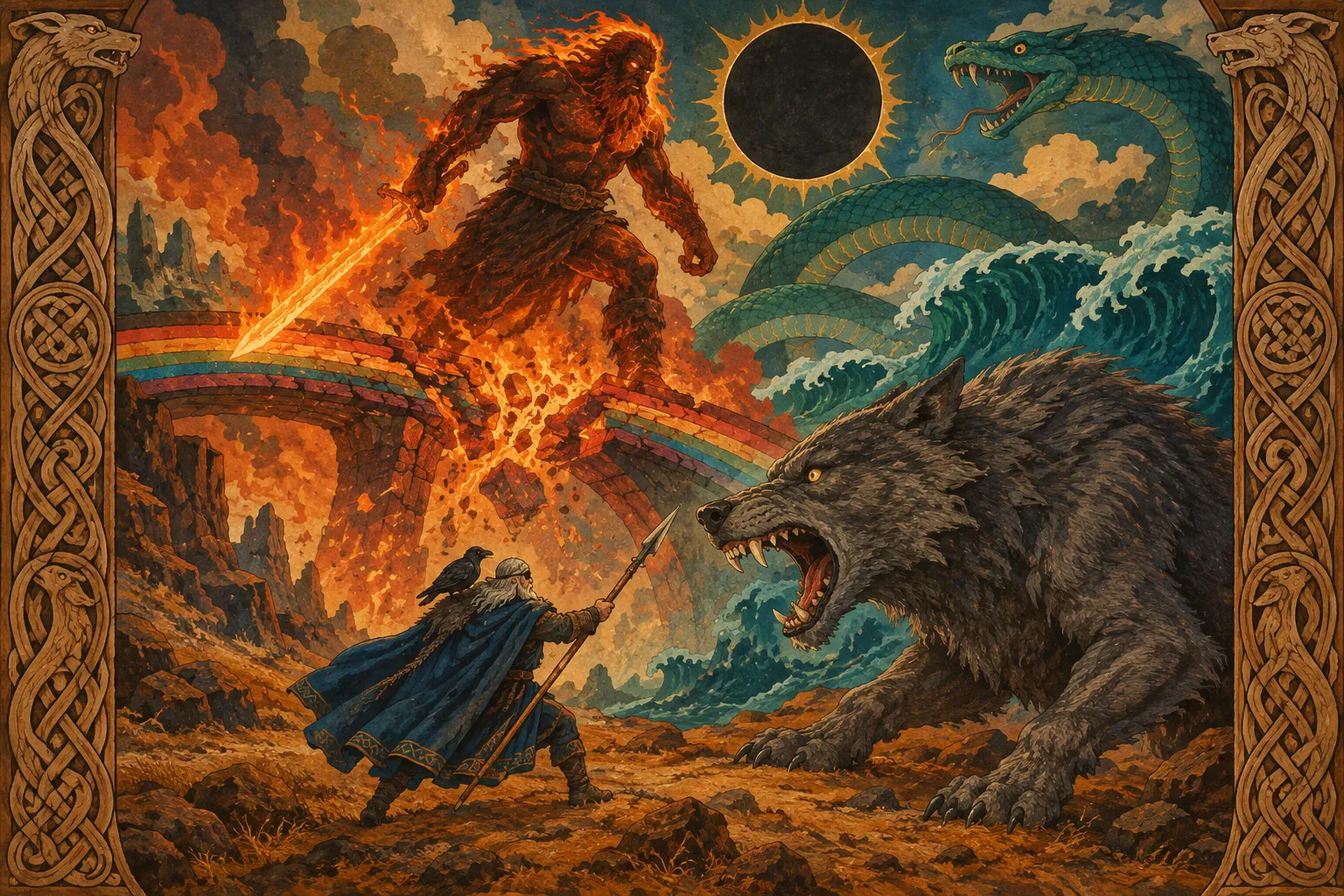
The earth shakes, trees are torn up, mountains fall, and every chain and fetter snaps. Fenrir, the monstrous wolf the gods had bound, runs free.
Jörmungandr, the Midgard Serpent that circles the world, heaves itself out of the ocean, and the sea floods the land. Garm, the hound of Hel, howls at the mouth of its cave, a line the Völuspá repeats like a drumbeat.
A ship sails from the east. In the Völuspá, Loki steers it, free of his bonds, and in Gylfaginning it is Naglfar, a ship built from the nails of the dead.
From the fire-land Muspell, Surtr leads his people with a flaming sword. When they ride over Bifröst, the rainbow bridge, it breaks under them.
The battle
Heimdall, the watchman of the gods, blows the horn Gjallarhorn to call them to arms. Odin rides to Mímir's well for counsel, because even the chief god wants to know how this ends.
The gods and the einherjar, the warriors Odin has gathered in Valhalla, meet their enemies on the plain of Vígríðr. There the great duels begin.
Odin fights Fenrir and is swallowed. His son Víðarr steps forward, plants a foot on the wolf's lower jaw and kills it, which avenges his father.
Thor fights Jörmungandr and kills it. Then he walks nine paces and falls dead from the serpent's venom.
Týr and the hound Garm kill each other. Freyr, who had given away his own sword, is beaten by Surtr.
Heimdall and Loki also kill each other. Then Surtr hurls fire over the world, the earth burns, and it sinks into the sea.
The new world
The Völuspá does not stop at the fire. The seeress sees the earth rise again from the water, green once more, with waterfalls running and an eagle hunting fish in the mountains.
Some of the gods return or survive. Víðarr and Váli live, Thor's sons Móði and Magni inherit his hammer Mjölnir, and Baldr and Höðr come back from Hel to live in peace.
Gylfaginning also tells of two humans, Líf and Lífthrasir, who hide in a wood called Hoddmímis holt during the fire. They live on morning dew, and their children repopulate the world.
The sun, too, has a daughter, who follows her mother's path through the sky. The Völuspá ends with a hall roofed in gold, called Gimlé, where the righteous live.
Where the story comes from
The Völuspá is the first poem in the Poetic Edda. It is preserved in Codex Regius, a manuscript from about 1270, and in a different version in the later Hauksbók.
Many scholars date the poem itself to about the year 1000, though nobody can say for certain. It was passed on by mouth before anyone wrote it down.
Snorri Sturluson (1179–1241) was an Icelandic chieftain and poet. He wrote the Prose Edda as a handbook to help young poets understand the old myths behind the poetry.
In Gylfaginning, a king named Gylfi travels in disguise to Asgard and questions three figures called High, Just-as-High and Third. Their answers retell the Völuspá and add details of their own.
All of our manuscripts were made in Christian Iceland. Scholars therefore argue about how much of Ragnarök is old pagan belief and how much was shaped by Christian ideas such as a last judgement and a world made new.
The sources also differ from one another. The Völuspá has a wolf in giant's form taking the moon, while Gylfaginning has two wolves swallowing the sun and the moon, and the poem's two manuscripts do not order their stanzas in the same way.
Other poems, such as Vafþrúðnismál, mention the survivors Líf and Lífthrasir as well. There is no single official version, only several voices telling a shared tradition.
What it means
Ragnarök is a story about fate. The gods know it is coming and still go out to fight, and that courage in a lost cause is one of the most striking features of Norse myth.
Many readers also see a cycle. The world is destroyed, then reborn with fewer gods and a gentler peace, so the end is also a beginning.
The causes are moral as well as cosmic. Murder, broken oaths and family betrayal come before the monsters do, which suggests that a world can fall apart from within.
Some readers connect Fimbulwinter with the long, hard winters of the North, though that is an interpretation, not something the texts say. What the texts do say is that even Odin cannot escape his fate.
The seeress asks again and again, “Do you still understand, or not?” (Völuspá, our translation).
It reads as a question put to every listener.
Common misconceptions
“Ragnarok means Twilight of the Gods.” The older form means “fate of the powers”, and the “twilight” reading comes from a later variant of the word.
“Loki is the Norse devil.” Loki is a trickster who helps cause Baldr's death and fights on the giants' side at the end, but he is also a travelling companion of the gods for much of the myths.
“It is the end, and nothing comes after.” Both main sources describe a new, green earth and surviving gods and people.
“All Vikings believed exactly this.” We know the story from Icelandic manuscripts written down centuries later.
Beliefs differed from place to place and from time to time.
“Wagner's opera tells the Norse story.” Richard Wagner's Götterdämmerung (1876) is a German adaptation with its own plot and characters.
Read next
Norse mythology explained is the best starting point for the gods, giants and worlds that appear in this story.
Yggdrasil and the nine worlds shows the world tree and the realms that Ragnarök shakes apart.