Norse mythology in five minutes
Norse mythology is the set of stories that people in medieval Scandinavia and Iceland told about their gods, giants and the shape of the world.
It begins with a gap of nothing, moves through wars, thefts, jokes and betrayals, and ends with a final battle called Ragnarök, after which the world rises again.
The best-known figures are Odin, the one-eyed god of wisdom, poetry and war, and Thor, the thunder god with a hammer. Beside them is Loki, a shape-shifting trickster who starts as a companion and ends as an enemy.
The gods belong to two families, the Aesir and the Vanir, and they share the cosmos with giants who are both their enemies and their relatives.
Almost everything we know comes from two Icelandic books of the 13th century: the Poetic Edda, a collection of old verse, and the Prose Edda by Snorri Sturluson.
This page tells the story in order, then explains where it comes from and how to read it.
The story
Before the world: ice, fire and a giant
In the Prose Edda, the story starts with Ginnungagap, a yawning empty gap between Niflheim, a world of mist and ice, and Muspelheim, a world of fire.
Where frost met heat it melted and dripped, and the drops took the shape of Ymir, the first giant.
A cow named Auðumbla fed Ymir with her milk and licked a salty block of ice until a new being, Búri, appeared. His grandsons Odin, Vili and Vé later killed Ymir.
From the giant's body they made the world: the earth from his flesh, the sea from his blood, the mountains from his bones and the sky from his skull.
Walking along the shore, the gods then found two tree trunks and gave them breath, sense and warmth. These became Ask and Embla, the first man and the first woman.
Two families of gods
The Aesir include Odin, Thor, Baldr and Tyr. The Vanir include Njörðr and his children Freyr and Freyja, who are linked with fertility, wealth and the land.
Völuspá recalls a war between the two families, and neither side could win.
Snorri's Gylfaginning and his Ynglinga saga say they made peace by exchanging hostages, and from then on the Vanir lived among the Aesir.
The nine worlds and the tree
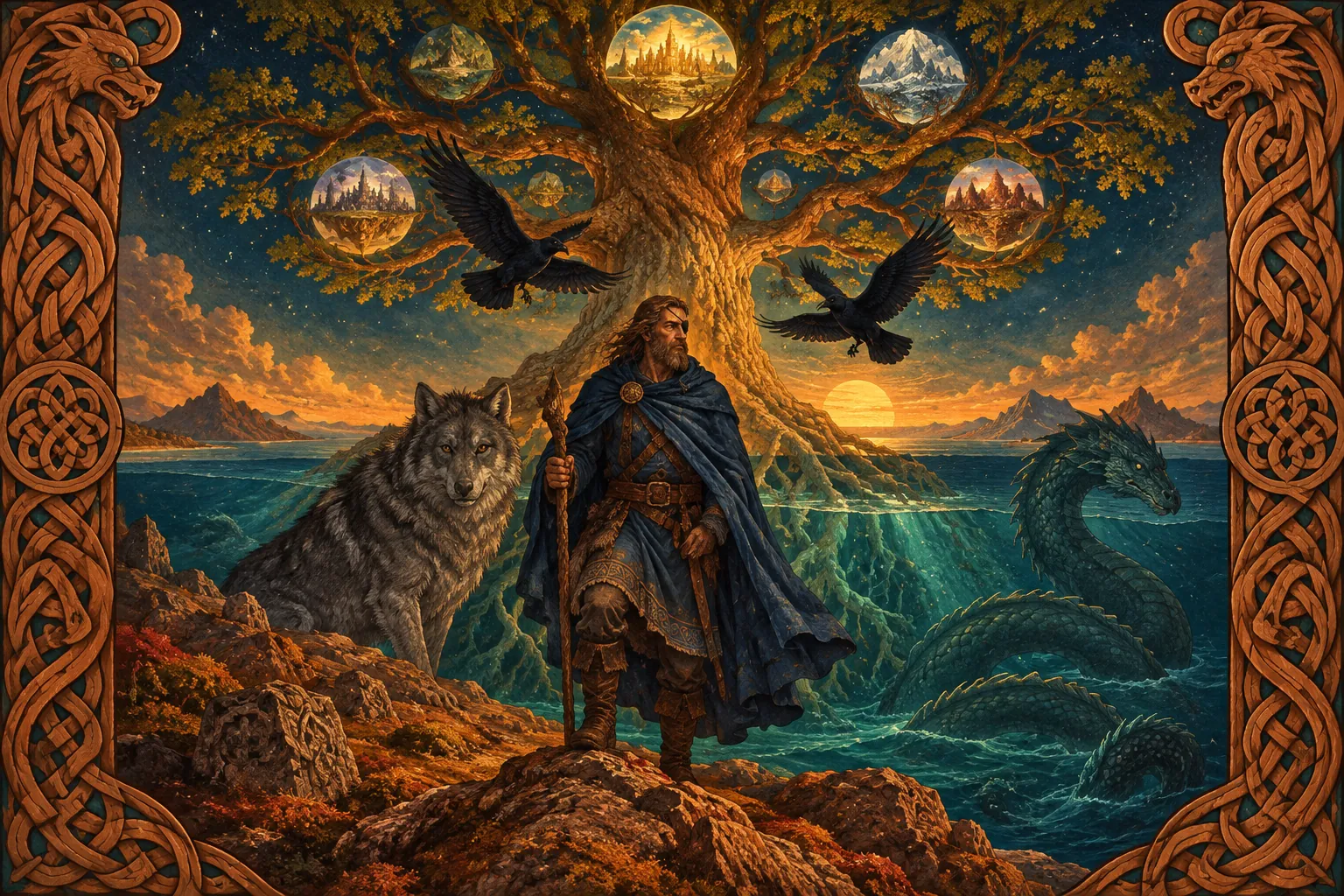
The cosmos is arranged around Yggdrasil, a vast ash tree. The Poetic Edda and Gylfaginning speak of nine worlds, among them Asgard, home of the Aesir, Midgard, the world of humans, and Jötunheimr, the land of the giants.
The lists of worlds differ from text to text, so there is no single official map.
Our guide to Yggdrasil and the nine worlds walks through the main versions.
Odin, the seeker
Odin is the chief of the Aesir, but the poems show him as a restless seeker rather than a calm ruler.
In Hávamál he hangs on a windy tree for nine nights, wounded by a spear, to win the knowledge of the runes.
In the Prose Edda he gives one eye to Mímir's well in return for a drink of wisdom. Two ravens, Huginn and Muninn, fly out each day and bring him news of the world.
He also takes the mead of poetry from a giant, which is why the old poets called verse the gift of Odin.
Warriors who fall in battle are chosen by the Valkyries, and many of them go to Odin's hall, Valhalla, to prepare for the last fight.
Thor, the protector
Thor is the god of thunder: strong, quick to anger and trusted by ordinary people. His hammer Mjölnir and his battles with giants make him the defender of gods and humans alike.
The poem Þrymskviða tells how a giant steals the hammer and demands the goddess Freyja as his bride.
The gods dress Thor in a bridal veil instead, and at the wedding feast he grabs back the hammer.
In another tale, told in Hymiskviða and the Prose Edda, Thor goes fishing with an ox head as bait and hooks the world serpent Jörmungandr.
The giant Hymir panics and cuts the line, and the serpent sinks back into the sea.
Loki, the trickster
Loki is the son of giants, yet he lives among the gods as Odin's sworn blood-brother. He is clever and funny, and his schemes first rescue the gods and then land them in worse trouble.
In one story a giant builder offers to wall Asgard, and Loki's advice leads the gods to cheat him of his pay. To stop the builder's horse, Loki turns into a mare, and he later gives birth to Odin's eight-legged horse Sleipnir.
With the giantess Angrboða, Loki also has three monstrous children: the wolf Fenrir, the serpent Jörmungandr and Hel, who rules a realm of the dead.
The death of Baldr
Baldr, a son of Odin, is the best-loved of the gods. After he has bad dreams, his mother Frigg makes almost everything in the world swear not to harm him.
She skips the mistletoe, which seemed too young to ask for an oath.
The gods turn it into a game and throw things at Baldr, who cannot be hurt. Loki hands a mistletoe twig to Baldr's blind brother Höðr, and Baldr falls dead.
Hel offers to release Baldr if every creature weeps for him, but one giantess refuses, and he stays in Hel's realm.
The gods bind Loki under a snake that drips venom onto his face, while his wife Sigyn catches the drops in a bowl.
Ragnarök and the new world
Völuspá and Gylfaginning describe the end in broadly similar terms: oaths are broken, the wolf Fenrir breaks free, and a last battle begins.
Gylfaginning adds the Fimbulwinter, three winters without a summer.
The watchman Heimdallr blows his horn, the fire giant Surtr marches out of Muspelheim, and the gods and the dead warriors of Valhalla ride out to meet them.
Odin is swallowed by Fenrir and his son Víðarr avenges him. Thor kills Jörmungandr but dies from its venom after nine steps.
The earth then sinks into the sea, but Völuspá describes it rising green again, with Baldr returning.
Gylfaginning, in the Prose Edda, adds that two humans who hid in a wood, Líf and Lífþrasir, begin the world anew.
The full story has its own page: Ragnarök: the end of the Norse gods.
Where the story comes from
No Norse priest left a holy book. The stories were told aloud for centuries and written down only after Iceland turned Christian around the year 1000.
The Poetic Edda is a collection of mythological and heroic poems in Old Norse. Its main manuscript, the Codex Regius, was copied in Iceland around 1270, but many of the poems are much older and the dating of each is debated.
It includes Völuspá, the seeress's vision of creation and doom, Hávamál, the sayings of Odin, and comic poems such as Þrymskviða and Lokasenna.
The Prose Edda was written around 1220 by Snorri Sturluson, an Icelandic chieftain and poet. In its Gylfaginning a Swedish king asks three mysterious figures about the gods and gets the story in the form of questions and answers.
Snorri's goal was practical: poets still needed to understand the old myths hidden in poetic images.
Other evidence fills gaps. The Danish historian Saxo Grammaticus retold some myths in Latin around 1200, and runestones, carved crosses and Thor's hammer pendants show how the gods were pictured.
Four of our weekdays also come from the old gods, through Tyr, Odin, Thor and Freyja or Frigg.
Where versions differ
The sources do not agree on everything.
Völuspá says three gods found Ask and Embla, while Snorri names Odin and his brothers. In the Prose Edda, Höðr kills Baldr as a blind brother tricked by Loki, but in Saxo's version Höðr is a human rival who fights Baldr over a woman.
Snorri also writes as a Christian scholar. His order and neatness may reflect his own shaping of the material.
What it means
The most striking feature is that the gods are not all-powerful. They know from the start that the world will end, and they fight on anyway.
A saying in Hávamál sums up the outlook: cattle die, kin die, you too will die, but the good name of one who earns it never dies.
Fate is also a central idea. The Norns, three women at the foot of Yggdrasil, shape what will happen, and even Odin cannot change it.
Wisdom is paid for. Odin gives an eye and risks his life to learn more, and in these stories knowledge is a price, not a gift.
Giants and gods are not simple good and evil. The giants stand for raw forces of nature and chaos, yet gods marry them and take counsel from them.
These are readings, not official doctrine. Different scholars stress different things, and no ancient text tells us how a worshipper would have explained the myths.
Common misconceptions
Myth: the Eddas were the Vikings' Bible. They are medieval Icelandic books written by Christians, and they record stories rather than rules of worship.
Myth: Loki is Thor's brother and simply evil. The sources make him Odin's blood-brother, and he travels with Thor in several tales before he turns on the gods.
Myth: Ragnarök is the final end. Völuspá describes the earth rising green again, and Gylfaginning has human survivors too.
Myth: all Scandinavians worshipped the same gods in the same way. Practice varied by place and period, and much of what we know about it is thin or comes from outsiders.
Read next
Ragnarök: the end of the Norse gods follows the last battle in detail.
Yggdrasil and the nine worlds explains the layout of the cosmos.