In five minutes
The Narcissus myth is the story of a young man who falls in love with his own reflection in a pool, and of Echo, a nymph who has lost the power to speak for herself. The version most readers know comes from Book 3 of Ovid's Metamorphoses, a Latin poem written around 8 CE.
Echo loves Narcissus and is turned away. Someone else he has scorned prays that he will know love that cannot be answered.
He finds a clear pool, sees a face in it and cannot leave. He wastes away on the bank, and a flower grows where he lay.
It is one of the best-loved stories in Greek mythology, and it gave us the word "narcissism".
The story
A warning from Tiresias
Narcissus was the son of the river god Cephisus and the water nymph Liriope. When he was a baby, Liriope asked the blind seer Tiresias whether her son would live a long life.
Tiresias gave an odd answer: yes, as long as he never comes to know himself. Nobody understood it at the time.
A boy nobody could win
By the age of sixteen Narcissus was so beautiful that young men and young women alike fell for him. He was proud and hard-hearted, and he turned every one of them away.
Echo
Echo was a nymph of the woods who loved to talk. When Juno, the Roman name for Hera, went looking for her husband Jupiter among the nymphs, Echo kept the goddess busy with long conversation while the nymphs slipped away.
Juno punished her by taking away her ordinary speech. From then on Echo could only repeat the last words of what someone else had said.
One day she saw Narcissus hunting deer and fell in love at once. She followed him through the trees, but she could not speak first.
Narcissus had wandered away from his friends and called out, "Is anyone here?" Echo answered, "Here!"
He called, "Come!" and she called, "Come!" back to him.
When she stepped out with her arms open, he pulled away. He said he would die before she could have any hold over him, and all she could do was repeat his last words.
Ashamed, Echo hid in caves and lonely woods. She grieved until her body faded away, and Ovid says her bones turned to stone, leaving only her voice.
The pool
Someone else whom Narcissus had scorned lifted their hands and prayed that he might fall in love and never win what he loved. The goddess Nemesis heard the prayer.
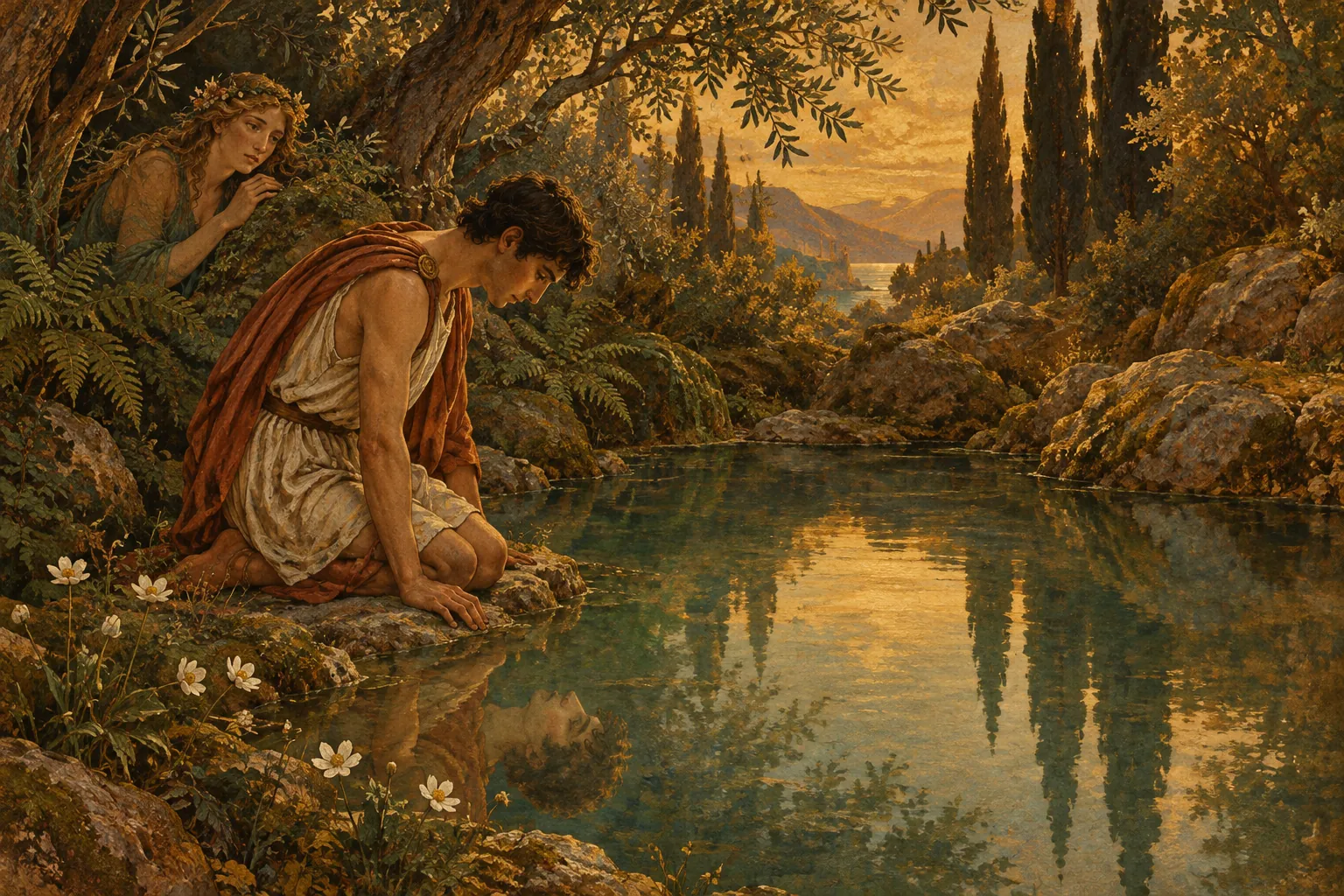
Ovid describes a clear, silver-bright pool deep in the woods that no shepherd or goat had ever disturbed. Narcissus, tired and hot from hunting, lay down to drink.
As he drank, he saw a beautiful face looking up at him and fell in love with it. He did not realise it was his own.
He tried to kiss it and to hold it, but the water rippled and the face broke apart each time. He lay there and forgot food and sleep.
At last he understood. In Ovid's Latin he says iste ego sum, "I am he", and sees that what he longs for is himself and can never be held.
He stayed by the water and faded like wax in a gentle flame. Echo was still nearby, and although she remembered how he had treated her, she pitied him.
When he cried out in pain, she cried it back.
When he spoke a last farewell to the face in the pool, Echo repeated the farewell. His head dropped to the grass, and Ovid adds that his eyes still gazed at themselves in the waters of the Styx, the river of the dead.
His sisters the water nymphs and the nymphs of the woods mourned him and prepared the funeral pyre. When they came for the body, there was none.
In its place stood a flower with a yellow centre ringed by white petals.
Other ancient versions
Ovid's telling is not the only one. The travel writer Pausanias, in his Description of Greece (2nd century CE), reports a version in which Narcissus has a twin sister whom he loves dearly.
She dies, and he goes to a spring knowing perfectly well that he is looking at his own face. He takes comfort in seeing her likeness in it.
Pausanias also says that the idea of someone mistaking his reflection for another person seems implausible to him.
A third version comes from the mythographer Conon. In it a young man named Ameinias loves Narcissus and is rejected.
Narcissus sends him a sword, and Ameinias kills himself at Narcissus's door, praying to the gods for revenge.
Narcissus then sees his reflection in a spring, understands what has happened to him and takes his own life. In this account a flower grows from the spot where he fell.
The pairing with Echo is the one most readers know from Ovid. The tellings agree on three things: a beautiful youth who rejects love, a reflection in water, and a flower.
Where the story comes from
The anchor text is Ovid's Metamorphoses, a long Latin poem in fifteen books about transformations. Narcissus and Echo fill lines 339 to 510 of Book 3, placed after the story of Tiresias and before the story of Pentheus.
Ovid wrote in Rome under the emperor Augustus and drew on Greek tradition, which is why the characters keep their Greek names while Juno and Jupiter appear under their Roman ones. Every quotation on this page is our own translation.
What it means
Tiresias's riddle is the key to the story. Narcissus is doomed because he sees himself without knowing who he is looking at, and the story is partly about the gap between looking at yourself and knowing yourself.
Echo and Narcissus also mirror each other. She has a voice but no words of her own, and he has an image but no real person.
Each reaches for someone who can only give back what they were given.
The story is also about the cost of cruelty. Narcissus does not die because he is handsome, but because he refuses love again and again, and the prayer of someone he has hurt finally comes true.
Ovid ends with a change of form. Grief, longing and loss become a flower, which is exactly what the poem's title promises.
Narcissus and "narcissism"
Writers in the late nineteenth century borrowed his name to describe excessive self-love, and Sigmund Freud's 1914 essay "On Narcissism" helped make the word common. Today "narcissistic personality disorder" is a clinical term used by professionals.
The myth itself does not describe that condition. Narcissus is not shown boasting about himself; he is shown fooled by an image and suffering for it.
This page is about the story, not about diagnosing anyone, and anyone worried about themselves or someone close should talk to a qualified professional.
Common misconceptions
- "He knew it was his own face." In Ovid he does not, until the moment he says "I am he". Pausanias tells a version where he does know, but there he is grieving for his sister.
- "It is simply a story about vanity." Ovid shows pride and cruelty, but also longing and a painful lesson in self-knowledge.
- "Narcissus drowned." In Ovid he fades away on the bank, and his body is never found.
- "Ovid names the daffodil." He describes a flower with a yellow centre and white petals but does not name it. The link between the flower and Narcissus's name came through later tradition.
- "Narcissus cursed Echo." It was Juno who took away Echo's voice. Narcissus only rejected her.
Read next
- Greek mythology explained: the gods, heroes and sources behind stories like this one.
- Icarus and Daedalus: another tale from Ovid's Metamorphoses, about ambition, a warning ignored and a fall.