In five minutes
Orpheus and Eurydice is the best-known love story of Greek mythology, and it is a story about loss rather than victory. Orpheus, the finest musician of the legends, loses his wife Eurydice on their wedding day and travels to the land of the dead to bring her back.
His music moves even Hades and Persephone, and they agree to let her go on one condition. He must walk ahead of her and not turn around until they are both back in the world of the living.
At the last moment he turns, and she slips away for good. The story survives mainly in two Roman poems: Ovid's Metamorphoses, Book 10, and Virgil's Georgics, Book 4.
Everything below follows those two poems and says clearly where other writers disagree.
The story
A wedding that ends in grief
Orpheus is a singer from Thrace, the son of the Muse Calliope. In the stories his lyre can calm wild animals and make trees lean closer to listen.
He marries Eurydice, a young woman who in Ovid's telling is one of the nymphs. Soon after the ceremony she walks through the grass with her companions, and a snake bites her ankle.
She dies almost at once.
Ovid adds a small ominous detail: the torch at the wedding would not burn cleanly and gave only smoke. Orpheus mourns on earth for as long as he can bear to, and then he decides to go and ask for her back.
The road down
In Ovid, Orpheus enters the underworld through a cave near Taenarus, at the southern tip of the Peloponnese. He passes the thin, drifting dead and comes before the king and queen of that realm.
He does not try to fight his way in, and he does not trick anyone. He sings, and he says plainly that he came only for his wife, whose life was cut short too early.
The song works. In Ovid's picture the punishments of the underworld pause: Tantalus stops reaching for water, Sisyphus sits down on his stone, and Ixion's wheel stands still.
Even the Furies are said to weep.
Persephone and Hades agree to his request. Eurydice is called from among the recent dead, and she comes slowly because her wound still pains her.
The condition
The rule is simple and strict. Orpheus walks first and Eurydice follows.
He must not turn his eyes back until they have left the valley of Avernus, or the gift is cancelled.
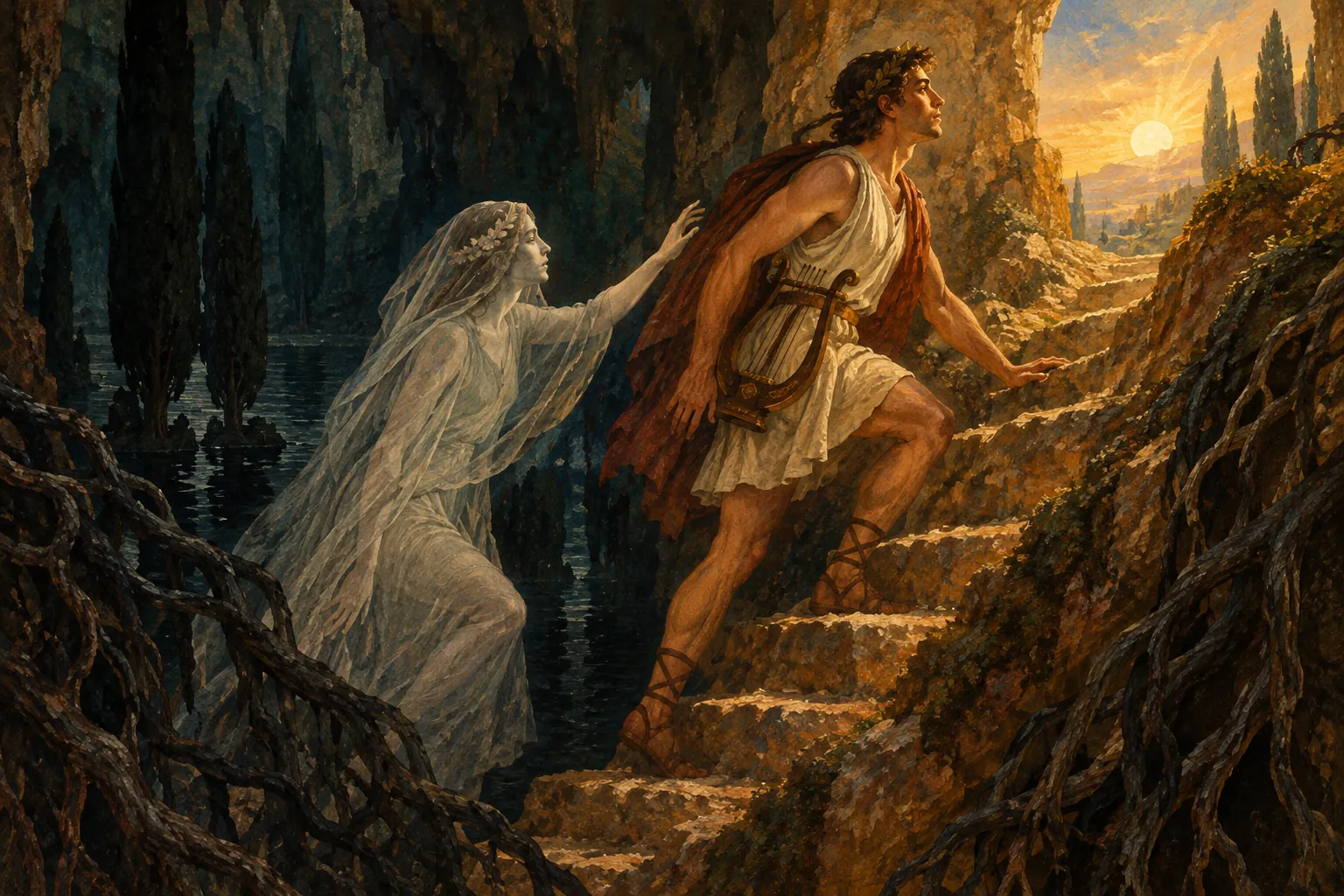
They climb a steep, dark path in complete silence. Near the top, with the upper air almost in reach, Orpheus is gripped by fear that she may not be following, or by a longing he cannot control.
He turns to look. Eurydice is still there, and for a moment he sees her.
Then she is pulled back, and Ovid says she makes no complaint, since what could she blame him for except loving her. She says one last farewell that hardly reaches him.
After the loss
Orpheus tries to cross the river again, but this time the ferryman refuses him. In Ovid he sits at the bank for seven days, unfed and in tears, and then returns to the world above.
He keeps away from other women and sings sorrowful songs on the mountains. Finally a group of Thracian women, angry at being refused, kill him.
His head and lyre drift down the river Hebrus to the sea, still sounding, and he is reunited with Eurydice among the dead.
Where the versions differ
The myth was never one fixed text. Virgil, in the Georgics, places the story inside another tale.
The beekeeper Aristaeus loses his bees and learns from the sea-god Proteus that the cause was Eurydice's death, because she stepped on the snake while fleeing Aristaeus.
In Virgil's account Orpheus looks back as he nears the light, and he is carried away by a sudden madness, a lapse of control rather than doubt. Eurydice speaks at more length than in Ovid and mourns the fate of both of them.
The Greek philosopher Plato gives a harsher version in the Symposium. There the gods mock Orpheus by showing him only a phantom of his wife, because he was a soft musician who would not die for love as Alcestis did.
Later artists changed the ending again. Some retellings, including operas, let Orpheus keep his wife, because audiences preferred a happy end.
Where the story comes from
Orpheus is older than the Roman poems. Greek writers mention him as a legendary singer long before Ovid, and a religious movement called Orphism grew up around his name.
The fullest narrative versions, however, come from Rome. Ovid wrote the Metamorphoses around the start of the first century AD, and Virgil wrote the Georgics in the decades before.
Their poems are our main sources, so this page treats them as the anchor texts. Where the details differ, such as who chased Eurydice, we name the poem rather than blend the two.
What it means
The easiest reading is about grief. A person tries to take back a loss, nearly succeeds, and learns that the dead cannot be won back by skill alone.
It is also about the limits of art. Orpheus's song can stop torments and move gods, but it cannot protect him from his own impulse at the final step.
Many readers focus on the moment of looking back. One reading says it is a failure of trust, another says love cannot stand to wait for proof, and Virgil sees it as a sudden madness.
The myth does not choose between them.
Writers and composers have used the story for centuries to talk about creativity and memory. The poet is the one who goes down and comes back with something, even if he loses what he came for.
Common misconceptions
Many people think that Orpheus was told never to look at Eurydice at all. In Ovid, the instruction is not to turn his eyes back until they have left the valley of Avernus.
It is also commonly said that Eurydice was a goddess. In the Roman poems she is a nymph or a young bride, a mortal-style figure who can die.
Another mistake is to treat the myth as having a single canonical ending. As seen above, Ovid, Virgil and Plato disagree on the details.
Finally, this is a Greek story, but its best-known tellings are in Latin. That is why Ovid and Virgil are the places to start.
Read next
For the wider picture of gods, heroes and sources, start with Greek mythology explained.
Another journey to the land of the dead, with a very different outcome, is told in Persephone, Hades and the seasons.