In five minutes
Susanoo and the eight-headed serpent is one of the best-known stories in Japanese mythology. It is told in the Kojiki, the oldest surviving book in Japan, which was presented to the court in the year 712.
Susanoo, a storm god thrown out of heaven, arrives in the land of Izumo and finds an old couple weeping beside their last daughter. A serpent called Yamata no Orochi (八岐大蛇) has already eaten seven of their eight daughters, and it is coming for the eighth.
Susanoo asks to marry the girl, Kushinada-hime, and promises to kill the monster. He sets out eight vats of strong rice wine, waits for the serpent to drink and fall asleep, and cuts it to pieces.
Inside its tail he finds a great sword, which becomes known as Kusanagi. It is later counted among the three Imperial Regalia of Japan.
This page tells the story as the Kojiki gives it, then looks at where it comes from, how the versions differ and what readers have made of it. It is part of our guide to Japanese mythology and the Kojiki.
The story
Exile from heaven
The myth comes right after the episode in which the sun goddess Amaterasu hides in a cave. Her brother Susanoo has behaved so badly that the gods of heaven cut his beard, take his fingernails and toenails, and expel him from Takamagahara, the High Plain of Heaven.
You can read that episode in Amaterasu and the hidden cave. The serpent story is the other half of Susanoo's story: the troublemaker leaves heaven and becomes a hero on earth.
In the Kojiki, Susanoo comes down to a place called Torikami, at the upper reaches of the Hi River in Izumo, in what is now Shimane Prefecture. He sees chopsticks floating down the stream and understands that people live upstream.
The weeping family
Following the river, he finds an old man, an old woman and a young girl sitting together and crying. The man says he is Ashinazuchi, a local earth deity, and that his wife is Tenazuchi.
Their daughter is Kushinada-hime. They once had eight daughters, but every year the serpent of Koshi has come and eaten one, and now it is nearly time for the last.
Susanoo asks what the monster looks like. The old man describes it in detail, and the Kojiki gives a vivid portrait.
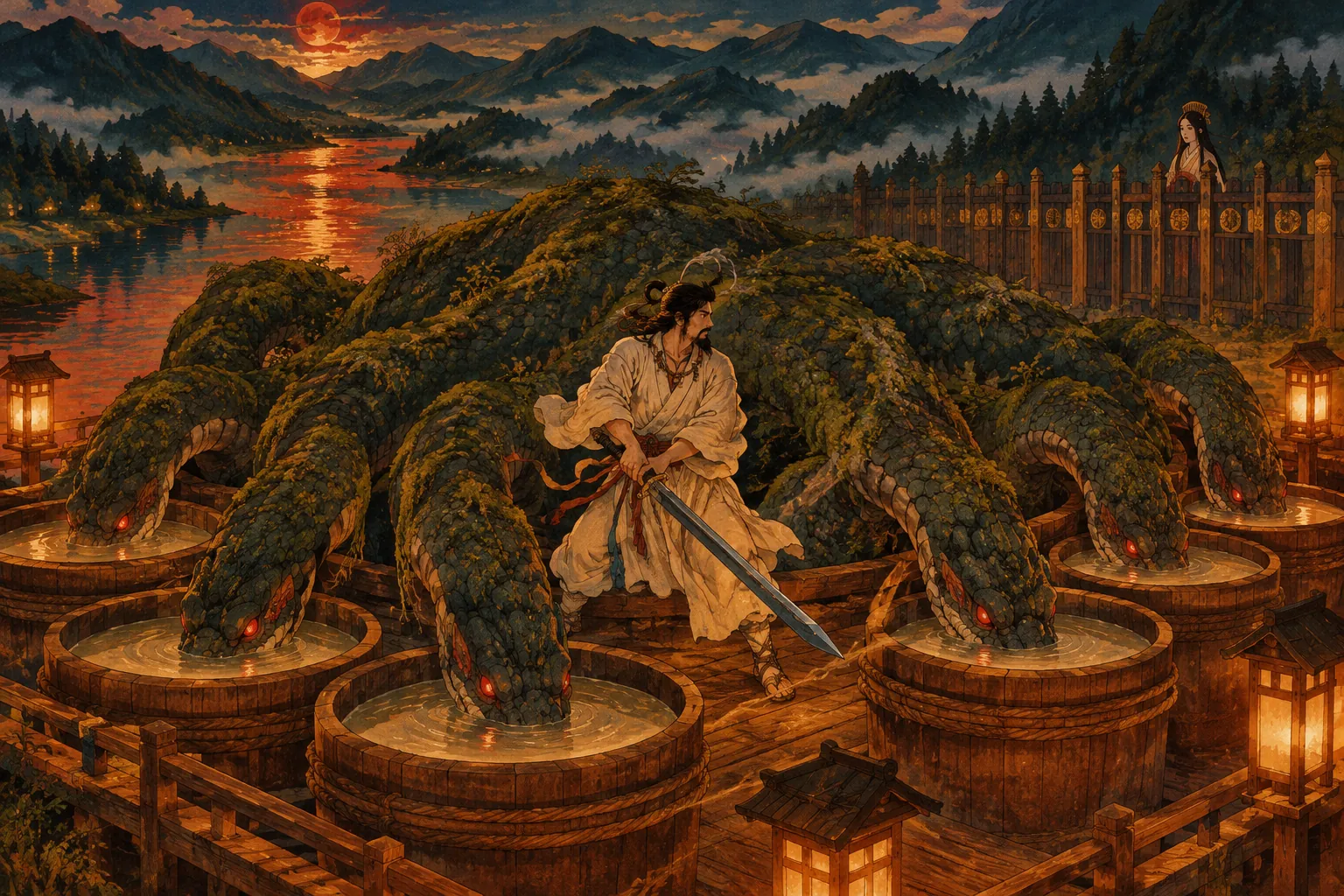
It has one body with eight heads and eight tails, and eyes as red as winter cherries. Moss, cypress and cedar grow on its back, it stretches across eight valleys and eight hills, and its belly is always bloody and inflamed.
The bargain and the plan
Susanoo offers to kill it if he may marry Kushinada-hime. The old man is cautious, since he does not yet know who the stranger is, so Susanoo says he is the younger brother of Amaterasu and has just come down from heaven.
Hearing this, Ashinazuchi and Tenazuchi agree at once. Susanoo then magically turns the girl into a comb, pushes it into his hair and begins to prepare.
He tells the couple to brew a strong, many-times-refined rice wine and to build a fence with eight gates. Behind each gate they must set up a platform with a vat of the wine on it.
The night of the wine
When the serpent arrives, it sinks one head into each vat and drinks. The wine overcomes it, and it lies down and falls asleep.
Susanoo draws his ten-hand-span sword and hacks the monster to pieces. The Hi River runs red with its blood.
When he cuts the middle tail, the edge of his blade chips. He looks closer, splits the tail open and finds a great sword inside.
The sword and the new home
Susanoo takes this strange sword and, thinking it a wonder, presents it to Amaterasu through the gods of heaven. The Kojiki says this is the sword now called Kusanagi, the "grass-cutting sword".
He then looks for a place to build a house for his bride and finds Suga in Izumo. There, the Kojiki says, his heart felt clear and fresh, and he built a palace.
Clouds rose over the new building, and Susanoo is said to have composed the poem that opens with the words "Yakumo tatsu", roughly "Many-layered clouds rise". Many readers count it as the first waka in Japanese tradition.
Susanoo and Kushinada-hime have descendants, and the Kojiki follows that line down to Ōkuninushi, the great god of Izumo.
Where the story comes from
The main source is the Kojiki (古事記, "Record of Ancient Matters"). It was written down by Ō no Yasumaro and presented to Empress Genmei in 712, based on stories recited by a court reciter, Hieda no Are.
In the Kojiki, the serpent is written 八俣遠呂智, and Susanoo is 須佐之男命. The sword that kills it is a ten-hand-span sword, totsuka no tsurugi.
The second source is the Nihon Shoki (日本書紀), finished in 720 and written in classical Chinese. It tells the same story with different spellings: the serpent is 八岐大蛇, Susanoo is 素戔嗚尊 and the girl is Kushiinada-hime (奇稲田姫).
The Nihon Shoki gives a main account and then several "one version says" variants. The sword found in the tail is called Ame no Murakumo no Tsurugi, and the name Kusanagi is explained later, through the story of the prince Yamato Takeru.
In that later story, the prince uses the sword to cut grass during a field fire, which is why it is called the grass-cutting sword. One Nihon Shoki variant also sends Susanoo to the land of Silla before he comes to Izumo.
So when you read the story, remember there is no single "official" version. This page follows the Kojiki, and notes where the Nihon Shoki differs.
What it means
Readers have long found several layers in the story. The simplest is a hero tale: a young god proves his worth by saving a family and winning a bride.
It also completes Susanoo's arc. In heaven he is violent and destructive, but on earth the same energy, along with some cleverness, defeats a far greater destroyer.
Many scholars connect the serpent with the Hi River, which floods often and spreads in several channels like many heads. In that reading, killing the serpent stands for taming the river and making the land safe for farming.
Others point to the sword in the tail and to the iron-making of the Izumo region, and suggest the story preserves a memory of ironworking. These are interpretations, not claims made by the Kojiki itself.
The comb is another detail worth noticing. Kushinada-hime's name can be read as "wondrous rice field", and the story ties her to the fertility of the land that is saved.
Finally, the sword gives the myth a lasting connection to the present. Kusanagi is one of the three sacred treasures traditionally associated with the imperial throne, along with a mirror and a jewel, and it is kept at Atsuta Shrine in Nagoya.
Common misconceptions
"The Orochi is a fire-breathing dragon." The Kojiki describes a huge snake-like creature with eight heads and tails, red eyes and a bloody belly, and says nothing about fire or wings.
"Susanoo fights it in a straight duel." He wins by planning: the fence, the vats and the strong wine do most of the work before he draws his sword.
"The number eight is exact." In old Japanese, eight (ya) often means "many", as in "eight layers of cloud" or "eight-fold fence".
"The myth is history." It is a sacred story from the early court, not a record of an actual event.
Shinto is still practised today, and Susanoo is worshipped at many shrines.
"You can see the Kusanagi sword." The sword is traditionally kept hidden, and it is not shown to the public.
Read next
- Japanese mythology and the Kojiki: the main guide to the book that tells this story, and to the gods who appear around it.
- Amaterasu and the hidden cave: the episode that ends with Susanoo's exile, and the best place to start.