In five minutes
Yōkai (妖怪) are the strange beings of Japanese folklore: spirits, shape-shifters, haunted objects and monsters that sit somewhere between animals, ghosts and gods. The word is written with two characters, 妖 and 怪, and both point to something eerie that is hard to explain.
There is no official list. A yōkai can be frightening, mischievous or simply odd, and the same creature may be feared in one valley and laughed at in the next.
This hub rests on three books. Toriyama Sekien’s Gazu Hyakki Yagyō (1776) turned the creatures into a printed catalogue of pictures, and the Konjaku Monogatarishū, a story collection from the early twelfth century, shows how much older the tales are.
Lafcadio Hearn’s Kwaidan (1904) retold several of them in English and introduced them to readers abroad. Use this page as a map: what a yōkai is, where the tales are written down, and where to go for each famous creature.
What does yōkai mean?
Yōkai is the widest word Japanese has for supernatural creatures. Related words cover parts of the same ground: bakemono and obake are things that change shape, and mononoke is an old word for a spirit that haunts or possesses people.
A yūrei is different. It is the ghost of one particular dead person, usually someone who died with a grievance, while a yōkai is normally a kind of being rather than one person’s spirit.
The border is soft, and the old books mix both. The oni, the horned ogre, is usually counted among the yōkai too.
Kami, the gods of Shinto, are a separate matter and are honoured at shrines that are still in use today. Even so, village tradition sometimes tells of a place spirit as a kami in one story and a dangerous yōkai in another, a theme you can follow further in our hub on Japanese mythology and the Kojiki.
In the late nineteenth century the philosopher Inoue Enryō (1858–1919) collected reports of strange events and studied them as “yōkai-gaku,” the study of yōkai. He wanted to show that many of them had natural explanations.
His work shows that Japanese readers already treated yōkai as a subject worth sorting and discussing, not only as tales for children.
The story: the night parade of a hundred demons
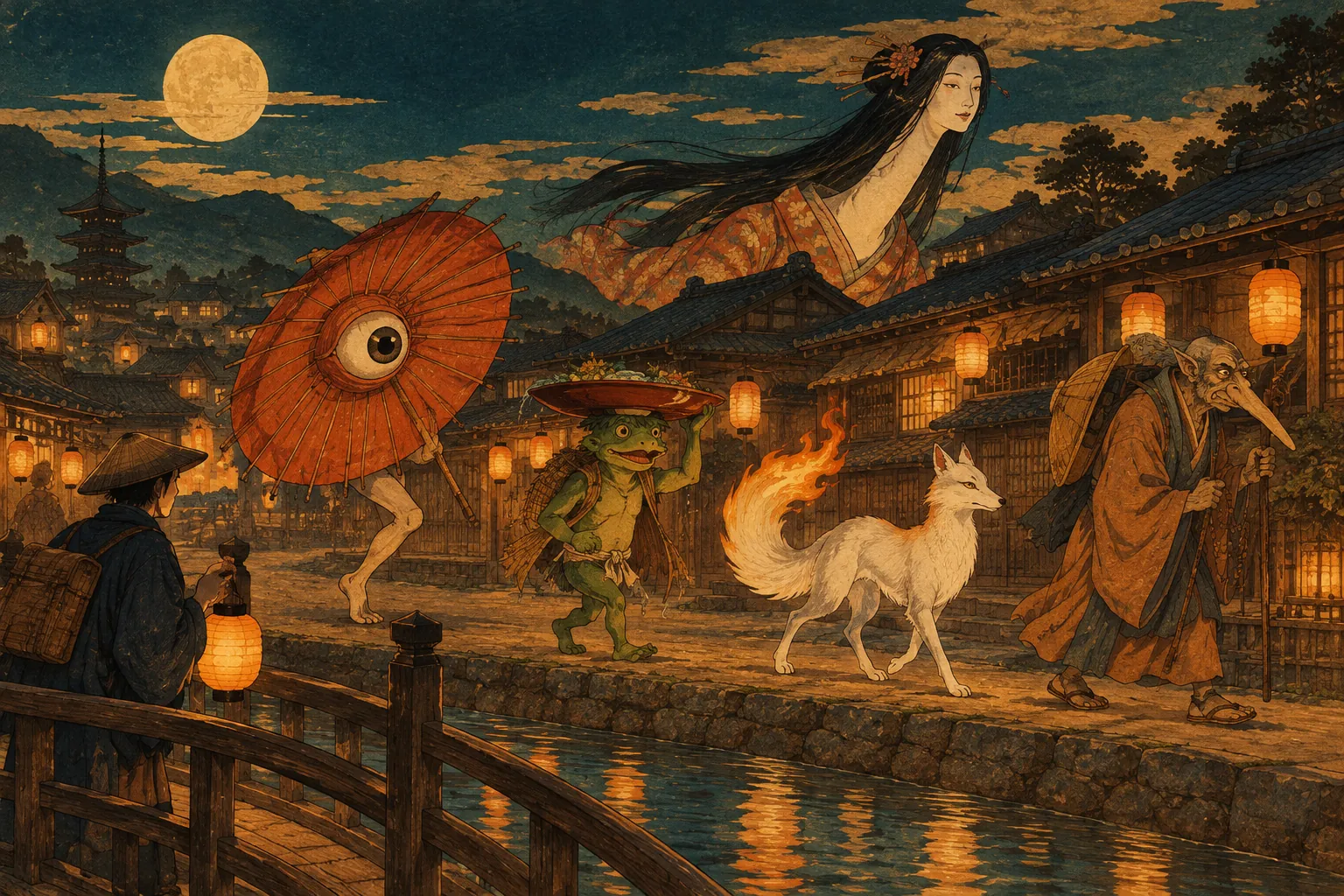
The image that holds the whole subject together is hyakki yagyō, the night parade of a hundred demons. The idea is that on certain nights demons walk the streets in a crowd, and a person who meets them may be in mortal danger.
Heian-period tales, including one in the Konjaku Monogatarishū, tell of a young man who runs into the parade by chance. A protective charm taken from a sutra saves him, and the demons pass by without seeing him.
In later picture scrolls of the Muromachi period, the parade gets a new cast: household tools. Under the idea of tsukumogami, an object that has lasted long enough, often said to be a hundred years, can wake up and gain a spirit.
One scroll tells of old tools thrown out after the yearly house-cleaning. They resent it, take monstrous shapes and march through the night.
In 1776 Toriyama Sekien published Gazu Hyakki Yagyō, the “Illustrated Night Parade of a Hundred Demons.” It was printed from woodblocks, so for the first time many readers could own a book of yōkai pictures.
Each page shows one creature or a small group, often with a playful caption. Sekien mixed figures from older scrolls with new ones of his own, and he followed the book with further volumes over the next years.
Edo readers loved the format, and the creatures stepped out of the scroll into popular culture. In the same age people played hyakumonogatari, telling a hundred ghost stories by candlelight, one flame put out after each tale.
Three tales that readers still know
In Kwaidan Lafcadio Hearn wrote down stories of strange things in his own style. Here are three of them, in short.
Mujina
A man walking at night along a slope in Akasaka, in Tokyo, finds a woman crying beside the moat. When she turns around, her face is smooth, with no eyes, nose or mouth.
He runs and reaches a noodle seller’s stall. The seller asks whether the face looked like this, wipes his own face smooth, and the lantern goes out.
In the story, mujina means badger, an animal that, like the fox, was long believed to be able to change shape.
Yuki-onna
Two woodcutters shelter from a blizzard in a hut. A woman in white breathes on the older man, Mosaku, and he dies, while the young Minokichi is spared on one condition: he must never tell anyone what he saw.
Years later Minokichi, now married to a woman named O-Yuki, breaks that promise. She shows who she is, but leaves him alive for the sake of their children and vanishes.
Mimi-nashi Hōichi
Hōichi, a blind biwa player, is called each night to perform the tale of the Heike clan’s defeat for noble listeners. They are the ghosts of the clan, and he has been playing among their graves.
The priest of his temple paints the words of a sutra on Hōichi’s body to hide him, but forgets his ears. The ghosts take only the ears.
All three are told with restraint and without gore, which is part of why they last.
Where the story comes from
Our three anchor texts sit at different points in time. The Konjaku Monogatarishū is an anonymous collection of over a thousand tales from India, China and Japan, put together in the early twelfth century.
Its Japanese section holds stories of oni, ghosts and fox spirits told as strange events, often with a Buddhist lesson attached.
Sekien (1712–1788) was a painter who lived in Edo, now Tokyo. His Gazu Hyakki Yagyō is not a folk record but an artist’s catalogue that made yōkai visible and collectable.
Lafcadio Hearn (1850–1904) was born in Greece, grew up in Ireland and moved to Japan in 1890, where he later took the name Koizumi Yakumo. Kwaidan, published in 1904, retells stories he found in older books and heard from people around him.
Rural tradition has its own record. Yanagita Kunio’s Tōno Monogatari (1910) gathered tales from the Tōno region, including the kappa and the house spirit zashiki-warashi.
Versions differ. The snow woman has other habits in other regions, and Hearn’s stories are his retellings, not word-for-word copies of one old text, so Sekien’s names and drawings are best read as one tradition among many.
A short field guide
Several yōkai have a page of their own on FiveMinRead.
- Kitsune: the fox spirit, a shape-shifter and messenger that can be a trickster or a guardian.
- Kappa: the river imp, with a dish of water on its head, known from tales that warn children about rivers.
- Tengu: the mountain goblins, long-nosed or bird-like, tied to mountain ascetics and the forest.
- Kuchisake-onna: the slit-mouthed woman, a modern urban legend that spread through Japan in 1979.
- Rokurokubi: a person whose neck stretches at night, drawn by Sekien and retold by Hearn.
- Tsukumogami: tools and household objects that come to life, such as the one-legged umbrella spirit.
What it means
Yōkai have worked as explanations. A strange light over a marsh, a drowning in a river, an uncanny noise on a mountain path: each can be given a name and a face, which makes it easier to talk about and to avoid.
They also carry warnings. Stories of the kappa near water or of the snow woman in the mountains taught children where not to go and how to behave.
Humour matters just as much. In Sekien’s age many yōkai were drawn to amuse, and that playful side never left.
Many tales also treat nature and old things with respect. The tsukumogami idea quietly suggests that tools should be cared for, not simply thrown away.
In the twentieth century the manga artist and folklorist Mizuki Shigeru (1922–2015) brought yōkai to a wide postwar audience through illustrated books and comics. Today the creatures keep appearing in new forms.
Common misconceptions
“All yōkai are evil.” Many are mischievous or neutral, and some, like the house spirit zashiki-warashi, are said to bring good fortune.
“Yōkai and ghosts are the same.” A yūrei is the ghost of a specific dead person, while a yōkai is usually a kind of being, though the border is blurry.
“There are exactly one hundred.” The “hundred” in hyakki means “very many,” not a fixed count.
“Kwaidan is an ancient Japanese book.” It is Lafcadio Hearn’s collection of retold stories, published in English in 1904.
“Every yōkai is ancient.” New ones keep appearing, and the slit-mouthed woman became a nationwide rumour only in 1979.
Read next
Kitsune: the fox spirit is the best first stop, because the fox shows up in nearly every kind of Japanese tale.
Kappa: the river imp follows one creature from rural folklore to the picture books.
Tengu: the mountain goblins explains how a feared spirit became a figure of mountain faith.
Kuchisake-onna and Japanese urban legends shows how new yōkai are born today.