In five minutes
The Ship of Theseus is a puzzle about what makes a thing the same thing over time. If you replace every part of a ship, one plank at a time, is it still the same ship?
The story comes from the Greek writer Plutarch, who described an old Athenian ship that was kept in repair for generations. Philosophers have argued about the answer ever since.
Science fiction turned the ship into a person. Replace your neurons with chips, or copy your brain into a machine, and the question becomes whether you are still you.
This page covers the original story, the main answers, what biology really says about your body, and where the idea shows up in fiction. It is one of the core ideas in our History of Science Fiction guide.
The story in Plutarch
Plutarch, a Greek writer who lived from about AD 46 to 120, tells the tale in his Life of Theseus. Theseus was the legendary Athenian hero who sailed to Crete and defeated the Minotaur.
Plutarch says the Athenians kept Theseus's thirty-oared ship for generations, right down to the time of Demetrius of Phalerum, who governed Athens in the late 300s BC. As the old timbers rotted, they took them out and fitted sound ones in their place.
Philosophers who looked at the ship disagreed, Plutarch writes. Some said it was still the same ship, and others said it had become a different one.
That is the whole original puzzle. It is a short passage inside a long biography, and Plutarch does not settle it.
The ship also appears in Plato's Phaedo. Athens sent a sacred ship to the island of Delos every year, and no one could be executed while it was away.
That is why Socrates lived on in prison for some weeks in 399 BC. Plato says it was the ship in which Theseus had once sailed.
Hobbes adds a second ship
The version most people know today has an extra step. In De Corpore (1655), the English philosopher Thomas Hobbes asks what happens if someone collects the discarded planks and rebuilds the ship from them.
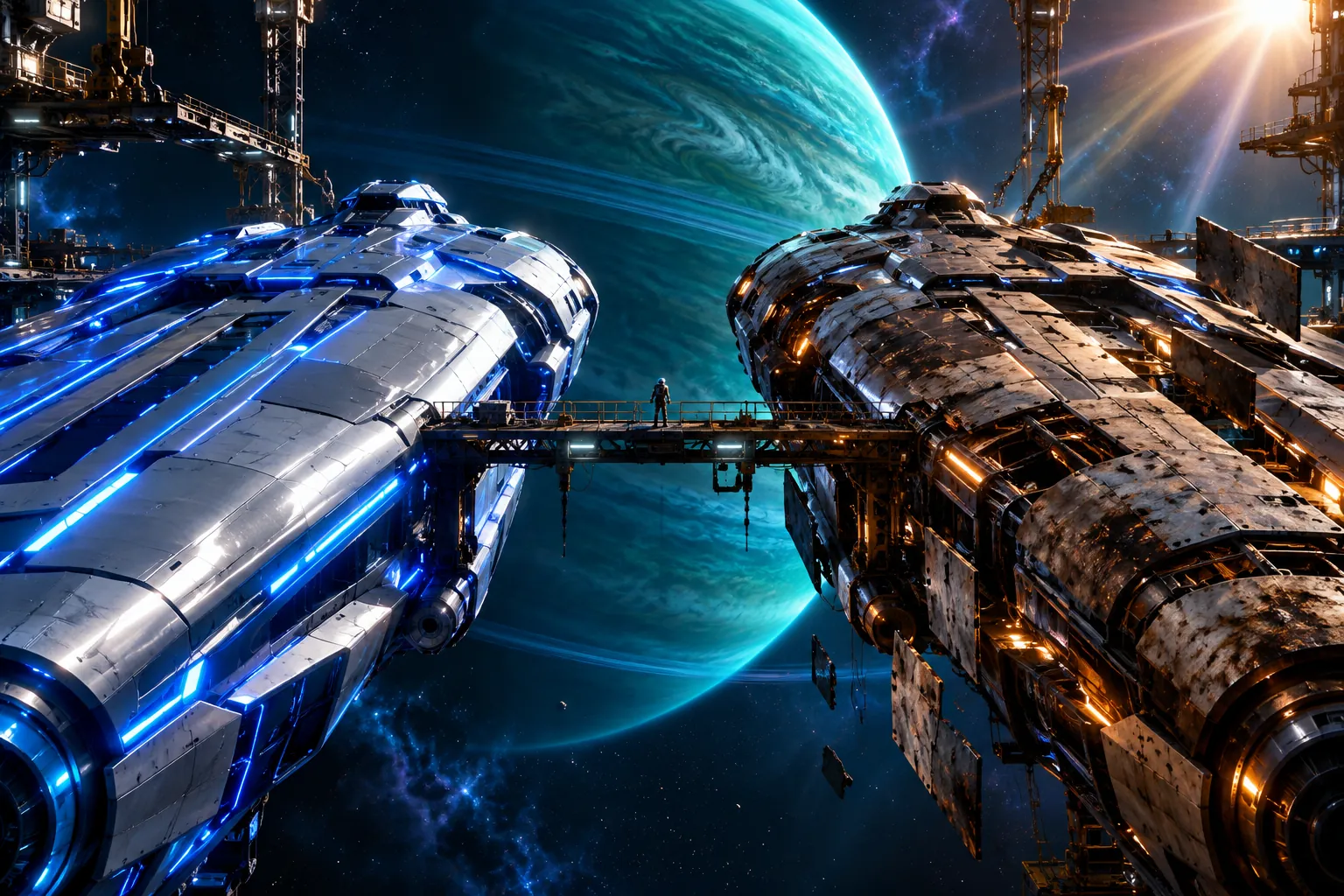
Now there are two candidates. One has the original shape and an unbroken history but all-new wood, and the other has the original wood but a gap in its history.
Which one is Theseus's ship, or is it both, or neither? Hobbes's twist is what makes the puzzle hard, because the two obvious tests for sameness now point in different directions.
Four ways to answer
Philosophers have given many answers, but four of them cover most of the ground. Each one reveals a different idea about what identity is.
- Continuity of form. A ship is a pattern that persists through gradual change, like a river or a football club whose players come and go. The ship that was repaired plank by plank is the original.
- Continuity of matter. A thing is its parts. The rebuilt ship made of the original planks is the real one, and the repaired ship is a copy that grew over it.
- It depends on the purpose. A museum curator cares about the original wood, while a harbour master cares about the working ship. The word "same" shifts with the question you are asking.
- No deep fact. "Same ship" is a label we use for convenience, and nature holds no hidden answer. Once you know every fact about the planks and the history, nothing is left to discover.
None of these has won. That is part of why the puzzle has lasted more than two thousand years.
From ships to people
The step from ships to people is old. John Locke argued in his Essay Concerning Human Understanding (1690) that a person stays the same through continuous consciousness and memory, not through the same body.
In Reasons and Persons (1984), the philosopher Derek Parfit pushed this further with the teletransporter. A machine scans you, destroys your body, and builds an exact copy from new atoms on Mars.
Parfit argued that what matters is psychological continuity, and that the copy has all of it. Many readers find that conclusion unsettling, which is exactly why the thought experiment is so useful.
Note that this is philosophy, not a measurement. No experiment can tell us which answer is right, because the disagreement is about what the word "same" should mean.
The real science
Your body really does replace its material, but unevenly. Cells lining the gut last only days, and red blood cells last about four months.
Bone is remodelled slowly over years. Even in cells that live a long time, the molecules inside are constantly swapped for new ones.
The brain is the interesting case. Studies that dated cells using carbon-14 from Cold War nuclear tests found that most neurons in the cerebral cortex are as old as the person.
So you are less like a ship with all its planks swapped than a ship where some planks change every week and the keel stays for life. Whether the keel is the "real you" is a philosophical choice, not a biological one.
Technology adds a second layer. Pacemakers, prosthetic limbs and cochlear implants already replace parts of people.
Replacing neurons with artificial ones, or copying a mind into a computer, is speculation. Nobody has done it, and nobody knows if it would preserve a person.
Where it shows up in fiction
Parfit's teletransporter is a philosophy thought experiment, but it is plainly modelled on the transporter of science fiction. The Star Trek series made the question famous: does the person who steps out at the other end continue the one who stepped in?
Masamune Shirow's manga Ghost in the Shell (1989) imagines a world of artificial bodies. Its heroine lives in an almost entirely prosthetic body and keeps asking what, if anything, makes her herself.
Stories about uploaded minds use the ship in reverse. Instead of replacing the parts, they move the pattern, and the plot asks whether the copy or the original gets to be the person.
Our cyborg article follows the gradual-replacement version, in which each swapped part is small enough to seem harmless. The brain in a vat article covers a neighbouring puzzle about what a mind can know.
Cryosleep stories look like the opposite case, because the body is kept whole and only time passes. They still raise a related question about what survives a long gap, which we cover in suspended animation.
Common misconceptions
"Your body is completely replaced every seven years." This popular claim is false.
Different tissues renew at very different speeds, and some cells, such as most cortical neurons, are not replaced at all.
"Hobbes invented the puzzle." The original comes from Plutarch, and it was already an old debate in his time.
Hobbes added the second ship made of the old planks.
"There is one correct answer." Philosophers still disagree, and the answer depends on what you take identity to be.
A good way to read the puzzle is as a test of your own assumptions.
"It is about boats." The ship is just an easy example.
The same logic applies to a person, a city, a software project or an organisation.
Read next
Cyborg follows the gradual-replacement idea from real prosthetics to fictional machine bodies.
Brain in a vat asks what a mind can be sure of once it is separated from its body.
Suspended animation / cryosleep covers the case where the body stays the same and only the years change.
Go back to the History of Science Fiction hub for the wider map of ideas.