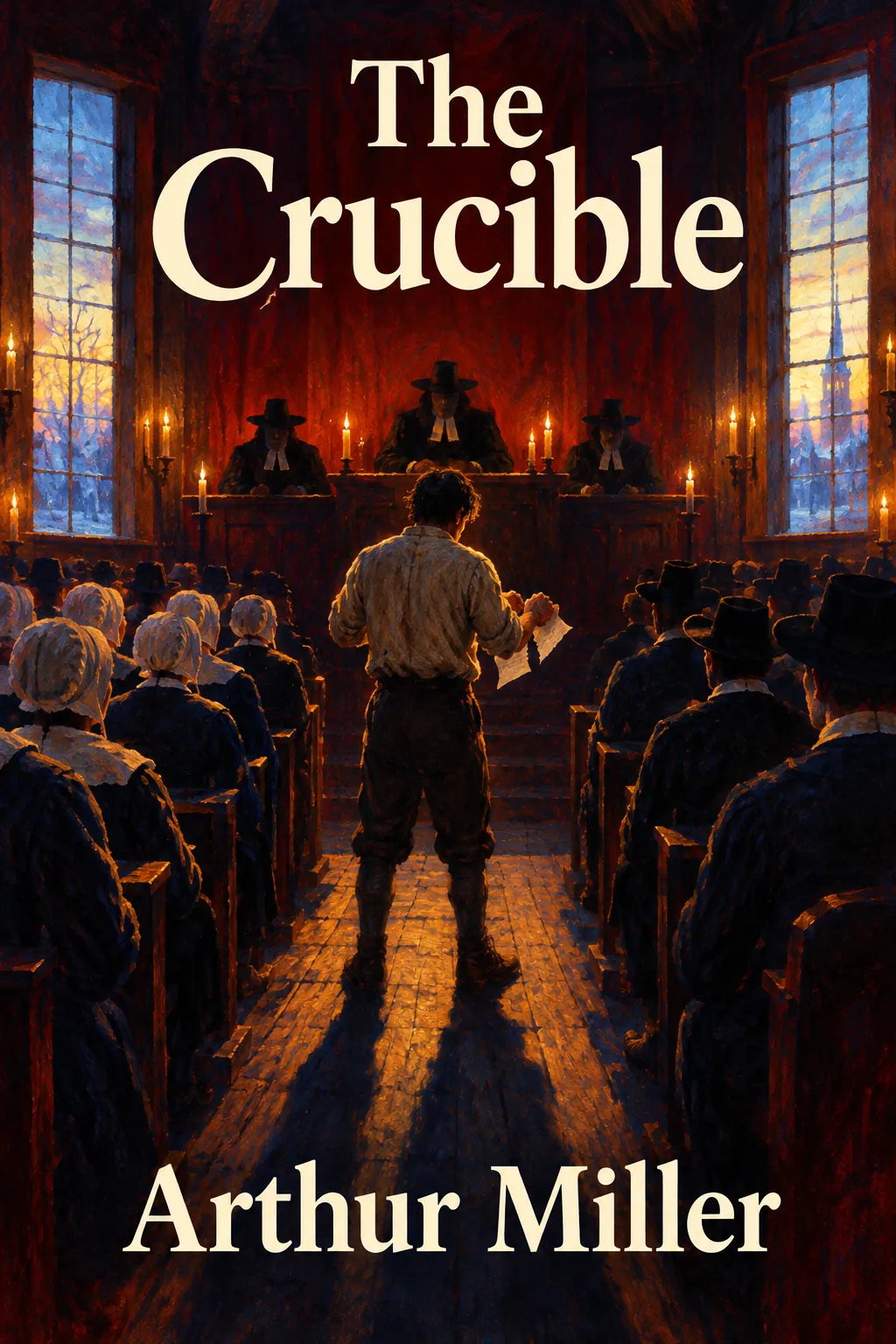
The Crucible
by Arthur Miller
The Crucible is Arthur Miller's 1953 play about the Salem witch trials of 1692. When a group of girls is caught dancing in the woods, they avoid punishment by claiming that witchcraft is to blame. Accusations spread, and the court believes anyone who names a neighbor. Farmer John Proctor, who has a guilty secret tied to the girls' leader, Abigail Williams, tries to stop the panic without destroying his own reputation. The play is also a comment on the fear of Communism in 1950s America.
The Big Idea
"In 1692 Salem, a lie told to escape punishment grows into a witch hunt, and ordinary people must choose between safety and conscience. Miller shows how fear lets a community destroy its own members."
Key Insights
Fear turns a community into a hunt
Miller shows a town that responds to fear by looking for someone to blame. Once accusing others becomes a way to gain safety, status or revenge, evidence stops mattering and confidence counts as proof. The play suggests that panic is not only the work of villains, because ordinary people join in when refusing is dangerous.
Tituba confesses in Act 1 to escape punishment, and soon Abigail and Betty are naming townspeople, until respected neighbors such as Rebecca Nurse are in jail.
Reputation versus integrity
Many characters guard their reputation as if it were the same thing as goodness. Miller separates the two. A name can be protected by silence, but integrity is tested by what a person is willing to lose, and Proctor learns that difference only when the court asks him to trade one for the other.
In Act 3 Proctor destroys his public image by admitting the affair, and in Act 4 he refuses to let a false confession be posted on the church door.
Authority that cannot admit error
The court is built so that doubt looks like disloyalty. Danforth does not ask whether the girls are lying, because an answer of yes would undo every earlier verdict. Miller uses the judges to show how an institution can become more dangerous the more it tries to defend itself.
Danforth refuses to postpone the hangings in Act 4, even after Abigail has fled, because a reprieve would suggest earlier executions were mistaken.
The play as allegory
Miller wrote The Crucible in the early 1950s, when congressional committees pressed people to name suspected Communists. Salem is a different setting for the same mechanism: a demand to confess, to name others and to prove loyalty. The allegory works because the human pattern is recognizable, even if the specific events are different.
Proctor is willing to confess his own guilt but will not name others, which echoes the choice facing people questioned in the 1950s.
Symbolism: the crucible, the poppet and the paper
A crucible is a vessel in which metal is heated until impurities burn away, so the title suggests that Salem tests people under extreme heat. Smaller objects carry meaning too. A doll becomes false evidence, and a sheet of paper becomes a battleground over a man's identity.
The poppet with a needle condemns Elizabeth in Act 2, and the signed confession in Act 4 makes Proctor choose what his name means.
Chapter Breakdown
Chapter-by-chapter summary
Spoiler warning: this section covers the whole plot, including the ending.
The real Salem witch trials of 1692 left twenty people dead. Miller changes some facts, such as the ages of Abigail and Proctor, to serve his drama.
Act 1: A Sick Child and a Frightened Town
The play opens in Reverend Parris's house, where his daughter Betty lies motionless after Parris found her and other girls dancing in the woods at night. Rumors of witchcraft spread through Salem, and Parris's niece Abigail Williams threatens the other girls into silence.
Abigail also confronts John Proctor, with whom she had an affair while she worked in his house, and he rejects her. When Reverend Hale, an expert on witchcraft, arrives and questions the girls, Abigail blames Tituba, who confesses and names other people to save herself.
Act 1 matters because it sets the rule that drives the whole play: accusing someone else is the safest way to escape blame.
Act 2: The Proctor Home
Eight days later, John and Elizabeth Proctor share a tense supper, and their talk shows that his affair still divides them. Their servant Mary Warren returns from court and says that Elizabeth's name has come up in the accusations.
Hale visits to test the family's faith, and Proctor stumbles over the commandments. Officials then arrive with a warrant, and a needle found in a doll that Mary made is treated as proof that Elizabeth attacked Abigail.
Elizabeth is arrested, and Proctor must decide whether to expose Abigail even if it exposes his own sin. This act matters because it moves the panic from the town into a marriage.
Act 3: The Court
In the meetinghouse, Giles Corey and Francis Nurse protest to Deputy Governor Danforth, who presides over the court. Proctor brings Mary Warren to testify that the girls have been pretending, and Danforth answers by treating every challenge as an attack on the court.
To prove that Abigail is lying, Proctor confesses the affair. Elizabeth, who has never lied, is called in and denies it to protect his name, and Abigail and the girls then pretend that Mary's spirit is attacking them.
Mary collapses and accuses Proctor, who is arrested, and Hale denounces the proceedings and quits. The act matters because honesty is punished while performance is rewarded.
Act 4: The Jail
On an autumn morning, Parris reports that Abigail has robbed him and fled, and that unrest is spreading in nearby towns. Danforth still refuses to delay the hangings, and Hale now urges the condemned to confess in order to live.
Ending: The Torn Confession
Proctor agrees to confess and signs, but he refuses to give the paper to the court or to name anyone else. He tears it up, saying he cannot give up his name, and he goes to the gallows with Rebecca Nurse as drums roll.
The ending matters because Proctor's death is not a defeat of conscience, even though the court gets what it wanted.
Characters
John Proctor is a farmer in Salem who is ashamed of his affair with Abigail. He starts the play protecting his reputation and ends it protecting his integrity.
Elizabeth Proctor is his wife, a stern and honest woman who is slow to forgive him. Her one lie in Act 3 shows how the court bends even the truth-teller.
Abigail Williams is Parris's niece and the leader of the accusing girls. She is clever, forceful and willing to destroy anyone who stands in her way.
Reverend Hale comes to Salem sure of his expertise. He slowly sees the court's injustice and ends by begging prisoners to save their lives.
Deputy Governor Danforth is the proud, intelligent judge who cannot admit the court could be wrong. He represents authority that protects itself.
Reverend Parris is a minister preoccupied with his position and with enemies in the congregation. His fear for his reputation helps launch the crisis.
Mary Warren is the Proctors' timid servant who joins the court's girls. She tries to tell the truth but gives in under pressure.
Rebecca Nurse is an elderly, respected woman known for kindness. She is accused anyway, which shows that no reputation is safe.
Writing about this book
Start with an argument, not a retelling. For example, you could argue that Miller shows how fear turns neighbors into informers, or that Proctor finds integrity only when he loses everything else.
Choose three or four pieces of evidence from different acts, so that you can show change over time. Good scenes to compare are Proctor's silence in Act 2, his confession in Act 3 and his refusal in Act 4.
After each quotation, explain what the word choice or the stage action does. Keep quotes short, and stay with one idea per paragraph.
Link the play to its context in a sentence or two, without letting history replace analysis. Miller wrote in the early 1950s, when many Americans were pressured to name suspected Communists.
The model essays below are learning examples at three levels. Read them next to your own draft to see what each level adds, then write your own answer in your own words.
Take Action
Practical steps you can implement today:
-
Build an essay on an argument about how Miller makes his point, not on a list of events.
-
Compare a character at the start and at the end of the play to show change.
-
Use short quotations and explain the effect of specific words or stage actions.
-
Connect Salem to the 1950s in one or two sentences, then return to the text.
-
Check each act for a turning point, such as Tituba's confession, Elizabeth's lie or the torn paper.
Notable Quotes
"“Because it is my name! Because I cannot have another in my life!” (Act 4)"
— Arthur Miller
"“I have given you my soul; leave me my name!” (Act 4)"
— Arthur Miller
"“a person is either with this court or he must be counted against it” (Act 3)"
— Arthur Miller
"“Life, woman, life is God’s most precious gift; no principle, however glorious, may justify the taking of it.” (Act 4)"
— Arthur Miller
"“He have his goodness now. God forbid I take it from him!” (Act 4)"
— Arthur Miller
Who Should Read This
This guide suits high-school students in the United States and the Philippines who study The Crucible in English or American literature, and AP Literature students who need a play for the open-ended essay. It also helps readers who want to understand the Salem story before seeing a production.
Characters
John Proctor
protagonist
A farmer in his thirties who is respected in Salem but private about his shame over an affair with Abigail. He first tries to protect his reputation, then learns that his integrity matters more.
Elizabeth Proctor
foil to Abigail; moral center
Proctor's wife is honest, reserved and slow to forgive his betrayal. In Act 3 she lies for the first time to protect him, and the lie shows how the court corrupts even the truth-teller.
Abigail Williams
antagonist
Parris's niece and the leader of the accusing girls. She wants Proctor, and she uses the court's fear of witchcraft to remove his wife and punish anyone who threatens her.
Reverend John Hale
dynamic character
A minister who arrives as an expert on witchcraft and trusts the process at first. As the evidence weakens, he turns against the court and ends the play urging prisoners to confess to save their lives.
Deputy Governor Danforth
authority figure; antagonist
The intelligent and proud judge who leads the court. He cannot allow himself to doubt its verdicts, so he treats every challenge as disloyalty.
Reverend Samuel Parris
minor antagonist
The minister of Salem, who is worried about his salary, his status and his enemies. His fear for his reputation shapes how the first accusations are handled.
Mary Warren
foil; victim of pressure
The Proctors' servant, who is also a court girl. She briefly finds the courage to tell the truth in Act 3 but collapses when Abigail turns the girls on her.
Rebecca Nurse
symbol of integrity
An elderly woman admired across Salem for her kindness. Her arrest shows that goodness offers no protection once fear takes over.
Giles Corey
supporting character
An elderly farmer who is known for lawsuits and blunt speech. He accuses Thomas Putnam of using the trials to take land, and he is arrested after refusing to name the source of his evidence.
Tituba
scapegoat
The Parris household's enslaved woman from Barbados, who is pressured to confess in Act 1. Her answers show the court how confession can buy safety.
Thomas Putnam
opportunist
A wealthy landowner who is bitter about old disputes. He uses the trials to eliminate rivals and acquire their land.
Exam practice: sample answers
Model answers are examples to learn from; write your own in your words.
literary argument
1. In many works of literature, a character must choose between protecting himself or herself and standing by a principle. Choose a work of literary merit and, in a well-organized essay, analyze how this choice contributes to the meaning of the work as a whole. (AP Literature Question 3 style)
Outline
- Thesis: name the choice and the meaning it creates
- Early: how the character protects himself and why
- Middle: how pressure raises the cost of principle
- End: the final choice and what it shows
- Conclusion: the meaning of the work as a whole
Basic Model answer
In The Crucible by Arthur Miller, John Proctor has to choose between saving his life and keeping his principles. This choice shows that honesty is more important than staying alive.
At first, Proctor hides the truth because he is ashamed. He had an affair with Abigail Williams, and he does not want everyone to know.
He is afraid that people will not respect him if they find out.
Later, the court puts him in prison and tells him to confess to witchcraft. If he says he is a witch, he can live.
Proctor does sign a confession, but he will not let the court display it. He tears it up and goes to the gallows.
This shows the meaning of the play. Miller wants us to see that some things, like your name, are worth more than your life.
Proctor is a good man in the end because he stops lying.
In conclusion, the choice between safety and principle shows the message of The Crucible. People should tell the truth even when it is hard.
Good Model answer
In Arthur Miller’s The Crucible, John Proctor must decide whether to save his life with a lie or to die with his integrity intact. Miller uses this choice to argue that a person’s conscience, not a community’s approval, is the final measure of a good life.
At the start of the play, Proctor values safety. He keeps his affair with Abigail Williams secret, and in Act 2 he hesitates to testify against the girls because it would expose him.
Elizabeth’s quiet honesty at home reminds him daily of what he has done, so his private guilt shapes every public decision. He is not a coward, but he is protecting his reputation more than the truth.
In Act 3 the choice becomes harder. Proctor reveals the affair to prove that Abigail is lying, and this costs him the very reputation he was protecting.
When Elizabeth lies to shield him, the court destroys his case, which shows that in Salem even honest evidence is treated as a threat.
Miller contrasts Proctor with Reverend Hale, who spends the first half of the play trusting the court and the second half trying to undo its damage. Hale ends by urging prisoners to lie to survive, which makes Proctor’s refusal stand out as a choice made with full knowledge of the alternative.
The final choice comes in Act 4, when Danforth offers life in return for a signed confession. Proctor says he is no good man, yet he refuses to let the paper be nailed to the church door, saying, “Because it is my name!”
This outburst shows that he has finally defined himself by his own standards rather than the town’s.
Proctor’s choice gives the play its meaning. By dying, he turns his earlier shame into moral courage, and the audience sees that integrity can survive even when justice fails.
Even Elizabeth’s final refusal to stop him, because he has found his own goodness, confirms that the play values self-respect over survival.
The Crucible therefore suggests that true principle is tested only when the cost is real.
Excellent Model answer
Arthur Miller’s The Crucible argues that integrity is not a possession a person holds from the start but a decision made under pressure, and that the cost of the decision is what gives it meaning. John Proctor’s journey from guarded self-protection to costly honesty shows how a community’s terror can force a private conscience into public view.
Proctor begins the play as a man who has learned to manage his guilt rather than face it. He has ended his affair with Abigail Williams, yet he lets Salem’s accusations grow while telling himself that her claims will collapse without his help.
The delay is not villainy; it is the ordinary habit of a man who confuses privacy with safety.
The pressure that breaks this habit is structural, not accidental. Miller builds a court in which denial counts as proof, and Danforth states the logic bluntly when he says a person is “either with this court or he must be counted against it.”
In such a system no neutral position exists, so Proctor’s silence stops being a private failure and becomes a form of complicity.
Act 3 is where Miller tests the cost of honesty rather than its reward. Proctor sacrifices his reputation by confessing the affair, and the sacrifice is wasted when Elizabeth, protecting his name the one time she has ever lied, denies it.
Her lie is the most painful irony in the play: the person who never lies does so out of love, and the lie convicts him. The scene shows that principle without power is fragile, and that truth depends on who is permitted to hear it.
Rebecca Nurse offers a second model of integrity. She is calm, charitable and unwilling to lie, and she is hanged anyway.
Miller places her beside Proctor to show that principle is a steady habit of character rather than a rare burst of courage, and Proctor’s difference is that he must learn it late, which makes his choice more dramatic.
By Act 4 Miller has stripped away every incentive except conscience. Proctor can live, and Hale, now a broken man, begs him to, arguing that life is “God’s most precious gift.”
Proctor’s temptation is therefore not cowardice but reasonable self-preservation, which is why his decision is credible rather than melodramatic.
The decision hinges on the word “name.” Proctor signs the confession, then refuses to surrender it, crying, “Because it is my name!”, because a public lie would turn his name into a tool of the court.
In this moment the word shifts meaning: in the early acts reputation was something Proctor guarded for others’ approval, whereas now it is something he owns for himself.
Elizabeth’s final words complete the argument. She refuses to persuade him to confess, saying he has “his goodness now,” so the play treats Proctor’s death not as a defeat but as the moment self-knowledge becomes whole.
Miller’s wider context sharpens the point. Writing in the early 1950s, when Americans were pressured to name suspected Communists, he shows that the choice between safety and conscience is not confined to 1692.
The play invites audiences to ask what they would sign, and what they would refuse to hand over.
Ultimately, the choice between self-preservation and principle gives The Crucible its moral structure. Proctor’s death does not stop the hysteria, but it restores a standard against which the court’s authority looks hollow, and that is the play’s final claim: conscience cannot be legislated away, even when it cannot win.
Marking rubric
- Thesis: a defensible claim about meaning, not a summary of the plot
- Evidence: specific moments from more than one act, with short accurate quotations
- Commentary: explains how word choice, structure or stage action builds the idea
- Whole work: links the choice to the meaning of the play and its context
- Control: clear paragraphs, precise language and a purposeful conclusion
Now write your own
Choose a different character who faces a similar choice, such as Hale, Elizabeth or Giles Corey, and write your own answer to the question in about 40 minutes. Then compare your thesis and evidence with the three levels above.
drama passage analysis
2. Analyze how Arthur Miller uses diction, dramatic irony and stage action in the closing movement of Act 4, in which John Proctor signs a confession, refuses to give it to Danforth and tears it. Explain how these choices portray Proctor's final decision. (AP Literature Question 2 style, drama passage; the passage is described, not reproduced)
Outline
- Thesis: how Miller shows the decision as a claim to identity
- Diction: the repeated 'because' and the word 'name'
- Stage action: signing, pulling back and tearing the paper
- Dramatic irony: the court needs his permission to look just
- Conclusion: what the scene shows about conscience
Basic Model answer
In the end of The Crucible, John Proctor tears up his confession. Miller uses strong words and actions to show that Proctor has made up his mind.
First, Proctor shouts about his name. He says, “Because it is my name!”
He repeats the word “because”, which makes it sound like he is finally giving real reasons. This shows that his name is the most important thing he has left.
The exclamation mark makes the line sound loud and angry.
Second, the stage action shows his feeling. Proctor takes the paper and tears it up, so the audience can see his choice and not just hear it.
Tearing the paper is a way of saying no to Danforth.
Third, Danforth wants the confession to be public and nailed to the church door. This makes Proctor angry because everyone in Salem would see it.
It is irony because Danforth thinks he has won, but Proctor takes back his power.
Overall, Miller shows that Proctor chooses to die honestly. The words and actions work together to show that he finds his courage at the end.
Good Model answer
In the final scene of The Crucible, Arthur Miller uses charged diction, repetition and physical stage action to show that John Proctor’s decision is about identity, not only about death. The scene turns a signed confession into a symbol of the self.
Miller’s diction centers on the word “name.” Proctor’s cry, “Because it is my name!”, repeats the conjunction “because” in a rush, as though he is discovering his reasons as he speaks.
The exclamations, short clauses and broken rhythm are what an actor can use to show strain, and they make the speech feel spontaneous and emotional, which suggests that the decision comes from conscience rather than calculation.
The same speech sets up a contrast between his name and his soul. Proctor accepts that he has done wrong and is willing to bear the guilt privately, but his plea to “leave me my name” shows that he will not let the court use his reputation to convince others that the trials are just.
Stage action carries the argument as well. Proctor signs the paper but then pulls it back from Danforth, and the physical struggle over a sheet of paper shows that the document is a weapon in the court’s hands.
When Proctor finally tears it, the audience sees his refusal as a physical act, not only a spoken one.
There is also dramatic irony. Danforth and Parris believe that a signed confession will calm Salem, but the audience, aware of the earlier lies and false accusations, sees that the court’s victory depends on a document that the confessor himself calls a lie.
Elizabeth’s response adds weight. She does not ask Proctor to reconsider, which suggests that his choice is moral rather than only personal.
The drums that close the play make the decision final and public.
Miller therefore presents Proctor’s last act as a reclaiming of identity. The language, the repeated “because” and the torn paper all show a man choosing what he will be remembered for.
Excellent Model answer
In the closing movement of Act 4, Arthur Miller turns a signed piece of paper into the play’s final battlefield. Through charged diction, a collapse of syntax, dramatic irony and carefully placed stage action, he presents John Proctor’s refusal not as stubbornness but as the first moment in which Proctor controls the meaning of his own life.
The dispute begins as a legal problem. Danforth wants the confession posted publicly so that Salem will accept the court’s verdict, while Proctor asks why it must be shown at all.
The question matters because it exposes the real function of a confession in this world: it is not an act of repentance but a piece of propaganda.
When Proctor reclaims the paper, his language becomes the play’s most direct statement of value. “Because it is my name!” arrives as an answer that has been waiting all night, and the repeated “because” makes each reason seem to arrive faster than the last.
The syntax breaks from the formal, scriptural cadence that dominates Salem’s speech into short, ragged bursts, as though the discipline of Puritan rhetoric cannot hold what he is feeling.
The speech also redefines two words that the play has been testing since Act 1: soul and name. Proctor says he has given the court his soul, and asks only to keep his name.
In a Puritan community a person’s soul belongs to God, so to speak of surrendering it to the court is to admit that the confession is a spiritual lie, while to keep the name is to preserve the one thing he still has the right to define.
A related refusal shows the same logic. Earlier in the scene, Proctor will confess his own guilt but will not name any other prisoner, saying that he cannot judge another person.
The distinction between confessing for oneself and informing on others speaks directly to the 1950s hearings Miller had in mind, and it prepares us to see the paper as a demand for more than honesty.
Stage action reinforces the argument. Proctor signs, so he does fulfill the court’s demand, and the audience feels how close he has come to surrender.
When he pulls the paper out of Danforth’s reach and finally tears it, Miller gives the actor a physical gesture that reverses the earlier moment of submission, so the reversal is seen as well as heard.
Dramatic irony sharpens the scene. Danforth and Parris believe that a public confession would calm Salem, yet the audience has seen across four acts that the court’s authority depends on false confessions and manipulated fear.
When Proctor denies them the document, he exposes the weakness of an institution that needs his permission to look legitimate.
The reactions of the other characters complete the picture.
Hale, who once believed in the proceedings, pleads with Elizabeth to persuade Proctor to save himself, and her refusal, expressed in the claim that he now has his goodness, confirms that the decision belongs to him.
Her restraint also contrasts with Hale’s anguish, so that the moral clarity of the scene comes from the person with the least power rather than the most.
Miller closes with the sound of drums rather than a speech. The drums set the public machinery of the court against the private choice we have just seen, and the contrast leaves the audience with the cost of the decision instead of a neat reassurance.
Taken together, these choices show that Proctor’s final act is not a fall into martyrdom but a claim to authorship. The paper that was meant to prove the court’s authority becomes evidence that conscience can refuse it.
Marking rubric
- Thesis: a claim about how techniques portray the decision
- Evidence: short accurate quotations and specific stage actions
- Commentary: explains the effect of each technique, not just its name
- Context: connects the scene to the play's argument and Miller's setting
- Style: controlled organization and precise vocabulary
Now write your own
Write your own analysis of a different moment of choice in the play, such as Elizabeth's lie in Act 3, using the same three techniques: diction, stage action and irony.
theme / character analysis
3. How does Arthur Miller show that the authority of the Salem court depends on fear? Support your answer with evidence from at least two acts. (Standard high-school analytical essay prompt: thesis, evidence, commentary)
Outline
- Thesis: the court's authority depends on fear
- Act 1: Tituba's confession teaches that confession is safe
- Act 3: Danforth's logic and Abigail's performance
- Act 4: authority that cannot admit error
- Conclusion: fear as the engine of the play
Basic Model answer
In The Crucible, Miller shows that the court gets its power from fear. People in Salem are scared of being accused, so they do what the court wants.
In Act 1, Tituba is afraid of being punished. When Parris and Hale pressure her, she says she saw other people with the Devil.
Miller shows that confessing is the quickest way to stay safe. This saves her from being punished, and it makes other people copy her.
Abigail also uses fear. She tells the other girls that she will hurt them if they tell the truth.
Later, she pretends to see a spirit so that people believe her instead of Mary Warren.
Danforth is the judge, and he does not want to hear that the court could be wrong. In Act 3 he says that anyone who is not with the court is against it.
This means people are too scared to disagree.
In conclusion, fear makes the court strong in Salem. Miller wants us to see how dangerous it is when people are too scared to speak up.
Good Model answer
In The Crucible, Arthur Miller argues that the authority of the Salem court rests not on evidence but on fear. By making denial look like guilt, the court forces everyone to choose between silence and accusation, and each choice feeds the panic.
The pattern begins in Act 1 with Tituba. Pressed by Parris and Hale, she learns that confessing wins sympathy while denying brings punishment, so she names others.
Her confession shows the audience that the “proof” of witchcraft is simply what frightened people say to protect themselves.
Abigail Williams turns this logic into a weapon. She frightens the other girls into silence and later, in Act 3, pretends that Mary Warren has sent a spirit against her.
Because the court accepts her performance over Mary’s calm deposition, Abigail learns that the more dramatic the fear, the more convincing it seems.
Fear also hides private motives. Giles Corey says that Thomas Putnam is using his daughter’s accusations to seize land, and the court’s refusal to investigate shows that fear is useful to those who benefit from it.
Danforth supplies the legal structure for this logic. In Act 3 he says that a person is “either with this court or he must be counted against it,” which removes any space for honest doubt.
When Proctor presents ninety-one signatures supporting good people, Danforth treats the petition as an attack and orders the signers questioned.
Even in Act 4, when it is clear that Abigail has fled and that unrest is growing in nearby Andover, Danforth refuses to postpone the hangings because he fears that doing so will cast doubt on those already dead. His authority has become something he must protect through more fear and more deaths.
Miller therefore shows that fear is not a side effect of the witch hunt but its engine. A court that cannot be questioned must keep producing guilty people to prove it is right, which is why the play ends in tragedy rather than correction.
Excellent Model answer
In The Crucible, Arthur Miller presents fear not as an emotion that overwhelms the court but as the system that keeps the court running. The authority of Salem’s judges depends on a cycle in which fear produces accusations, accusations produce confessions, and confessions seem to prove that the fear was justified.
The cycle starts in Act 1, when Reverend Parris is more afraid of losing his position than of the girls’ dancing. He worries that enemies in the congregation will use the scandal against him, and his anxiety about reputation sets the terms of the investigation.
When Tituba is pressed, she discovers that the only safe answer is the one the questioners want. Her confession is not evidence of witchcraft; it is evidence of what fear teaches an accused person to say.
Abigail seizes on that lesson and begins naming townspeople, so one frightened answer becomes a model for the whole town.
Miller shows that this logic also feeds private ambition. Giles Corey says that Thomas Putnam has used his daughter’s accusations to acquire land, and the exchange suggests that fear offers cover for greed.
A court that cannot question motive cannot tell the sincere from the opportunistic.
Danforth is where fear becomes policy. When he declares that a person is “either with this court or he must be counted against it”, he turns neutral doubt into disloyalty.
That one sentence explains why Proctor’s petition, with its ninety-one signatures, is treated as an attack rather than as evidence of respect for the accused.
His examination of Mary Warren is a model of this method. Mary tries to tell the truth, but when Abigail and the girls pretend to be attacked by her spirit, she panics and accuses Proctor instead.
The court prefers the performance of terror to the quieter testimony of a frightened girl, so the more extreme the fear is, the more credible it appears.
Even the play’s most honest character is shaped by this atmosphere. In Act 3, Elizabeth, who has never lied, gives the court a false answer because she thinks she is protecting her husband, and the lie destroys him.
Fear thus damages the one person who stands for truth.
Act 4 reveals the final stage, in which authority must defend itself by continuing to act. Danforth learns that Abigail has fled and that other towns are resisting, yet he refuses to delay the hangings, because reprieve would imply that earlier executions were mistaken.
Fear of being wrong has replaced the search for the truth.
Miller’s settings reinforce the point by moving from the private worry of Parris’s house and the Proctors’ kitchen to the public fear of the meetinghouse and finally to the confinement of the jail. Each place narrows the space for dissent, so the audience feels the pressure close in.
Miller wrote the play in the shadow of congressional investigations into suspected Communists, and the same pattern of pressure to name others and pay for silence helps explain why the play still reads as contemporary. The lesson reaches beyond 1692: institutions that cannot be doubted become institutions that cannot be corrected.
Fear therefore functions as the play’s engine. The more people are afraid, the more the court appears to be needed, and the more the court is needed, the less anyone dares to stop it.
Marking rubric
- Thesis: an argument about how the court depends on fear
- Evidence: examples from at least two acts, accurate to the text
- Commentary: explains cause and effect, not just events
- Quotations: short, relevant and correctly attributed
- Organization: clear topic sentences and a purposeful conclusion
Now write your own
Write a single body paragraph (claim, evidence, commentary) arguing that Reverend Parris's fear for his reputation helps start the witch hunt. Use one short quotation or a precise reference to the text.
Frequently Asked Questions
What is The Crucible about?
The Crucible is a four-act play by Arthur Miller set during the 1692 Salem witch trials. A group of girls accuses townspeople of witchcraft, a court believes them, and John Proctor must choose whether to protect his name or his life. It also criticizes fear-driven politics in the 1950s.
Is The Crucible a true story?
It is based on real events, but it is not a history lesson. The Salem trials happened in 1692 and several characters, including Proctor, Rebecca Nurse and Giles Corey, were real people. Miller changed ages, merged roles and invented scenes, such as Proctor's affair with Abigail, to make a tighter drama.
Why did Arthur Miller write The Crucible?
Miller wrote it in the early 1950s, when government committees pressed Americans to name suspected Communists and many people lost jobs for refusing. He used Salem as a way to examine the same pattern of fear, confession and betrayal. The play opened on Broadway in January 1953.
What does the title The Crucible mean?
A crucible is a strong container used to heat metals until they melt and impurities are burned away. Miller uses the word as a metaphor for a harsh test of character. In Salem, the pressure of the trials reveals who will lie to survive and who will keep their conscience.
What are the main themes in The Crucible?
The main themes are hysteria and scapegoating, reputation versus integrity, the abuse of authority, and the cost of telling the truth. Revenge and greed also appear, as some accusers use the panic to settle old grudges or gain land. Students often link these ideas to the play’s allegory of the 1950s.
How should I quote The Crucible in an essay?
Use short quotations of a phrase or a single sentence, put the act number in parentheses and explain what the wording does. Strong choices include Proctor's speech about his name and Danforth's line that people must be with the court or against it. Do not copy long speeches.
Check Your Understanding
Pick an answer for each question to see if you were right.
-
Where and when is The Crucible set?
Salem, Massachusetts in 1692 — The play dramatizes the 1692 witch trials in Salem, Massachusetts.
-
Who is the first person in Act 1 to confess to witchcraft?
Tituba — Tituba confesses under pressure and names others, which sets the pattern for the rest of the play.
-
How is Abigail Williams related to Reverend Parris?
She is his niece — Abigail is Parris's niece and lives in his household.
-
What is used as evidence against Elizabeth Proctor in Act 2?
A doll with a needle in it — A needle in a doll that Mary Warren made is taken as proof that Elizabeth attacked Abigail.
-
Which real-world event did Miller have in mind when he wrote the play?
McCarthy-era investigations of suspected Communists — Miller wrote the play as a comment on the early 1950s hunt for suspected Communists.
About Arthur Miller
Arthur Miller (1915–2005) was an American playwright born in New York City. His best-known plays include All My Sons, Death of a Salesman and The Crucible, which opened on Broadway in 1953. In 1956 he was questioned by the House Un-American Activities Committee and refused to name other people. His work often explores guilt, family and a person's duty to society.
Summary Written By

Software Engineer & Writer
Software engineer with a passion for distilling complex ideas into actionable insights. Writes about finance, investment, entrepreneurship, and technology.
View all summaries →Reviews
No reviews yet. Be the first to share your thoughts!
Write a Review
Keep reading
Explore the topic: Study GuidesSummaries

The Outsiders by S.E. Hinton
S.E. Hinton
Ponyboy Curtis and his gang of Greasers clash with the wealthy Socs in a cycle of violence. After a tragic…

Noli Me Tangere
José Rizal
Noli Me Tangere (1887) is José Rizal's novel about Crisóstomo Ibarra, a young Filipino who returns home after seven years…

Educated by Tara Westover
Tara Westover
A memoir about a young woman born to survivalists in Idaho who, despite having no formal schooling, teaches herself to…

Atomic Habits: An Easy & Proven Way to Build Good Habits & Break Bad Ones
James Clear
No matter your goals, Atomic Habits offers a proven framework for improving–every day. James Clear, one of the world’s leading…
Articles

Yokai explained: Japan’s spirits and monsters
Yōkai are the spirits, shape-shifters and monsters of Japanese folklore, from the fox and the river imp to the haunted…

Ship of Theseus
The Ship of Theseus is a thought experiment about identity: if every plank of a ship is replaced over time,…

Japanese mythology and the Kojiki
Japanese mythology is the set of stories about the kami, the gods and ancestors of Japan, told mainly in the…