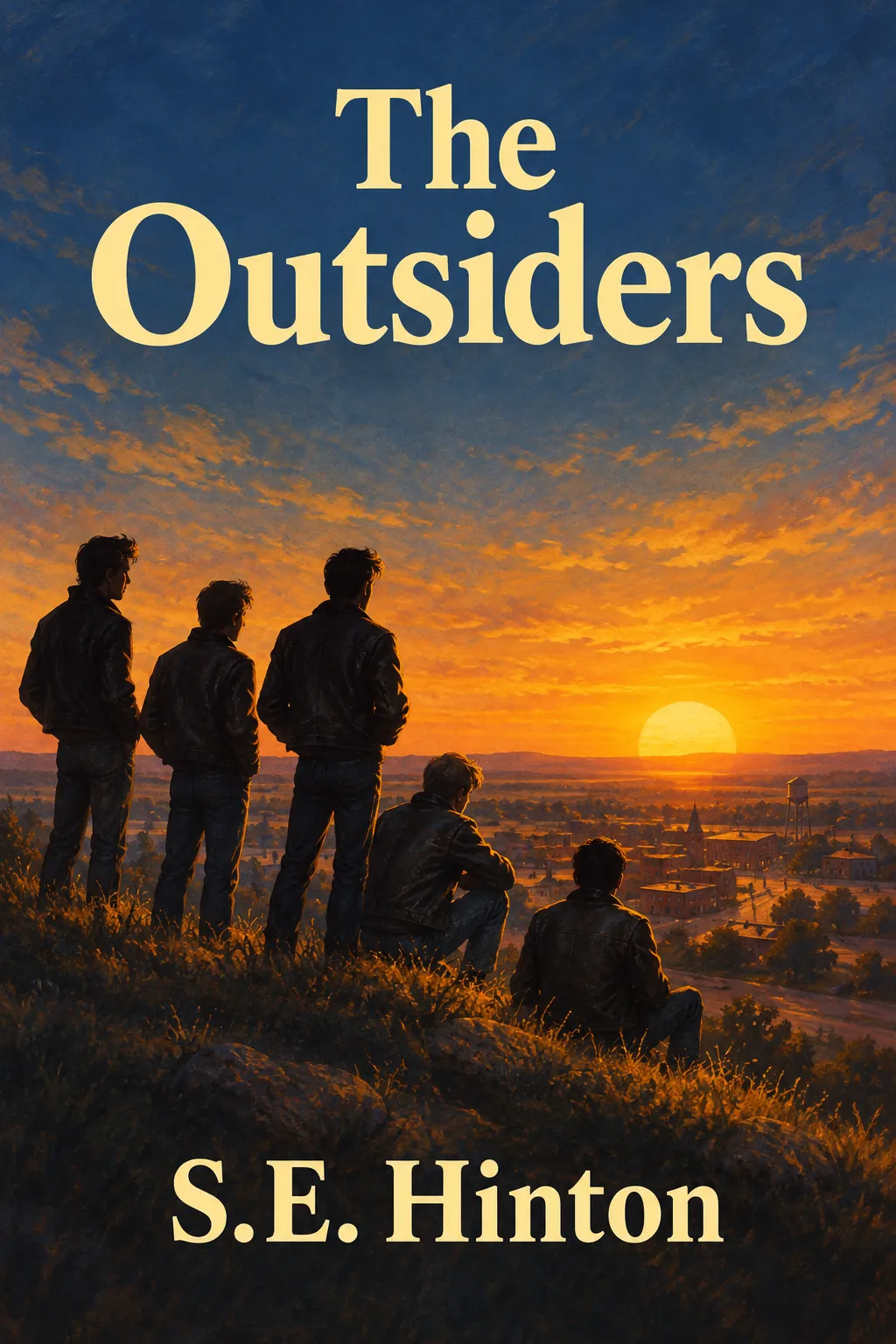
The Outsiders by S.E. Hinton
by S.E. Hinton
Ponyboy Curtis and his gang of Greasers clash with the wealthy Socs in a cycle of violence. After a tragic accident and a heroic rescue, Ponyboy learns that empathy and innocence are more valuable than social status.
Try Audible · As an Amazon Associate we earn from qualifying purchases. Details
The Big Idea
"Social class and gang labels are superficial barriers that hide a shared human experience of pain, longing, and the desire for acceptance."
Key Insights
The Illusion of Class Divide
While the Socs have money and the Greasers have nothing, both groups face internal struggles and pressures.
Cherry Valance explains to Ponyboy that the Socs' lives are restricted by expectations and a lack of genuine feeling.
Chosen Family
For those with broken homes, peer groups become essential survival mechanisms and sources of unconditional love.
The Greasers protect Johnny, who is abused by his parents, treating him as a beloved younger brother.
The Fragility of Innocence
Youthful idealism and purity are easily corrupted by a violent environment.
Johnny's plea to 'stay gold' refers to maintaining a sense of wonder and goodness despite hardship.
The Futility of Violence
Fighting and 'winning' a rumble does not solve the underlying social issues or bring back the dead.
Even after the Greasers win the final fight, the grief over Johnny and Bob remains unchanged.
The Power of Empathy
Recognizing the humanity in your 'enemy' is the only way to escape the cycle of hatred.
Ponyboy realizes that Bob the Soc was just another kid with his own set of problems.
Chapter Breakdown
The World of Greasers and Socs
Written by S.E. Hinton when she was only sixteen, The Outsiders is a poignant exploration of class conflict, adolescent identity, and the fragility of innocence. Set in 1960s Oklahoma, the story introduces us to a starkly divided social landscape.
On one side are the Greasers, the working-class boys from the 'wrong side of the tracks,' characterized by their long, slicked-back hair and leather jackets. On the other side are the Socs (short for Socials), the wealthy, privileged teenagers who drive Mustangs and wear Madras shirts.
This systemic divide creates a cycle of violence and resentment, where the Greasers are often unfairly branded as hoodlums by society, regardless of their individual characters.
A Cycle of Violence and Loss
The plot centers on Ponyboy Curtis, a sensitive and intelligent fourteen-year-old who feels out of place even among his own peers. After the death of their parents, Ponyboy and his brother Sodapop are raised by their oldest brother, Darry, who has sacrificed his own ambitions to keep the family together.
The tension escalates when Ponyboy and his friend Johnny Cade are jumped by a group of Socs. This encounter leads to a pivotal night where Ponyboy and Johnny, fleeing from a brutal attack in a park, find themselves embroiled in a tragedy.
To save Ponyboy from being drowned, Johnny kills a Soc named Bob. The two boys go on the run, hiding in an abandoned church in Windrixville.
This period of isolation allows them to bond over literature and the concept of 'staying gold,' but it culminates in a heroic yet tragic act when Johnny risks his life to save children from a fire, leading to his fatal injuries.
Major Themes: Identity and Empathy
At its core, the novel is about the search for identity beyond the labels imposed by society. The conflict between the Greasers and Socs is presented not as a battle of good versus evil, but as a clash of circumstances.
Hinton emphasizes that everyone struggles, regardless of their bank account. The theme of brotherhood is also central; for the Greasers, their gang is not just a social circle but a chosen family that provides the emotional support and protection they lack at home.
Furthermore, the concept of 'innocence' is explored through the lens of the poem 'Nothing Gold Can Stay,' suggesting that the purity of youth is fleeting and must be consciously protected against the hardening effects of a cruel world.
Key Scenes and the Turning Point
One of the most impactful scenes is the conversation between Ponyboy and Cherry Valance, a Soc girl who recognizes that the two groups aren't as different as they seem. She tells him, 'Things are rough all over,' bridging the gap between their social strata.
Another critical moment is Johnny's final letter to Ponyboy, which serves as the emotional climax of the story. In this letter, Johnny urges Ponyboy to 'stay gold,' encouraging him to maintain his curiosity, his love for sunsets, and his capacity for empathy despite the violence surrounding them.
The final rumble—a massive fight between the two gangs—ultimately proves futile, as the victory provides no real resolution to the pain and loss the characters have suffered.
Legacy and Lasting Impact
The Outsiders remains a staple of young adult literature because it captures the universal feeling of alienation. It was one of the first novels to authentically portray the teenage experience from a perspective of struggle and vulnerability.
By challenging the stereotypes of the 'juvenile delinquent,' Hinton gave a voice to marginalized youth and taught readers that the labels we use to categorize people often hide the shared humanity beneath. Its legacy lies in its timeless message: that empathy is the only tool capable of breaking the cycle of violence and prejudice.
The novel continues to resonate today as a reminder that no matter where we come from, we all live under the same sun.
Take Action
Practical steps you can implement today:
-
Look beyond social labels and stereotypes to find common ground with others.
-
Protect your inner 'gold'—your curiosity, kindness, and passion—regardless of external pressures.
-
Understand that everyone is fighting a battle you know nothing about, regardless of their outward success.
-
Cultivate a support system of loyal friends who act as a chosen family during hard times.
-
Recognize that aggression is often a mask for fear or a lack of belonging.
Notable Quotes
"Stay gold, Ponyboy. Stay gold."
— S.E. Hinton
"Things are rough all over."
— S.E. Hinton
"I kill him. I kill that boy."
— S.E. Hinton
"Nature's first green is gold, Her hardest hue to hold."
— S.E. Hinton
Who Should Read This
This book is perfect for teenagers navigating the complexities of social hierarchy, adults revisiting the raw emotions of adolescence, and anyone interested in a timeless story about friendship, class conflict, and the struggle to remain a good person in a harsh world.
Characters
Ponyboy Curtis
protagonist and narrator
Ponyboy is a fourteen-year-old Greaser who loves books, movies and sunsets. He tells the story in the first person, and he writes it down as a school theme at the end. His outsider's eye lets him see the Socs as people and not only as enemies.
Johnny Cade
Ponyboy's closest friend; symbol of fragile innocence
Johnny is a quiet, nervous boy who is neglected at home and treated by the gang as a younger brother. He kills Bob Sheldon in the park to save Ponyboy. His request to 'stay gold' becomes the novel's best-known message.
Darry Curtis
guardian figure and foil to Ponyboy
Darry is the eldest Curtis brother, who gave up his own future to keep the family together. He pushes Ponyboy hard at school and at home, and Ponyboy at first mistakes this for coldness. Their conflict shows how fear can look like harshness.
Sodapop Curtis
peacemaker
Sodapop is the middle brother, easygoing and well liked, who stands between Darry and Ponyboy when they argue. He dropped out of school to work. His warmth shows what the Curtis family still has, even without parents.
Dallas (Dally) Winston
hardened Greaser; tragic foil
Dally is the toughest and most cynical member of the gang, shaped by a rough childhood and time in trouble with the law. He helps Ponyboy and Johnny escape, and he cares about Johnny more than he can say. His death shows what happens when a person has only one thing left to hold on to.
Two-Bit Mathews
comic relief; loyal friend
Two-Bit is the oldest of the friends, known for his jokes, his switchblade and his habit of shoplifting. His humour lightens the mood and shows that the Greasers are boys who laugh as well as fight. He is also one of the steadiest friends Ponyboy has.
Cherry Valance
cross-class bridge
Cherry is a Soc cheerleader who talks honestly with Ponyboy at the drive-in and sees that the two groups share the same sunsets. She admits that she may not greet him at school. Her mix of kindness and limits makes the class divide feel real.
Bob Sheldon
antagonist and victim
Bob is the Soc who leads the attack in the park and who is killed by Johnny. He seems cruel at first, but later we learn that his parents spoiled him and never set limits. His death turns an enemy into a person.
Randy Adderson
Soc who questions the feud
Randy is Bob's friend and a leader among the Socs, and he refuses to fight in the rumble. He later talks to Ponyboy and admits that he is tired of the feud. His visit shows Ponyboy that understanding can come from the other side.
Exam practice: sample answers
Model answers are examples to learn from; write your own in your words.
theme / literary argument
1. In The Outsiders, S.E. Hinton presents social class as both a real barrier and a false one. To what extent do you agree? Write an analytical essay with a clear thesis, supported by evidence and commentary.
Outline
- Thesis: class has real effects but says little about character
- Real barrier: appearance, money, who is believed, Darry's lost future
- False barrier: Cherry, Randy and Bob's parents
- Symbol: the shared sunset
- Counter-point: the rumble solves nothing and understanding comes at a cost
- Conclusion: Ponyboy's decision to write the story
Basic Model answer
In The Outsiders, S.E. Hinton shows that social class divides people, but that the divide is not as strong as it looks.
The Greasers are poor and the Socs are rich, and they fight each other because of it.
The Greasers wear long, greased hair and have little money. The Socs drive nice cars and have everything they want.
Because of this, the two groups hate each other and keep fighting.
However, Hinton shows that the Socs have problems too. Cherry Valance tells Ponyboy that things are rough all over.
This means that rich kids also feel pain and are not happy just because they have money. Later, Randy tells Ponyboy that he is tired of fighting.
In the end, Ponyboy learns that Socs and Greasers are not so different. They can even look at the same sunset.
This shows that class is a barrier, but people are still the same inside.
In conclusion, Hinton uses the two groups to show that class creates conflict but that understanding can break it down.
Good Model answer
In The Outsiders, S.E. Hinton presents social class as a real barrier that shapes how people live, but also as a false one that hides what the two sides share.
Her argument is that the labels “Greaser” and “Soc” explain a lot about how characters are treated and very little about who they are.
The barrier is real because it decides how each group is seen. Greasers are branded as hoodlums by their appearance, with greased hair and little money, while the Socs, with their Mustangs and madras shirts, expect to be believed and protected.
Ponyboy knows that a Greaser who is caught fighting will be blamed first. The attack in the park, in which Socs try to drown him in a fountain, shows how little the Socs expect to be punished.
The barrier is false because the boys on both sides feel the same pain. When Ponyboy and Cherry talk at the drive-in, she tells him that things are rough all over, and he begins to see that wealth does not protect anyone from loneliness.
The idea returns after Bob's death, when Randy tells Ponyboy that Bob was spoiled by parents who never set limits. Ponyboy realises that the boy he feared was a kid with problems of his own.
Hinton also uses the sunset as a shared image. Ponyboy notices that Cherry can see the same sunset from the other side of town, which suggests that people are closer than their neighbourhoods suggest.
However, Hinton does not pretend that understanding is easy. Two boys die before anyone listens, and the final rumble changes nothing about who has money.
In conclusion, Hinton shows that class is a real force that causes violence, yet it is a poor guide to character. Ponyboy's decision to write his story is her answer: telling the truth about both sides is the best way to weaken the divide.
Excellent Model answer
S.E. Hinton builds The Outsiders on a deliberate paradox: social class is the most powerful force in Ponyboy's world, and yet it tells us almost nothing true about the people it sorts.
By letting a Greaser narrate, she makes the reader feel the barrier from below and then watch it dissolve into shared grief.
Hinton first makes the divide concrete through detail. The Greasers are marked by greased hair, jeans and thin pockets, while the Socs carry Mustangs, madras shirts and an easy confidence that the law is on their side.
Class also limits choices. Darry, the eldest Curtis brother, has the ability to go to college, yet he works long hours on roofing jobs to keep the family together, which shows that poverty can close a future before it opens.
The Greasers' loyalty offers a counter-argument to the Socs' wealth. Their gang gives Johnny the care his own parents deny him, so Hinton suggests that the poor have a richness the rich lack, even though that closeness cannot keep them safe.
The barrier also shapes who is believed. Ponyboy knows that a Greaser's account of a fight will be doubted, which explains why Johnny and Ponyboy run after Bob's death instead of trusting the police.
Yet the novel keeps undermining the labels it sets up. At the drive-in, Cherry Valance tells Ponyboy that “things are rough all over,” and her honesty forces him to see that the Socs' boredom and emotional numbness are a kind of poverty of their own.
Cherry also admits that she may not greet him at school, which shows that she understands the barrier and has not yet found the courage to cross it. Hinton lets her stay imperfect, so the bridge between the groups feels earned rather than sentimental.
Bob's death sharpens the point. Randy later explains that Bob's parents spoiled him and never set limits, so Ponyboy recognises that the boy he feared was also a casualty of neglect.
The Socs' cruelty begins to look like a symptom rather than a privilege.
The recurring image of the sunset gives the idea its symbolic form. Because boys on opposite sides of town can watch the same sky, nature becomes neutral ground that class cannot divide, and Frost's “Nothing Gold Can Stay” turns that shared view toward shared loss.
Hinton resists an easy reconciliation, however. The rumble ends in a Greaser victory that feels empty, and Dally dies provoking the police, so the barrier is false in principle but still lethal in practice.
That tension explains the novel's form. Ponyboy's decision to write a school theme turns private grief into public testimony and addresses readers who may stand on either side of the divide.
Ultimately, Hinton presents class as real in its effects and false in its claims. Her closing image of a boy picking up a pen, rather than a weapon, offers honest storytelling and empathy as the response that can outlast the fight.
Marking rubric
- Clear, arguable thesis about class (not only a summary)
- At least three specific moments from the text
- Commentary that explains how each moment supports the claim
- Awareness of both sides of the argument
- Short, accurate quotation (25 words or fewer)
- Controlled conclusion linked to the novel's ending
Now write your own
Write your own answer to this question in 40 minutes. Then compare your thesis, evidence and commentary with the three samples above, and decide what your essay would need to reach the next level.
prose analysis
2. Prose analysis (AP Literature and Composition Q2 style). Read the sunrise scene in Chapter 5, in which Ponyboy and Johnny watch the dawn from their hiding place and Ponyboy recites Robert Frost's “Nothing Gold Can Stay.” Write an essay analysing how Hinton uses setting, imagery, allusion and dialogue to develop the boys' attitude toward innocence and change. (In class you would have the passage printed. Here, work from your own knowledge of the scene.)
Outline
- Thesis about what the scene says about innocence
- Setting: a refuge outside the gang world
- Imagery: dawn, colour and light
- Allusion: Frost's poem and its idea of gold
- Dialogue and silence: Johnny's response
- Link forward: dramatic irony and the 'stay gold' letter
Basic Model answer
In this scene, Ponyboy and Johnny watch the sunrise and Ponyboy says a poem by Robert Frost. The scene shows that the boys care about beauty and innocence.
The sunrise is described with bright colours, which shows that the boys can still see good things in the world. This is surprising because they are hiding from the police after Bob's death.
The poem says that gold things cannot last. This makes the boys think about how young people lose their innocence as they grow up.
Johnny listens to the poem and thinks about it. This shows that he is sensitive, even though he has had a hard life.
Hinton uses imagery and a poem to show these ideas. The setting of nature is calm, which is different from the violence in the rest of the story.
In conclusion, the scene shows that the boys want to stay innocent. Hinton uses the sunrise and poem to make this message clear.
Good Model answer
In Chapter 5, Hinton slows the plot down so that Ponyboy and Johnny can watch the sunrise from their hiding place and think about what they have lost.
Through imagery, a borrowed poem and quiet dialogue, she suggests that the boys' sensitivity is not weakened by their lives as outlaws but is the very thing worth protecting.
The imagery of the dawn contrasts sharply with the violence of the previous chapters. Ponyboy describes the changing light in terms of colour and gentle movement, which turns a moment of danger into one of wonder.
The setting shows that the two boys, who are supposed to be hardened delinquents, still respond to beauty.
Even the hideout contributes. The abandoned church, a place meant for refuge, becomes a place where the boys can speak openly because nobody is watching them.
Frost's poem gives the scene its meaning. Its central image, that early green is gold and gold cannot last, links the sunrise to the idea that childhood is the most precious stage and also the shortest.
The dialogue then shows how the poem lands. Johnny's reaction shows that he understands the poem as being about people like them, which is why his later request to “stay gold” feels earned.
The pace of the passage supports this. Plain language and the lack of action make the moment feel suspended, as if the boys have stepped outside the story of gangs and revenge.
Hinton's choice of a first-person narrator also matters. Because Ponyboy tells the story, we hear the poem through the eyes of a boy who reads and watches films, and we can see why the Greasers think of him as different.
Overall, the scene argues that innocence is fragile but worth guarding. The sunrise, the poem and the quiet conversation together prepare the reader for the later tragedy, because the reader has seen exactly what the boys stand to lose.
Excellent Model answer
In Chapter 5, Hinton pauses the plot of flight and hiding to give Ponyboy and Johnny a sunrise, and in doing so she makes the novel's central claim: tenderness is not the opposite of toughness but the thing toughness exists to protect.
Through luminous imagery, an intertextual poem and sparse dialogue, the scene turns two fugitives into figures of fragile innocence.
The setting is the first signal. An abandoned church and an empty hillside are places of refuge outside the city's gang geography, and in that neutral space the boys can lose the postures they must keep on the street.
The imagery of dawn then extends the contrast. Ponyboy describes shifting colour and slow light, language that belongs to wonder rather than to the hard-edged vocabulary of fights and switchblades.
The shift in diction tells the reader that his perception, not his circumstances, defines him.
The rhythm of the passage supports the mood. Calm, unhurried sentences replace the quick action of the earlier chapters, so the reader experiences the same slowing of time that the boys do.
Frost's poem works as a lens through which this imagery is read. Its claim that the first green of spring is gold, and that gold cannot last, compresses the novel's fear of lost innocence into a few lines, and Hinton trusts it to do work that exposition could not do.
Placing a canonical poem in the mouth of a teenage gang member is itself an argument. It rejects the stereotype that a Greaser cannot value literature, and it echoes the Romantic tradition in which nature's beauty and its transience move together.
The dialogue is deliberately plain, and that plainness is the point. Johnny does not analyse the poem; he simply takes it in, and his later letter, in which he asks Ponyboy to stay gold, reveals how deeply it settled.
There is also a link to the title. Both boys are outsiders to society, yet in this scene they are insiders to something larger, the natural world that welcomes everyone equally.
Hinton also uses dramatic irony. Readers who have just watched the boys flee after a killing sense that the dawn cannot last, so the beauty of the scene is shadowed by what is coming, which mirrors the poem's own logic.
The scene also sets up Johnny's later heroism. A boy who has learned to notice beauty is more likely to run into a fire for children, because he has a reason to want the world to continue.
Finally, Ponyboy's retrospective narration colours the memory. Since he is telling the story afterwards, the sunrise reads as a moment he returns to deliberately, a fixed point of goodness in a story otherwise dominated by loss.
Overall, the passage shows that Hinton understands innocence as something chosen and defended rather than simply possessed. By combining setting, imagery, borrowed poetry and understatement, she makes “gold” the novel's measure of what the violence costs.
Marking rubric
- Thesis that makes a claim about innocence and change
- Names devices and explains their effect (setting, imagery, allusion, dialogue)
- Uses precise details from the scene
- Links the scene to the wider novel
- Controlled, formal style and conclusion
Now write your own
Choose one other quiet scene from the novel, such as the drive-in conversation with Cherry, and write a prose analysis essay of your own. Check your work against the rubric above.
literary argument
3. Literary argument (AP Literature and Composition Q3 style). Novels and plays often feature a character who stands slightly outside the group he or she belongs to, and that distance can give the character a valuable view of the world. Choose a work of literary merit and write an essay analysing how this outsider position contributes to the meaning of the work as a whole. (Sample answers use The Outsiders.)
Outline
- Thesis: Ponyboy's distance gives the novel its clarity and its argument about empathy
- How Hinton sets him apart: reading, school, Darry's expectations
- What he sees: Greaser loyalty and its cost; the Socs as people
- Other outsiders: the title, Johnny, Dally and Cherry
- Counter-point: the cost of being different
- Resolution: the act of writing the story
Basic Model answer
Ponyboy is an outsider in The Outsiders because he is different from the other Greasers. He likes books, movies and sunsets, while many of his friends prefer fighting.
This helps the meaning of the book because Ponyboy sees things differently. He does not hate the Socs as much as the others do, so he can talk to Cherry and understand her.
Because Ponyboy is the narrator, the reader sees the story through his eyes. He explains how the Greasers feel and also shows that the Socs are people too.
His perspective shows the theme that people should not be judged by labels. He also shows that violence does not solve problems, since the rumble does not change anything.
At the end, Ponyboy writes his story so that other people will understand. This shows how his outsider view can help the world.
In conclusion, being an outsider gives Ponyboy a special perspective, and this makes the novel's message about empathy stronger.
Good Model answer
In S.E. Hinton's The Outsiders, Ponyboy Curtis belongs to the Greasers but never quite fits among them.
This distance lets him question the gang's rules and see the Socs as people, and so it carries the novel's central argument that labels hide shared humanity.
Ponyboy's difference is shown early. He loves reading and movies, he does well at school, and his brothers worry that he is too clever to end up as a hood.
His friends admire his mind but also treat him as the one who might get out.
This position makes him an unusually good narrator. Because he is inside the gang but not fully of it, he can describe the Greasers' loyalty with affection while also noticing the cost of their violence.
His outsider view also lets him cross the class line. At the drive-in he talks with Cherry Valance as an equal, and he understands her remark that things are rough all over because he is already used to looking at life from the margins.
After Bob dies, Ponyboy keeps looking at the Socs differently. When Randy visits, Ponyboy is able to see a tired boy rather than an enemy, which a more typical Greaser might not do.
The ending shows why his perspective matters. By writing his story as a school theme, he turns his position between two worlds into a message addressed to anyone who feels judged.
One could argue that his distance also has a cost, since he feels lonely and misunderstood even by Darry. However, that pain is exactly what makes his empathy convincing.
Overall, Hinton uses Ponyboy's outsider position to show that the people who stand on the edge of a group often see it most clearly. The novel's message about empathy depends on that clear sight.
Excellent Model answer
In The Outsiders, S.E. Hinton places a reader, a dreamer and a narrator inside a gang that does not read or dream, and the resulting distance becomes the novel's main instrument of meaning.
Because Ponyboy Curtis sees the Greasers from within and the Socs from the margins, he can show that the divide between them is a social habit, not a moral fact.
Ponyboy's separateness is established through small details. He loves books and movies, earns good grades, and is pushed by Darry to make use of his mind, so even his family treats him as the one who might leave the life they are stuck in.
That separateness gives him a double vision. He can describe Greaser loyalty with real affection, yet he also notices what the code costs: fear of the police, grief and a rush toward violence that his friends take for granted.
The title widens the idea. Johnny, Dally and even Cherry are outsiders in their own ways, so Ponyboy's distance is not unique but representative, and the novel suggests that feeling out of place is a common human condition rather than a Greaser one.
This is why Ponyboy can cross the class line. His conversation with Cherry works because both of them are slightly detached from their own groups, and her phrase “things are rough all over” lands with him as recognition rather than as pity.
His perspective is tested after Bob's death. When Randy visits, Ponyboy listens, sees a tired and guilty boy and recognises the Socs' pain, an act of generosity that a more fully assimilated Greaser could not easily make.
Dally offers a useful contrast. He is hardened inside the gang and has no outside view, and when Johnny dies, he has nothing to fall back on; his death shows what happens when a person's world has only one way of seeing.
Hinton does not present outsiderhood as simply a gift. Ponyboy's detachment leaves him lonely and misread, and his clash with Darry shows that being different can hurt the people who are trying to protect you.
The outsider must also learn to see his own side clearly. Darry's strictness, which Ponyboy reads as dislike, turns out to be fear for his future, and only after the quarrel, the running away and the hospital does Ponyboy understand that his family's care was there all along.
Her plain, teenage-sounding narration reinforces the idea. Ponyboy's honest, unpolished voice makes his perspective feel authentic rather than literary, so readers trust it.
The reader's position mirrors his. We enter a world of gangs from a boy's modest vantage and leave with sympathy for both camps, so Hinton turns a narrow viewpoint into a wide moral lens.
The retrospective frame resolves the tension. Ponyboy ends by deciding to write the story that we have just read, so his outsider's insight becomes an act of communication and a way of belonging to a wider audience.
Ultimately, the novel argues that standing slightly apart can be a form of clarity. Ponyboy's perspective gives the theme of empathy its credibility, because it comes from someone who knows both loyalty and distance.
Marking rubric
- Defensible thesis linking outsider status to the meaning of the whole work
- Specific evidence from at least three parts of the novel
- Analysis of narration or structure, not only plot
- Acknowledges complexity (the cost of being different)
- Sophisticated, controlled conclusion
Now write your own
Choose a different work you have studied, such as To Kill a Mockingbird or The Catcher in the Rye, and write your own essay on an outsider character. Then compare it with the samples above.
Frequently Asked Questions
What is the main theme of The Outsiders?
The central theme is that social class and group labels hide the shared humanity of the people they divide. Hinton also explores loyalty, chosen family, the loss of innocence and the emptiness of violence. Most essays on the novel start from the idea that Greasers and Socs suffer in similar ways despite their different worlds.
Who are the main characters in The Outsiders?
The main characters are Ponyboy Curtis, the narrator, and his brothers Darry and Sodapop. Around them are Johnny Cade, Dally Winston, Two-Bit Mathews and Steve Randle among the Greasers, and Cherry Valance, Bob Sheldon and Randy Adderson among the Socs. Ponyboy and Johnny are the heart of the story.
What does “stay gold” mean in The Outsiders?
“Stay gold” comes from Robert Frost's poem “Nothing Gold Can Stay,” which Ponyboy recites. In the novel it means keeping the goodness, wonder and innocence of youth despite a harsh world. Johnny uses the phrase in his final message, and it becomes the book's best-known symbol.
Why do the Greasers and the Socs fight?
They fight because of social class, pride and boredom. The Socs are wealthy and feel safe from the law, while the Greasers are poor and used to being blamed. Each group sees the other as a threat. The novel shows that this hostility feeds itself and creates harm for both sides.
How old was S.E. Hinton when she wrote The Outsiders?
Susan Eloise Hinton began writing the novel as a teenager and was about sixteen when she worked on it. It was published in 1967, when she was a student. Using her initials helped readers judge the book on its story rather than on the author's age or gender.
How can I write a good essay on The Outsiders?
Start with a clear thesis that makes a claim, such as how Hinton presents class. Then use two or three specific moments, like the drive-in conversation with Cherry or Randy's visit, and explain how each supports your claim. Use short quotations only, and end by linking your argument to the novel's ending.
Check Your Understanding
Pick an answer for each question to see if you were right.
-
Who narrates The Outsiders?
Ponyboy Curtis — Ponyboy tells the story in the first person, and he writes it as a school theme.
-
Who kills Bob Sheldon in the park?
Johnny Cade — Johnny stabs Bob to stop the Socs from drowning Ponyboy.
-
Which poet wrote “Nothing Gold Can Stay”?
Robert Frost — Robert Frost wrote the poem, and Ponyboy recites it in the novel.
-
How does Johnny get the injuries that later kill him?
Rescuing children from a burning church — Johnny is badly hurt when he and Ponyboy run into a burning church to save children.
-
What does Ponyboy decide to do at the end of the novel?
Write down his story — He decides to write the story as a school theme, so that others can understand the Greasers.
Want the full book?
Read or listen to The Outsiders by S.E. Hinton in full.
Try Audible · As an Amazon Associate we earn from qualifying purchases. Details
Summary Written By

Software Engineer & Writer
Software engineer with a passion for distilling complex ideas into actionable insights. Writes about finance, investment, entrepreneurship, and technology.
View all summaries →Reviews
No reviews yet. Be the first to share your thoughts!
Write a Review
Keep reading
Explore the topic: Study GuidesSummaries
The Color Purple
Alice Walker
“The Color Purple” by Alice Walker is a powerful, deeply moving narrative about the life of Celie, a young Black…
The Grapes of Wrath by John Steinbeck
John Steinbeck
A displaced family of Oklahoma sharecroppers migrates to California during the Great Depression to escape the Dust Bowl. They face…
Great Expectations by Charles Dickens
Charles Dickens
The story follows Pip, an orphan who rises from poverty to become a gentleman through a mysterious benefactor. Along the…
A Farewell to Arms by Ernest Hemingway
Ernest Hemingway
An American ambulance driver on the Italian front during WWI falls in love with a British nurse. After deserting the…
Articles
The Enlightenment Explained: Ideas, Thinkers and Legacy
The Enlightenment was an 18th-century European movement that trusted reason and evidence over tradition and authority. Its thinkers, from Locke…
World History 1700–1918: Revolutions, Industry, Empire and War
Between 1700 and 1918, revolutions, factories, empires and a world war reshaped societies across Europe, the Americas, Asia and Africa.…

Chinese Room Argument
The Chinese room argument is a thought experiment by philosopher John Searle, published in 1980. It says a computer that…