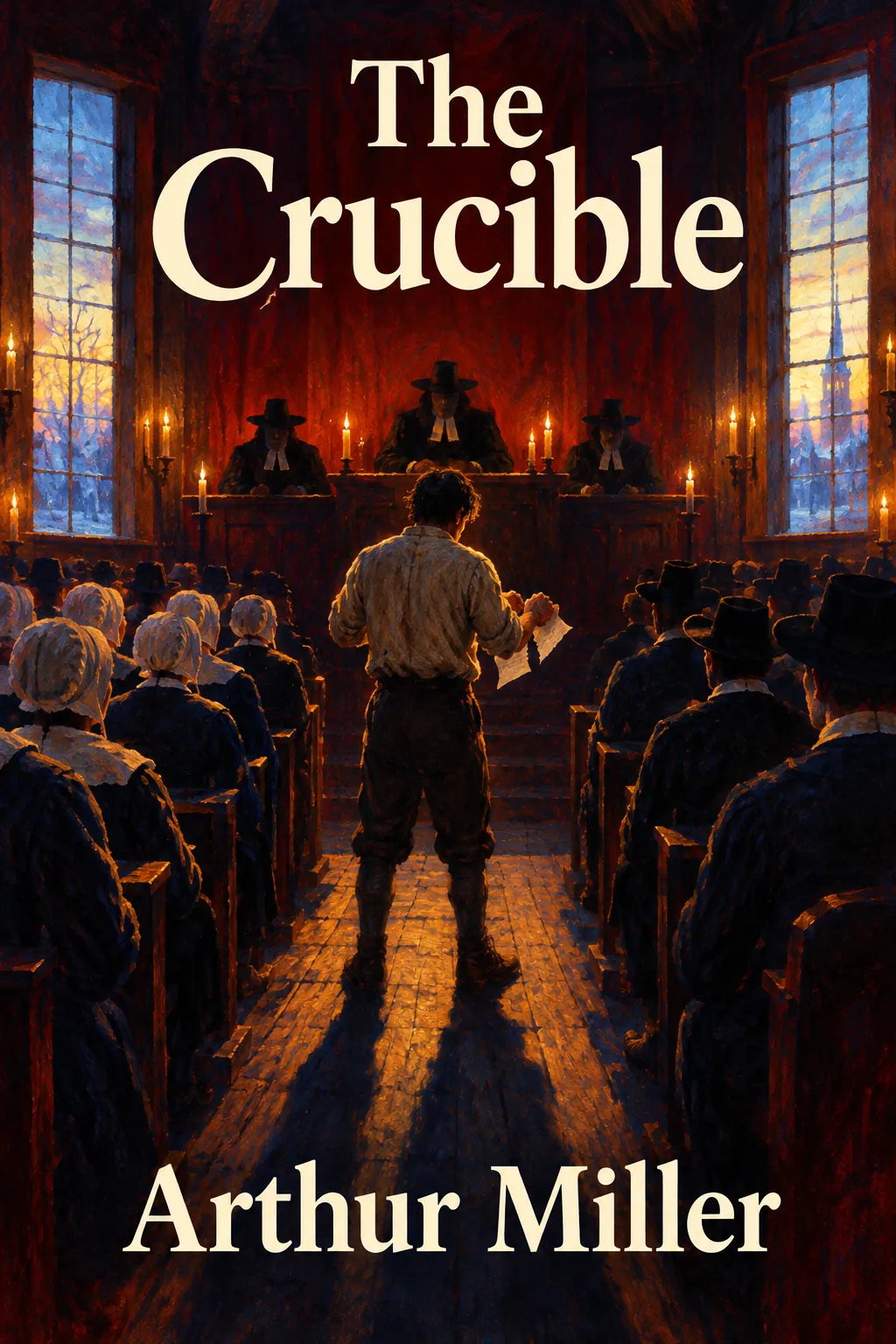
The Crucible
par Arthur Miller
The Crucible is Arthur Miller's 1953 play about the Salem witch trials of 1692. When a group of girls is caught dancing in the woods, they avoid punishment by claiming that witchcraft is to blame. Accusations spread, and the court believes anyone who names a neighbor. Farmer John Proctor, who has a guilty secret tied to the girls' leader, Abigail Williams, tries to stop the panic without destroying his own reputation. The play is also a comment on the fear of Communism in 1950s America.
L'idée principale
"In 1692 Salem, a lie told to escape punishment grows into a witch hunt, and ordinary people must choose between safety and conscience. Miller shows how fear lets a community destroy its own members."
Aperçus clés
Fear turns a community into a hunt
Miller shows a town that responds to fear by looking for someone to blame. Once accusing others becomes a way to gain safety, status or revenge, evidence stops mattering and confidence counts as proof. The play suggests that panic is not only the work of villains, because ordinary people join in when refusing is dangerous.
Tituba confesses in Act 1 to escape punishment, and soon Abigail and Betty are naming townspeople, until respected neighbors such as Rebecca Nurse are in jail.
Reputation versus integrity
Many characters guard their reputation as if it were the same thing as goodness. Miller separates the two. A name can be protected by silence, but integrity is tested by what a person is willing to lose, and Proctor learns that difference only when the court asks him to trade one for the other.
In Act 3 Proctor destroys his public image by admitting the affair, and in Act 4 he refuses to let a false confession be posted on the church door.
Authority that cannot admit error
The court is built so that doubt looks like disloyalty. Danforth does not ask whether the girls are lying, because an answer of yes would undo every earlier verdict. Miller uses the judges to show how an institution can become more dangerous the more it tries to defend itself.
Danforth refuses to postpone the hangings in Act 4, even after Abigail has fled, because a reprieve would suggest earlier executions were mistaken.
The play as allegory
Miller wrote The Crucible in the early 1950s, when congressional committees pressed people to name suspected Communists. Salem is a different setting for the same mechanism: a demand to confess, to name others and to prove loyalty. The allegory works because the human pattern is recognizable, even if the specific events are different.
Proctor is willing to confess his own guilt but will not name others, which echoes the choice facing people questioned in the 1950s.
Symbolism: the crucible, the poppet and the paper
A crucible is a vessel in which metal is heated until impurities burn away, so the title suggests that Salem tests people under extreme heat. Smaller objects carry meaning too. A doll becomes false evidence, and a sheet of paper becomes a battleground over a man's identity.
The poppet with a needle condemns Elizabeth in Act 2, and the signed confession in Act 4 makes Proctor choose what his name means.
Détail des chapitres
Chapter-by-chapter summary
Spoiler warning: this section covers the whole plot, including the ending.
The real Salem witch trials of 1692 left twenty people dead. Miller changes some facts, such as the ages of Abigail and Proctor, to serve his drama.
Act 1: A Sick Child and a Frightened Town
The play opens in Reverend Parris's house, where his daughter Betty lies motionless after Parris found her and other girls dancing in the woods at night. Rumors of witchcraft spread through Salem, and Parris's niece Abigail Williams threatens the other girls into silence.
Abigail also confronts John Proctor, with whom she had an affair while she worked in his house, and he rejects her. When Reverend Hale, an expert on witchcraft, arrives and questions the girls, Abigail blames Tituba, who confesses and names other people to save herself.
Act 1 matters because it sets the rule that drives the whole play: accusing someone else is the safest way to escape blame.
Act 2: The Proctor Home
Eight days later, John and Elizabeth Proctor share a tense supper, and their talk shows that his affair still divides them. Their servant Mary Warren returns from court and says that Elizabeth's name has come up in the accusations.
Hale visits to test the family's faith, and Proctor stumbles over the commandments. Officials then arrive with a warrant, and a needle found in a doll that Mary made is treated as proof that Elizabeth attacked Abigail.
Elizabeth is arrested, and Proctor must decide whether to expose Abigail even if it exposes his own sin. This act matters because it moves the panic from the town into a marriage.
Act 3: The Court
In the meetinghouse, Giles Corey and Francis Nurse protest to Deputy Governor Danforth, who presides over the court. Proctor brings Mary Warren to testify that the girls have been pretending, and Danforth answers by treating every challenge as an attack on the court.
To prove that Abigail is lying, Proctor confesses the affair. Elizabeth, who has never lied, is called in and denies it to protect his name, and Abigail and the girls then pretend that Mary's spirit is attacking them.
Mary collapses and accuses Proctor, who is arrested, and Hale denounces the proceedings and quits. The act matters because honesty is punished while performance is rewarded.
Act 4: The Jail
On an autumn morning, Parris reports that Abigail has robbed him and fled, and that unrest is spreading in nearby towns. Danforth still refuses to delay the hangings, and Hale now urges the condemned to confess in order to live.
Ending: The Torn Confession
Proctor agrees to confess and signs, but he refuses to give the paper to the court or to name anyone else. He tears it up, saying he cannot give up his name, and he goes to the gallows with Rebecca Nurse as drums roll.
The ending matters because Proctor's death is not a defeat of conscience, even though the court gets what it wanted.
Characters
John Proctor is a farmer in Salem who is ashamed of his affair with Abigail. He starts the play protecting his reputation and ends it protecting his integrity.
Elizabeth Proctor is his wife, a stern and honest woman who is slow to forgive him. Her one lie in Act 3 shows how the court bends even the truth-teller.
Abigail Williams is Parris's niece and the leader of the accusing girls. She is clever, forceful and willing to destroy anyone who stands in her way.
Reverend Hale comes to Salem sure of his expertise. He slowly sees the court's injustice and ends by begging prisoners to save their lives.
Deputy Governor Danforth is the proud, intelligent judge who cannot admit the court could be wrong. He represents authority that protects itself.
Reverend Parris is a minister preoccupied with his position and with enemies in the congregation. His fear for his reputation helps launch the crisis.
Mary Warren is the Proctors' timid servant who joins the court's girls. She tries to tell the truth but gives in under pressure.
Rebecca Nurse is an elderly, respected woman known for kindness. She is accused anyway, which shows that no reputation is safe.
Writing about this book
Start with an argument, not a retelling. For example, you could argue that Miller shows how fear turns neighbors into informers, or that Proctor finds integrity only when he loses everything else.
Choose three or four pieces of evidence from different acts, so that you can show change over time. Good scenes to compare are Proctor's silence in Act 2, his confession in Act 3 and his refusal in Act 4.
After each quotation, explain what the word choice or the stage action does. Keep quotes short, and stay with one idea per paragraph.
Link the play to its context in a sentence or two, without letting history replace analysis. Miller wrote in the early 1950s, when many Americans were pressured to name suspected Communists.
The model essays below are learning examples at three levels. Read them next to your own draft to see what each level adds, then write your own answer in your own words.
Passer à l'action
Étapes pratiques à mettre en œuvre dès aujourd'hui :
-
Build an essay on an argument about how Miller makes his point, not on a list of events.
-
Compare a character at the start and at the end of the play to show change.
-
Use short quotations and explain the effect of specific words or stage actions.
-
Connect Salem to the 1950s in one or two sentences, then return to the text.
-
Check each act for a turning point, such as Tituba's confession, Elizabeth's lie or the torn paper.
Citations notables
"“Because it is my name! Because I cannot have another in my life!” (Act 4)"
— Arthur Miller
"“I have given you my soul; leave me my name!” (Act 4)"
— Arthur Miller
"“a person is either with this court or he must be counted against it” (Act 3)"
— Arthur Miller
"“Life, woman, life is God’s most precious gift; no principle, however glorious, may justify the taking of it.” (Act 4)"
— Arthur Miller
"“He have his goodness now. God forbid I take it from him!” (Act 4)"
— Arthur Miller
À qui s'adresse ce texte
This guide suits high-school students in the United States and the Philippines who study The Crucible in English or American literature, and AP Literature students who need a play for the open-ended essay. It also helps readers who want to understand the Salem story before seeing a production.
À propos de Arthur Miller
Arthur Miller (1915–2005) was an American playwright born in New York City. His best-known plays include All My Sons, Death of a Salesman and The Crucible, which opened on Broadway in 1953. In 1956 he was questioned by the House Un-American Activities Committee and refused to name other people. His work often explores guilt, family and a person's duty to society.
Résumé écrit par

Software Engineer & Writer
Software engineer with a passion for distilling complex ideas into actionable insights. Writes about finance, investment, entrepreneurship, and technology.
Voir tous les résumés →Avis
Pas encore d'avis. Soyez le premier à partager vos impressions !
Écrire un avis
Continuer la lecture
Explorer le thème: Guides d’étudeRésumés

outsiders (S.E. Hinton)
S.E. Hinton
L'histoire suit Ponyboy Curtis et son gang, les Greasers, dans leur conflit violent avec les Socs, les jeunes riches de…

Noli Me Tangere
José Rizal
Noli Me Tangere (1887) is José Rizal's novel about Crisóstomo Ibarra, a young Filipino who returns home after seven years…

Educated par Tara Westover
Tara Westover
Le récit poignant d'une jeune femme née dans une famille survivaliste isolée dans l'Idaho, sans scolarité ni soins médicaux. À…

Atomic Habits résumé : quatre lois pour commencer petit
James Clear
Atomic Habits présente quatre lois pour concevoir une habitude : rendre évident, attractif, facile et satisfaisant. Clear les relie aux…
Articles

Yōkai : les esprits et monstres du Japon expliqués
Les yōkai sont les esprits, les métamorphes et les monstres du folklore japonais, du renard au lutin des rivières en…

Le bateau de Thésée
Le bateau de Thésée est une expérience de pensée sur l'identité : si chaque planche d'un navire est remplacée au…

Mythologie japonaise et Kojiki
La mythologie japonaise est l'ensemble des récits sur les kami, les dieux et les ancêtres du Japon, racontés surtout dans…