In five minutes
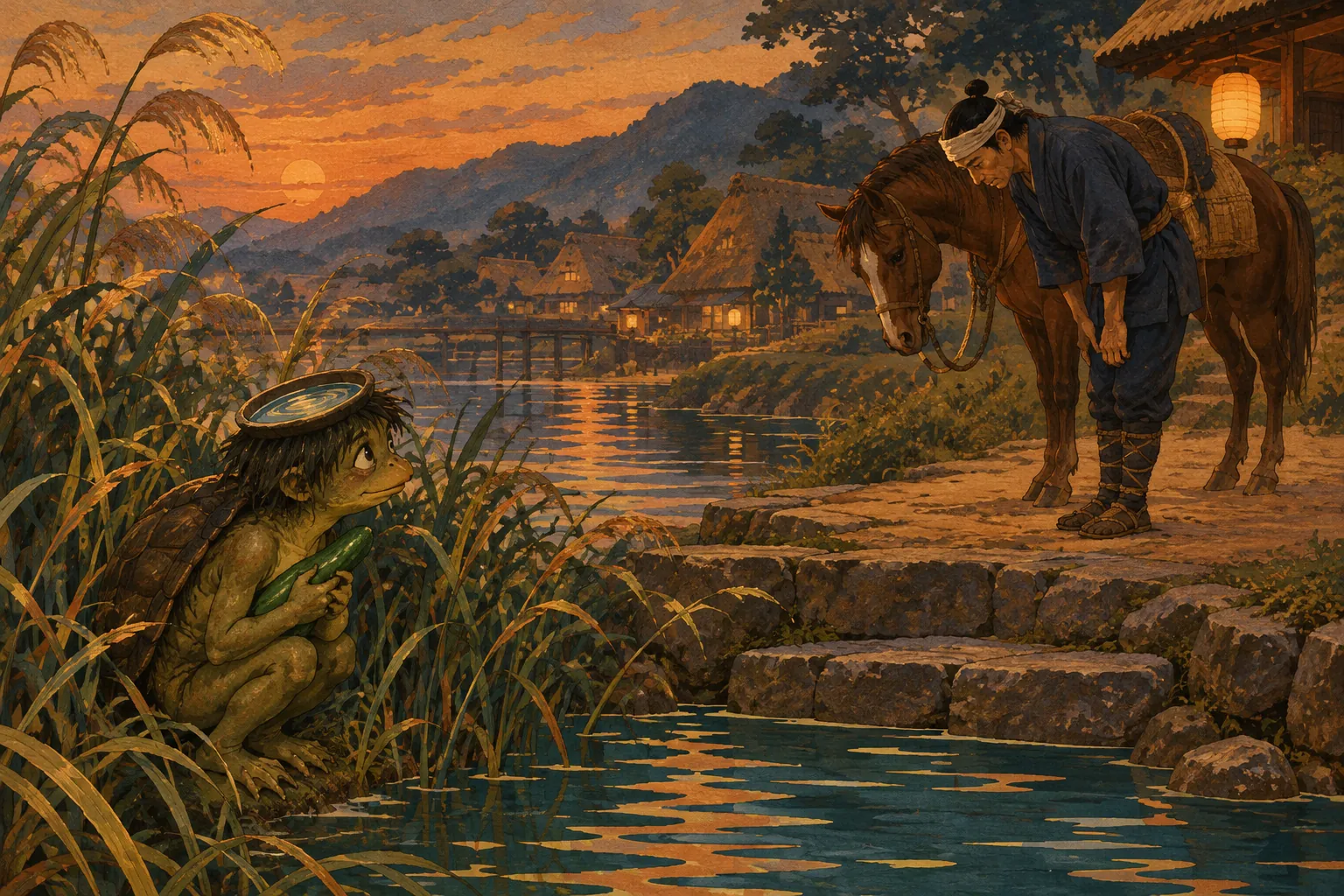
The kappa (河童) is a water creature from Japanese folklore, about the size of a child, said to live in rivers, ponds and marshes. Its best-known features are a hollow dish on top of its head that holds water, a turtle-like shell, webbed hands and a love of cucumbers.
Stories treat it as both a danger and a neighbour. It pulls horses and swimmers into the water, yet it can also be tricked, befriended and made to keep a promise.
The kappa is not one fixed creature. Its look and habits change from region to region, and it is recorded under many local names, such as kawataro, gataro and hyosube.
This page tells the common story first. Then it follows the kappa through two written sources: the Edo-period encyclopedia Wakan Sansai Zue and Akutagawa Ryunosuke's 1927 story Kappa.
The story
A farmer leads his horse down to the river to wash it on a hot afternoon. Something small and slippery grabs the animal's leg and tries to drag it under.
The horse panics and bolts for the stable, pulling the creature behind it. The kappa ends up on dry land, far from its water, and the farmer finds it helpless on the stable floor.
This is the moment the tale turns on the kappa's weakness. The dish on its head has tipped, the water has spilled, and the creature has lost its strength.
The farmer, or the village elder, makes the kappa promise to stop harming people and animals. In many versions it pays for its freedom with a gift, such as fish left at the door or knowledge of a healing remedy.
Another well-known tale begins with a challenge to a sumo match on the riverbank. A clever traveller bows deeply, and the kappa, being very polite, bows back so low that the water runs out of its dish.
A softer strand of stories shows the kappa as a friend. In some regions the kappa is said to leave gifts for a household that feeds it cucumbers, and a kappa that has been shown kindness is said never to forget it.
Not every story ends well for the human. Some kappa are mere pranksters, but others are blamed for drownings, and the tales do not hide that.
What a kappa looks like
Accounts agree on a few things: a small body, a beak-like mouth, a shell on the back, webbed fingers and a smell of fish or river mud. The colour is usually green, but red-faced kappa appear in the folk tales collected in Tono in 1910 by Yanagita Kunio.
The dish on the head, called the sara, is the most important detail. As long as it holds water the kappa is strong, and when it dries or spills the kappa weakens.
Many tales also say the kappa is fond of sumo and of cucumbers, can be harsh on swimmers, and is fearful of iron and of certain kinds of plants. Folk belief also says it was after a mysterious organ, the shirikodama, which was said to be kept inside the human body.
This gave the creature a gruesome edge in stories told to keep children away from deep water.
Variants and local names
Because the kappa was told about in villages all over Japan, there is no single canonical version. The name changes with the place: kawataro (river boy) is recorded in the west, gataro and hyosube in Kyushu, and many other local names are known.
Some regions describe a seasonal movement. In Kyushu, the kappa is said to leave the river in autumn, climb into the hills and become a mountain creature called yamawaro, then return to the water in spring.
The look also varies. Some versions give it fur or a monkey's face, some a bird's beak, and some make it almost human.
The attitude varies too. In some villages the kappa is a dangerous pest, in others a guardian of the river who must be given respect and offerings.
Where the story comes from
The kappa is far older than its modern image, and it was never recorded in one founding text. It lives in oral tradition, local legends and the books that collected them.
Wakan Sansai Zue, an illustrated encyclopedia of about 105 volumes compiled around 1712 by the Osaka physician Terajima Ryoan, is one of the most useful Edo-period sources. It was modelled on a Chinese reference work and catalogues the natural and supernatural world of its day, including a river creature of this kind.
For a modern reader it shows how educated Edo people filed the kappa: not as a joke, but as a reported creature to be described next to real animals.
Edo picture books gave the kappa its familiar face. Toriyama Sekien's Gazu Hyakki Yagyo (1776), an illustrated catalogue of yokai, includes a kappa, and similar prints made the dish and shell standard.
In 1910 Yanagita Kunio published Tono Monogatari, tales collected from the Tono region of Iwate. It records local kappa stories and shows the creature as part of everyday village belief rather than a literary invention.
The best-known literary use is Akutagawa Ryunosuke's Kappa, published in 1927 and now in the public domain. Its narrator, a patient in an asylum known as Patient No. 23, tells how he fell into a hole while climbing in the mountains near Kamikochi and landed in a country of kappa.
There he finds a society that is odd, funny and uncomfortably familiar. In one scene a kappa father asks his unborn child through a tube whether it wants to be born, and the child may refuse.
The story satirises human society: its art, its industry, its treatment of workers and its habit of calling its own customs natural. Akutagawa died in the same year, and the book is often read as one of his late, darkest works.
What it means
The most practical reading is the oldest one. A river with deep pools and sudden currents is dangerous, and a story about a creature that drags you under is a way for parents to say do not swim alone.
Some scholars also see in the kappa a reduced form of an older water deity. In this view an offering of cucumbers to the river and a respectful bow keep the old relationship with the water going, even after the god has shrunk into a trickster.
The tales also encode manners. The kappa loses to the person who bows, keeps promises and cannot resist good etiquette, so the creature works as a mirror of the courtesy that Edo society valued.
With Akutagawa, the kappa becomes a way to look at ourselves from outside. Because it is not human, the creature lets him ask what a society would look like if its rules were taken to extremes.
Common misconceptions
The kappa is not one fixed creature. The turtle shell, the dish and the cucumber are common, but regions differ, and there is no single official description.
It is not always a killer. Many tales show kappa as helpers, debtors or friends, and punishment usually follows rudeness or broken promises.
It is not an animal that scientists have found. Some writers have suggested that sightings of otters, giant salamanders or turtles fed the stories, but this is speculation, not a documented origin.
The cucumber is the clue to a familiar name. The cucumber roll in sushi shops is called kappa-maki because the cucumber is the creature's favourite food.
Belief matters. For some communities the river deity behind the kappa is part of living tradition, so the tales are best read with respect for that background.
Read next
Start with the hub, Japanese mythology and the Kojiki, for the older stories of gods and the land.
For the wider world of spirits and monsters, read Yokai explained: Japan's spirits and monsters.
For another creature of the Japanese folk imagination, a mountain one with a very different temper, read Tengu: the mountain goblins.