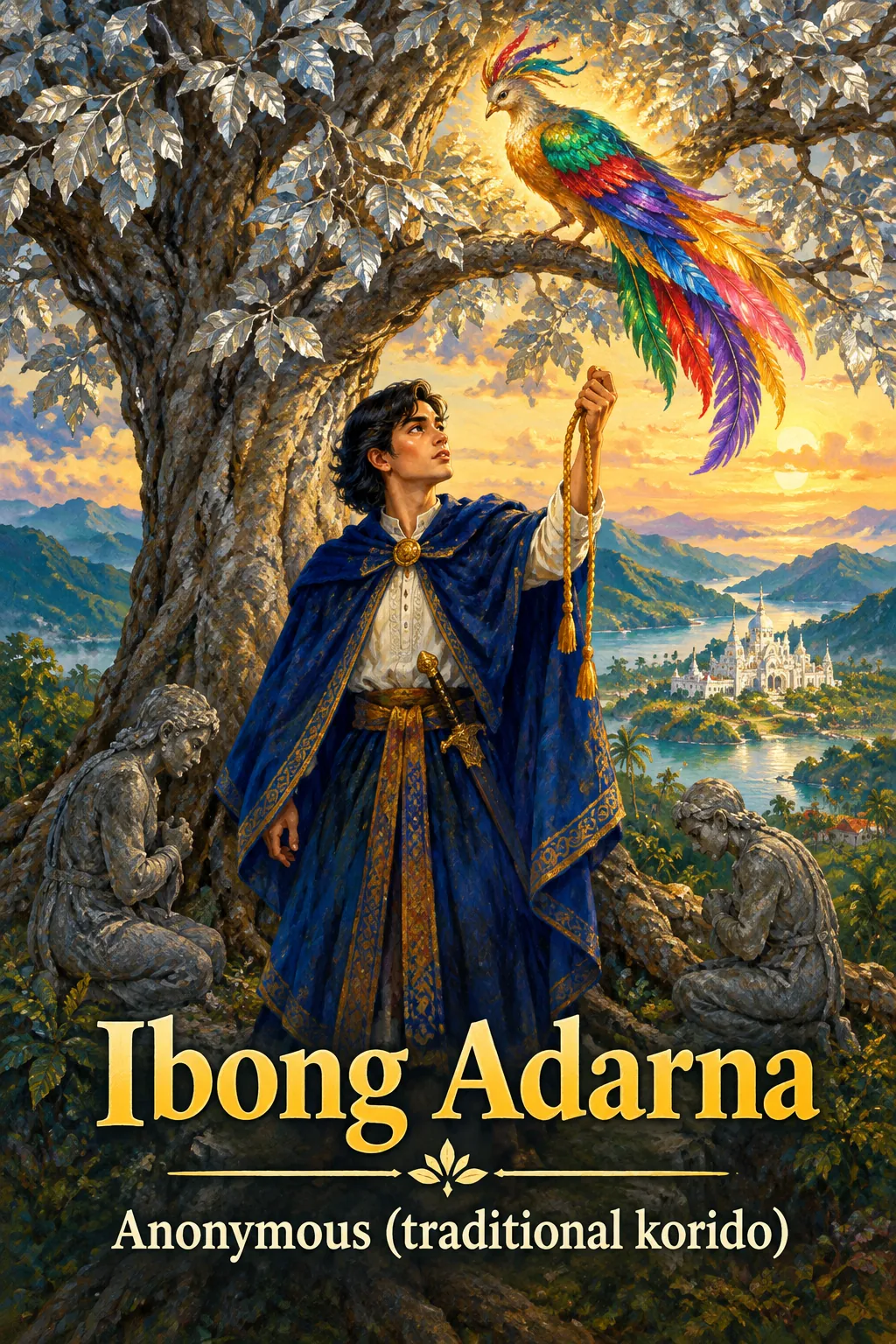
Ibong Adarna
by Anonymous (traditional korido)
Ibong Adarna is a Filipino verse romance about three princes of the kingdom of Berbanya. Their father, King Fernando, falls gravely ill, and only the song of the magical Adarna bird can heal him. The two eldest sons fail the quest, but the youngest, Don Juan, succeeds with the help of a kind hermit. His brothers' jealousy then turns a rescue into a story of betrayal, love and loyalty that carries him far beyond his father's kingdom.
The Big Idea
"Ibong Adarna is a Filipino korido about the youngest of three princes, who wins through humility, discipline and forgiveness, while his envious brothers show how jealousy can break a family."
Key Insights
Gratitude and humility open the way (Pasasalamat at Kababaang-loob)
Don Juan succeeds where his brothers fail because he treats a stranger kindly and listens to advice. The hermit's gifts are practical, and each one is used at the right moment. The poem suggests that people who admit they need help go further than people who trust only their rank or strength. In this story, gratitude is not just a feeling but a habit of sharing and learning.
Don Juan shares his bread with the hermit on Mount Tabor, while the older princes fail the quest and are turned to stone.
Envy destroys the family (Inggit at Pamilya)
The poem's deepest conflict is not between humans and monsters but between brothers. Don Pedro and Don Diego cannot celebrate Don Juan's success because they fear losing their father's favour. Their envy leads to violence, lies and repeated betrayals, which hurts them as well as him. The aral is that jealousy turns relatives into rivals, while generosity keeps people close.
After Don Juan frees them from stone, the brothers beat him on the road home and claim the bird as their own.
Perseverance and self-discipline (Tiyaga at Disiplina)
Don Juan is never the strongest figure in the poem, but he keeps going when the task seems impossible. He plans for the bird's songs, endures pain, and later completes Haring Salermo's seven trials. The story treats perseverance as a moral habit supported by good advice and by the help of others. For students, the lesson is to prepare, keep trying and accept help instead of giving up or taking shortcuts.
He cuts his own hand and squeezes lemon juice on it to stay awake while the Adarna sings.
Love, memory and loyalty (Pag-ibig at Katapatan)
The last part of the poem asks whether love can survive a curse. Don Juan forgets Maria Blanca when he enters Berbanya, and the poem does not blame him for the curse. Maria shows loyalty by travelling to the kingdom in disguise and restoring his memory. The aral is that faithful love needs truthfulness and effort from both partners, and that it cannot rely on luck alone.
Maria Blanca arrives dressed as a pilgrim just as Don Juan is about to marry Leonora.
Chapter Breakdown
Plot Summary (Buod)
Spoiler warning: this section covers the whole plot, including the ending.
The Ibong Adarna is one continuous poem of four-line stanzas (saknong), not a book of numbered chapters (kabanata).
Editions mark the episodes differently, so this guide groups the story into eight parts. Small details, such as the exact marriages at the end, differ between editions.
Part 1: The King's Dream in Berbanya (Ang Panaginip ng Hari)
King Fernando and Queen Valeriana rule Berbanya with their three sons: Don Pedro, Don Diego and Don Juan. The king loves Don Juan most, and the older brothers notice it.
The king then dreams that Don Juan is murdered by two men, and he falls gravely ill. A physician tells the court that only the song of the Ibong Adarna, a bird that lives in a tree on Mount Tabor, can cure him.
Why it matters: the dream hints that the danger to Don Juan comes from inside the family, and it starts the whole quest.
Part 2: Don Pedro and Don Diego Fail
Don Pedro rides out first and finds the Adarna in the Piedras Platas tree. The bird sings seven songs, changing its feathers each time, and Don Pedro falls asleep, after which the bird's droppings turn him to stone.
Don Diego follows with the same result. The court waits in worry as the king grows weaker.
Why it matters: the two older princes are stronger and higher in rank, yet they fail. The poem shows that strength alone does not win this quest.
Part 3: Don Juan and the Hermit (Ang Ermitanyo)
Don Juan sets out and meets an old hermit who asks for bread. Don Juan shares what he has, and the hermit gives him a knife, dayap (small lemons), a golden cord and water.
On Mount Tabor, Don Juan cuts his hand and squeezes lemon juice into the wound so that the pain keeps him awake through the seven songs. He then catches the bird with the golden cord and uses the water to bring Don Pedro, Don Diego and the other stone figures back to life.
Why it matters: Don Juan wins by kindness, listening and self-discipline, the opposite of his brothers' approach.
Part 4: Betrayal on the Road Home
On the journey back, Don Pedro and Don Diego, burning with envy, beat Don Juan and leave him almost dead. They carry the bird to Berbanya and take the credit.
Don Juan recovers and returns, and he forgives his brothers. In the version most often taught in schools, the Adarna sings again once he is back, and the king is healed.
Why it matters: the story sets rescue and betrayal side by side and tests Don Juan's character, not only his courage.
Part 5: The Escaped Bird and the Well in Armenya
The brothers are told to watch the bird, but the bird escapes while Don Juan is on guard. Don Juan sets out to bring it back, and Don Pedro and Don Diego follow him.
At Mount Armenya, Don Juan goes down a well on a rope and reaches two enchanted palaces. He rescues Princess Juana from a giant and Princess Leonora from a seven-headed serpent, but his brothers cut the rope and he falls to the bottom.
Why it matters: the same pattern repeats: Don Juan does the brave work, and his brothers try to take the reward.
Part 6: Reino de los Cristales and Maria Blanca
Don Juan is healed, helped by a wolf, and guided to Reino de los Cristales by an eagle. There he sees three princesses bathing in a crystal lake and falls in love with Maria Blanca, daughter of Haring Salermo.
The king does not welcome the match and decides to test the stranger.
Why it matters: the story moves from a family quest to a love story, and Maria Blanca becomes the poem's other great hero.
Part 7: Haring Salermo's Trials and the Curse
Haring Salermo gives Don Juan seven tasks, such as moving a mountain and finding a ring lost in the sea. Don Juan passes them with Maria Blanca's magic and loyalty.
When the angry king turns on him, the couple flee. Salermo curses them so that Don Juan will forget Maria once they enter Berbanya.
Why it matters: the poem shows that love needs both effort and loyalty, and that the hero succeeds with help from other people.
Part 8: Forgotten Love and Restored Memory
In Berbanya, Don Juan forgets Maria Blanca and prepares to marry Leonora. Maria arrives dressed as a pilgrim and uses her magic to restore his memory.
Don Juan chooses Maria again. In the version most often taught, the two end the story ruling Reino de los Cristales, while Berbanya remains with the family.
Why it matters: memory and faithfulness are the final test, and the ending rewards patience and truthfulness over rank.
Characters (Mga Tauhan)
Don Juan is the youngest prince and the hero. He is humble, brave and patient, and he forgives his brothers even after they harm him.
Don Pedro is the eldest prince. He is proud and confident at the start, and his envy of Don Juan makes him a betrayer.
Don Diego is the second prince. He follows Don Pedro in failing the quest, then joins him in beating and betraying Don Juan.
Haring Fernando is the king of Berbanya. His illness starts the quest, and his dream warns that the family is in danger.
Ang Ermitanyo is the hermit on Mount Tabor. He rewards Don Juan's kindness with practical gifts and advice.
Ibong Adarna is the magical bird whose seven songs can heal. It stands for a prize that can only be won by self-control.
Donya Leonora is a princess rescued by Don Juan in Armenya. She is a gentle and loyal figure whose presence tests Don Juan's faithfulness later.
Donya Maria Blanca is the princess of Reino de los Cristales and Don Juan's true love. She uses magic, courage and persistence to protect him.
Haring Salermo is Maria Blanca's father and a powerful ruler. His tests and his curse make Don Juan's love story the hardest trial of all.
Donya Juana is the princess Don Juan rescues from a giant. Her rescue shows his willingness to help others for no reward.
Writing about this book (Pagsusulat tungkol sa Ibong Adarna)
Most school tasks on the Ibong Adarna ask for a character analysis, a theme and aral essay, a reaction paper or a compare and contrast. Start with one clear idea, such as humility, envy or perseverance, and follow it through the episodes.
Use two or three events as evidence, and name them exactly: the hermit's bread, the lemon and knife, the beating on the road, the well in Armenya, Salermo's trials, the curse. Briefly explain what each event shows about the character or the aral.
Keep quotations very short, or paraphrase in your own words, and give the saknong or episode if your teacher asks for it. Do not copy a published summary or translation, because your teacher can usually tell.
For a reaction paper, write in the first person and give your honest opinion, then support it with the story. For a compare and contrast, use a clear pattern, such as Don Juan against Don Pedro and Don Diego, and finish with what the comparison teaches.
The essay set below shows three levels of the same task, so you can see what makes an answer better. Use them to compare with your own writing, not to copy.
Take Action
Practical steps you can implement today:
-
Share what you have and listen to advice, as Don Juan does with the hermit; help often comes back in unexpected ways.
-
Be happy for the success of your brothers, sisters and classmates, because envy harms you as much as it harms them.
-
Prepare for hard tasks with a plan, as Don Juan does with the knife and lemon, instead of trusting only your talent.
-
Forgive when you can, but stay wise: the brothers in the story repeat their wrongs.
Notable Quotes
"Paraphrase of the hermit's counsel on Mount Tabor: share what you have, listen to advice, and use pain to stay awake. (Part 3)"
— Anonymous (traditional korido)
"Paraphrase of the bird's seven songs: each song lulls the listener into sleep until someone finds a way to resist. (Part 2)"
— Anonymous (traditional korido)
"Paraphrase of Salermo's curse: once Don Juan sets foot in Berbanya, he will forget the princess who helped him. (Part 7)"
— Anonymous (traditional korido)
Who Should Read This
This guide is for Filipino high school students (about Grades 7 to 10) who study the Ibong Adarna in Filipino or English class, and for teachers who need a clear buod, tauhan list, aral and sample essays. It also suits anyone who wants a quick introduction to this classic Philippine korido before reading an edition.
Characters
Don Juan
protagonist
The youngest prince of Berbanya and the hero of the story. He is humble, patient and brave, he accepts advice, and he forgives his brothers even after they harm him.
Don Pedro
foil and antagonist
The eldest prince, confident and proud. He fails the first quest and later turns his envy of Don Juan into violence and lies.
Don Diego
foil and antagonist
The second prince, who follows Don Pedro in failing the quest and in betraying Don Juan. His actions show how envy spreads when people give in to it.
Haring Fernando
father and king
The ruler of Berbanya, whose illness begins the quest. His dream of Don Juan's murder warns that danger is close to home.
Ang Ermitanyo (the Hermit)
helper and guide
An old man on Mount Tabor who rewards Don Juan's kindness. He gives practical gifts and advice, and he shows that help goes to those who are humble.
Ibong Adarna
symbol and goal
The magical bird whose seven songs can heal the king. It stands for a prize that can be won only through self-control and wisdom.
Donya Leonora
love interest and test of loyalty
A princess rescued by Don Juan in Armenya. Her presence in Berbanya tests his faithfulness to Maria Blanca.
Donya Maria Blanca
heroine and helper
The princess of Reino de los Cristales who loves Don Juan. She uses magic, courage and persistence to help him through her father's trials and to restore his memory.
Haring Salermo
antagonist
Maria Blanca's powerful father, who sets seven trials for Don Juan. His curse of forgetfulness is the final test of the lovers.
Donya Juana
rescued princess
The princess Don Juan frees from a giant in Armenya. Her rescue shows that he helps others even when he gains nothing.
Exam practice: sample answers
Model answers are examples to learn from; write your own in your words.
character analysis / compare and contrast
1. Compare and contrast Don Juan with his brothers, Don Pedro and Don Diego. Explain which choices make Don Juan the true hero of the Ibong Adarna.
Outline
- State your thesis: Don Juan is the hero because of his choices, not his strength.
- Contrast how each prince treats other people (the hermit).
- Contrast how each prince faces difficulty (the bird's songs).
- Contrast how each prince treats family (the road home and forgiveness).
- Conclude with what the comparison teaches.
Basic Model answer
Don Juan is the youngest prince of Berbanya, and he is the hero of the Ibong Adarna. His older brothers, Don Pedro and Don Diego, are very different from him.
The first difference is how they treat other people. Don Juan shares his bread with the old hermit and listens to his advice.
Pedro and Diego do not follow the same path in the usual retelling, so they fail and are turned to stone. Don Juan succeeds because he is humble and willing to learn.
The second difference is how they treat family. Don Juan frees his brothers from the stone, but they are jealous and beat him.
A third difference is forgiveness. Even after the betrayal, Don Juan forgives his brothers and does not take revenge.
These choices show that Don Juan is kind, patient and loyal. His brothers are proud and envious.
This is why Don Juan is the true hero of the korido. He is not the strongest prince at the start, but he has the best heart.
The story teaches that good character matters more than rank or age.
Good Model answer
Thesis: in the Ibong Adarna, Don Juan is the true hero because he answers hardship with humility, discipline and forgiveness, while Don Pedro and Don Diego answer it with pride and envy.
Humility is the first contrast. Don Juan shares his bread with the hermit on Mount Tabor, and the old man repays him with practical help: a knife, lemons, a golden cord and water.
Pedro and Diego trust only their own strength and fall asleep under the bird's songs, so they are turned to stone.
Discipline is the second contrast. Don Juan cuts his hand and squeezes lemon juice on the wound to stay awake while the bird sings, which shows that he accepts pain on purpose to protect his mission.
His brothers have no such plan, so their failure is partly a failure of preparation.
Envy is the third contrast, and it drives the plot. After Don Juan frees his brothers and captures the bird, Pedro and Diego beat him and take the credit.
Their act shows that being older does not mean being wiser, because they fear losing their father's favour instead of celebrating their brother's success.
The contrast continues in Armenya, where Don Juan rescues Princess Juana from a giant and Princess Leonora from a seven-headed serpent. Courage here is not showy: he acts to save others, not to gain credit, while his brothers cut the rope that lifts him from the well.
Forgiveness is the final contrast. When Don Juan recovers, he forgives his brothers, and the king spares them.
However, forgiveness does not make him foolish, because the brothers betray him again, so the poem shows that forgiveness is not the same as being naive.
In conclusion, Don Juan's heroism lies in how he answers kindness, pain and betrayal. His brothers have the same chances, but they choose envy.
Excellent Model answer
Thesis: Don Juan is the hero of the Ibong Adarna not because he is the strongest prince, but because he is the only one who treats power, help and failure as responsibilities rather than prizes. His brothers treat the same three things as rewards to be taken.
The poem sets this contrast up before the quest begins. King Fernando's dream of Don Juan being murdered by two men prepares the reader to see the favourite son as vulnerable and the older sons as dangerous.
On Mount Tabor, the first test is not a fight but an encounter with an old hermit who asks for bread. Don Juan shares what he has and accepts the hermit's tools: a knife, lemons, a golden cord and water.
Gratitude here is practical, because it keeps him open to instruction, while his brothers' pride leaves them to rely on strength alone, and both end up turned to stone.
The most telling detail is the knife and the lemon. Don Juan wounds his own hand and presses lemon juice into the cut so that pain keeps him awake against the bird's seven songs, which turns suffering into a tool instead of a threat.
Pedro and Diego bring no such plan, and their failure suggests that in this world talent without preparation is a form of arrogance.
The korido form helps this contrast. Its short eight-syllable lines move quickly from episode to episode, so each brother's choice is easy to compare, as in a repeated test.
The poem's central human conflict follows the victory. Don Juan frees his brothers, and Pedro and Diego repay him by beating him and claiming the bird, so that rescue and betrayal happen in one episode.
Their envy is more than a personal flaw: it is a social one, since they fear losing their place in the royal family to a younger brother, and it shows how rank can turn siblings into rivals.
A reader might argue that the brothers deserve some sympathy as sons of a father who prefers Don Juan. The text allows this reading, but their violence turns possible sympathy into guilt.
When Don Juan forgives, the poem does not present him as weak. He can forgive precisely because he never defined himself by competition, which is why his father's favour does not change his character.
The same pattern appears in the later episodes. In Armenya, Don Juan rescues Juana from a giant and Leonora from a seven-headed serpent, and when his brothers cut the rope that lifts him from the well, they again choose advantage over loyalty.
The poem also refuses to make him flawless. Under Haring Salermo's curse he forgets Maria Blanca in Berbanya, and he is saved by her loyalty and magic, so the hero's success depends on the people who stand with him.
This complicates the contrast in a useful way: Don Juan is admirable because he accepts help and corrects his course, whereas his brothers refuse both.
As a korido in the oral tradition, the Ibong Adarna uses the youngest-son pattern common in folk tales, but it gives that pattern a moral reason: the youngest wins by character, not by luck.
In conclusion, Don Juan's heroism lies in how he answers kindness, pain and betrayal. The poem invites readers to ask not who is the strongest, but who deserves to lead.
Marking rubric
- Clear thesis about Don Juan's heroism (2 marks)
- Accurate comparison with both brothers (3 marks)
- Specific events as evidence (3 marks)
- Explanation of why each event matters (3 marks)
- Organisation, conclusion and language (2 marks)
Now write your own
Write your own comparison of Don Juan with one of his brothers. Choose three events, state your thesis first, and then compare your answer with the three samples above.
theme and aral essay
2. Write a theme and aral essay on the Ibong Adarna. Choose one main theme, explain the aral it teaches, support it with two or three events from the story, and show how it applies to your life today.
Outline
- Name the theme and state the aral in one sentence.
- Give the first event and explain what it shows.
- Give the second event and explain what it shows.
- Connect the aral to a real situation for a student today.
- Conclude by restating the aral.
Basic Model answer
A main theme of the Ibong Adarna is perseverance, which means not giving up when the task is hard. The aral is that success comes to people who keep trying and accept help.
Don Juan shows this when he goes to Mount Tabor after his brothers fail. He stays awake by cutting his hand and using lemon juice, and he captures the Adarna bird.
He shows it again when he must complete the tasks of Haring Salermo to win Maria Blanca. The tasks look impossible, but he does not quit and he accepts Maria's help.
Don Juan also shows gratitude. He shares his bread with the hermit and later trusts Maria Blanca's advice.
This lesson is useful for students today. When an exam, a project or a family problem feels too hard, we should keep working step by step and ask for help from teachers, parents or friends.
Giving up quickly would leave us like the brothers who failed, while patience can lead to better results.
In conclusion, the Ibong Adarna teaches that perseverance and humility go together.
Good Model answer
The Ibong Adarna teaches that perseverance is strongest when it is joined to humility, because the hero succeeds not by working alone but by continuing to try while accepting guidance.
The first evidence is the climb to the Piedras Platas tree on Mount Tabor. Don Pedro and Don Diego fall asleep under the bird's songs, but Don Juan keeps himself awake by cutting his hand and pressing lemon juice into it.
His courage is not only physical. He follows the hermit's advice and uses the golden cord at the right moment, which shows patience and obedience to good guidance.
The contrast with Pedro and Diego makes the lesson clearer. They want the reward but not the work, so they quit when the song becomes too hard to resist, and they later try to take the credit by harming their brother.
The second evidence is the long trial in Reino de los Cristales. Haring Salermo gives Don Juan seven tasks, including moving a mountain and finding a ring lost in the sea, and Don Juan could not finish them without Maria Blanca's magic and loyalty.
Maria's help does not make his effort smaller. He still keeps going when the tasks seem impossible, which is what lets her help matter.
The poem also shows how perseverance can be tested after success. Under the curse, Don Juan forgets Maria in Berbanya, yet the story ends with their reunion because Maria never gives up on him.
This aral applies to students today. A Grade 10 student who fails a quiz can follow Don Juan's example by studying in small steps, asking a teacher for advice and thanking those who help, instead of copying a classmate or giving up.
It also teaches gratitude, because Don Juan's victories come after someone helps him: the hermit's tools and Maria's magic.
In conclusion, the aral of the Ibong Adarna is not 'try harder alone' but 'keep trying with a grateful heart'.
Excellent Model answer
Thesis: in the Ibong Adarna, perseverance is not simple endurance but a moral practice, joined to gratitude and fidelity, so the aral is that success is earned by those who keep trying while remembering what others have given them.
The korido, a fast-moving verse romance, uses a pattern of repeated tests: the bird on Mount Tabor, the well in Armenya, the trials of Haring Salermo and the curse of forgetting. Each test asks Don Juan for a different kind of persistence.
The first is physical and mental. Don Juan cuts his own hand and presses lemon juice into the wound so that the bird's seven songs cannot put him to sleep, which turns pain into a deliberate instrument of self-control.
His brothers, by contrast, want the reward but not the discipline, so they quit when the songs become too strong. The poem makes this a lesson about attitude: a gifted person who does not prepare is less reliable than a modest person who does.
The hermit explains why this matters. Don Juan receives help because he first shares his bread, so his persistence is supported by humility instead of pride.
After the betrayal on the road home, Don Juan keeps going. In Armenya he rescues Juana from a giant and Leonora from a seven-headed serpent, and even when his brothers cut the rope that lifts him from the well, he does not return home in despair but continues toward Reino de los Cristales.
The second test is a test of effort and trust. Haring Salermo's seven tasks, such as moving a mountain and finding a ring in the sea, are impossible for one man, and Don Juan completes them with Maria Blanca's magic.
A critic might say that magic, not perseverance, wins these trials. Yet Maria's help comes only because Don Juan has already shown courage and honesty, and he still has to carry out the tasks and flee with her.
The final test is fidelity. Under Salermo's curse, Don Juan forgets Maria in Berbanya, and the hardest effort belongs to her: she travels there, disguised as a pilgrim, and restores his memory.
This shows that perseverance in the korido is shared, since love and loyalty also need people who refuse to give up on each other.
The aral connects with Filipino values of tiyaga (patience and effort) and utang na loob (a debt of gratitude), although the poem does not use these words. Don Juan keeps working, and he remembers those who help him.
For a student, this means that perseverance is not only studying more but also asking for help, thanking those who give it and staying loyal to people who believe in you. A student balancing school and family duties, for example, can succeed by working steadily and accepting support, not by working alone.
In conclusion, the Ibong Adarna teaches that persistence without gratitude becomes pride, and gratitude without persistence becomes passivity. Don Juan wins because he joins both.
Marking rubric
- Clear theme and aral (2 marks)
- Accurate events from the story (3 marks)
- Explanation linking events to the aral (3 marks)
- Real-life application (2 marks)
- Organisation and language (2 marks)
Now write your own
Choose a different theme, such as envy, forgiveness or loyalty. Write your own theme and aral essay and compare its structure with the samples above.
reaction paper / reflection
3. Write a reaction paper (a short reflection) on the scene where Don Juan forgives Don Pedro and Don Diego after they beat him. Do you agree with his decision? Use events from the story and your own experience.
Outline
- Say whether you agree, disagree or partly agree.
- Briefly describe the scene and why it matters.
- Give your reasons, using at least one other event from the story.
- Connect it to your own experience or to your community.
- Conclude with what you learned.
Basic Model answer
In my reaction, I partly agree with Don Juan's decision to forgive his brothers. I think it shows a good heart, but it also made me worry about him.
I agree because Don Juan could have asked the king to punish Pedro and Diego. Instead, he chose peace and thought of his family.
Forgiving also protects the family. If Don Juan held on to anger, the family would break apart.
However, I also felt worried because the brothers did not change. Later they let the Adarna bird escape and cut the rope in Armenya.
This taught me that forgiving someone does not mean letting them hurt you again. We can forgive and still be careful.
In my own life, I have forgiven a friend who spoke badly about me, but I kept some distance until she showed she was sorry.
In conclusion, I agree with Don Juan's forgiveness, and I think the story also teaches us to be wise.
Good Model answer
I partly agree with Don Juan's decision to forgive Don Pedro and Don Diego, because forgiveness shows his good heart, but I think it should not remove all caution.
In the scene, Don Juan has just freed his brothers from stone and captured the Adarna bird, and they beat him and leave him almost dead. I felt angry on his behalf when I read it, because he had just saved them.
When Don Juan recovers, he forgives them, and the king spares them. This fits his character, since he shares his bread with the hermit and thinks of others before himself.
I agree with this choice because forgiveness keeps the family from breaking apart. A king who loses all three sons would lose far more than a bird.
Forgiveness also frees Don Juan himself. If he carried hatred all the way home, the victory over the bird would feel empty, and the king's healing would be marked by revenge instead of joy.
However, I do not think the brothers deserved a second chance without changes. Later they let the bird escape while Don Juan is on watch, and they cut his rope in Armenya.
This shows that the brothers did not learn from forgiveness. The poem seems to separate forgiveness from trust, and I think that is wise.
Maria Blanca's later loyalty gives a contrast: she stays faithful to Don Juan even when he forgets her, which shows what a person worth trusting looks like.
In my own life, I forgave a classmate who took credit for our group project. I kept working with her, but I made sure my name was on my part and we agreed on rules for sharing the work.
That experience helped me understand the scene better. Forgiving her made the group calmer, and the rules protected all of us from the same problem happening again.
In conclusion, I agree that forgiving is right, but I also learned that kindness works best with honesty and limits.
Excellent Model answer
I agree with Don Juan's decision to forgive his brothers, but I read it as an act of strength, not of weakness, and I think the poem asks us to separate forgiveness from trust.
The scene is painful because of what comes just before it. Don Juan has used the hermit's gifts to survive the bird's songs and has freed his brothers from stone, and Don Pedro and Don Diego repay him by beating him and leaving him almost dead.
My first reaction was anger on his behalf, since the betrayal is so unfair. My second reaction was surprise, because Don Juan does not answer with revenge when he recovers.
This fits what the story has shown about him. He shares his bread with a stranger, accepts advice and is able to put the family's needs above his own pride.
It also fits the king's dream, in which Don Juan is murdered by two men. The poem lets the dream come close to true, and then shows him choosing mercy over revenge.
The korido form adds to my reaction. Its short, quick stanzas do not linger on Don Juan's feelings, so the reader must imagine the hurt and the choice that follows.
Because the poem leaves this gap, I think readers are invited to decide for themselves whether mercy is wise, which is exactly what this reaction paper asks me to do.
There is also a question of timing. Forgiveness in the poem comes after Don Juan has recovered, not in the middle of the beating, so it is a calm decision and not a reflex.
A critic could say that forgiveness is dangerous here, because the brothers do not change. They let the bird escape while Don Juan is on watch, and later they cut the rope that lifts him from the well in Armenya.
I accept this criticism, but I do not think it cancels his forgiveness. The poem never says that Don Juan trusts his brothers blindly, and the later episodes show him relying on help from those who have proved loyal, such as the hermit and Maria Blanca.
That contrast is the lesson I took from the scene: forgiveness is a decision about what we carry in our hearts, while trust is a decision about what we allow people to do.
Maria Blanca's pilgrim disguise adds another layer. When Don Juan forgets her, she does not punish him for something that was not his fault.
She forgives, acts and restores their love.
The two forms of forgiveness show that the poem sees mercy as active work.
In many Filipino families, the idea of keeping the peace for the sake of the elders is strong, and I can see why Don Juan thinks of his father's recovery first. But peace that depends on one person always giving way is not fair, and the poem's later episodes seem to know this.
In my own experience, I have seen a family where an older cousin repeatedly borrowed money and did not repay it. The family forgave him each time, but they also stopped lending large amounts, and I think that response was kinder to everyone, including him.
In conclusion, I agree with Don Juan because his forgiveness protects his family and his own character. I also learned from the Ibong Adarna that mercy and wisdom must go together.
Marking rubric
- Clear opinion (2 marks)
- Accurate description of the scene and other events (3 marks)
- Reasons and reflection (3 marks)
- Personal connection (2 marks)
- Organisation and language (2 marks)
Now write your own
Write your own reaction to a different scene, such as Maria Blanca's pilgrim disguise or the king's dream. Use the three levels above to check whether your opinion, evidence and reflection are strong enough.
Frequently Asked Questions
What is the Ibong Adarna about?
The Ibong Adarna is a Filipino korido about three princes of Berbanya who search for a magical bird whose song can cure their sick father. The youngest, Don Juan, succeeds with the hermit's help, but his brothers betray him. The story then follows his adventures in Armenya and Reino de los Cristales and his love for Maria Blanca.
Who wrote the Ibong Adarna?
The author is unknown. The poem is often attributed to José de la Cruz, known as Huseng Sisiw, but that attribution is unproven. It was printed anonymously in the Spanish colonial period, and it is a traditional korido that was handed down in many versions, so editions may differ in detail.
Is the Ibong Adarna a korido or an awit?
It is a korido, a metrical romance in four-line stanzas (saknong) of eight-syllable lines. An awit has twelve-syllable lines and a slower, more solemn tone. The korido form moves quickly from episode to episode, which suits the adventures in the Ibong Adarna.
What are the aral (lessons) of the Ibong Adarna?
The main aral are humility and gratitude, the danger of envy in a family, perseverance, forgiveness and faithful love. Each lesson appears in a clear episode: the hermit's bread, the brothers' beating of Don Juan, the seven trials of Salermo and Maria Blanca's pilgrim disguise. Teachers often ask students to connect one lesson to their own lives.
Who are the main characters (mga tauhan) of the Ibong Adarna?
The main characters are Don Juan, Don Pedro, Don Diego, King Fernando, the hermit, the Ibong Adarna, Donya Leonora, Donya Maria Blanca and Haring Salermo. Don Juan is the hero, his brothers are the foils, and Maria Blanca is the heroine who helps him win the final trials.
Check Your Understanding
Pick an answer for each question to see if you were right.
-
What does King Fernando need to be healed?
The song of the Ibong Adarna — Only the song of the Ibong Adarna can cure the king's illness, which starts the quest.
-
Why does Don Juan succeed on Mount Tabor when his brothers fail?
He shares his bread and follows the hermit's advice — Don Juan's kindness earns the hermit's gifts, and he follows the advice to stay awake and catch the bird.
-
What does Don Juan do to stay awake during the bird's songs?
He cuts his hand and uses lemon juice — The hermit's knife and dayap let him use pain to stay awake.
-
Who is Maria Blanca?
A princess of Reino de los Cristales and the daughter of Haring Salermo — Maria Blanca is Salermo's daughter and Don Juan's true love.
-
What is the main aral about Don Pedro and Don Diego's actions?
Envy can destroy a family — Their jealousy leads them to beat and betray their brother, which shows the danger of envy.
About Anonymous (traditional korido)
The Ibong Adarna is an anonymous Filipino korido, a verse romance in four-line stanzas of eight-syllable lines, that circulated in Tagalog during the Spanish colonial period. It is often credited to José de la Cruz, but that attribution is unproven. It remains a core school text in the Philippines because it joins adventure, family conflict and clear moral lessons.
Summary Written By

Software Engineer & Writer
Software engineer with a passion for distilling complex ideas into actionable insights. Writes about finance, investment, entrepreneurship, and technology.
View all summaries →Reviews
No reviews yet. Be the first to share your thoughts!
Write a Review
Keep reading
Explore the topic: Study GuidesSummaries
The Outsiders by S.E. Hinton
S.E. Hinton
Ponyboy Curtis and his gang of Greasers clash with the wealthy Socs in a cycle of violence. After a tragic…
To Kill a Mockingbird by Harper Lee
Harper Lee
A young girl named Scout Finch grows up in the racially divided town of Maycomb, Alabama. Through her father Atticus's…
Rashomon
Ryunosuke Akutagawa
Rashomon is a short story by Ryunosuke Akutagawa, published in 1915 and set in Kyoto during a time of famine…
The Moon over the Mountain
Atsushi Nakajima
The Moon over the Mountain (Sangetsuki) is a short story by Japanese writer Atsushi Nakajima, set in Tang-dynasty China. Li…
Articles
Tengu: the mountain goblins
Tengu are the mountain spirits of Japanese folklore, drawn as red-faced figures with a very long nose or as crow-beaked…

Mary Shelley: The Author Who Invented Science Fiction
Mary Shelley (1797–1851) was an English writer who began Frankenstein at 18 and published it anonymously in 1818. Many critics…
Kappa: the river imp
The kappa is a river creature of Japanese folklore: child-sized, green or reddish, with a water-filled dish on its head…