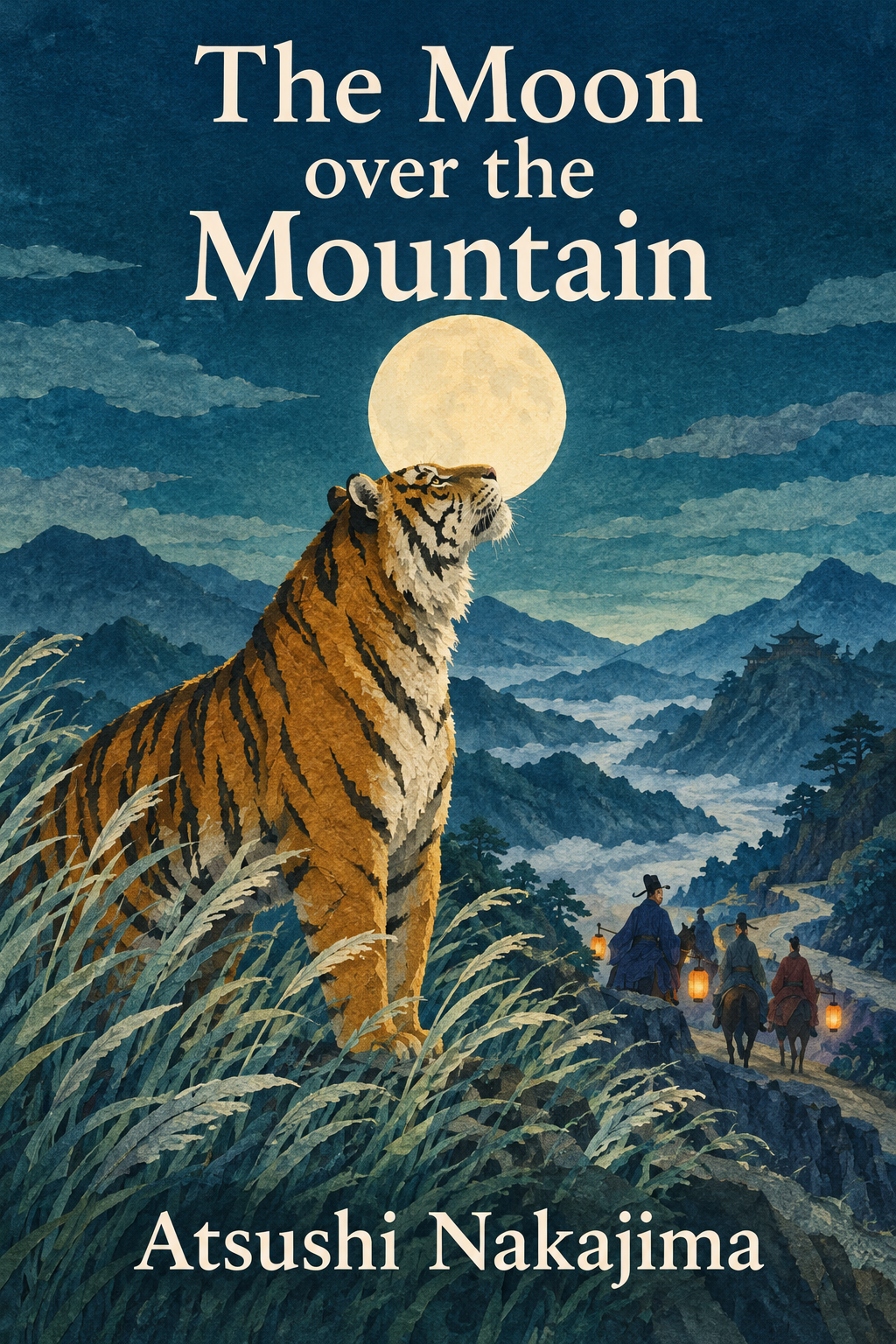
The Moon over the Mountain
by Atsushi Nakajima
The Moon over the Mountain (Sangetsuki) is a short story by Japanese writer Atsushi Nakajima, set in Tang-dynasty China. Li Zheng, a brilliant young official, quits his post to become a great poet, fails, and vanishes into the night. A year later his old friend Yuan Can meets a tiger on a mountain road, and the tiger speaks with a familiar voice. The story asks why talent, pride and fear can destroy a person.
The Big Idea
"A gifted man too proud to risk failure, and too afraid to be ordinary, is slowly eaten by his own shame, until it takes the shape of a tiger."
Key Insights
Cowardly pride, arrogant shame
Li Zheng blames his fate on a “cowardly pride and arrogant shame.” He feared criticism would show his talent was small, so he never trained with a teacher or shared his work. Yet he was too proud to be one ordinary man among others, so he withdrew. The two feelings look opposite but come from the same fear of being hurt. The story suggests that fear, not lack of talent, kept him from growing.
Refusing to show a draft to anyone, because feedback might sting, costs you the very chance of getting better.
Half-believing in your own talent
Li Zheng says he feared he was not a jewel, but half believed he was. That double feeling kept him from either working hard or giving up. If he had trusted his gift, he might have polished it. If he had accepted his limits, he might have found another life. Instead he hung in between, and the years passed.
Someone keeps saying they will start the big project soon, but never starts, because starting would test the belief.
Clever phrases as excuses
Li Zheng remembers telling himself that life is too long to do nothing and too short to do something great. He now sees this neat line as a cover for two things: fear that his talent would be exposed, and a dislike of hard work. The story shows how a good-sounding phrase can protect us from facing ourselves.
Calling yourself a perfectionist when you are really avoiding the risk of finishing.
Everyone keeps a beast
Li Zheng says every person is a tamer of a beast, and that beast is their own temperament. His was arrogant shame, and it grew until it took over. The tiger is therefore the outer form of something already inside him. This is why a fantasy plot reads as a very human story, and why it still feels close to readers today.
A person who cannot bear being second best may stop trying at all, rather than risk a visible loss.
Chapter Breakdown
Chapter-by-chapter summary
Spoiler warning: this section covers the whole plot, including the ending.
Part 1: A Prodigy Turns Away
Li Zheng comes from Longxi and is learned and gifted. Near the end of the Tianbao era, while still young, he passes the imperial examination and is appointed as a district officer in Jiangnan. But he is stubborn, proud and unwilling to bow to anyone. He cannot stand being a minor clerk, so after a few years he resigns, goes home, cuts himself off from other people and devotes himself to writing poetry. He wants his name to live on for centuries, and he believes poetry will do it. Why it matters: the story begins with a man who has every advantage and still chooses isolation, which sets up the pride that will ruin him.
Part 2: Poverty and Humiliation
Fame does not come. Li Zheng's poems stay unknown, and his household slides into poverty. To support his wife and child he finally returns to government work, taking a low provincial post. The friends he once looked down on have been promoted over the years, and now he must take orders from them. The humiliation eats at his pride, and he grows gaunt, sharp-eyed and hard. About a year later, on an official trip, he stays at a lodging by the Ru River and goes mad in the night. He runs out into the dark and is never seen again. Why it matters: the collapse is social and slow before it becomes supernatural, and wounded pride does the first damage.
Part 3: The Tiger on the Road
The next year, Yuan Can, an imperial inspector, travels to Lingnan on the emperor's orders and spends a night at Shangyu. Local people warn him that a man-eating tiger haunts the road ahead and that travellers should wait until full daylight. With a large escort, he brushes off the warning and sets out early. A tiger springs from the grass, then turns away at the last moment and hides. From the bushes comes a human voice, muttering that it was a near thing. Why it matters: the tiger is a threat and a puzzle at once, and the real subject of the story starts with that doubled voice.
Part 4: A Friend's Voice
Yuan Can recognises the voice and calls out: is that his friend Li Zheng? After a silence, the voice admits that it is. The two passed the examination in the same year, and Yuan Can was one of the few close friends of a prickly man. Forgetting his fear, he dismounts and greets Li Zheng warmly, asking why he will not come out. Li Zheng replies that his body is too ugly and frightening to show. Then, in a steady voice, he begins to explain how he came to be a tiger. Why it matters: the tiger still has a human mind and a human friend, so the reader is invited to listen rather than run.
Part 5: The Night He Changed
Li Zheng describes that night at the Ru River. He heard someone calling his name outside and ran towards the voice. Soon he found he was running with his hands on the ground. Strength filled his body and fur grew on his skin. The first rabbit that crossed his path, he caught and ate. Now, he says, his human mind returns for a few hours each day, but those hours are growing shorter. He fears the day when only the beast remains. Why it matters: the change is told without drama, and the fear of losing oneself is quieter and more frightening than the tiger.
Part 6: His Poems and His Confession
First, Li Zheng asks Yuan Can to record his poems, which he still knows by heart. An attendant writes as the voice from the grass recites about thirty pieces. They are elegant and carefully made, yet Yuan Can senses that something essential is missing. Li Zheng knows it too. On reflection, he says, he can think of a reason for his fate: he avoided other people, never studied under a teacher, and refused to polish his talent for fear of learning it was no jewel. He calls this cowardly pride and arrogant shame. Why it matters: this is the heart of the story, a man diagnosing himself too late.
Part 7: A Request and a Farewell
Li Zheng then recites a short poem about his new form and asks, hesitantly, that Yuan Can look after his family, who must be cold and hungry. He laughs at himself: he asked about the poems first, which proves he is more beast than man. He warns Yuan Can never to come this way again, in case he attacks, and asks him to look back from the hill so that the sight of the tiger will end any wish to return. Yuan Can does look back. A tiger leaps from the grass, roars twice at the pale moon, and vanishes. Why it matters: the farewell is both tender and final, and it leaves the friendship intact.
Characters
Li Zheng. A prodigy from Longxi who passed the imperial examination young. Proud, prickly and set on becoming a famous poet. His failure, shame and fear shape everything that happens to him.
Yuan Can. An imperial inspector who passed the examination in the same year as Li Zheng. He stays calm when he recognises the tiger, listens fully, and carries out his friend's requests. Readers see the story through his eyes.
The tiger. Li Zheng's new form. A human mind survives inside it for a few hours a day, long enough to speak, but that time is shrinking, which gives the tiger a tragic edge beyond mere menace.
Li Zheng's wife and child. They never appear directly. They matter because they are the people who suffer for Li Zheng's poetry and the ones he asks his friend to protect. He admits he thought of them only after his poems.
The people of Shangyu. Post-station people who warn Yuan Can about the man-eating tiger and advise him to wait for full daylight. Their warning makes the encounter feel like real danger before it becomes a reunion.
Writing about this book
The Moon over the Mountain is a common school text, and a good one for essays because it rewards personal connection. A plot summary alone will not carry a report, so use these questions to find your own angle.
- Was Li Zheng's failure caused by lack of talent, or by his fear of testing it? What makes you say so?
- Do “cowardly pride” and “arrogant shame” describe anything you have seen in yourself or people around you?
- Yuan Can feels something is missing from the poems. What do you think it is?
- Li Zheng shows his tiger form so his friend will not come back. How do you read that choice?
- What could Li Zheng have done differently before it was too late?
When you write, use one short quotation, then explain it with an example from your own life. End with what you would change, not only with pity for Li Zheng. That turns a summary into your own argument.
Take Action
Practical steps you can implement today:
-
Show your work early, even when it is imperfect. Feedback stings less than never improving.
-
Watch for phrases like “someday” or “when I am ready”. They can quietly hide a fear of finding out.
-
When something makes you ashamed, ask what the shame is protecting before you let it make your choices.
-
Whatever you chase, check that the people who depend on you are not the ones paying for it.
Notable Quotes
"“Cowardly pride and arrogant shame.” (Part 6)"
— Atsushi Nakajima
"“Life is too long to do nothing, yet too short to do anything great.” (Part 6)"
— Atsushi Nakajima
"“I half believed I was a jewel, so I could not bring myself to live among pebbles.” (Part 6)"
— Atsushi Nakajima
Who Should Read This
Students who read Sangetsuki in Japanese class or want a clear map of the story before the exam, and anyone puzzling over talent, pride and fear of failure. It is a short story, so it suits readers aged about fifteen and up, as well as adults who like classic fiction. The original is in the public domain.
Frequently Asked Questions
What is The Moon over the Mountain about?
It follows Li Zheng, a proud Tang-dynasty poet who disappears after a breakdown and is later found by his old friend as a tiger. In a calm conversation, he explains how pride and shame shaped his failure, recites his poems, and asks for help for his family.
Who wrote it, and when?
Atsushi Nakajima published it in 1942 in the magazine Bungakukai. He died of asthma that December, at age 33, so the story became one of the best-known pieces of his short career. It is a standard text in Japanese high school classrooms.
Why does Li Zheng turn into a tiger?
The story never explains the change as a plain fact. Li Zheng himself says he does not really know why, but suggests it grew from his cowardly pride and arrogant shame. Readers usually take the tiger as the outward form of what his character had become.
Is it based on an older story?
Yes. The idea of a man who turns into a tiger comes from a Tang-dynasty tale, The Tale of the Man-Tiger (Renhu zhuan). Nakajima kept the transformation and the friendship, but built a new story about a poet's pride and failure, in refined, classical-sounding Japanese.
How do I write about it for school?
Summarise the plot in two or three sentences, then pick one idea, such as cowardly pride, and connect it to a real experience of your own. Use one short quotation at most, and finish with what you would do differently. Avoid retelling every scene.
Check Your Understanding
Pick an answer for each question to see if you were right.
-
What did Li Zheng pass when he was young?
The imperial examination — He passed the imperial examination young, which made his later failure as a poet more painful.
-
What is Yuan Can's job?
Imperial inspector — Yuan Can is an imperial inspector travelling to Lingnan on official orders.
-
What does Li Zheng say lies behind his fate?
Cowardly pride and arrogant shame — He names cowardly pride and arrogant shame as the likely cause.
-
What is the first thing Li Zheng asks of Yuan Can?
To record his poems — He asks Yuan Can to have his poems written down before he asks about his family.
-
What does the tiger do in the last scene?
Roars at the pale moon and vanishes — It leaps from the grass, roars at the moon, and disappears for good.
About Atsushi Nakajima
Atsushi Nakajima (1909–1942) was a Japanese writer born in Tokyo into a family of classical Chinese scholars. He worked as a teacher and later in the South Seas Mandate, and wrote short fiction drawing on Chinese tales. He died of asthma at 33, the same year his first stories appeared.
Summary Written By

Software Engineer & Writer
Software engineer with a passion for distilling complex ideas into actionable insights. Writes about finance, investment, entrepreneurship, and technology.
View all summaries →Reviews
No reviews yet. Be the first to share your thoughts!
Write a Review
Keep reading
Explore the topic: FictionSummaries

Out of My Mind
Sharon M. Draper
“Out of My Mind” by Sharon M. Draper is a poignant narrative that explores the life of Melody Brooks, a…

Ender’s Game
Orson Scott Card
“Ender’s Game” by Orson Scott Card is a riveting science fiction novel that transports readers into a future where humanity…

Pachinko
Min Jin Lee
“Pachinko”, a spellbinding multigenerational historical saga by Min Jin Lee, explores the lives of a Korean family trying to make…

The Perks of Being a Wallflower
Stephen Chbosky
The Perks of Being a Wallflower by Stephen Chbosky is a profound coming-of-age novel, told through the intimate letters of…
Articles

The Enlightenment Explained: Ideas, Thinkers and Legacy
The Enlightenment was an 18th-century European movement that trusted reason and evidence over tradition and authority. Its thinkers, from Locke…

World History 1700–1918: Revolutions, Industry, Empire and War
Between 1700 and 1918, revolutions, factories, empires and a world war reshaped societies across Europe, the Americas, Asia and Africa.…

A Christmas Carol themes: generosity, isolation and responsibility
Dickens's novella is usually read as a story about a man who changes his mind. Its themes are sharper than…