In five minutes
Tengu are the mountain goblins of Japanese folklore. The name is written with the characters for “heaven” and “dog,” a leftover from an old Chinese idea about shooting stars.
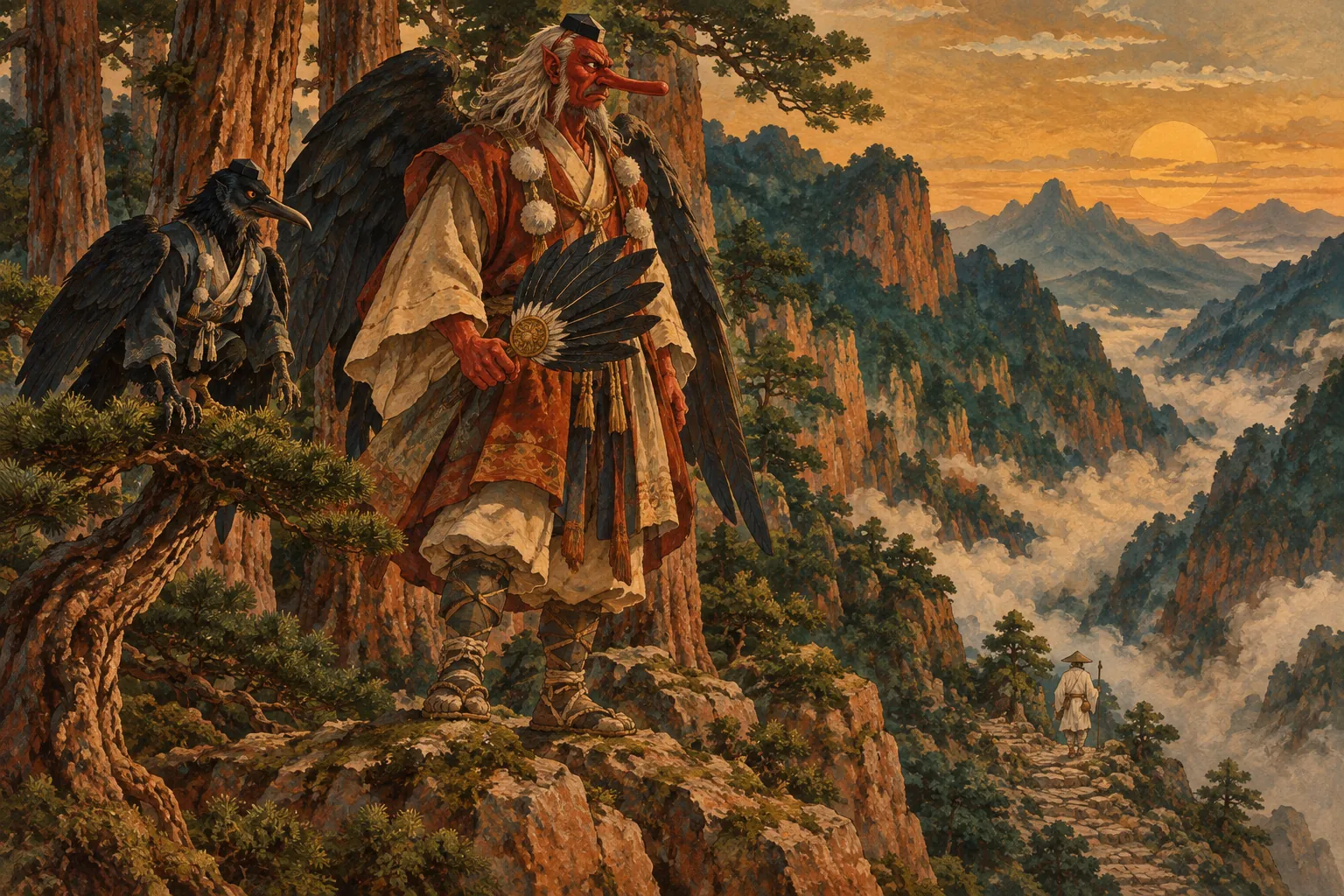
Two faces are famous. The long-nosed tengu is red-faced, proud and often called a daitengu, while the crow tengu (karasu-tengu) has a black beak and feathered wings.
Both haunt remote peaks, and both are usually dressed like yamabushi, the mountain ascetics of the Shugendo tradition. They carry feather fans, wear small black caps and are said to fly, raise storms and lead travellers astray.
The best early stories come from two medieval books: the Konjaku Monogatarishu, a twelfth-century collection of Buddhist and worldly tales, and the Taiheiki, a fourteenth-century war chronicle. In them the tengu is a trickster who preys on pride, and the monk who thinks himself holier than everyone else is its favourite target.
Later ages softened the picture. By the Edo period the tengu was also a guardian of mountains, a teacher of swordsmen and the face of one of Japan’s most popular masks.
For the wider world of Japanese myth, see Japanese mythology and the Kojiki. If you came for the masks, go straight to the section on long-nosed and crow tengu masks below.
The story
Picture a hermit deep in the mountains. He has prayed for years and is sure that enlightenment is only a few steps away.
One evening a glowing figure arrives on a white elephant, wrapped in music and light, and declares that he is the bodhisattva Fugen.
The hermit weeps and bows. A hunter standing nearby has no such trust in visions, and he looses an arrow into the glow.
The light goes out. On the ground lies a huge wounded bird, a tengu that had borrowed a holy shape to fool a man who wanted to be fooled.
The Konjaku Monogatarishu holds several tales in this mould, with the tengu as a kite-like creature that mimics Buddhas or snatches monks from their temples.
The Taiheiki gives the tengu a darker, political edge. In one famous scene the Kamakura regent Hojo Takatoki, a great fan of dengaku dance, is carousing at his mansion when strange performers join in and sing eerie songs.
A servant peeks through a gap and sees not men but beaked, winged creatures dressed like mountain ascetics. When the guards rush in, the room is empty.
The chronicle tells this as an omen: the Kamakura government is rotten, and it fell in 1333.
Another Taiheiki chapter follows a yamabushi named Unkei on Mount Atago near Kyoto. He meets a stranger who turns out to be a tengu, and he is shown the troubles waiting for the realm.
Why do tengu turn up in these tales at all? Medieval writers believed that a proud person, above all a learned monk, could fall into the “tengu path” after death.
The picture scroll known as the Tengu zoshi, made around 1296, paints the same idea with arrogant priests sprouting beaks and wings.
Variants
In the oldest layer tengu look like kites, with beaks and talons. The long human nose comes later, and by the Edo period (1603–1868) it had become the standard picture.
Folklore adds ranks. Great tengu lead, crow tengu serve, and small “leaf tengu” (konoha-tengu) run errands for their chiefs.
Some chiefs have names. Sojobo of Mount Kurama is said to have taught swordsmanship to the young Minamoto no Yoshitsune, and Tarobo lords over Mount Atago.
That Yoshitsune tale belongs to later works such as the Gikeiki and the noh play Kurama Tengu, not to the Konjaku Monogatarishu or the Taiheiki.
Where the story comes from
The word tengu came from China, where tiangou, the “heavenly dog,” meant a comet or meteor that foretold war.
The Nihon Shoki, finished in 720, records a star that streaked across the sky with a roar like thunder in the year 637. The monk Min declared it was not a star but a tengu, whose bark sounded like thunder.
That is only an omen, not yet a goblin with a face.
The Konjaku Monogatarishu was put together in the early twelfth century and gathers tales from India, China and Japan. Its twentieth volume, on strange events in Japan, opens with tengu stories.
The Taiheiki runs to forty volumes and follows the wars from about 1318 into the 1360s. It reached its present form in the later fourteenth century.
The Heike Monogatari, the war tale of the Taira clan, shares that medieval world of monks, warriors and restless spirits. Tengu take centre stage mainly in the other two works.
All of these are old classics, and their Japanese originals are in the public domain. The stories on this page are retold in our own words.
Long-nosed and crow tengu masks
The best-known mask shows the long-nosed tengu: a red face, wide eyes, thick brows and a nose that juts out like a horn.
The nose is a joke about pride. In everyday Japanese, tengu ni naru, “to become a tengu,” means to get conceited.
The crow tengu mask is darker, with a short hooked beak and sometimes a small cap. It stands for the younger, swifter attendants who serve the great tengu.
Masks are made from wood, clay or papier-mache and painted by hand. Shrines and temples sell them, and many homes hang one by the door as a protective charm.
At many Shinto festivals a parade is led by a person in a red long-nosed mask and tall wooden clogs, who walks ahead to clear the way. That figure is really Sarutahiko, the god who guided the heavenly grandson down to earth in the Kojiki and the Nihon Shoki.
The Nihon Shoki gives Sarutahiko a nose seven hand-spans long and a glowing red face, and in popular memory the two images merged.
Masked tengu also appear in kagura dance and in noh. Kurama Tengu tells of the young Yoshitsune and the mountain spirit of Kurama.
Kurama-dera near Kyoto and Mount Takao west of Tokyo are two places where tengu statues and charms are easy to find.
What it means
Read as a story, the tengu is a lesson about pride. The monk who feels superior has already opened the door to being fooled.
Read as folk belief, it is the voice of the mountain. Trees that crash with no woodcutter nearby, strange lights on a ridge and children who vanish near the forest were all blamed on tengu (tengu-daoshi, tengu-bi and tengu-kakushi).
Read through religion, it marks the meeting of temple Buddhism and mountain worship. The yamabushi blended both, and over the centuries the tengu borrowed their clothes.
Belief lasted long. In 1820 a boy named Torakichi told the scholar Hirata Atsutane that tengu had taken him to their world, and Hirata wrote the account down.
Politics used the word as well. A remark ascribed to Minamoto no Yoritomo in the 1180s called Retired Emperor Go-Shirakawa the greatest tengu in Japan, meaning a master schemer.
Common misconceptions
“Tengu are simply demons.” Medieval tales show tricksters, but later folklore also makes them guardians who protect temples and punish the greedy.
“The long nose always came first.” The earliest descriptions give tengu a beak, and the long nose became standard only in later centuries.
“A tengu is a kitsune or a kappa.” They are different yokai, each with its own habitat and habits.
“The tengu masks are just souvenirs.” They are also festival gear, stage props and temple charms with a long history.
Read next
Japanese mythology and the Kojiki: the hub for the gods and stories behind figures like Sarutahiko.
Yokai explained: Japan’s spirits and monsters: where the tengu sits among Japan’s other creatures.
Kitsune: the fox spirit: another shape-shifter who fools the proud.