In five minutes
Yggdrasil is the giant ash tree at the centre of Norse myth. Its roots and branches link the worlds of the gods, the giants, humans and the dead.
The oldest descriptions come from two poems of the Poetic Edda, Völuspá and Grímnismál. Snorri Sturluson retold them in Gylfaginning, part of his Prose Edda, in the early 1200s.
If you want the wider picture first, start with Norse mythology explained. This page stays with the tree.
The short version has four parts. Three roots reach three realms, creatures run up and down the trunk, three Norns tend the tree from a well, and the tree shakes when the end of the world begins.
The story
The tree at the centre
In Völuspá, a seeress tells Odin what she remembers from the start of the world. She recalls nine worlds and a mighty tree, still hidden in the earth.
Later in the poem she describes the ash called Yggdrasil, tall and wet with pale water. Dew drips from it into the valleys, and it stands evergreen over the well of Urd.
Three roots, three wells
Grímnismál says the tree has three roots growing in three directions. Under one lives Hel, under another the frost giants, and under the third humans.
Snorri tells it a little differently in Gylfaginning. For him one root reaches the gods near the well of Urd, one reaches the frost giants at the well of Mimir, and one lies over Niflheim, the cold land of mist.
Mimir's well holds great wisdom. Odin gave one of his eyes to drink from it.
The creatures in the branches and roots
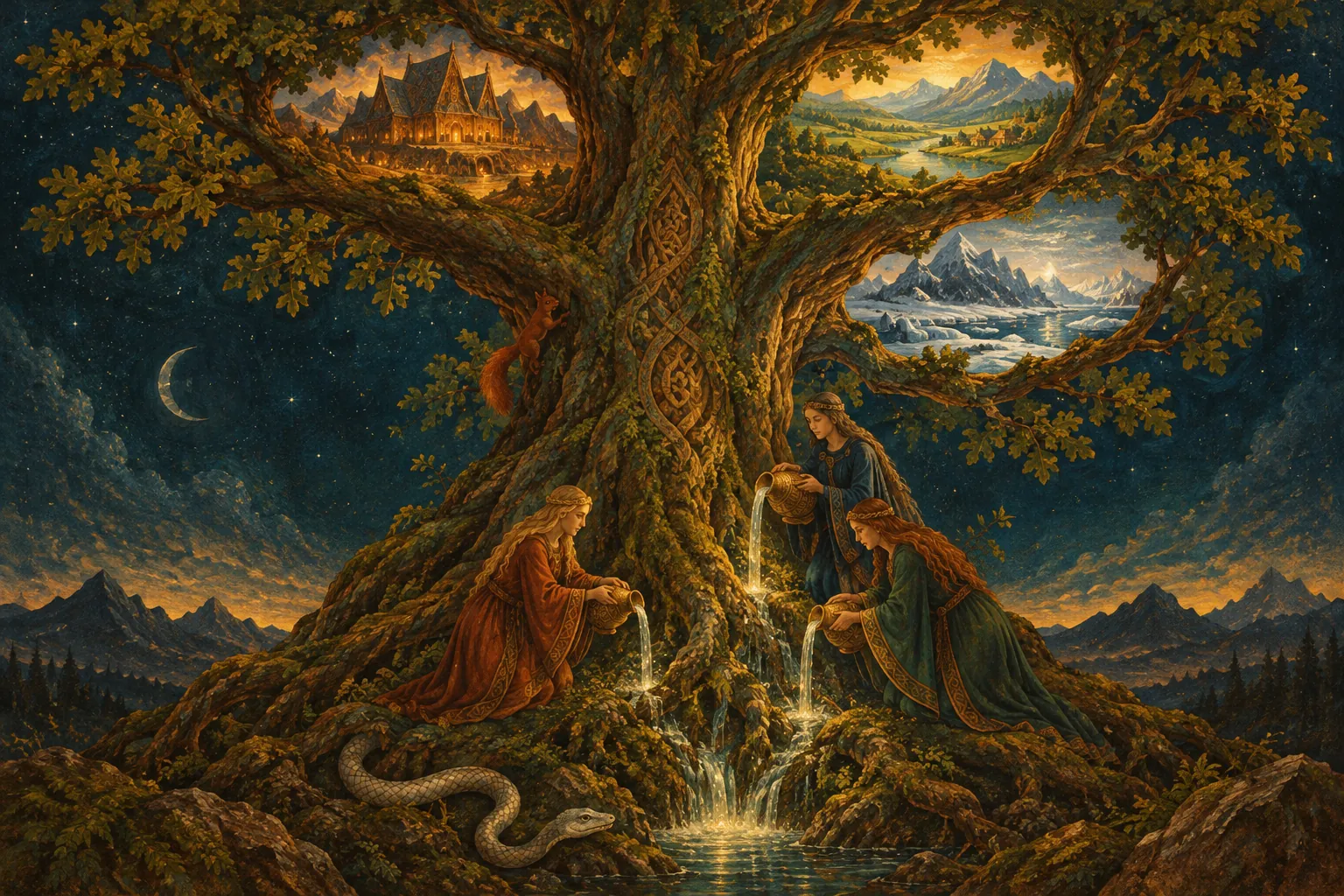
An eagle sits in the branches, and Snorri adds a hawk called Veðrfölnir between its eyes. The squirrel Ratatoskr runs up and down the trunk, carrying words between the eagle above and the serpent Níðhöggr below.
In Grímnismál those words are insults, so the squirrel keeps the quarrel alive. Níðhöggr gnaws at the roots, and four harts named Dáinn, Dvalinn, Duneyrr and Duraþrór bite at the new shoots.
The poem says the ash suffers more hardship than people know. A hart bites above, the side rots, and the serpent gnaws below.
The Norns and the well of Urd
By the well of Urd live three Norns, women who shape fate. Völuspá and Gylfaginning name them Urd, Verdandi and Skuld.
Völuspá says they lay down laws and choose the lives of human children. Snorri adds that each day they take water and clay from the well and pour it over the tree, so that it does not wither or rot.
He also says the gods ride to this well every day to hold their court. They cross the rainbow bridge Bifröst to get there.
The nine worlds
Völuspá speaks of nine worlds, but neither poem gives a tidy numbered list. The usual list is gathered from several Old Norse texts.
- Asgard, home of the Æsir gods
- Vanaheim, home of the Vanir gods
- Alfheim, home of the light elves
- Midgard, the world of humans
- Jotunheim, land of the giants
- Svartalfheim or Nidavellir, home of dwarfs and dark elves
- Muspelheim, the realm of fire
- Niflheim, the realm of ice and mist
- Hel, the realm of the dead
The sources do not fix where each world sits on the tree. Diagrams with a world on every branch are modern teaching tools.
When the tree shakes
Völuspá says that when the end begins, the tree trembles. In our own translation:
Yggdrasil shakes, the ash still standing; the old tree groans.
The poem does not say the tree is destroyed. In Gylfaginning, two humans named Líf and Lífþrasir hide in a place called Hoddmímis holt and live through the fire.
Some readers link that hiding place to the tree, but the texts do not say so. For the full sequence, see Ragnarok: the end of the Norse gods.
Where the story comes from
The Poetic Edda survives mainly in a manuscript called Codex Regius, written in Iceland around 1270. The poems in it are older, though scholars debate how much older.
Völuspá, the seeress's prophecy, tells the history of the world from creation to its end and its rebirth. Grímnismál is a lesson in the form of a speech: Odin, disguised as Grímnir, sits bound between two fires and lists the halls and wonders of the cosmos.
Gylfaginning is the first part of the Prose Edda, written by the Icelandic chieftain Snorri Sturluson around 1220. He wrote it to help poets understand the old stories, and he sometimes arranges scattered details into a neat order.
That is why the versions differ. In Grímnismál the roots go to Hel, the giants and humans, while Snorri gives the roots to the gods, the giants and Niflheim.
Another poem, Hávamál, describes Odin hanging nine nights on a windswept tree, wounded by a spear, to win the runes. That poem does not name the tree, but the name Yggdrasil is usually read as Odin's horse, with Yggr as a name for Odin and drasill as a poetic word for a horse.
A gallows was called the horse of the hanged.
What it means
Yggdrasil shows a world held together by connection. Gods, giants and humans are not separate, because one living thing feeds all of them.
It is also a world under constant strain. The tree is gnawed, eaten and rotting, and yet the Norns keep it alive, which fits the Norse view that fate is a steady effort and not a single decision.
The wells matter too. Wisdom at Mimir's well costs an eye, and the law of the gods is held beside the well of fate.
Some scholars connect the tree with real sacred trees in Scandinavian tradition. That is a scholarly link, not something the poems say.
Common misconceptions
It is not called the Tree of Life in the sources. The Old Norse texts call it an ash, and labels such as World Tree or Tree of Life are modern.
There is no official map of the nine worlds. The count of nine comes from Völuspá, while the names come from different texts.
It was not a god. In the poems it is a cosmic structure, and there is no evidence in them of the tree being worshipped.
It does not simply burn at Ragnarok. The poem says it shakes and groans, and Snorri leaves its fate open.
Read next
Norse mythology explained gives the whole map of the gods, worlds and sources in one place.
Ragnarok: the end of the Norse gods shows what happens when the tree begins to shake.