In five minutes
The Egyptian gods are the many deities that people in ancient Egypt worshipped for about 3,000 years. Most are tied to something people could see or fear: the sun, the Nile, the desert, the sky and the dead.
Eight names carry most of the story: Ra, Osiris, Isis, Horus, Set, Anubis, Thoth and Hathor.
Egypt never had one fixed rulebook of belief. Each city had its favourite gods, and the same god could appear as an animal, as a human with an animal's head, or as a symbol, depending on the temple and the century.
This guide gives a short portrait of each of the eight gods and tells the Osiris myth in one piece. It then shows why the stories do not always match.
Our anchor texts are the Pyramid Texts, the Book of the Dead and Plutarch's essay On Isis and Osiris.
The story
Ra, the sun god
Ra was the sun, and in many versions the king of the gods. By day he crossed the sky in a boat, and by night he sailed through the underworld, which the Egyptians called the Duat.
In the night journey the huge serpent Apep tried to stop the boat, and other gods fought it off so that the sun could rise again.
Ra was honoured above all at Heliopolis. In the New Kingdom he was joined with the god Amun as Amun-Ra, the national god of the empire.
Osiris, king of the dead
Osiris is shown wrapped like a mummy, holding a crook and a flail, the signs of a king. He was the lord of the dead and a god of renewal, linked to the yearly flood of the Nile and to grain that sprouts from buried seed.
His main cult centre was Abydos, where pilgrims left offerings for centuries.
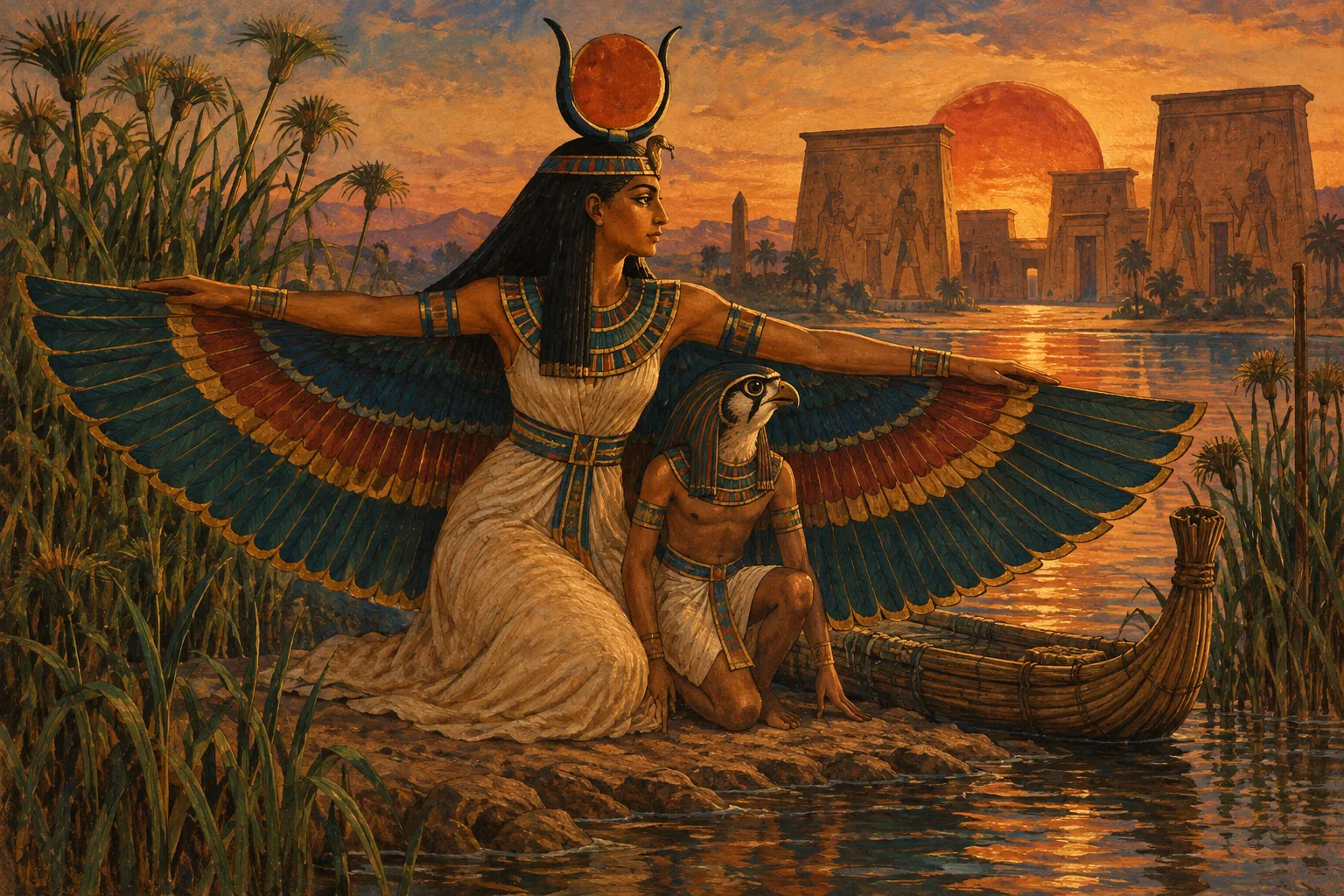
Isis, the great magician
Isis was the sister and wife of Osiris, a goddess of magic, healing and protection, and her sign was the throne. In a New Kingdom tale she forces Ra to tell her his secret name by making a serpent bite him, and she heals him only when he agrees.
Her worship later spread across the Roman world, and her temple at Philae stayed in use into late antiquity.
Horus, the falcon of the sky
Horus was the falcon god of the sky and of kingship. In the Osiris story he is the son of Isis and Osiris, and the avenger of his father.
Every living pharaoh was seen as Horus on earth, and the dead king as Osiris. The Eye of Horus, a symbol of healing and protection, comes from a fight in which his eye was hurt and then restored.
Set, lord of the desert and storm
Set ruled the red desert, storms and foreign lands. In the Osiris story he is the killer and the rival of Horus.
He was not only a villain, though. In some texts he stands in the prow of Ra's boat and spears Apep, and some pharaohs even took his name.
Only in the Late Period did he become mainly a hated figure.
Anubis, guide of the embalmers
Anubis is the jackal-headed god of embalming and cemeteries. He guides the dead and watches over the scale in the judgement scene.
He is older than Osiris as a god of the dead. Over time Osiris became the ruler, and Anubis kept the workshop and the road.
Thoth, scribe of the gods
Thoth, shown as an ibis or a baboon, was the god of writing, counting and the moon. He recorded the verdict when a heart was weighed, and he was said to have given the Egyptians their hieroglyphs.
His city was Hermopolis, and the Greeks later identified him with Hermes.
Hathor, goddess of joy
Hathor, with the ears or horns of a cow, was the goddess of music, dance, love and motherhood. Her great temple stands at Dendera.
In the Book of the Heavenly Cow, Ra sends his Eye against rebellious humans and she rampages as the lioness Sekhmet. Ra then floods the land with beer dyed red, she drinks it, and the killing stops.
The Osiris myth in one piece
This is the story in the form Plutarch gives it, and the variants follow afterwards. Osiris ruled Egypt well, but his brother Set grew jealous.
Set held a feast and offered a fine chest to whoever fitted it exactly. When Osiris lay down in it, Set sealed it and threw it into the Nile.
Isis searched until she found the chest at Byblos, where a tree had grown around it. She brought it home, but Set found the body and cut it into fourteen pieces, which he scattered.
Isis, helped by her sister Nephthys, gathered the pieces, and Anubis prepared the body. Isis conceived Horus and raised him in hiding in the marshes.
When Horus grew up he challenged Set for the throne. The gods judged between them, Horus won the kingship, and Osiris became ruler of the dead.
The variants are real. In Egyptian texts Osiris is simply said to have been killed by Set, and Plutarch is the only source that gives the chest and the fourteen pieces in a single story.
In the Egyptian tale of the Contendings of Horus and Set, the contest is long, quarrelsome and sometimes funny.
Where the story comes from
The Pyramid Texts are the oldest. Carved on the walls of royal pyramids at Saqqara from about 2350 BCE, they are spells to help a dead king rise to the sky.
Osiris is already the dead king there, and Isis and Nephthys already mourn. But there is no continuous story, only allusions.
The Book of the Dead is the name given to a collection of spells on papyrus, used from about 1550 BCE. The Egyptians' own name for it is closer to the Book of Coming Forth by Day.
Its best-known part is spell 125, the judgement hall, where the dead person's heart is weighed against the feather of Ma'at, the goddess of truth. No two surviving copies are exactly alike.
Plutarch, a Greek writer, wrote On Isis and Osiris around 100 CE for a priestess of Delphi. It gives the fullest story in one place, but it is a Greek reading of Egyptian belief, written some 2,000 years after the first pyramid spells.
Each major city also told its own creation story. Heliopolis had the family of nine gods called the Ennead, Memphis had Ptah, and Thebes raised Amun.
Even the ruler could reshape religion: around 1350 BCE the pharaoh Akhenaten promoted the sun disk Aten above the other gods, and the old gods returned after his reign.
What it means
The myths explain how order returns. The sun comes back each dawn, the Nile floods each year, and a king's power passes from father to son.
Osiris and Horus express that pattern. The dead king becomes Osiris, and the new king is Horus.
The judgement scene says that death is a trial and not an end, and that a person is measured by how they lived according to Ma'at, meaning truth and balance.
These were living beliefs in their own time, and temple worship of these gods lasted for thousands of years. They are best read as belief and tradition and not as history.
Common misconceptions
The Egyptians worshipped animals. They used animal forms as symbols of a god's nature, such as the falcon's far sight, and some animals were kept as sacred to a god.
The god was not simply the animal.
Set was the devil. He was dangerous, but in early periods he was also a defender of Ra's boat.
The purely evil Set belongs to later times.
Anubis rules the underworld. That was Osiris.
Anubis is the embalmer and the guide.
There was one official family tree. There was not.
Gods were joined, split and renamed from city to city and from period to period.
The Book of the Dead is one book. It is a changing collection of spells, and each papyrus chose its own.
Read next
See how another culture tells the story of a divine family and a god's death in Norse mythology explained.