In five minutes
The panopticon is a prison design by the English philosopher Jeremy Bentham, drawn up in 1787. It is a ring of cells around a central watchtower, built so that one guard can see every prisoner without being seen.
The clever part is the doubt. Prisoners never know whether the guard is looking at them right now, so they behave as if he always is.
That small trick grew into one of the best-known ideas in political thought and in the history of science fiction. Writers use it for telescreens, glass cities and data tracking, and thinkers use it as shorthand for power that works through being watched.
This page covers where the idea came from, how the building works, what Foucault did with it, and where you will meet it in novels. It ends with the common mistakes people make about it.
Where the idea came from
Bentham (1748–1832) was a reformer who wanted laws and institutions judged by whether they made people happier. In 1787 he was staying with his younger brother Samuel in Krichev, in what is now Belarus.
Samuel was an engineer working for Prince Grigory Potemkin, and he had to supervise a crowd of unskilled workers. He arranged a workshop so that one overseer in the middle could see everyone at once.
Jeremy took that practical trick and pushed it much further. He wrote a series of letters describing a building made for watching people, and they were published in 1791 as Panopticon; or, The Inspection-House.
The name comes from Greek: pan means "all" and optikon means "of sight." Bentham himself called it "a new mode of obtaining power of mind over mind," a phrase that sounds chilling today but was meant as a boast about efficiency.
He honestly believed he was offering a kinder system. Compared with the dark, overcrowded gaols of his day, his cells would be light, clean and orderly, and punishment by whipping would be less needed.
How the building works
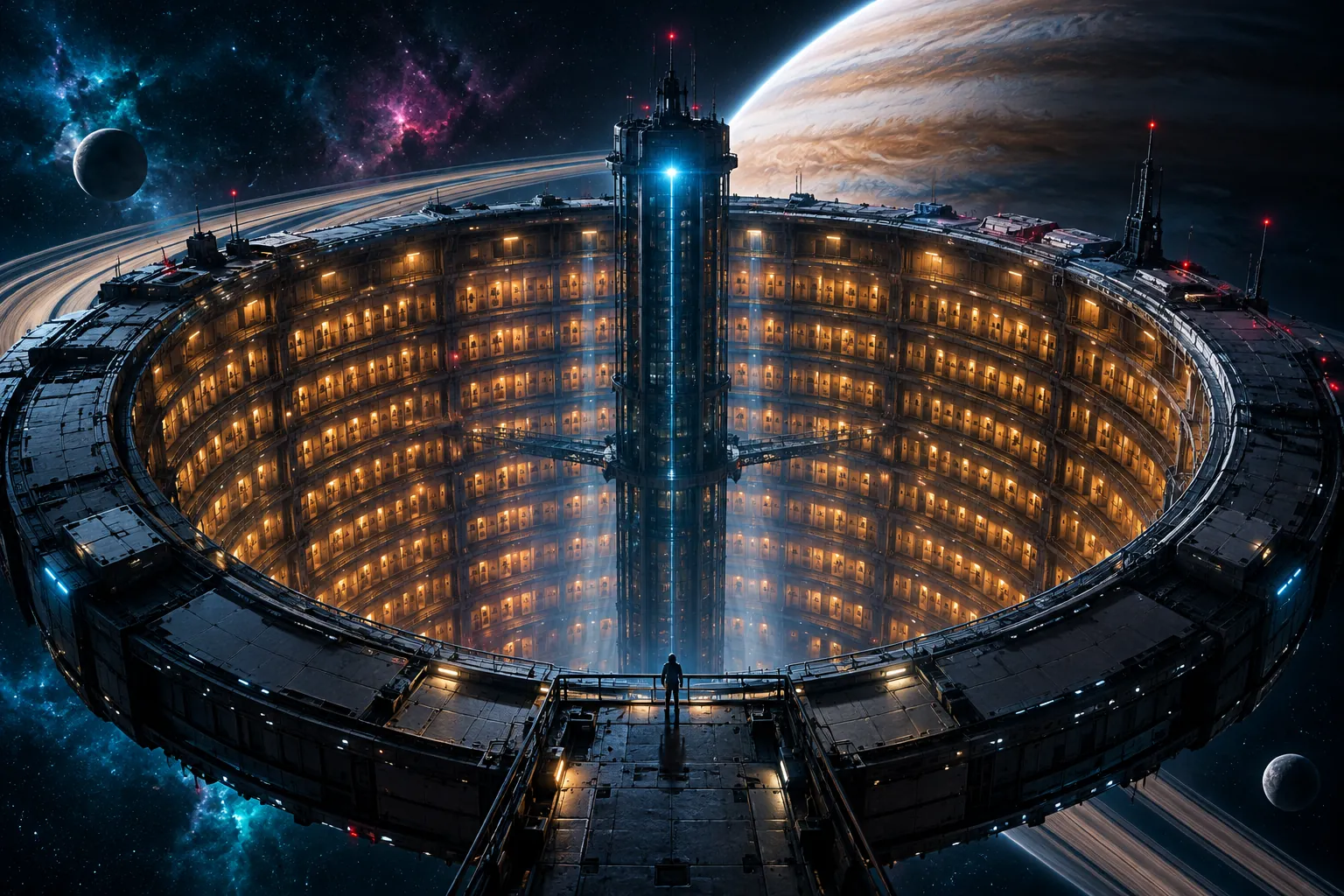
Picture a round building several floors high. The cells sit around the outer wall, and each one has a window on the outside and an open front facing the middle.
Daylight from the outer window crosses the cell, so a guard in the central tower sees each prisoner as a clear silhouette. The tower has blinds or screens, so the prisoners cannot tell whether anyone is inside.
The cells are also separated from one another, so inmates cannot talk, plot or comfort each other. Bentham reasoned that a few staff could then keep many people in line, which made the building cheap to run.
His central claim was psychological. Because inmates can never be sure they are unobserved, the watching works even when nobody is watching.
He did not stop at prisons. He argued that the same shape would suit factories, workhouses, hospitals, schools and asylums, anywhere a few people had to oversee many.
Was it ever built?
Not as Bentham drew it. He spent years lobbying the British government, which backed the scheme in the 1790s, but delays and disputes over land and money followed.
The project was dropped in 1803, and Parliament later paid Bentham compensation. The Millbank Penitentiary, which opened in London in 1816, stood on land bought for the project, though its design was different.
Buildings that follow the circular idea more closely did appear later. The best known is the Presidio Modelo on the Isle of Pines in Cuba, finished around 1931, with circular cell blocks arranged around central towers.
Round and radial prisons spread through the nineteenth and twentieth centuries, but few copied the whole of Bentham's plan. The hidden watcher and the strict separation of prisoners were the hardest parts to reproduce.
Foucault and the panopticon as an idea
For almost two centuries the panopticon was a footnote in the history of prison design. Then in 1975 the French philosopher Michel Foucault made it famous in Discipline and Punish (Surveiller et punir).
Foucault argued that modern societies control people less by punishing bodies in public and more by training them. Schools, barracks, hospitals and factories all use timetables, examinations and records to shape behaviour.
The panopticon was his clearest picture of this. The person who might be watched takes the watcher inside their own head and polices themselves.
Notice that this is Foucault's argument, not a proven law. Historians point out that real institutions were messier and less efficient than his model, but the word "panoptic" stuck anyway.
The real science: does being watched change us?
The psychology behind the idea has some support. In a 2006 study at a university in England, researchers placed a picture of a pair of eyes above an honesty box for tea and coffee money, and people paid noticeably more than in the weeks when the picture showed flowers.
Studies of CCTV give a mixed picture. Reviews of the evidence find modest drops in some crimes, mostly in car parks, and little effect in many other settings.
What remains speculation is the bigger claim, that constant possible observation makes a whole society obedient. That is a theory about power, not a measured result.
Modern tools also change the shape of watching. In 1997 the Norwegian sociologist Thomas Mathiesen proposed the word "synopticon" for the reverse arrangement, where the many watch the few through television and now social media.
Where it shows up in fiction
The most famous echo is Nineteen Eighty-Four by George Orwell (1949). Its telescreens work both ways, and Winston knows he cannot tell when he is being watched, so he has to assume he always is.
That is panopticon logic, even though Orwell never uses the word. For the face of the watcher, see Big Brother, and for the language side of control, see Newspeak and doublethink.
Yevgeny Zamyatin's We, written around 1920–21, imagines a city of glass walls where every life is visible to the state. It shows the same idea as architecture rather than as a machine.
Dave Eggers's The Circle (2013) moves it to a tech company that persuades people to share everything. There the watching is voluntary and even applauded, which makes it a useful contrast with Bentham's prison.
Why it still matters
Phones, cameras, workplace software and online accounts record what we do all day. Many people feel they might be observed without knowing when, which is exactly the situation Bentham designed.
The comparison has limits. Nobody is locked in a cell, and much of today's tracking is done by companies for advertising, not by a single guard in a tower.
Still, the panopticon gives us a short test for any system of watching. Ask who can see, who cannot see them, and whether the person watched ever knows when it is happening.
Common misconceptions
- "Bentham meant it as a torture machine." He presented it as humane reform, with light, clean cells and fewer beatings, though modern readers find the constant exposure disturbing.
- "A panopticon watches everyone all the time." The point is only that someone might be watching at any moment.
- "Foucault invented it." Bentham designed it in 1787. Foucault made it a symbol of modern discipline almost two hundred years later.
- "1984 is a panopticon." Telescreens share its logic, but Orwell's world also relies on informers, propaganda and fear.
- "Every round prison is a panopticon." Only a design with a central hidden observer and visible, separated cells follows Bentham's idea.
Read next
Big Brother (Orwellian) looks at the watcher in Orwell's novel and where the phrase now appears.
Newspeak and doublethink explains how 1984 controls thought through language as well as sight.
History of Science Fiction places these ideas of surveillance and control in the wider story of the genre.