In five minutes
The US Constitution is the written framework of government that the United States still uses today. Delegates drafted it in Philadelphia between May and September 1787 to replace the Articles of Confederation, the loose agreement that had held the states together during and after the American Revolutionary War. It took effect once nine of the thirteen states approved it, which happened in June 1788.
Three ideas hold it together. Power is shared between the national government and the states, which is federalism. National power is split among a legislature, an executive and courts that can check one another. And the government's authority comes from the people, which is why the text opens with the words "We the People." If the Declaration of Independence said why the colonies broke away, the Constitution answered a harder question: how to govern a large country without recreating the power they had just rejected. It is one chapter in the larger story told in The American Revolution: Causes, War and Independence.
Why the Articles of Confederation failed
The Articles were adopted by Congress in 1777 and took effect in 1781, when the last state ratified. They created a "league of friendship" among sovereign states. Congress had no president, no national court system and no power to tax. It could ask the states for money, but it could not make them pay. Each state had one vote, whatever its size, and changing the Articles required every state to agree.
The weaknesses showed quickly. Congress struggled to pay its war debts, states argued over trade and borders, and foreign governments doubted that the United States could keep its promises. In 1786 and 1787, farmers in western Massachusetts, squeezed by debt and taxes, closed courts and took up arms in what is called Shays' Rebellion. The national government had no army of its own to respond. For many leaders the lesson was plain: the country needed a stronger centre.
The Philadelphia Convention, 1787
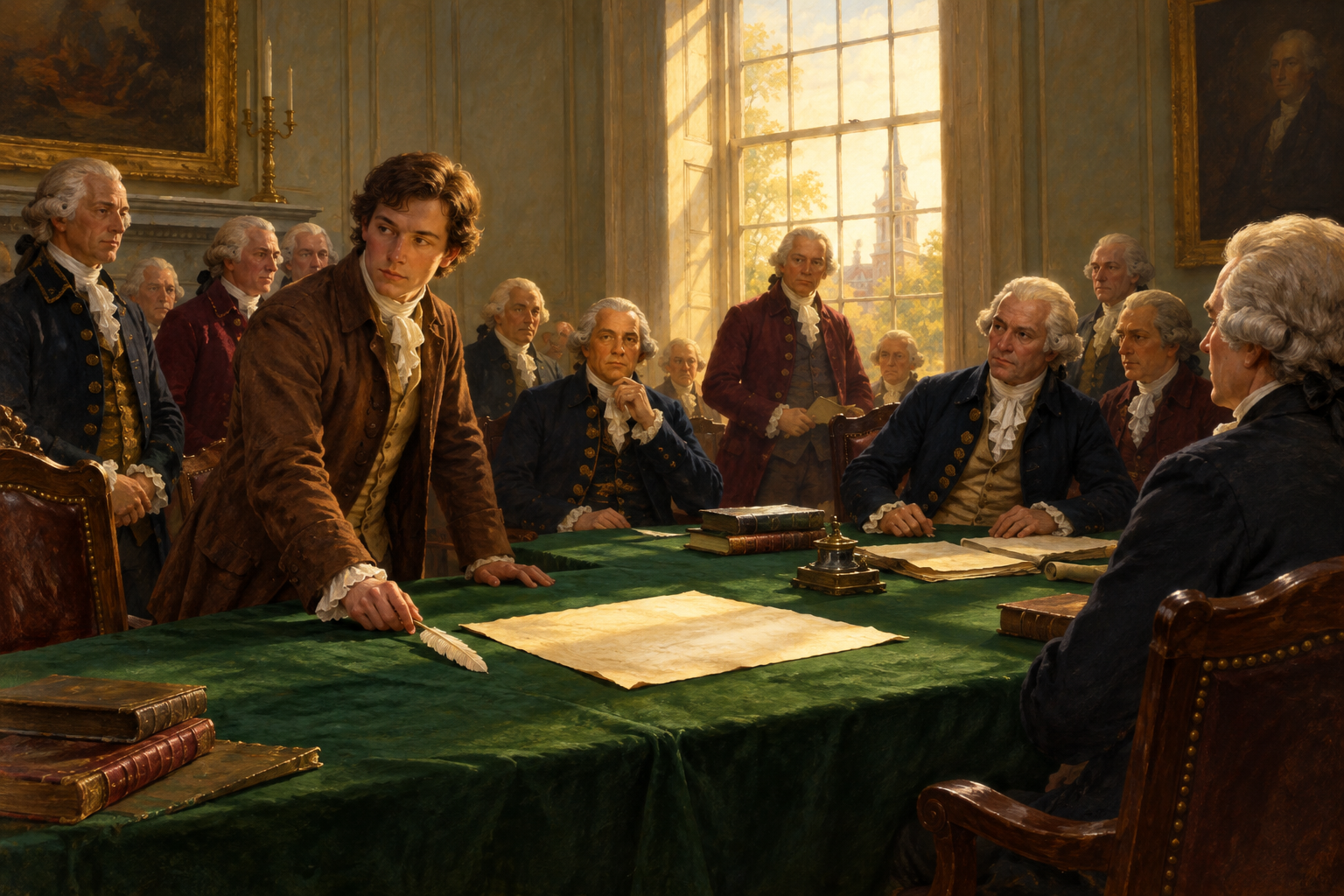
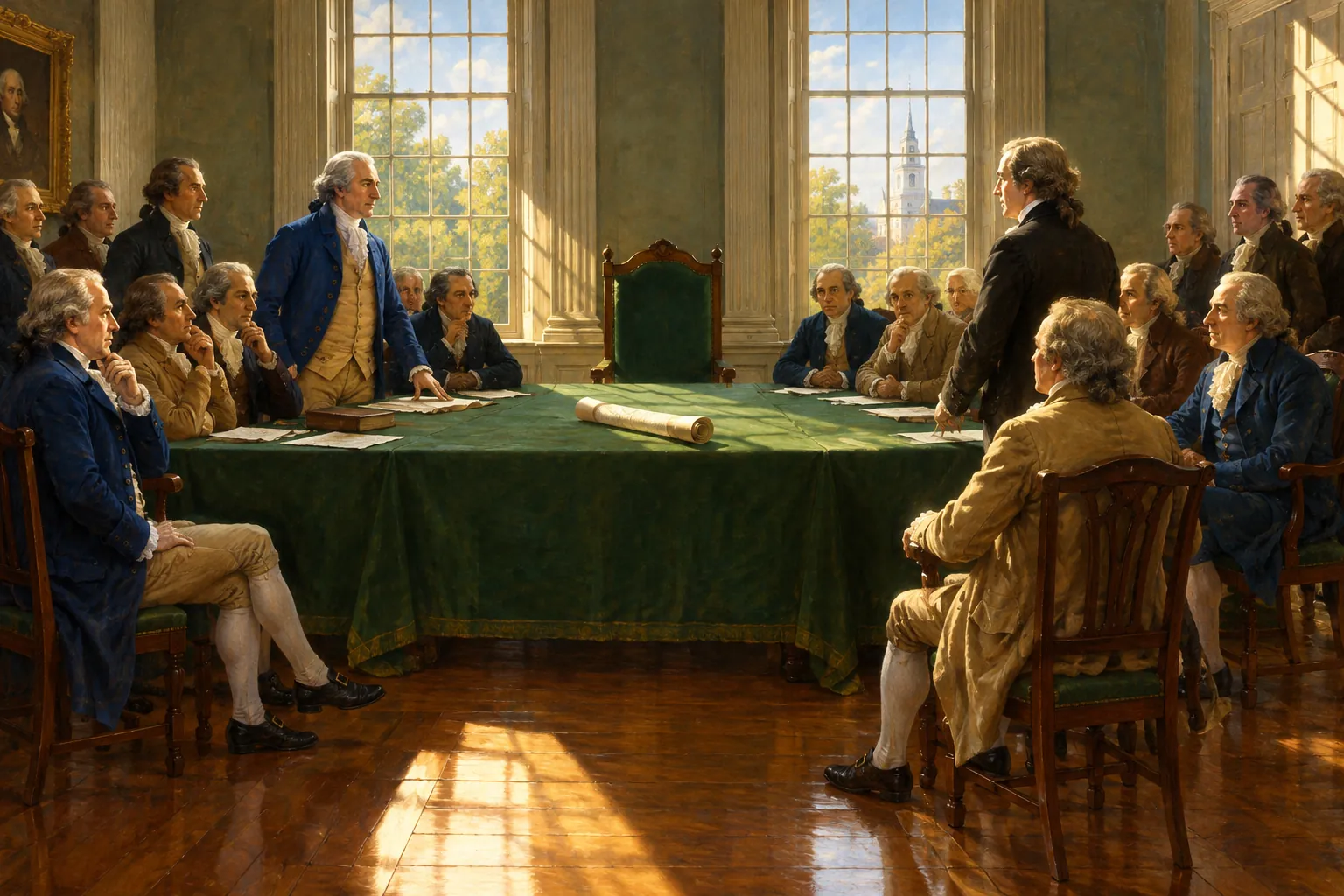
A meeting at Annapolis in September 1786 on trade between the states drew few delegates, but it called for a wider gathering. Congress agreed that a convention should meet in Philadelphia to revise the Articles. It opened on 25 May 1787 in the Pennsylvania State House, today called Independence Hall. Rhode Island sent no one. About 55 delegates took part at different times, and George Washington was chosen to preside.
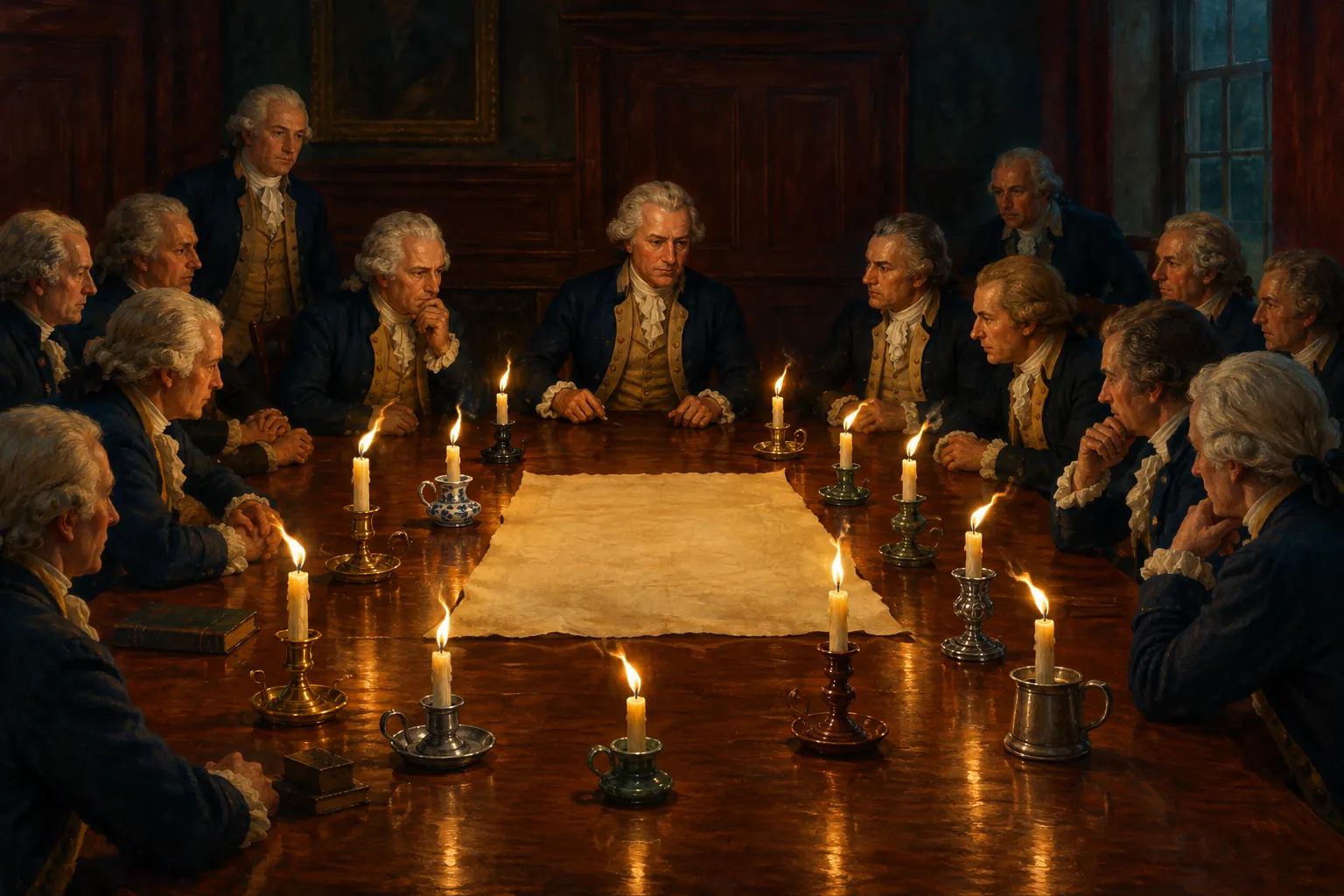
The delegates met behind closed doors, and they kept the debates secret so that members could change their minds without public pressure. They quickly went beyond their instructions: instead of patching the Articles, they wrote a new framework. James Madison of Virginia, who arrived with a detailed plan and kept careful notes, is often called the "Father of the Constitution," though many hands shaped the final text.
The big compromises
The first fight was about representation. The Virginia Plan, presented by Edmund Randolph in late May, proposed a strong national government with a legislature based on population. Small states feared being outvoted, and in June William Paterson offered the New Jersey Plan, which kept one vote per state. In July the delegates reached the Connecticut Compromise, sometimes called the Great Compromise. The House of Representatives would be based on population, and the Senate would give each state two members.
The second fight was about slavery. Delegates from the southern states wanted enslaved people counted for representation but not for taxes, while many northern delegates argued the reverse. They settled on the three-fifths compromise: each enslaved person counted as three-fifths of a free person for both representation and direct taxes. Congress was also barred from banning the importation of enslaved people before 1808. The Constitution avoided the word "slavery" itself, yet it protected the institution in several clauses. This was a political bargain made to keep the union together, and its human cost was enormous.
Other decisions included how to choose a president, which led to the Electoral College, and how to amend the document, which required broad agreement but not unanimity. A Committee of Style, with Gouverneur Morris doing most of the drafting, polished the final wording. On 17 September 1787, 39 delegates signed.
How the Constitution works
The document is short. It has a Preamble and seven articles. Article I creates Congress, with the House and the Senate, and lists its powers, including taxation, regulating commerce and declaring war. Article II creates the presidency. Article III creates the Supreme Court and allows Congress to set up lower courts. Later articles deal with relations among the states, the amendment process, the supremacy of federal law and the method of ratification.
Each branch has ways to restrain the others. The president can veto bills, Congress can override a veto, the Senate must confirm major appointments, and the House can impeach officials. This system of checks and balances drew on Enlightenment thinkers such as Montesquieu, who argued that liberty is safer when power is divided. Federalism adds another layer: the national government has listed powers, and the states keep authority over many everyday matters.
The ratification fight
The Convention sent the text to special state conventions rather than to the state legislatures, underlining that the people were the source of its authority. Delaware ratified first, on 7 December 1787. Supporters, called Federalists, argued that a stronger union was essential. Between October 1787 and May 1788, Alexander Hamilton, James Madison and John Jay wrote 85 essays defending it, now known as the Federalist Papers.
Opponents, called Anti-Federalists, feared a distant government with too much power and noted that the draft had no list of individual rights. Several states, including Massachusetts, ratified only after leaders promised to add amendments. New Hampshire became the ninth state on 21 June 1788, which made the Constitution operative. Virginia and New York followed in June and July. North Carolina joined in November 1789 and Rhode Island in May 1790. Washington took office as the first president on 30 April 1789.
The Bill of Rights and later amendments
Madison drafted amendments in the First Congress to meet the Anti-Federalist concerns. Ten of them were ratified on 15 December 1791 and are known as the Bill of Rights. They protect freedom of religion, speech, the press and assembly, the right to a fair trial, and protection from unreasonable searches. Since then, 17 more amendments have been added, for a total of 27. They include the abolition of slavery in 1865, equal protection in 1868 and votes for women in 1920.
The Constitution has lasted because it sets out principles and procedures more than detailed rules, leaving later generations to interpret and amend it. Its first draft excluded most people from political life, including women, enslaved people and many men without property. The history of the document since 1787 is partly the history of widening who counts as part of "We the People."
What exams ask
For AP US History and similar courses, expect questions on four themes. First, why the Articles failed: no taxing power, no executive and one vote per state. Second, the compromises: the Connecticut Compromise, the three-fifths clause and the 1808 slave-trade limit. Third, the Federalist and Anti-Federalist debate, including the Federalist Papers and the demand for a bill of rights. Fourth, the principles of the Constitution: federalism, separation of powers, checks and balances, and popular sovereignty. A strong answer connects each design choice to a specific problem of the 1780s, such as Shays' Rebellion or the unpaid war debt.
Read next
- The American Revolution: Causes, War and Independence: the full overview that places the Constitution at the end of the story.
- The Declaration of Independence Explained: the ideas of 1776 that the Constitution tried to turn into working government.
- The American Revolutionary War (1775–1783): the war whose debts and divisions shaped the debate in Philadelphia.