In five minutes
A black hole is a region of space where gravity is so strong that nothing, not even light, can escape once it crosses a boundary called the event horizon. Science fiction loves it for that reason: it is a one-way door, a clock-slower and a cosmic power plant in a single object.
Real black holes are stranger in some ways and duller in others than the stories suggest. They are not hungry vacuum cleaners, and falling into one looks very different to the traveller than to the person watching.
This page separates what authors invented from what physicists have measured, and shows where the line between them runs. It is part of our guide to the History of Science Fiction.
Where the idea came from
In 1783 the English clergyman John Michell reasoned that a star massive enough would have an escape speed above the speed of light, so its light could never leave. Pierre-Simon Laplace made a similar argument in the 1790s.
Those "dark stars" were guesses based on Newton's gravity. The modern picture starts with Einstein's general relativity, finished in 1915.
A year later Karl Schwarzschild found the first exact solution of Einstein's equations, describing the space around a single, non-rotating mass. It contained a boundary that puzzled physicists for decades before they agreed it was real.
The name came late. John Archibald Wheeler popularised "black hole" in the late 1960s, and writers picked it up quickly.
The real science
The event horizon is a boundary, not a surface
The event horizon is the point of no return: inside it, every possible path leads further in. Nothing is there to touch, and a traveller crossing it would notice no wall.
Its size depends on mass. For a black hole with the Sun's mass the horizon is about 3 kilometres in radius, and for one with the Earth's mass it would be about 9 millimetres.
Three sizes of black hole
Stellar-mass black holes form when a very massive star collapses at the end of its life. The nearest one known today, Gaia BH1, lies roughly 1,600 light-years away and is about ten times the Sun's mass.
Supermassive black holes sit at the centres of large galaxies. Sagittarius A* at the heart of the Milky Way holds about four million Suns, and M87* in a galaxy some 55 million light-years away holds billions.
The Event Horizon Telescope released an image of M87* in April 2019 and of Sagittarius A* in May 2022. In September 2015 the LIGO detectors recorded gravitational waves from two black holes merging, announced in February 2016.
What falling in looks like
Gravity pulls harder on your feet than on your head if you fall feet first, and near a small black hole that difference becomes lethal. Physicists call the result spaghettification.
Around a supermassive black hole the stretching is gentle at the horizon, so a traveller could cross it intact and be doomed only later.
Time behaves oddly too. To a distant observer, a falling clock appears to slow down and fade without ever visibly crossing the horizon, while the traveller's own clock runs normally.
Hawking radiation and the inside
In 1974 Stephen Hawking showed that quantum effects should make a black hole emit a very faint glow. A black hole of stellar mass is colder than the cosmic microwave background, so today it absorbs more than it gives off.
Inside the horizon, general relativity predicts a singularity of infinite density. Most physicists read that as the point where the theory stops working, and what really happens there is unknown.
Established or speculative?
- Measured: black holes exist, in several sizes, and they merge, bend light and power bright discs of gas.
- Well supported by theory: event horizons, time dilation and Hawking radiation.
- Open questions: the interior, what happens to information, and whether any shortcut or time machine is possible.
Where it shows up in fiction
Authors have used black holes for four jobs: a gateway, a time trap, a power source and a place for final-act spectacle. Three works show the range.
The Forever War (Joe Haldeman, 1974)
Haldeman's soldiers travel between stars by falling into "collapsars", which is his term for black holes used as jump points.
The real physics he borrows is time dilation: because the ships move so fast, the soldiers age months while Earth ages decades, and home becomes a stranger each time they return.
Gateway (Frederik Pohl, 1977)
Pohl's prospectors fly alien ships to unknown destinations and gamble their lives on finding something valuable. A black hole appears as a place where time dilation turns a brief event into a lasting wound for the main character.
Spoiler note: the book's emotional centre depends on that scene, so we give no more of it here.
Interstellar (2014)
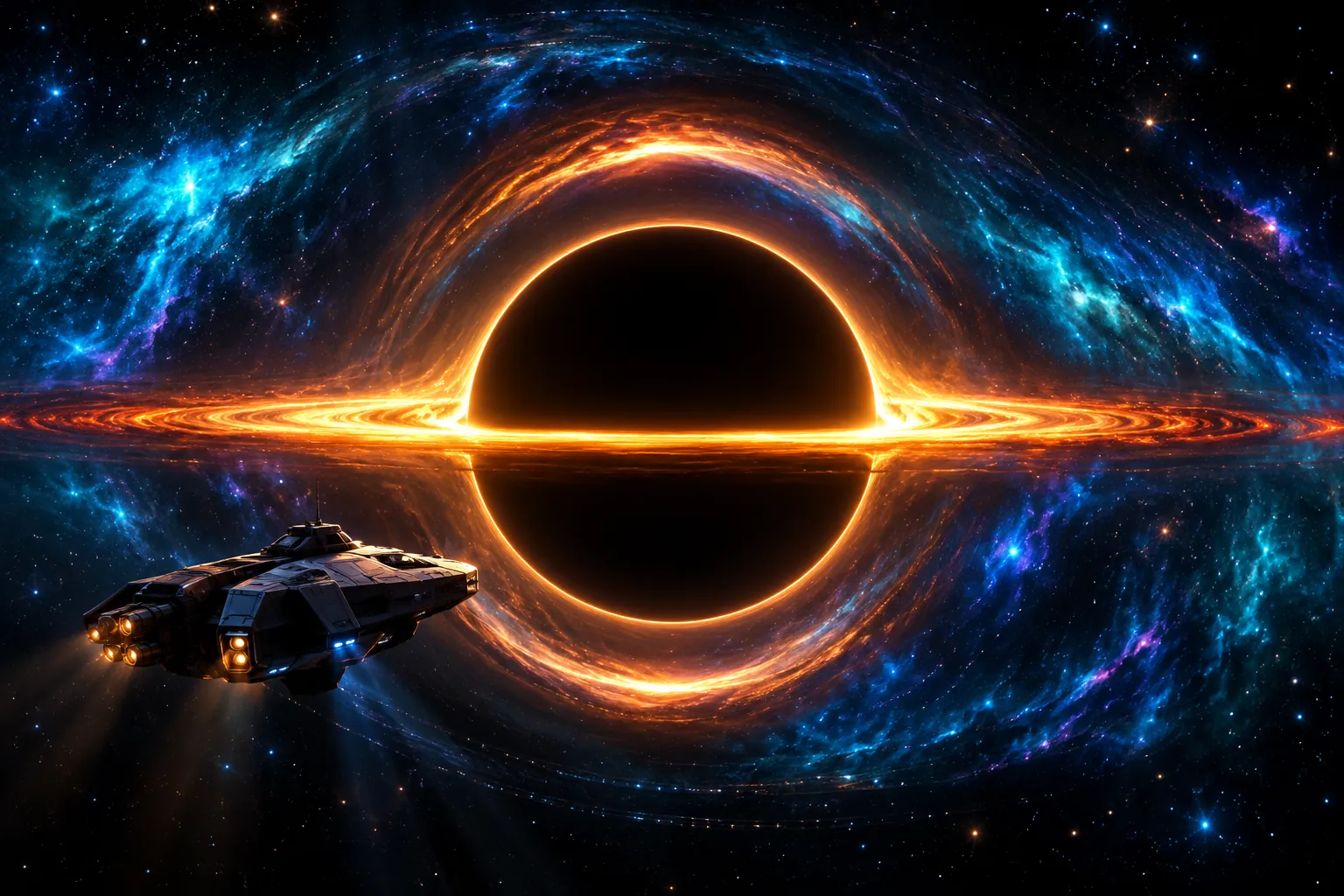
Christopher Nolan's film shows a spinning black hole called Gargantua. Physicist Kip Thorne advised the production, and the team's calculations of how light bends around the hole were later published in a physics journal.
To keep the image readable, the film softened some effects, such as the lopsided brightness real discs would show.
Common story roles
- Gateway: black holes as jump points. Real physics offers no known way to emerge on the other side.
- Time machine: time dilation lets a traveller move into the future of outsiders, but it only runs forwards.
- Power source: real black holes do power quasars and gas jets, and a civilisation might use them, as with Dyson spheres around stars.
- Disposal chute: good drama, but dropping rubbish into a black hole would be a very expensive trip.
Common misconceptions
- "Black holes suck everything in." At a distance a black hole pulls just like any object of the same mass. If the Sun became a black hole of the same mass, the planets would keep orbiting, in the dark.
- "A black hole is a hole." It is a compact object, or more exactly a region of curved spacetime, and it has a mass you can measure.
- "Black holes are wormholes." They are different ideas. A wormhole is a theoretical tunnel with no observed example, and you can read about it on our wormhole page.
- "Nothing ever comes out." Nothing comes out from inside the horizon, but the hot gas around it can shine brilliantly and launch jets of matter.
- "Black holes are shortcuts to anywhere." Nothing observed supports this, and faster-than-light ideas such as the warp drive use a different theoretical route.
Read next
- History of Science Fiction: the wider story of the genre these ideas belong to.
- Wormhole: the tunnel idea that is often confused with black holes.
- Warp drive: faster-than-light travel by bending space around a ship.
- Dyson sphere: another stellar-scale idea, this one about harvesting a star's energy.