In five minutes
Telepathy is the supposed ability to pass thoughts, feelings or images from one mind to another without speech, writing or any known sense. In fiction it is everywhere, but in laboratories there is still no reliable evidence that it happens.
The word is young. The scholar Frederic W. H. Myers coined it in 1882, the year the Society for Psychical Research was founded in London, from Greek roots meaning "distant" and "feeling".
Since then the idea has lived three lives at once. It has been a research question for psychical researchers, a gift to novelists, and a loose label for brain technology that really can link minds to machines.
This page keeps those three lives apart, so you can tell which is which. It is part of our wider guide to the history of science fiction.
Where the word came from
Myers and his colleagues wanted a name for impressions that seemed to travel between people with no ordinary channel. "Telepathy" replaced older phrases such as thought-transference.
The Society for Psychical Research was set up in 1882 by a group of Cambridge-linked scholars, with the philosopher Henry Sidgwick as its first president. Its aim was to study mediums, hauntings and apparent thought-transfer with the same care applied to other subjects.
That ambition mattered. It meant the topic was argued over in journals and meetings, not only in drawing rooms, and it gave sceptics something concrete to test.
In 1886 Myers, Edmund Gurney and Frank Podmore published Phantasms of the Living, a two-volume collection of reported cases. Most were visions of a person at the moment of a distant crisis, such as a death.
The cases were anecdotes gathered after the event, which is exactly why critics found them weak. A memory can be reshaped by what happened next.
What researchers actually tested
In the 1930s J. B. Rhine at Duke University moved the question into the laboratory. With Karl Zener he used a deck of 25 cards, five each of five symbols, so a guesser would be right about one time in five by chance.
Rhine's 1934 book Extra-Sensory Perception made "ESP" a household term. Later reviewers found flaws: some cards could be read from their backs or from reflections, and scores were sometimes counted loosely.
These flaws are called sensory leakage. If a guesser can pick up even a faint clue through an ordinary sense, the result says nothing about a hidden one.
From the 1970s the Ganzfeld method tried to remove noise. A "receiver" rests in a mild sensory-deprivation state while a "sender" in another room looks at a picture, and afterwards the receiver picks the true picture from four, so chance is 25 percent.
Charles Honorton reported results above chance, and in 1986 he and the sceptic Ray Hyman published shared rules for better experiments. Studies run since then have not produced a result that the wider scientific community accepts.
The reasons are plain. Effects tend to shrink as controls tighten, small leaks of information are hard to rule out, and a result that cannot be repeated on demand is not yet a result.
There is also a bias in what gets published. Studies that find something are more likely to be written up than those that find nothing, which can make a small effect look larger than it is.
Why it feels real
Most people have had the moment: you think of a friend and the phone rings. Out of thousands of thoughts a day, a few will match something that happens by chance, and those are the ones we remember.
We forget the many times a thought was followed by nothing. This habit of counting the hits and ignoring the misses is a form of confirmation bias, and it makes coincidence feel like a signal.
The mind also fills gaps. People who know each other well, such as twins or old couples, share habits and context, so a matching thought is often a shared guess rather than a signal.
Stage "mind readers" use cold reading, body language and prepared tricks. A performance can be impressive and still be a trick.
The real science: brains linked to machines
Neuroscience does study communication that needs no speech. It does so with sensors and magnets, not with a hidden sense.
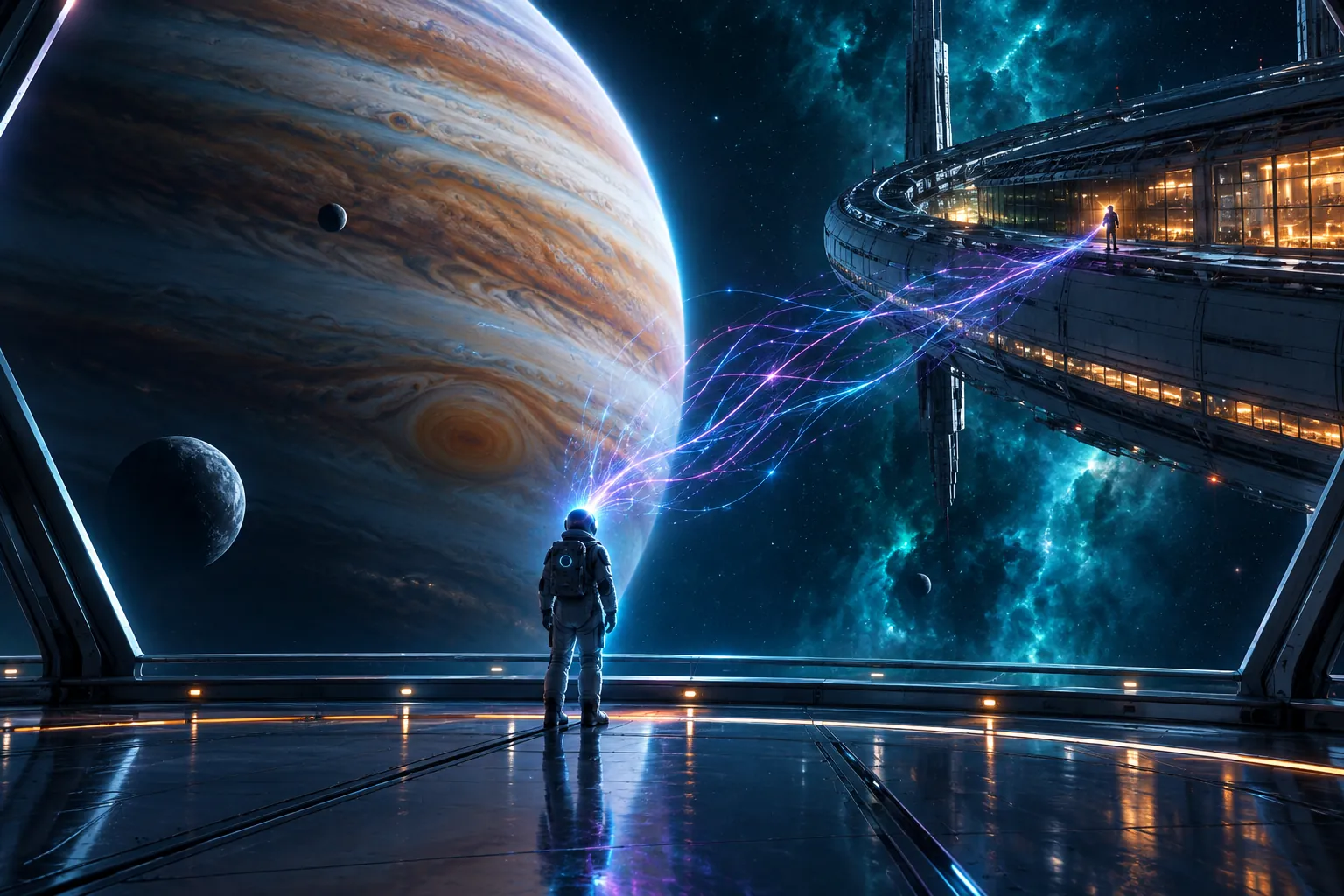
In 2013 Rajesh Rao and Andrea Stocco at the University of Washington let one person's brain signals, recorded with EEG, trigger a magnetic pulse that made another person's finger press a key in a different building. It carried a single yes-or-no signal.
In 2019 the same group's BrainNet let three people cooperate on a Tetris-style game in a similar way. The signals were simple choices, not thoughts.
In 2008 a team around Yukiyasu Kamitani in Kyoto reconstructed rough images that volunteers were looking at from fMRI scans. In 2021 a UCSF team led by Edward Chang turned a paralysed man's attempted words into text on a screen, and in 2024 Neuralink implanted its first device in a person.
None of this is telepathy in the old sense. Each system needs sensors, training for one user and a known kind of signal, and none picks up a stray thought across a room.
The medical purpose is also different. These projects aim to give speech or movement back to people who have lost it, not to let healthy minds chat silently.
Where it shows up in fiction
Science fiction took telepathy up in earnest in the 1950s, when the editor John W. Campbell of Astounding Science Fiction championed stories about "psi" powers. Writers soon treated it as a way to ask what society would look like if privacy ended.
Alfred Bester's The Demolished Man (1953) imagines a world of licensed telepaths, where murder is almost impossible to hide and the crime becomes a puzzle of concealing a motive. It won the first Hugo Award for Best Novel.
Theodore Sturgeon's More Than Human (1953) pictures a group of outcast people whose minds and gifts join into one shared being.
John Wyndham's The Midwich Cuckoos (1957) turns telepathy into unease, with unusual children who share whatever one of them learns.
Mild spoiler note: in Liu Cixin's Three-Body trilogy, the alien Trisolarans can show their thoughts to each other directly, so they struggle to understand human lies. Here telepathy is a thought experiment about deception and trust.
In Japan, Yasutaka Tsutsui's Nanase books, beginning with Kazoku Hakkei (1972), follow a young housemaid who can read the minds of the households she works in. The series shows how heavy it would be to hear everyone's private thoughts.
Why writers like it
Telepathy is useful to a storyteller for practical reasons. It lets characters share information instantly, and it lets an author show what is hidden behind polite words.
It also raises sharp questions: who may listen, who can shut the door, and what happens to trust when nothing can be kept back. Good stories use those questions rather than treating the power as a simple trick.
When you meet telepathy in a book, it helps to ask three things. What are the rules, what does it cost the user, and how does society respond to it?
Stories that answer these well tend to age best, because they are really about people, not about the gadget.
Common misconceptions
"Brain-computer interfaces prove telepathy is real." They prove that brain signals can be measured and used, which is a different claim from a mind sending a thought through the air.
"A few experiments beat chance, so it is proven." At the usual 5 percent threshold, about one study in twenty will look significant by luck alone.
What matters is whether independent teams can repeat it.
"Science has proven telepathy impossible." Science cannot prove a negative.
The accurate statement is that no known mechanism exists and no reliable evidence has been found.
"AI can read your private thoughts." Current decoders need a scanner or an implant, many hours of training on one person, and that person's cooperation.
Read next
First contact (in fiction and science): telepathy is one of the oldest ways fiction imagines two very different minds understanding each other.
History of Science Fiction: the wider story of the genre, from the first tales to the modern wave.