In five minutes
A flying car is a vehicle that can both drive on a road and fly, or a small personal aircraft sold with the promise of a "car for the sky." People have built prototypes for more than a century, yet almost nobody has one in the garage.
The idea is a staple of the genre, and it belongs to the wider story told in History of Science Fiction.
Two quite different machines share the name. A roadable aircraft is an aeroplane with wheels and folding wings that can use ordinary roads.
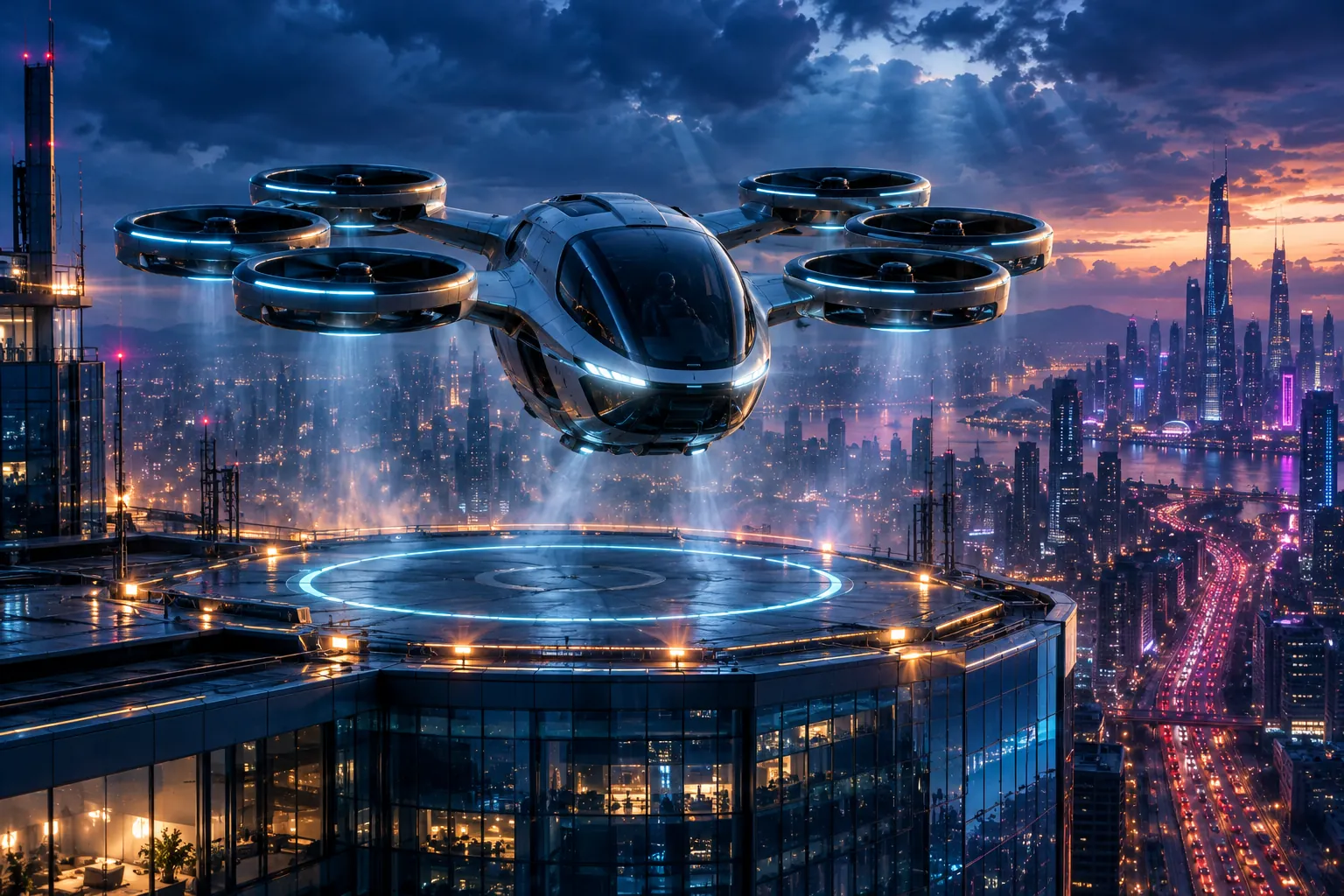
An eVTOL (electric vertical take-off and landing) aircraft is closer to a quiet multi-rotor air taxi that carries passengers between landing pads.
Both kinds exist today as prototypes or small-scale products. Neither has replaced the family car, and the reasons have more to do with energy, safety and cost than with a lack of imagination.
A century of prototypes
Inventors tried to join the car and the aeroplane almost as soon as aeroplanes worked. In 1917 the American aviation pioneer Glenn Curtiss showed the Autoplane, an aluminium-bodied car with a large triplane wing that managed only short hops.
In 1940 Henry Ford predicted that a combined aeroplane and motorcar was coming. The remark was repeated for decades and kept the dream alive.
A US prototype from Convair flew in 1947, but a crash during testing that year ended the project.
The best-known success was the Taylor Aerocar, designed by Molt Taylor. It first flew in 1949 and was certified by US aviation authorities in 1956.
Only a handful were built. The wings and tail had to be detached and towed behind the car, and flying still needed a pilot's licence and an airfield.
Paul Moller promised his Skycar for decades, but in public demonstrations it has only hovered on tethers. It became a symbol of how far the promise ran ahead of the hardware.
The 2000s brought new attempts. The Terrafugia Transition, a roadable aircraft with folding wings, first flew in 2009.
In 2021 the Slovak AirCar from Klein Vision flew between two Slovak cities in about 35 minutes. It received an airworthiness certificate from the Slovak authority in early 2022.
In 2023 the US company Alef Aeronautics received a special airworthiness certificate from the FAA for its Model A, a road-going electric vehicle designed to lift off vertically.
The real science
A car holds itself up for free, because the road does the work. A flying machine has to push air downwards constantly, which costs a great deal of energy, especially while hovering.
Wings make forward flight far cheaper, but wings only work at speed. That is why many designs need a runway, or rotors that tilt to turn lift into forward motion.
There is also a design conflict. A car needs a heavy crash structure, wheels and a drivetrain, while an aircraft must be as light as possible.
A machine built for both tends to be a compromise: an expensive car and a demanding aircraft in the same body.
The eVTOL approach avoids the road altogether. It uses several electric rotors, so that if one fails the others can keep the aircraft stable.
The main limit is the battery. Jet fuel stores roughly fifty times more energy per kilogram than the best lithium-ion cells, so electric air taxis tend to fly short routes of tens of miles.
Noise and rules matter as much as engineering. Aircraft must show that no single failure is catastrophic, and certification takes years.
The Chinese company EHang received a type certificate from China's aviation authority in 2023 for its two-seat, pilotless EH216-S. It was an early milestone for passenger eVTOL certification.
Japan's government uses the term "flying vehicle" (空飛ぶクルマ) for this class of aircraft and has promoted trials, including around Expo 2025 in Osaka.
What is established: roadable aircraft and eVTOL aircraft really fly, and some are certified. What is speculation: millions of ordinary drivers commuting through the sky, which would need automated air traffic control, quiet engines, landing sites everywhere and a much lower price.
How an air taxi trip would work
Picture the first real services. A passenger books through an app, walks to a rooftop or purpose-built pad called a vertiport, and boards a small aircraft flown by a pilot or an automated system.
The flight would last minutes, over a fixed route chosen to avoid dense housing and keep noise low.
Operators would need charging equipment at every pad, because a battery aircraft cannot refuel the way a petrol car does.
Fast charging and battery swapping are both being studied, and each one changes how many trips a single aircraft can make in a day.
Weather is another limit. Strong wind, ice and low cloud restrict small aircraft, so services would stop on bad days more often than a taxi on the road would.
Insurance, pilot training and maintenance checks add to the cost, which is why early fares are expected to sit well above those of an ordinary taxi.
Where it shows up in fiction
The flying car is one of the most recognisable images of the twentieth century's idea of the future. Popular magazines of the 1940s and 1950s pictured it in every suburban driveway.
The animated TV series The Jetsons, first aired in 1962, made it ordinary family transport. Back to the Future Part II (1989) imagined the year 2015 with cars lifting off from city streets.
Blade Runner (1982) put flying police vehicles over a crowded Los Angeles in 2019, a darker version of the same technology. The Fifth Element (1997) filled a vertical New York with aerial traffic.
These works use the flying car as shorthand for a world that has run out of room on the ground. Writers often show it together with its costs: congestion in three dimensions, crowded skies and a gap between the rich and everyone else.
The phrase "where is my flying car?" became a joke about unkept promises of progress. In 2018 the engineer and writer J. Storrs Hall used it as the title of a book about why the future of transport looked different from the predictions.
Looking back at old visions of the future is its own genre, retro-futurism. Steampunk does the same with Victorian machines, and the flying car is its twentieth-century cousin.
Why the dream keeps returning
The flying car survives because it answers a simple frustration: traffic. Anyone stuck in a jam can imagine rising above it.
The picture also appeals because it promises private, personal freedom rather than shared transport such as a train or a bus.
Critics point out that a sky full of private vehicles would bring noise, accidents above crowded streets and new rules for everyone, so planners lean toward shared air taxis instead.
Each decade has produced a fresh wave of prototypes and press excitement, followed by a quieter period while costs and regulations catch up.
Readers can use that pattern as a simple test. When a new flying car is announced, ask how far it can fly, who is allowed to pilot it, and where it can land.
Common misconceptions
"Flying cars do not exist." They do, in small numbers.
Some prototypes have flown for years, and a few designs hold certificates, but none is a mass-market product.
"Only technology is missing." Technology is part of it, but batteries, noise, safety rules, pilot training, air traffic and price are just as important.
"Everyone will fly to work." The first realistic uses are air taxis on fixed routes, airport transfers and emergency services, flown by trained pilots or automated systems.
"Scientists promised us flying cars." Most of the promises came from magazines, advertisers and entertainment.
Engineers have usually been more cautious about the physics.
Read next
History of Science Fiction shows where the flying car sits among the genre's other great images of tomorrow.
Steampunk looks at another way fiction reimagines machines from the past.