0% • 5 min left

Dokusho Kansobun for High School: How to Write a Japanese Book Reflection

November 16, 2026
A dokusho kansobun is a Japanese book reflection: not a plot summary, but your own thinking about a book, backed by evidence from the text. High school students build it in four parts, an opening, a short book introduction, feelings with reasons, and a closing, and can practise on short stories from Aozora Bunko.
Dokusho Kansobun for High School: How to Write a Japanese Book Reflection

Key facts

Task
Dokusho kansobun (読書感想文), a school book reflection
Audience
Japanese high school students (高校生)
Length
Follow the school’s limit; about 1,200–2,000 characters if none is given
Structure
Opening, book introduction, feelings with reasons, closing
Plot share
No more than about 20% of the piece
Where to find short stories
Aozora Bunko (public-domain Japanese works)
Integrity
Copying samples or AI text is not acceptable

In five minutes: what a dokusho kansobun is

A dokusho kansobun (読書感想文, “book reflection”) is a school writing task in Japan where you explain what a book made you think, not just what happens in it. Teachers want your own view, supported by specific moments from the text.

This guide covers the structure, five ways to open, short stories to choose from, common mistakes and how to use model answers honestly.

The model answers at the end are learning examples at three levels, built on two short stories. Use them to compare with your own work, never to hand in.

How high school differs from earlier years

In lower grades, a sincere “I was moved” or “I learned a lot” can earn praise. In high school, you are expected to show which scene or phrase produced that feeling, and why.

A high school reflection is therefore feeling plus reason plus evidence from the text.

The second difference is how you use personal experience. Do not just list it: compare it with the book, and say where it is similar and where it is different.

If the experience grows too long, the piece turns into a diary. Keep it short and use it as material for thinking.

The basic structure: four parts

For a piece of roughly 1,200 to 2,000 Japanese characters, think in four blocks. The proportions are a guide, not a rule.

  1. Opening (about 10%): why you chose the book, or a line that stayed with you.
  2. Book introduction and chosen scene (about 20%).
  3. Feelings, reasons and comparison with your own experience (about 50%).
  4. Closing (10 to 20%): how you changed between before and after reading.

1. The opening: bring the reader to the book

If you begin with only “I read this book”, your piece looks like everyone else’s.

Quote a short line, start from a question you had before reading, or start from an experience, and your voice appears in the first few lines.

Keep any quotation short and copy it exactly.

2. The book introduction: three sentences of plot

Give only enough plot for a reader who has not read the book to follow the scene. Three sentences is a good target.

It is better to introduce carefully the one scene you will discuss than to retell the whole story.

3. The centre: feeling, reason, evidence

The heart of the piece is a repeated unit: “I felt this”, “because the text shows this”, and “in my experience, this happened”.

Repeat the unit two or three times and the length and depth arrive naturally.

Scenes that divide readers are worth writing about. If you cannot sympathise with a character, explore exactly why.

4. The closing: compare before and after

Avoid repeating “I was moved”. Say in one or two sentences how your way of seeing something has changed.

If you write about what you will do next, keep it small and concrete rather than a grand promise.

Five ways to open

  • Quotation: start with a short line and explain why it caught you.
  • Question: start from something you wondered before or while reading.
  • Experience: describe a similar moment of your own in two sentences or fewer.
  • Scene: sketch the scene you will discuss in a few lines.
  • Before and after: contrast your first impression with your impression after reading.

Whichever you pick, make clear within a few lines what your piece will think about.

Returning to the opening in the last paragraph makes the whole thing feel finished.

Choosing a book: short stories on Aozora Bunko

Short stories are good practice because you can study one scene closely. Aozora Bunko is a free online library of Japanese works whose copyright has expired, and it holds many stories students meet in class.

Read before you choose. These are some that offer an easy angle:

  • Rashomon (Akutagawa Ryunosuke): a dismissed servant wonders whether crime is excusable if you are starving. Good for thinking about how we justify actions.
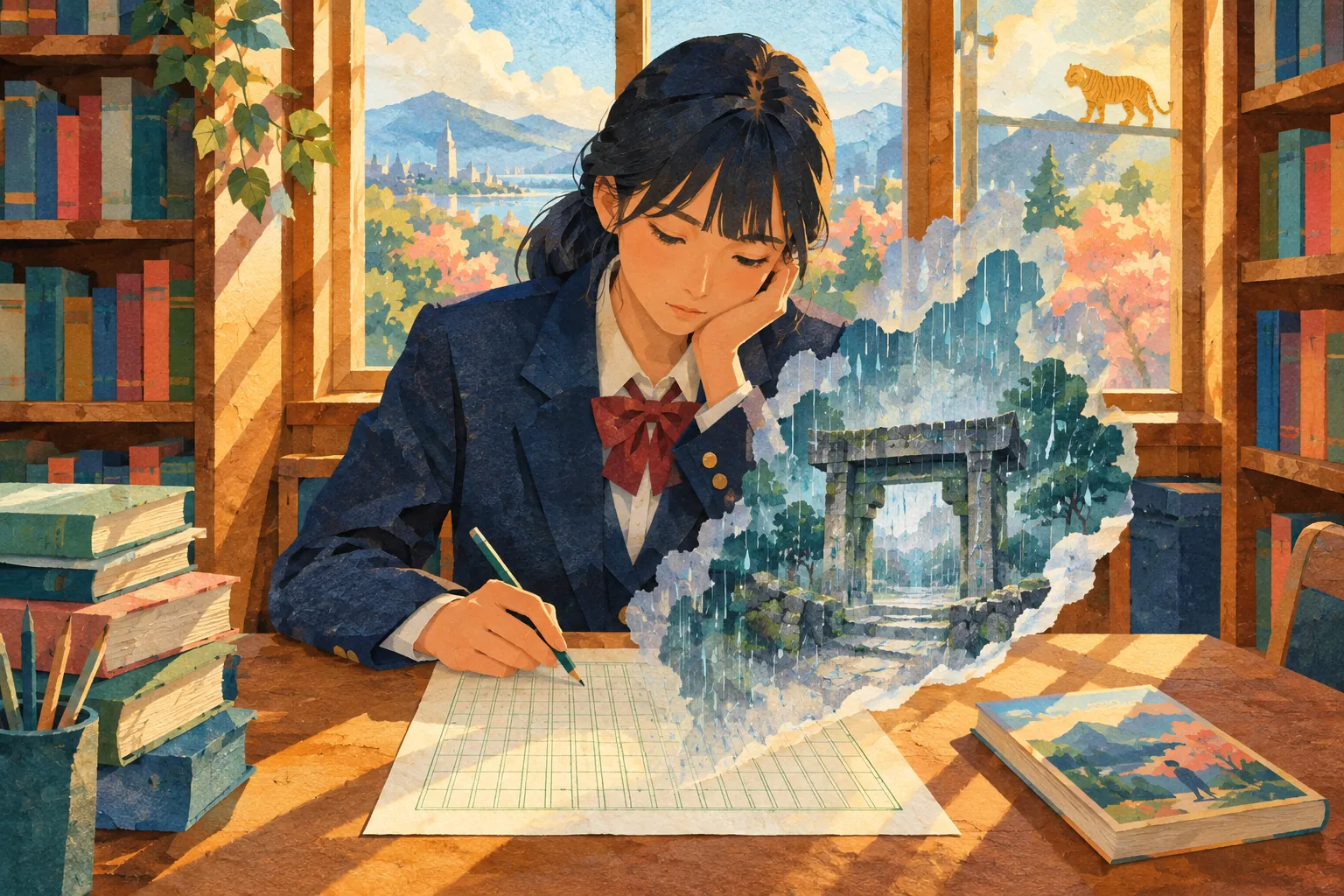
  • Sangetsuki (Nakajima Atsushi): a poet who wanted fame turns into a tiger. Good for thinking about pride and effort.
  • Run, Melos! (Dazai Osamu): a man races to keep a promise made on behalf of a friend. Good for thinking about trust.
  • The Spider’s Thread (Akutagawa Ryunosuke): short and easy to read, about selfishness. Good for a first attempt.
  • Takasebune (Mori Ogai): an officer escorting a convict reflects on life and contentment. Good for social themes.

If your school sets a required book or a contest list, follow that first.

Common mistakes and fixes

  • Plot takes more than half: choose one scene and spend the rest on feelings and reasons.
  • Only “it was interesting” or “I was moved”: add which scene and why.
  • Unrelated personal stories: always say how the experience resembles or differs from the book.
  • Only praise: mention what you doubted or disagreed with, with a reason.
  • A closing that is only a resolution: describe the change in your view instead.
  • Long quotations: keep to one short sentence and explain it in your own words.

Reading your draft aloud reveals repeated sentence endings and overlong sentences.

Follow your teacher’s instruction on writing style, and keep it consistent.

Do not copy: how to use model answers honestly

The task is meant to assess your own thinking. Submitting someone else’s reflection, an online sample or text generated by AI can count as plagiarism or cheating.

Model answers are for learning structure and for comparing with your own work.

  • Check the pattern: follow the flow from opening to closing, paragraph by paragraph.
  • Find the differences: compare basic, good and excellent, and note what each level adds.
  • Write your own: use your own scene and your own experience, even for the same book.

Your teacher knows your voice and your experiences, and borrowed text tends to sound different.

What exams ask

A dokusho kansobun itself is not a College Entrance Common Test format. The skill behind it, explaining a reason from evidence in the text, is exactly what school tests and the Common Test ask in questions about a character’s feelings or an underlined phrase.

Practising “why did I feel this?” in the words of the text helps with 60-character and 100-character written answers.

Sorting a character’s change into trigger, change and result works for both reflections and exam answers.

How to use the model answers below

Below are two questions, one on Rashomon and one on Sangetsuki, each with answers at basic, good and excellent levels. The Japanese page holds the full-length versions; these English ones are condensed companions.

Write your own answer first, then compare. The teacher notes explain why each level earns its place and what the next level adds.

Exam practice: sample answers

Model answers are examples to learn from; write your own in your words.

book reflection (dokusho kansobun)

1. Read Akutagawa Ryunosuke’s Rashomon and write a reading reflection that takes one scene and links it to your own thinking.

Outline

  1. Choose one scene and say why it stayed with you
  2. Introduce the story in about three sentences
  3. Explain your reaction with evidence from the text
  4. Compare it with a short experience of your own
  5. Close with how your view changed
Basic Model answer

I read Akutagawa’s Rashomon. It is about a servant who has lost his job and meets an old woman under a city gate.

The scene that stayed with me is when the old woman explains why she pulls hair from a dead woman. She says the dead woman had done bad things too, so it is fine.

After hearing this, the servant steals the old woman’s clothes. I think her excuse gave him permission to do what he was afraid to do before.

This reminded me of times I have made excuses, such as saying I was too busy to do my homework. Small excuses and big ones work in a similar way.

From this book I learned that people often find reasons to make wrong actions feel acceptable. I want to notice my own excuses more.

Why this level: The point is clear and linked to one scene, and the personal example is relevant. But the evidence is general, the structure is loose and the closing is a wish. To reach good level, state a thesis early, add more specific events from the scene and explain how the servant’s reaction changes.
Good Model answer

Akutagawa’s Rashomon asks a hard question: if you are desperate, can any action be excused? I think the story shows that desperation does not decide what we do, but the reasons we allow ourselves to accept do.

The servant has been dismissed and is sheltering from the rain beneath a ruined gate. He is torn between starving and becoming a thief, and he cannot choose.

Upstairs he finds an old woman pulling hair from corpses to make wigs. At first he is full of anger and a strong sense of justice.

Then she defends herself: the dead woman cheated people, and she herself would starve otherwise. Her words change him.

His anger disappears, and he takes her clothes, saying that he too must do this to survive.

What interested me is that he borrows the old woman’s own logic. He did not become a thief because of hunger alone.

He became one when someone gave him a reason that sounded acceptable.

I recognised this in myself. Last year I copied a friend’s homework and told myself everyone does it.

The reason made me feel less guilty, just as the old woman’s excuse did for the servant.

The stakes are very different, and I should not claim my situation was the same as his. But the pattern, finding a reason first and acting afterwards, was familiar.

After reading, I think I should ask whether a reason is true, not just whether it is convenient.

Why this level: A clear thesis, a logical order of events, specific evidence and a careful comparison (it admits the difference in stakes). What is missing for excellent: close attention to the ending and the author’s choices, context beyond the scene, and a sharper final idea.
Excellent Model answer

Akutagawa’s Rashomon is often read as a story about poverty, but I read it as a story about how a conscience is talked out of itself. The decisive moment is not the servant’s hunger.

It is the moment he hears an argument that lets him act.

At the start he is dismissed from service, sheltering from the rain at a half-ruined gate, unable to choose between starving and stealing. The narrator also notes a run of disasters in the city, so his plight belongs to a decaying society, not only to one man.

When he climbs up and sees the old woman taking hair from a corpse, his hatred is sudden and moral. For a moment he is certain that evil must not be done.

Then she gives her defence: the dead woman deserved it, and she herself is only surviving. The servant takes her reasoning as his own and strips her of her clothes.

The irony is sharp. He condemned her act in the name of justice, and within moments used her justification.

Akutagawa even describes two courages pointing in opposite directions inside the same man.

That reversal is why the ending, where the narrator says the servant’s whereabouts are unknown, feels so unsettling. The story offers no punishment and no moral.

It leaves the reader to ask what they would accept as a reason.

My own experience is far smaller, but the mechanism felt familiar. When I copied a friend’s homework, I did not decide to cheat and then look for an excuse.

I first found the excuse, that everyone does it, and the decision followed.

Reading Rashomon let me see that sequence from outside. The lesson, for me, is not that desperate people are bad.

It is that the sentences we tell ourselves can move us further than the situation does.

I now test my reasons with one question: would I accept this reasoning if someone used it against me? The old woman, once robbed, would not.

The question will not make choices easy, but it slows the moment when an excuse becomes an action.

Why this level: This version argues one idea from start to finish, uses precise details (the setting, the two courages, the ending), reads the author’s choices and turns the personal example into a general insight with a usable test. It also keeps quoting to a minimum and paraphrases in the writer’s own words.

Marking rubric

  • Takes a clear position about the book, not just a feeling
  • Uses specific moments from the text as evidence
  • Compares personal experience with the book, noting similarities and differences
  • Closing shows how the writer’s view changed
  • Language and length fit the task

Now write your own

Choose a different scene from Rashomon, or another short story from Aozora Bunko, and write your own reflection with the same four parts. Then compare it with the three samples.

book reflection (dokusho kansobun)

2. Read Nakajima Atsushi’s Sangetsuki and write a reflection on how the story changed your view of pride and effort.

Outline

  1. State the question the story made you ask
  2. Introduce Li Zheng’s situation briefly
  3. Explain his own diagnosis of his failure
  4. Link it to a specific experience of yours
  5. Close with what you will change
Basic Model answer

I read Nakajima Atsushi’s Sangetsuki. It is about a poet named Li Zheng who wanted to be famous and turns into a tiger.

He meets an old friend, Yuan Can, and explains what went wrong. He says he had a timid pride and an arrogant shame.

I think this means he was afraid of failing in front of others, so he did not ask teachers for help or work hard to improve.

This made me think of my club practice. I sometimes avoided asking seniors for advice because I did not want to look bad.

Li Zheng had talent but regretted it deeply. I learned that avoiding effort can cost you a lot later, and I want to ask for help more.

Why this level: The paraphrase of the key phrase is correct and the personal link is relevant. But the analysis stays on the surface and the structure is a list. For good level, state a thesis, show how pride and fear worked in the plot and explain the experience in more detail.
Good Model answer

Reading Sangetsuki, I asked why Li Zheng, who had real talent, failed as a poet. My answer is that his problem was not ability but a fear of being hurt.

He passes the exams, quits his official post to pursue poetry, and does not win recognition. He returns to a low position and suffers humiliation until he loses his mind and becomes a tiger.

When he meets his old friend Yuan Can, he describes his own nature as a timid pride and an arrogant shame. In other words, he feared discovering that his talent was not genuine, so he never studied under a teacher or competed with fellow poets.

What struck me is that he does not blame luck or other people. He names his own habit of mind, and that honesty is why his regret feels so deep.

I have a small version of this. In junior high club practice I felt too embarrassed to ask a senior to correct my form, so I kept practising my own way.

I improved slowly and later wished I had asked.

Pride itself is not bad. The trouble comes when we protect it by avoiding chances to grow.

I also noticed that he blames himself for thinking of his poems before his family’s hunger. Even in his regret, his values are visible.

After reading, I think embarrassment is not an obstacle to growth but a wall to climb. I want to start by asking about things I do not understand.

Why this level: There is a thesis, a sequence of events, a correct account of Li Zheng’s self-analysis and a developed personal example. To reach excellent, interpret the tiger and the ending, bring in the idea of an inner beast and context, and give a more original conclusion.
Excellent Model answer

Sangetsuki is often read as a story of talent and effort, but I read it as a story about how a person lives with embarrassment. What turned Li Zheng into a tiger was not fate but a habit of mind he cultivated himself.

He was a brilliant young official who abandoned his career for poetry. When fame did not come, he returned to a lower post and wore himself down working under men he once considered his equals.

After he lost his mind and ran into the mountains, he became a tiger. Nakajima reworks an old Chinese tale of a man who becomes a tiger and turns it into a question about a person’s inner life, not a punishment from outside.

As a tiger, Li Zheng meets Yuan Can and tells his story from the bushes. He names the thing that ruined him: a timid pride and an arrogant shame.

The two phrases seem to contradict, yet I think they share a root. The wish to be special and the fear of being found ordinary are the same impulse seen from two sides.

He avoided teachers and rival poets because he did not want to see what he would be if he polished his talent and it did not shine. Not trying kept his pride safe.

He then speaks of every person keeping a wild beast inside, which is each person’s own temperament. This suggests the tiger is not an outside curse but something that was already there and finally showed itself.

I am drawn to that idea because it makes his tragedy ordinary. Many of us grow the same beast in small moments.

My own episode is minor. In club practice I avoided asking a senior to correct my form because I was embarrassed, and I improved slowly.

I was protecting my image at the expense of my skill, which is Li Zheng’s structure in miniature.

So what should I do? I do not think the answer is to remove embarrassment.

It is to practise asking while still feeling embarrassed.

The story asks whether I am feeding my own beast in everyday moments. I will begin by asking one question a day that I would rather hide.

Why this level: The reading is unified around one claim (embarrassment as the beast), links the two phrases, uses the story’s inner-beast idea and treats the tiger as an image, not a plot device. The personal example is tied back to the argument and the conclusion is practical. Quotation is minimal and paraphrased.

Marking rubric

  • Explains how pride and fear shape Li Zheng’s choices
  • Uses specific events in the story as evidence
  • Connects an experience to the story with insight, not just similarity
  • Interprets the tiger or the ending
  • Ends with a concrete change in the writer’s view

Now write your own

Write a reflection on a story of your choice about a character who avoids something hard. Say what the character fears, what it costs them and what you would do differently.

Frequently Asked Questions

How long should a high school dokusho kansobun be?

Follow the length set by your school or contest first. If none is given, about 1,200 to 2,000 Japanese characters, roughly three to five sheets of 400-character paper, is a sensible target to plan the four parts against.

What should I do first when writing a book reflection?

While reading, mark scenes and lines that stay with you and jot a one-line reason for each. Then choose the single scene with the most to say and build the structure around it.

Which books suit a high school reflection?

Short stories from Aozora Bunko work well, for example Rashomon, Sangetsuki, Run, Melos!, The Spider’s Thread and Takasebune. If your school sets a required book, use that.

Can I copy a sample reflection?

No. Copying samples or AI-generated text can be treated as plagiarism. Use samples to learn structure and compare with your own draft, and write about your own scene and experience.

How much plot should I include?

About three sentences, and no more than roughly one fifth of the piece. Introduce only the scene you will discuss, so most of your words go to your own thinking.

What if I cannot think of anything to say?

Ask yourself where your feelings moved, whether you agree with a character and what you would do. If you cannot sympathise with someone, explaining why is already a strong core for a reflection.

Check Your Understanding

Pick an answer for each question to see if you were right.

  1. What matters most in a high school dokusho kansobun?

  2. Roughly how much of the piece should plot take?

  3. Which is a weak opening?

  4. How should you use a model answer?

  5. What is Aozora Bunko?

Share:

About the Writer

Alex Ng
Alex Ng

Software Engineer & Writer

Software engineer with a passion for distilling complex ideas into actionable insights. Writes about finance, investment, entrepreneurship, and technology.

Read more →

Keep reading

Explore the topic: 高校国語 (Japan)

Articles

Summaries