In five minutes
The Tale of the Bamboo Cutter (Taketori Monogatari) is a Japanese story about a tiny girl found inside a glowing bamboo stalk. She grows into a woman of striking beauty known as Princess Kaguya (Kaguya-hime), and in the end she returns to the moon.
It is usually called the oldest surviving prose tale in Japan. Nobody knows who wrote it, and it is generally dated to around the 10th century.
The plot has four movements. An old bamboo cutter finds the child and becomes rich, five nobles try to marry her, an emperor tries to win her, and then the people of the moon come to take her home.
Along the way the tale also explains, in a half-joking way, why smoke is said to rise from Mount Fuji. If you know Japanese mythology from the Kojiki, this is a very different kind of story: no creator gods, but a human village, a court, and a visitor from far away.
For that older world, see Japanese mythology and the Kojiki.
The story
The child in the bamboo
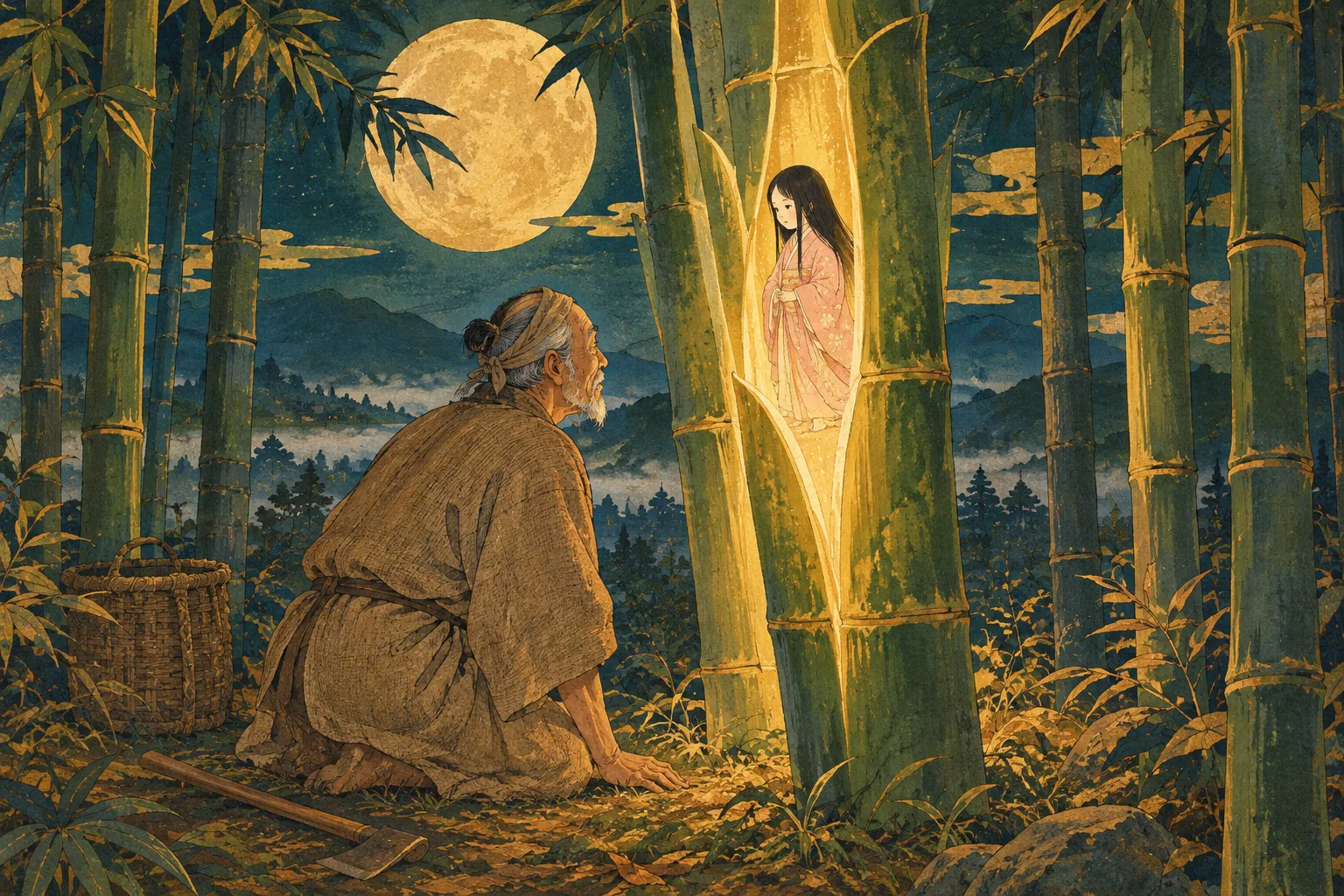
An old man cuts bamboo in the hills and makes baskets and other goods for a living. One day he sees a stalk that shines from within, and inside it is a girl about three sun tall, which is roughly nine centimetres.
He and his wife take her home and raise her as their own. From then on the old man keeps finding gold in the bamboo he cuts, and the family slowly becomes wealthy.
The girl grows with astonishing speed and is a full-grown woman in about three months. She is given the name Nayotake no Kaguya-hime, often rendered as the shining princess of the supple bamboo.
A three-day banquet follows, and word of her beauty spreads across the country.
Five suitors and five impossible tasks
Many men come to look at the house, and in time five great nobles remain. They are Prince Ishitsukuri, Prince Kuramochi, the Minister of the Right Abe no Miushi, the Grand Counselor Otomo no Miyuki and the Middle Counselor Isonokami no Maro.
The old man begs her to marry, but Kaguya says she will marry only the man who proves his devotion. She gives each suitor a different task for something nearly impossible to find.
Prince Ishitsukuri is sent to fetch the stone begging bowl of the Buddha. He presents an old bowl he found at a temple, but it gives off no light and she sends it back.
Prince Kuramochi is told to bring a branch of jewels from Mount Horai, the legendary island of the immortals. He secretly has craftsmen make a perfect fake, and he nearly succeeds until the craftsmen arrive at the house to ask for their pay.
The Minister Abe no Miushi must bring a robe made from the fur of a fire-rat, which cannot burn. He pays a great sum for a robe from a foreign merchant, but when it is thrown into a fire it burns up.
The Grand Counselor Otomo no Miyuki is sent for a jewel from the neck of a dragon. He sails into a storm, gives up the quest, and comes home ill and humbled.
The Middle Counselor Isonokami no Maro is asked for a cowrie shell that swallows are said to bear. He climbs up to a nest to reach for it, falls, and is badly hurt, and the tale says he did not recover.
These episodes read like short comic and moral tales. Each man tries to buy, cheat or force his way to a prize that can only be earned honestly, and each is exposed.
The emperor
News of Kaguya reaches the emperor, who goes to the house under the pretext of a hunting trip. He sees her, is struck by her, and tries to take her to the palace.
She refuses, and the tale shows that she is not an ordinary woman. When he tries to lead her away her figure turns to shadow, and he sees that she cannot be carried off by force.
The two stay in touch for about three years through letters and poems. He is the one person she treats with warmth, but she still does not go with him.
The moon
Kaguya begins to gaze at the moon and weep, especially as the eighth month approaches. At last she tells her foster parents that she comes from the capital of the moon, was sent to earth for a limited time, and must go back on the night of the full moon.
The old man tells the emperor, who sends about two thousand soldiers to guard the house. The guards ring the building and archers wait on the roof.
On the night, a light brighter than the full moon shines down, and beings from the moon arrive. The soldiers lose their strength and cannot lift their bows.
Kaguya says goodbye to her foster parents, leaves them a keepsake, and writes a letter to the emperor with a small jar of the elixir of immortality. One of the moon people drapes a feather robe over her, and as it touches her she loses her human feelings and rises into the sky.
The old couple are left grieving, and the emperor reads her letter. He decides he has no use for immortality without her and asks which mountain is closest to heaven.
He is told it is the great mountain in Suruga, so he sends men to burn the letter and the elixir at its summit. The tale ends by saying that the smoke is still rising, with a pun that links the mountain's name Fuji to the idea of immortality and to the many soldiers who climbed it.
Variants
The text survives in many manuscripts that differ in wording and small details. The overall plot is stable, but how individual episodes are told depends on the copy.
Children's retellings often cut the five tasks down to a few, or soften the ending so that Kaguya's departure feels gentler. Modern adaptations also tend to give her a stronger voice and more reasons for her sadness than the old text does.
Several places in Japan, including Fuji City in Shizuoka, tell local legends that place Kaguya in their own hills. These are local traditions built on the tale, not part of the original text.
Where the story comes from
The anchor text is the Taketori Monogatari itself, a work of the Heian era whose author is unknown. It is generally dated to the late 9th or early 10th century, and the oldest copies we have are much later.
The famous Tale of Genji, written about a century later, refers to it as the ancestor of all tales. That one line shows how early it was treated as the starting point of Japanese fiction.
The story mixes older folk motifs, such as a child found in a plant, with court satire and Buddhist and Chinese ideas about immortality and the Isle of Horai. Scholars still debate how much is folk tradition and how much is the invention of a learned writer.
What it means
The five suitors are usually read as a satire of court nobles who chase status and prizes, while the old man and Kaguya stand for sincerity. The tale repeatedly rewards honesty and punishes pretending.
It is also a story about impermanence and farewell. Kaguya's happiness on earth was always temporary, and the feather robe that erases her feelings makes the parting feel like a loss that cannot be argued with.
The emperor's burned elixir gives the tale a final turn. The smoke on Mount Fuji turns grief into a landmark that people can still see.
Readers also compare it with Urashima Taro, another Japanese tale in which a visitor crosses between two worlds and leaves loss behind. See Urashima Taro for that story.
Common misconceptions
It is sometimes said that Kaguya is a goddess of Shinto myth. In the tale she is a person from the moon, not one of the kami in the Kojiki, and the text never presents her as an object of worship.
Another mistake is to think the story was invented in the modern era. The text is more than a thousand years old, and modern retellings come from it.
People also assume that the story has a single author with a known name. In fact the author is unknown, and any name offered is a scholarly guess.
Finally, the ending is not a happy reunion. Kaguya's memories of her earthly life fade as she leaves, which is what makes the parting sad.
Read next
Japanese mythology and the Kojiki covers the creation myths that came before the Heian tales.
Urashima Taro is another old Japanese story about a crossing between the human world and a distant one.