In five minutes
Urashima Taro is a Japanese folktale about a fisherman who visits a palace under the sea and comes home to find that hundreds of years have passed. A small box from the sea princess, which he was told never to open, brings the story to its end.
The tale exists in several forms. The oldest written versions, in the Nihon Shoki and the Man'yōshū, are short and quiet, while the picture-book version most children know took its shape much later.
Below, we tell the story straight and then set the versions side by side. The tale belongs to our wider guide to Japanese mythology and the Kojiki.
The story
The version most people know
Urashima Taro is a young fisherman who lives in a village by the sea. One day he finds a group of children tormenting a turtle on the beach.
He persuades them to stop and carries the turtle back to the water. Taro thinks nothing more of it.
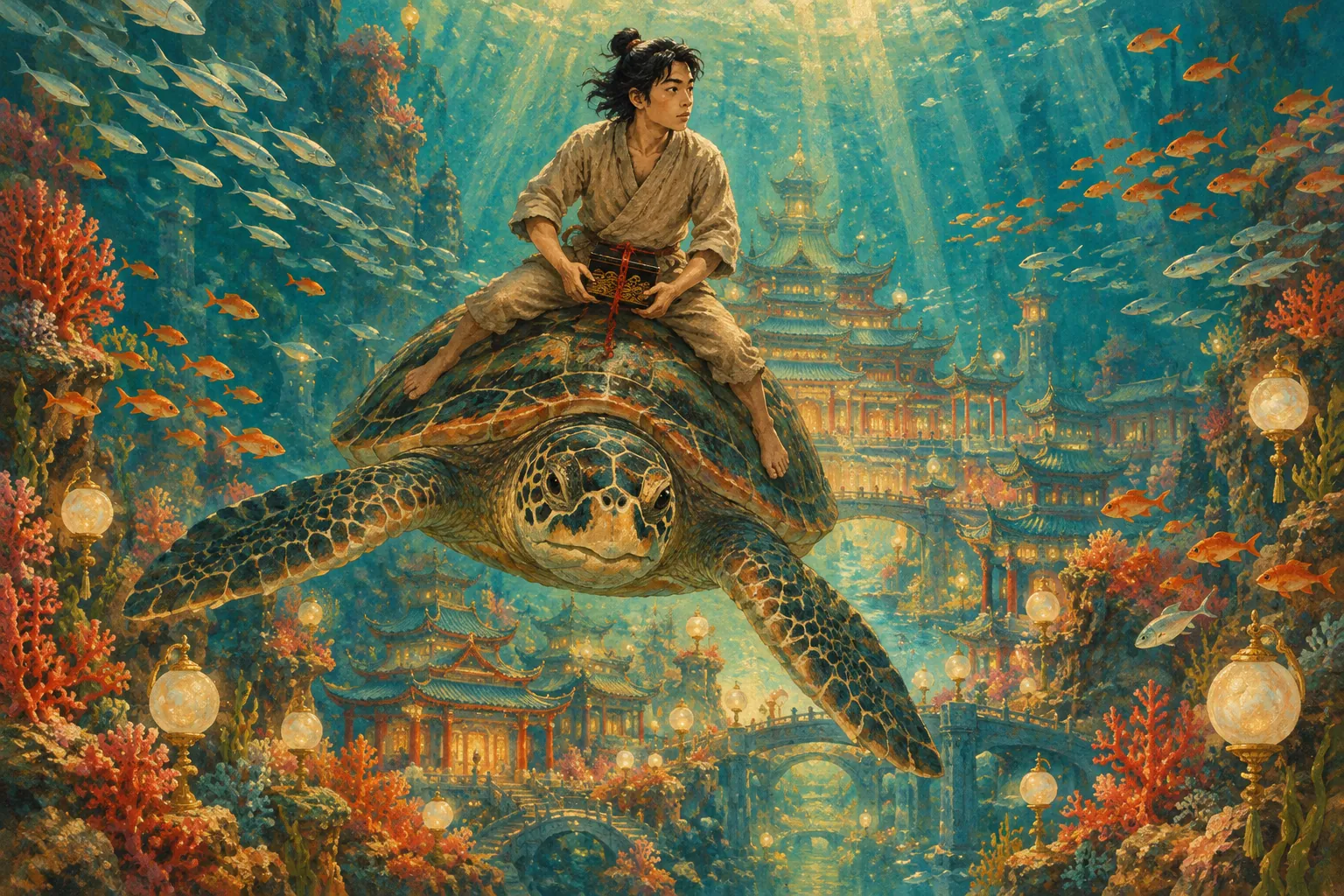
A few days later, while he is out in his boat, a turtle surfaces and thanks him. It offers to take him to the Dragon Palace (Ryūgū-jō), the home of the sea god's daughter.
Taro climbs onto its back and rides down through the waves. The water opens into a hall of coral, pearl and shining light.
The princess, Otohime, welcomes him as an honoured guest. There are feasts and music, and fish dance for him.
Time slips by without notice. After what feels like a few days, Taro remembers his mother and his village and asks to go home.
Otohime is sad but lets him go. She gives him a lacquered box called a tamatebako and asks him one thing: never open it.
On the beach, nothing looks right. The houses are different, the people are strangers, and nobody has heard of Urashima Taro.
He learns that hundreds of years have passed since he left. With his family and his home gone, he sits on the sand holding the only thing he has left.
He opens the box. A cloud of white smoke rises, and Taro becomes an old man with white hair and a white beard.
Many picture books end here, quietly, with the old man alone on the shore.
The older version in the Otogi-zōshi
The tale as it was told in the Muromachi period is a little different. Taro, a fisherman from Tango, hooks a turtle and sets it free with a few kind words.
He says that cranes live a thousand years and turtles ten thousand, so it would be wrong to end such a life.
Soon afterwards a small boat drifts toward him with a beautiful woman aboard. She says she was blown out to sea and asks him to take her home.
He rows her across the waves to a magnificent palace. There she tells him that she is the turtle he saved, and the two marry.
After three years Taro begins to miss his parents. His wife gives him a box and tells him not to open it.
He returns to find grass growing where his house stood. He is told that seven hundred years have passed since a man called Urashima vanished.
Taro opens the box and three wisps of purple cloud rise from it. He ages at once, then turns into a crane and flies away.
In the closing lines his wife, in the form of a turtle, joins him, and the two meet again as a married pair. The tale says they were afterwards honoured as a god in Tango.
Where the story comes from
The oldest record is in the Nihon Shoki, the court chronicle completed in 720. Under the 22nd year of Emperor Yūryaku (traditionally 478), it says that Urashima no ko of Mizunoe, in Yosa district of Tanba province, caught a great turtle.
The turtle turned into a woman. The two married and travelled together to Mount Hōrai, where they saw the immortals.
The entry is only a few lines long. It has no bullied turtle, no Dragon Palace and no box.
A regional record of Tango, the Tango no kuni fudoki, is known today only through quotations in later works. In it the man is called Shimako of Tsutsukawa, and the story already includes the box.
The Man'yōshū, the great eighth-century poetry anthology, carries a long poem on the subject in Book 9, attributed to the poet Takahashi no Mushimaro. It tells how Urashima fished for days, crossed into the realm of the sea god, married the god's daughter and lived there without age or death.
Homesick, he goes back to Suminoe and finds his house gone. He opens the box despite the warning, white cloud drifts up to the sky, and he dies soon afterwards.
The poem ends in sorrow, with no moral lesson attached. It is a poet's meditation on longing for home, and on what that longing costs.
The Otogi-zōshi is a collection of short illustrated tales, popular from the Muromachi period and printed widely in the Edo period. It gave the story the shape of a kind deed repaid by a sea princess, and it added the hopeful crane-and-turtle ending.
The bullying children and the princess named Otohime belong to the modern retelling. They became standard in the Meiji era, when the tale was written for children and used in school books and songs.
The versions at a glance:
- Nihon Shoki: a turtle becomes a woman, and the pair visit Mount Hōrai.
- Man'yōshū: the sea god's daughter, a return to a vanished home, and a sorrowful death.
- Otogi-zōshi: a turtle spared, three years in the palace, seven hundred years outside, and a transformation into a crane.
- Modern children's version: a bullied turtle, the Dragon Palace, and an old man on the beach.
Several coastal towns claim the tale as their own. The Urashima Shrine in Ine, in northern Kyoto Prefecture, which lies in the old Tango region, is one of the best known.
What it means
At heart the story is about time running differently in another world. People in many cultures tell tales like it, such as the Irish story of Oisín, who spends what seems a short while in Tír na nÓg and finds centuries gone when he returns.
The box can be read as the years Taro did not live. When he opens it, they return to him all at once.
The gift of a box with a warning also raises an old question: why give a gift that must not be used? Readers have taken it as a test, a parting kindness, or simply a sign that the two worlds cannot be mixed.
The turtle and the crane were both symbols of long life in Japan. That is why the Otogi-zōshi can end with a celebratory note, while the Man'yōshū and the modern children's tale end in loss.
The modern version also leaves a puzzle. Taro does a kind thing and is rewarded, yet he ends up an old man alone, so teachers and parents still disagree about its lesson.
It is a tale, not history. The place names and the date in the Nihon Shoki give it a feeling of real ground, but nothing in the story is offered as fact, and the shrines tied to it are visited today as places of tradition and faith.
Common misconceptions
The bullied turtle is original. It is not.
The oldest versions have a fisherman who catches a turtle, and the bullying children come from the modern retelling.
Otohime appears in the oldest records. She does not.
The Nihon Shoki simply says the turtle became a woman.
Taro is punished for disobeying. That is one reading, but not the only one.
In the Otogi-zōshi he becomes a crane and is reunited with his wife, and the Man'yōshū gives no moral at all.
The Dragon Palace and Mount Hōrai are the same place. They are not.
Hōrai, home of the immortals, is in the oldest versions, while the Dragon Palace belongs to later tellings.
Read next
Japanese mythology and the Kojiki explains the oldest Japanese chronicles and the gods and legends they record.
Momotaro, the peach boy is another well-loved Japanese folktale, and it too changed greatly between its old and modern forms.