In five minutes
Roro Jonggrang is the Javanese princess who tricked a prince into leaving his thousandth temple unbuilt, and who was turned to stone for it. The legend (legenda Roro Jonggrang in Indonesian) is told around Candi Prambanan, the great Hindu temple complex in Central Java.
It is a folk tale from Javanese oral tradition, so it has no single author and no fixed text. Today it is best known through Indonesian and Javanese retellings, in children's books, in school lessons and in what local guides tell visitors.
Here is the short version. Prince Bandung Bondowoso defeats the king of Prambanan and asks the king's daughter, Roro Jonggrang, to marry him.
She does not want to, but she cannot simply say no. So she names two conditions she believes no one can meet: a deep well and a thousand temples, both finished in a single night.
The prince calls on spirits and almost succeeds. She wakes the village women to fake the dawn, the spirits flee, and one temple is missing.
This page tells the story first, then the variants, then what archaeology says about the real temples, and finally what the tale may mean.
The story
A kingdom and a conquest
In the old tellings, the land of Prambanan is ruled by King Boko, who in many versions is a giant. His daughter, Roro Jonggrang, is known across Java for her beauty.
In Javanese, roro is an old word for a young woman, and jonggrang is usually explained as meaning slender. The name works almost like a title: the slender maiden.
Next to Prambanan lies the kingdom of Pengging. Its king has a son, Bandung Bondowoso, who is strong, proud and said to command magical power.
Pengging goes to war with Prambanan, and Bandung leads the attack. King Boko is killed in the fighting, and Prambanan falls.
When Bandung enters the defeated palace, he sees Roro Jonggrang and falls in love at once. He tells her that he wants to marry her.
Two impossible conditions
Roro Jonggrang is in a trap. The man who asks for her hand has just killed her father, and he has the power to take whatever he wants.
She cannot refuse openly, and she will not agree. So she answers with a bargain that sounds like consent but is meant as a refusal.
First, she says, he must dig a deep well, which the tellings call Sumur Jalatunda. Second, he must build a thousand temples (seribu candi), and both must be done in one night, before the first light of morning.
Bandung accepts. A prince with magic does not believe that the task is beyond him.
In many versions he is lowered into the well to finish the digging. Roro Jonggrang then has stones and earth thrown in on top of him, but his power lets him break free.
He climbs out angry, yet he still holds to the bargain, because the larger task is still waiting.
The night of the thousand temples
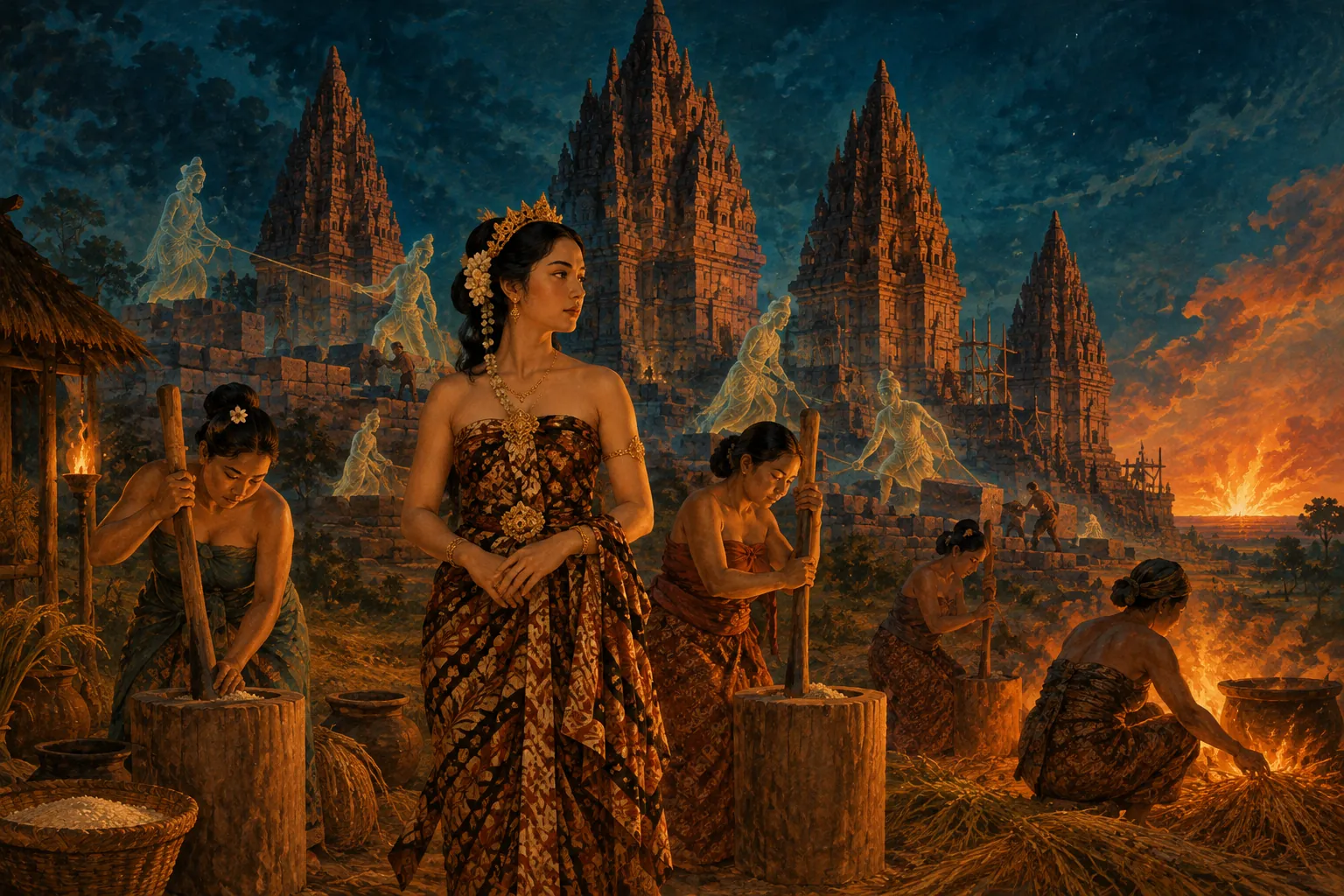
That evening Bandung Bondowoso summons spirits (jin in the Indonesian tellings) to do the building. They arrive in great numbers and begin to shape and stack stone.
Temple after temple rises in the dark, faster than any human crew could manage. Roro Jonggrang watches from the palace as the count climbs towards a thousand.
She realises that her impossible task is going to be completed. She needs a plan, and she needs it before the night ends.
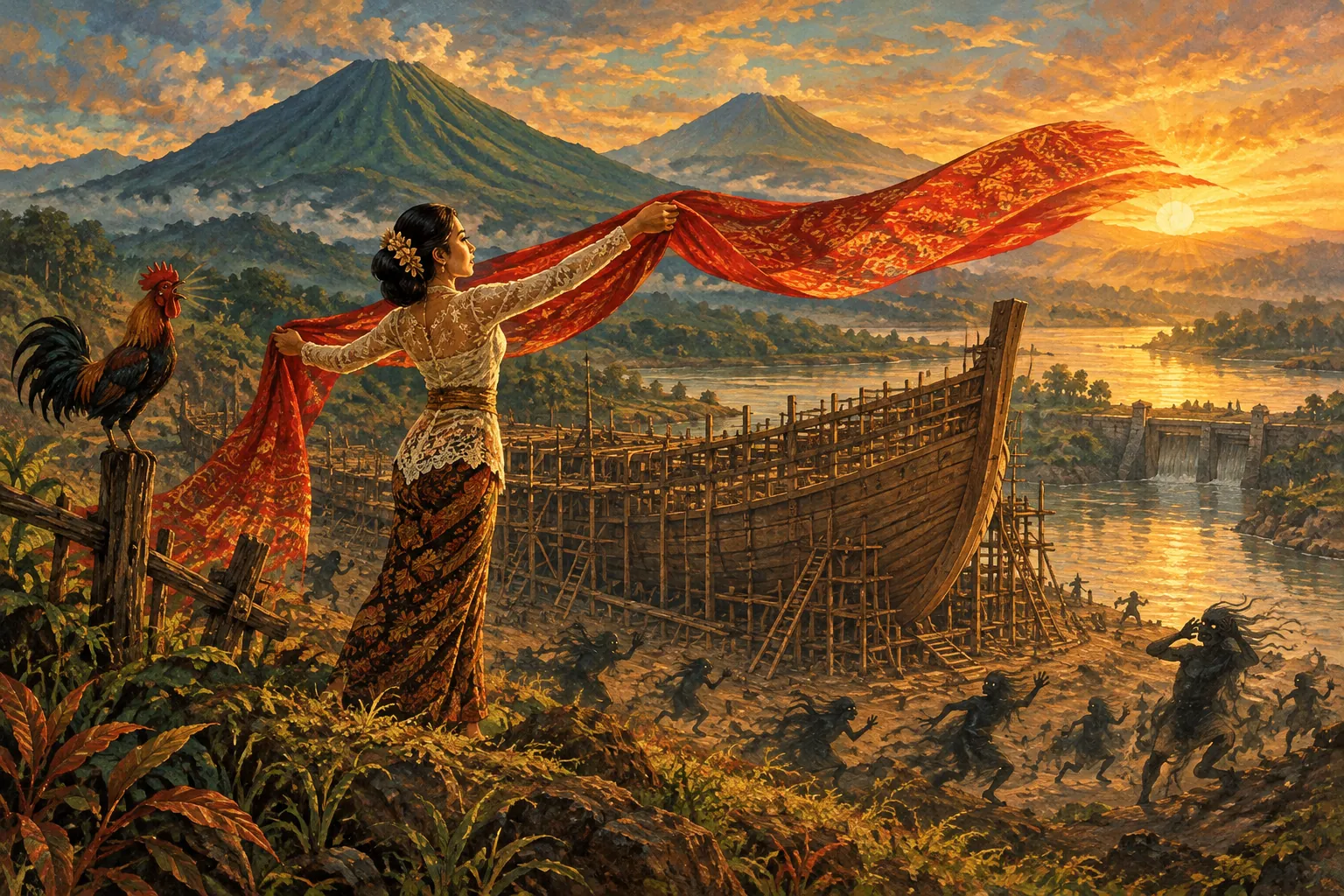
She wakes the women of the village and tells them to start pounding rice in the wooden mortars (lesung), as they do before sunrise. At the same time she has a pile of straw and dry grass set on fire in the east.
The noise and the red glow look and sound like morning. Roosters wake up and begin to crow.
The spirits believe that the day is coming. Spirits cannot work in daylight, so they drop their stones and vanish into the dark.
When they leave, 999 temples stand. The last one is unfinished.
The curse
At dawn Bandung counts the temples and finds one short. He understands that the early light, the noise and the crowing were all a trick.
His anger overwhelms him. He tells Roro Jonggrang that if one temple is missing, she will take its place, and he curses her.
She turns to stone. In the legend the missing thousandth piece is the statue of the slender maiden, and the tale ends with her standing among the temples.
Visitors to Prambanan are shown a statue in the northern chamber of the main Shiva temple, and local people call it Roro Jonggrang. The story gives a human name to a figure that archaeologists identify differently, as we will see below.
Where the story comes from
The anchor of this page is the Javanese oral tradition around Prambanan. There is no single founding text like Hesiod's Theogony or the Grimms' Kinder- und Hausmärchen, and each teller shapes the tale a little.
Javanese court chronicles (babad), such as the Babad Tanah Jawi, are the written tradition in which Javanese writers mixed history, genealogy and legend. The Roro Jonggrang tale lives mainly in retellings rather than in one fixed chronicle.
The legend is tied to real places, which is one reason it has lasted. Prambanan is a Hindu temple complex dedicated to Shiva, built in the middle of the 9th century (about 850 CE) in the Mataram period, and it was named a UNESCO World Heritage Site in 1991.
The main Shiva temple has chambers on its sides. The northern chamber holds a statue of the goddess Durga slaying a buffalo demon, and that is the figure the legend calls Roro Jonggrang.
Nearby stands Candi Sewu, a Buddhist temple complex whose name means thousand temples. It has far fewer than a thousand structures, but more than two hundred, and the name fits the legend neatly.
A few kilometres to the south, the hilltop site of Ratu Boko preserves the remains of a palace. Local tradition links it to King Boko, even though archaeology treats it as a separate matter from the folk tale.
Variants
Versions differ in the details. Some tellers say that Boko was a giant who ate people, and others make him an ordinary king.
Some versions include the well and the burial attempt, and others begin directly with the temples. In some, Bandung Bondowoso gets his spirits from his father or his own power, and in others the origin of his magic is not explained.
The final curse also varies. In some tellings Roro Jonggrang becomes the thousandth statue, in others the thousandth temple, and in a few she is turned to stone with her maids.
Keep the legend and the archaeology apart. The temples were built by the rulers of Mataram in the 9th century, and the story of Bandung Bondowoso was attached to them later as an explanation.
What it means
The most direct reading is that it is an origin story. It explains why a statue is called Roro Jonggrang, why a hill is called Ratu Boko and why a complex is named for a thousand temples.
It is also a story about two kinds of power. Bandung has force and spirits, while Roro Jonggrang has only knowledge of her own village and the sound of rice being pounded.
Her trick works because it uses ordinary life. The same women who pound rice every dawn become her army.
The ending is not simple. She wins the night, but she loses her life as a person, and the prince who loved her ends as her jailer and her judge.
Readers have taken the legend in different directions. Some read it as a warning against forcing someone's hand, and others as a story about the cost of deceit, and many take both lessons together.
A modern reader may also notice that nobody in the tale asks Roro Jonggrang what she wants. Her conditions are the first time she speaks for herself.
This is a story told to explain a place. It is not a record of what happened in the 9th century, and it does not need to be one.
Common misconceptions
The legend is not history. No historical record confirms a King Boko, a prince Bandung Bondowoso or a night of a thousand temples, and the real temples were built over time by named dynasties.
Prambanan does not have a thousand temples. The Prambanan complex has about 240 structures in all, and most of them are small shrines around eight main temples.
The statue is not a girl turned to stone. Art historians identify it as the goddess Durga in her role as the slayer of the buffalo demon, and the name Roro Jonggrang is a local nickname from the legend.
Jonggrang is not a surname. It is a descriptive word, and the whole name works as a title for the maiden in the tale.
There is only one version. Because the story is oral, the details of the well, the giant king and the curse depend on who is telling it.
Read next
If you like Indonesian origin legends, read Malin Kundang, the tale of the son who was turned to stone for denying his mother.
Another story that explains a landscape is Sangkuriang and Mount Tangkuban Perahu, in which an impossible night-time task also ends at dawn.